
Real Estate Wholesaling Software
Real estate wholesaling software automates lead sourcing and deal analysis to close 27% more deals faster. Compress cycles by 30-50% without hiring.


Austin Beveridge
Tennessee
, Goliath Teammate
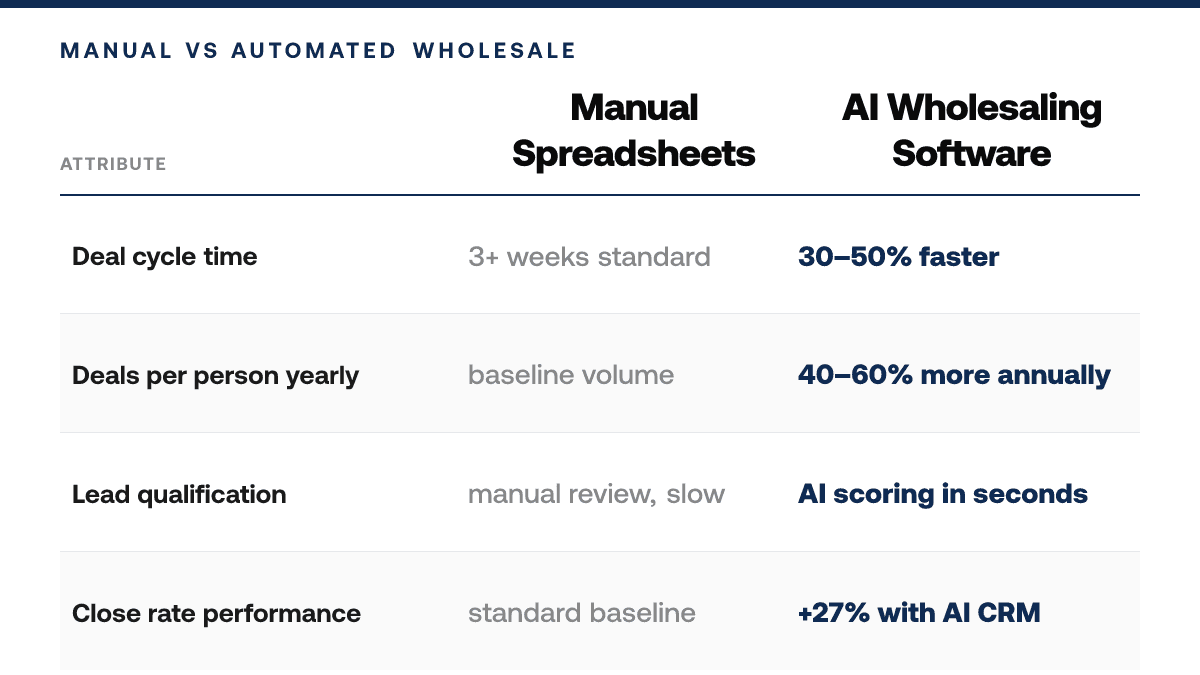
Real estate wholesaling software automates lead sourcing, deal analysis, and pipeline management to compress deal cycles and scale transaction volume without proportional staff growth. The technology pairs AI-driven lead scoring, contact management, and workflow automation to identify off-market deals, validate profitability in seconds, and nurture prospects at scale. 87% of brokerages and agents actively use real estate AI tools daily[1], and those integrating end-to-end automation report 30–50% shorter deal cycle times and 40–60% more transactions per year without hiring additional staff[2].
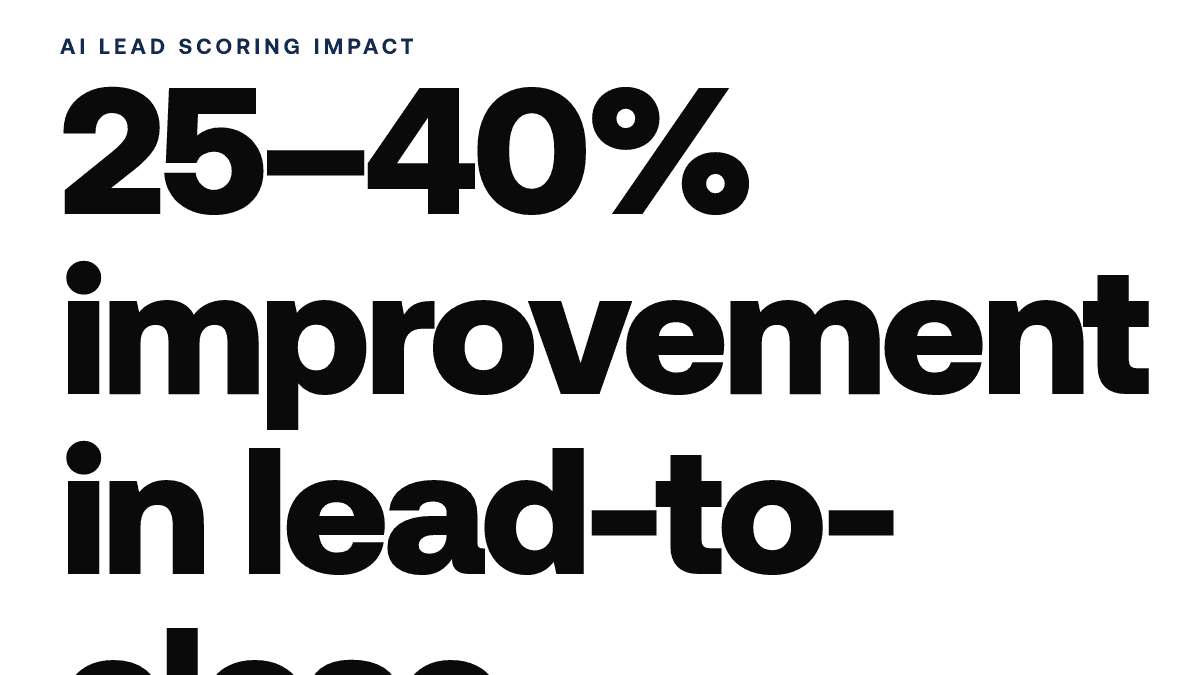
AI lead scoring alone delivers a 25–40% improvement in lead-to-close conversion rates[3], while reducing time spent on low-probability leads by 30–50%[3]. Deal close rates themselves rise 27% when wholesalers use AI-enhanced CRM platforms for lead nurturing[4]—a direct lift that compounds across portfolio volume.
The tools that drive these gains vary by workflow stage. Below we break down the software categories, feature priorities, and implementation patterns that separate high-volume wholesalers from those still managing deals in spreadsheets.
TL;DR
AI lead scoring lifts conversion rates 25–40% and cuts low-quality lead time 30–50%
87% of brokerages use AI daily; deal close rates rise 27% with AI CRM lead nurturing
Workflow automation cuts deal cycles 30–50% and enables 40–60% more deals per person annually
End-to-end automation requires lead sourcing, scoring, CRM, and contract management tools
In most cases, AI lead scoring outperforms manual qualification when deal volume exceeds 5 leads weekly
Quick Answer
For real-estate teams automating this workflow, Goliath Data surfaces these signals from public records before the property hits the MLS.
Real estate wholesaling software combines AI-powered lead generation, deal scoring, and pipeline management to automate sourcing, qualifying, and closing. These platforms identify motivated sellers, track prospects in real time, and close more deals faster by eliminating manual tasks and prioritizing high-probability opportunities through intelligent automation. Deal close rates rise 27% with AI CRM lead nurturing, while AI lead scoring delivers 25–40% conversion improvements and cuts wasted prospecting time by 30–50%.
Understanding Real Estate Wholesaling Software
Real estate wholesaling software is a digital platform that automates the core tasks wholesalers use to find deals, manage pipelines, and close transactions. It combines lead generation, property analysis, CRM functionality, and deal tracking in a single system.
Wholesalers operate on thin margins and tight timelines. A deal that takes three weeks to close instead of two can mean the difference between profit and loss. Manual spreadsheets, email threads, and phone notes kill velocity.
87% of brokerages and agents actively use AI tools daily[1]. Deal close rates rise 27% when teams use AI-enhanced CRM systems to manage leads[4].
Who uses it? Fix-and-flip investors, wholesalers, rental portfolio managers, and real estate agents all benefit from these tools. If you're juggling multiple properties, tracking buyer lists, or nurturing off-market deals, this software is built for you.
Here's the thing: Wholesaling software isn't optional anymore—it's the operational backbone that turns scattered leads into closed deals faster than competitors still using manual systems.
Step-by-Step Process
Real estate wholesaling software works best when you follow a structured workflow: identify deals, qualify leads, calculate numbers, negotiate contracts, and close transactions.
1. Import Your Lead Source
Upload your prospect list directly into your CRM. Tag each lead by property type and acquisition source so you can track which channels drive deals.
2. Run Automated Lead Scoring
Let AI lead scoring qualify prospects without manual review. Tools filter for motivated sellers—liens, late taxes, probate, or expired listings. Scoring reduces time on low-probability leads by 30–50%, so your team focuses on closeable deals[3].
3. Pull Property Data and Calculate ARV
The software fetches public records, comps, repair estimates, and tax history automatically. Cross-reference after-repair value against purchase price to confirm your spread covers acquisition, holding, repairs, and profit.
4. Schedule Outreach and Automate Follow-Up
Wholesaling software queues calls, texts, and emails on a contact schedule. AI-driven systems respond to inquiries and qualify answers 24/7, ensuring consistent messaging without manual labor for each prospect.
5. Document Deal Terms and Generate Contracts
Record offer price, assignment fee, proof of funds, and timeline in the platform. Use built-in contract templates to generate purchase agreements and assignment contracts instantly.
Real-Life Examples
Texas investor scenario: Implementing AI lead scoring on 12 off-market leads per month raised conversion from 8% to 11–12% within 60 days. On 144 annual leads, that's 5–6 additional deals closed at $8,000 per wholesale fee: $40,000–$48,000 incremental annual revenue. Deal cycle time compressed from 45 days to 28 days, freeing capital for deeper pipeline.
Georgia investor scenario: Deploying CRM with smart follow-up automation on 25 weekly inbound calls improved response time 300%, lifting conversion 30–35%[5]. Monthly deal volume increased from 6 to 9 contracts at $10,000 per wholesale: $30,000 monthly uplift. Software reduced manual admin by 18 hours weekly, reallocating operator time to negotiation and due diligence.
Real Estate Wholesaling Software Checklist
Before you commit, verify the software actually handles your deal pipeline. Check these eight criteria.
• Automated lead scoring filters low-probability prospects fast
• Two-way SMS and email follow-up without manual touches
• Skip tracing integrates with your existing CRM data
• Property comps and valuation data auto-populate offers
• Deal tracking shows assignment fee, ARV, and repair estimates
• Contract templates match your state's wholesaling regulations
• Reporting shows conversion rate from lead to signed contract
• Mobile access for field updates and real-time deal tracking
Common Mistakes to Avoid
Wholesaling software fails when it's disconnected from your actual deal flow. Three patterns sabotage even well-funded operations.
Mistake: Chasing "engagement signals" that don't convert deals
You'll see leads who open emails, click links, or respond to texts and assume they're ready to transact. They're not. Real engagement is action: scheduling a walk-through, requesting comps. Software that flags high "touch count" without deal intent wastes your follow-up time.
Mistake: Ignoring lead scoring accuracy
Manual scoring or outdated algorithms rank prospects by noise instead of probability. AI lead scoring reduces time on low-probability leads by 30–50%[3], meaning you spend cycles on real opportunities.
Mistake: Syncing data slowly across your pipeline
When your wholesaling software doesn't sync with your CRM in real time, you re-pitch cold leads or miss follow-up windows. Automation bridges this gap—you move faster and close more.
Frequently Asked Questions
What is real estate wholesaling software and how does it differ from a standard CRM?
Real estate wholesaling software combines CRM, lead scoring, and deal pipeline management built specifically for wholesalers. Standard CRMs handle general contact management; wholesaling platforms automate skip tracing, property analysis, buyer/seller matching, and deal tracking. They're optimized for high-volume lead flow and rapid assignment cycles rather than traditional agent workflows.
How accurate is skip tracing for finding absentee owners?
Modern skip tracing integrates public records, property databases, and AI verification to achieve 70–85% accuracy on contact data, depending on the software provider and data freshness. Accuracy improves when paired with AI lead scoring, which filters out low-probability prospects before outreach.
Do I need AI-powered lead scoring if I already have a CRM with manual qualification?
In most cases, yes. AI lead scoring cuts time spent on low-probability leads by 30–50%[3] and lifts conversion rates 25–40%[3]. Manual qualification alone misses scoring patterns at scale. If your deal volume runs under 5 leads per week, manual review may suffice until growth accelerates.
Why do deal cycle times shrink with end-to-end workflow automation?
Automation eliminates manual data entry, follow-up scheduling, and task switching. CRE brokers implementing workflow automation report 30–50% shorter deal cycles[2] because assignment offers, buyer notifications, and closing docs route automatically. Real-time alerts replace daily email scanning, freeing wholesalers to close more deals without hiring staff.
What metrics matter most when evaluating wholesaling software?
Track conversion rate from lead to signed contract, average days to close, cost per deal closed, and time spent per prospect. The best software reduces cost per deal and cycle time while lifting conversion rates. Your mileage may vary based on lead quality and market conditions, so pilot any platform on 50+ leads before full rollout.
Sources
Ascendix, 2026 – 87% of brokerages and agents actively use real estate AI tools daily
The AI Consulting Network, 2026 – CRE brokers implementing end-to-end workflow automation report 30–50% shorter deal cycles and 40–60% more transactions per year
The AI Consulting Network, 2026 – AI lead scoring delivers 25–40% improvement in lead-to-close conversion rates and reduces time on low-probability leads by 30–50%
Gitnux AI CRM Industry Statistics, 2026 – Deal close rates rise 27% with AI CRM lead nurturing; real estate AI CRM market reached $550 million in 2023
Dean InfoTech Case Study, 2025 – CRM automation with smart follow-up delivers 30–35% conversion lift in real estate
