
Real Estate CRM Pipeline Management: 8 Critical Features
Stop losing deals to poor pipeline visibility. Real estate CRM systems with AI-powered lead scoring cut deal cycles by automating follow-ups across 8 critical


Austin Beveridge
Tennessee
, Goliath Teammate
Quick Answer
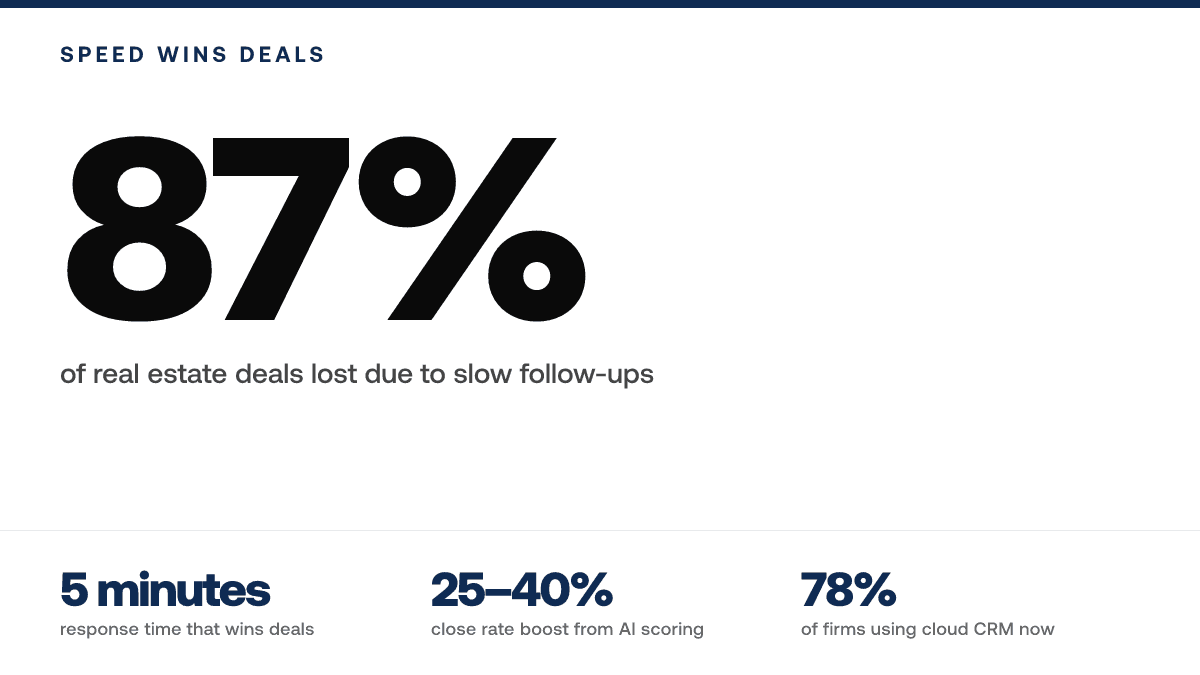
A real estate CRM organizes leads, tracks deals through sales stages, and automates follow-ups to prevent deals from stalling.[1] Modern systems use AI to score leads by likelihood to close, prioritize high-intent prospects, and surface response windows when speed matters most, because 87% of deals are lost due to slow follow-ups.[1] Cloud-based CRMs have become standard, with 78% of real estate firms using cloud solutions for centralized data management and workflow automation.[3]
The pipeline feature, tracking where each deal sits and why it's stuck, separates systems that generate revenue from those that just store contact names. Agents earning $100K+ annually are twice as likely to use dedicated CRM software.[4] AI-powered lead scoring can improve close rates by 25–40% within 90 days by routing your time toward prospects most likely to transact.[2]
Understanding Real Estate CRM
A real estate CRM centralizes client data, automates lead follow-up, tracks deals through stages, and surfaces the highest-probability prospects. It's the operational backbone that prevents deals from slipping through cracks due to disorganization or delayed responses.
Here's why it matters: 87% of real estate deals are lost because of slow follow-ups.[1] A CRM eliminates that delay by routing leads to agents in seconds, automating initial contact sequences, and flagging prospects ready to move. Without one, you're relying on spreadsheets, email folders, and memory.
For agents and brokers: A CRM tracks buyer and seller inquiries, manages follow-up tasks, logs property showings, and stores buyer preferences so you never duplicate work.
For real estate investors: You need financial analysis layers, deal underwriting, cash flow modeling, financing contingencies, and exit tracking, layered into your pipeline so every prospect flows through investment criteria, not just sales stages.
For teams: 60% of real estate agents earning at least $100,000 annually use CRM software,[4] signaling that CRM adoption directly correlates with revenue growth. A shared system keeps everyone on the same deal, prevents duplicate outreach, and makes handoffs between team members frictionless. Modern CRMs pair with AI lead scoring and predictive intelligence, which automatically rank prospects by likelihood to transact within 90 days, so you spend time on warm leads, not cold prospects.
Speed wins deals. Responding within 5 minutes to a lead inquiry increases your odds of closing that prospect dramatically. Most agents respond within 24–48 hours. That's a competitive disadvantage you can't afford.
Build Your Pipeline in Five Steps
1. Map Your Pipeline Stages
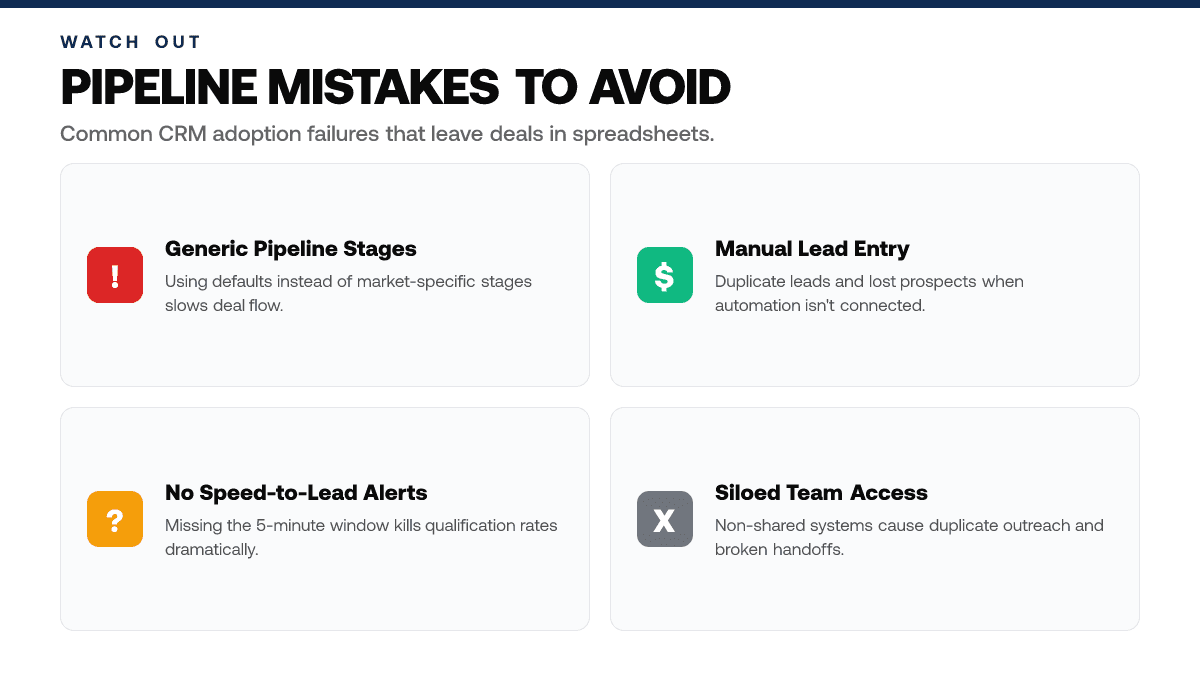
Define each stage your deals move through: Lead, Qualified, Negotiation, Inspection, Appraisal, Clear to Close. Customize stage names and entry criteria for your market. Don't use generic defaults, your residential deals move faster than commercial acquisitions.
2. Connect Your Lead Sources
Link your website forms, IDX feed, phone lines, and email to your CRM. Deduplicate leads automatically so one prospect doesn't enter the pipeline twice. Manual entry kills adoption; automation makes it stick.
3. Configure Speed-to-Lead Alerts
Set up notifications that fire the moment a new lead arrives. Responding within five minutes dramatically increases qualification rates. Tools like Goliath Data surface inbound prospects instantly, eliminating the delay between inquiry and first contact.
4. Build Automation Rules for Stage Movement
Create workflows that move deals forward automatically: when inspection passes, trigger appraisal scheduling; when title review clears, send closing docs. Reduce manual task creation through event-driven automation.
5. Run Weekly Bottleneck Reports
Identify which stages have the longest dwell time. If deals sit in Negotiation for 45 days on average, you've found your constraint. Track conversion rates between stages month-over-month and adjust follow-up cadence accordingly.
Real-Life Examples
Pipeline management systems separate agents who close deals from those who lose them to slow follow-up or disorganized tracking.
Residential Agent in Texas: A residential agent was responding to leads within 24–48 hours, losing deals to faster competitors. She had 40 active prospects scattered across email, text, and loose notes. She implemented a CRM with speed-to-lead dashboards and automated task routing. New leads triggered instant notifications and auto-routed to her phone. Response time dropped from 36 hours to under 5 minutes. Within 90 days, her closed transactions increased from 2 per month to 4.
Commercial Investor in Texas: A commercial real estate investor managed 12 concurrent deals, some in inspection, others awaiting financing approval, a few in negotiation. Deal progress was invisible until closing failed. He configured custom pipeline stages: Financial Analysis → LOI → Due Diligence → Underwriting → Closing. AI-powered lead scoring flagged which deals were stalling and why. Underwriting averaged 45 days; he accelerated lender communication. Deal velocity improved 30%. Average time from due diligence to close dropped from 75 days to 53 days.
Real Estate CRM Checklist
Use this as your operational standard, not optional, not later:
☐ Respond to new lead within 5 minutes of capture
☐ Score every contact using AI behavioral signals
☐ Segment prospects by transaction velocity and intent
☐ Route deals to agents by property type and geography
☐ Automate follow-up sequences across email, SMS, and phone
☐ Track pipeline stage conversion rates weekly
☐ Flag stalled deals after 7 days without interaction
☐ Log all client touchpoints without manual data entry
Real estate teams lose 87% of deals due to slow follow-ups.[1] Speed-to-lead dashboards, built into modern CRM platforms, surface which leads need immediate attention and which can move into nurture sequences. Stage-by-stage conversion tracking reveals bottlenecks. If 40% of prospects stall in negotiation but only 10% stall in inspection, you've identified a process problem, not a lead quality problem.
Common Mistakes to Avoid
Mistake 1: Treating All Leads as Equal Priority
Without AI-powered lead scoring, agents spend time on low-intent prospects while hot leads go cold. AI lead scoring delivers improvement in lead-to-close conversion rates by ensuring time allocation toward contacts most likely to transact within 90 days.[2] Manual triage doesn't scale.
Mistake 2: Automating Engagement Without Speed-to-Lead Visibility
Email drip sequences feel automated, but they mask response lag. 87% of deals are lost due to slow follow-ups.[1] True automation requires dashboards that flag inbound inquiries in seconds, not campaigns that send at 9 a.m. Tools like Goliath Data surface response urgency automatically.
Mistake 3: Using Generic CRM Stages Across Deal Types
A residential buyer's pipeline differs fundamentally from an investor's acquisition flow. Generic Lead → Qualified → Negotiation → Closed stages collapse under complexity. Commercial deals need environmental assessments; investors need financial modeling gates. Property type demands custom architecture.
FAQs
Why do 87% of real estate deals get lost if CRM response time matters so much?
Slow follow-ups kill deals because buyers contact multiple agents simultaneously.[1] When your CRM doesn't surface leads instantly or route them to available agents in seconds, competitors respond first. A speed-to-lead dashboard solves this by triggering instant notifications and auto-assigning prospects to your fastest responders.
Can AI lead scoring work with fewer than 50 closed deals in my CRM?
Not reliably. AI scoring requires 12–24 months of consistent historical data with at least 50–100 closed transactions to identify real patterns.[2] Smaller teams trying to implement AI scoring immediately will see generic, inaccurate rankings. Start with manual scoring rules based on your known buyer profiles, then graduate to AI scoring once you've accumulated enough transaction history.
Should I use a generic CRM or a purpose-built real estate pipeline tool?
Purpose-built is the 2026 standard. Generic CRMs force you to customize extensively and still miss real estate specifics, comparable sales integration, earnest money tracking, inspection contingencies. A real estate CRM includes those workflows natively.[3] In most cases, purpose-built wins, but if you manage multiple business lines, a configurable generic platform may consolidate your stack more efficiently.
What's the actual difference between lead nurturing and pipeline management in a CRM?
Lead nurturing is automated touch sequences (emails, SMS, calls) keeping prospects warm over months or years. Pipeline management is tracking where each prospect sits in your deal stages and identifying bottlenecks. Effective lead nurturing increases conversion rates by up to 40% over two years,[5] while pipeline management prevents deals from getting stuck in negotiation or inspection phases. You need both.
Is a mobile CRM feature just convenience, or does it actually impact deal velocity?
It's deal velocity. Agents responding to leads from showings, inspections, or open houses instead of waiting to return to the office convert faster. Cloud-based, mobile-first CRMs now hold the largest market share because response speed matters measurably.[3] If your CRM requires a desktop to log a lead status change or send a follow-up, you're losing the speed advantage that closes deals.
