
How to Find Motivated Sellers Using Skip Tracing
Find motivated seller leads faster by combining skip tracing with AI-powered lead scoring. See the 3-data sources that identify pre-foreclosure and distressed

Austin Beveridge
Tennessee
, Goliath Teammate
Quick Answer
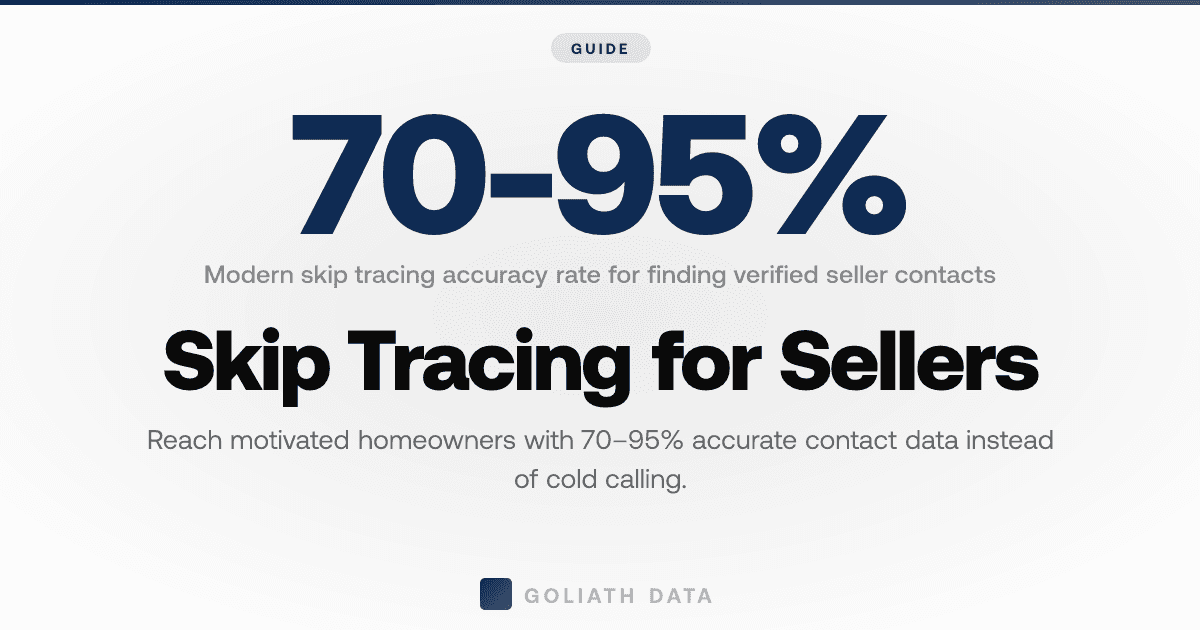
Skip tracing finds motivated sellers by revealing verified contact information for property owners flagged by public records (foreclosures, bankruptcies, divorces) and behavioral signals (job changes, inheritances). Real estate investors using skip tracing close 2–5% of contacted owners, compared to less than 0.5% from cold calling random homeowners.[1] Modern skip tracing accuracy reaches 70–95%, with phone hits at 70–80% and email hits at 50–60%.[4]
Tools like Goliath Data surface this kind of signal in real time, which is why investors increasingly lean on data-feed providers rather than manual list-building.

Understanding Motivated Seller Leads
Motivated seller leads are homeowners actively considering selling due to pressing life circumstances, job relocation, divorce, inheritance, foreclosure, or financial hardship. These aren't passive listings; they're individuals with urgency, making them far more likely to respond to outreach and close quickly.
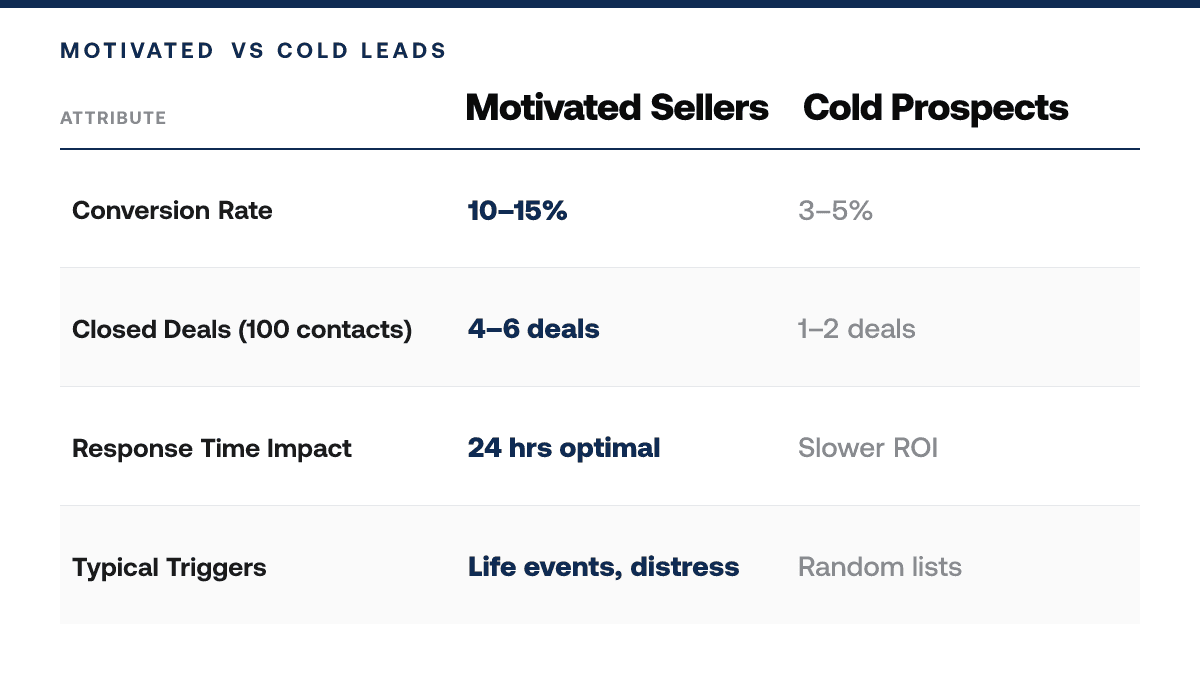
Motivated sellers convert at 10–15%, compared to 3–5% on cold lists.[3] If you contact 100 cold prospects and close 1–2 deals, you'll close 4–6 motivated sellers from the same effort. Distressed property sales alone account for roughly 17% of all residential transactions in key markets.[3]
Skip tracing, locating contact information through public records and data enrichment, is how you find and reach these sellers at scale. Real estate wholesalers, fix-and-flip investors, and agents hunting high-probability leads benefit most. Modern skip tracing services achieve 70–95% accuracy rates.[1]
Here's the thing: Motivated sellers don't require aggressive tactics, they require speed. Response time to initial contact cuts conversion rates in half when delayed beyond the first 24 hours.[3]
Steps to Find Motivated Sellers Using Skip Tracing
Skip tracing surfaces verified contact data for property owners most likely to sell. These five steps integrate data retrieval, AI prioritization, and rapid outreach into one complete workflow.
1. Identify Property Prospects by Distress Indicators
Pull property lists flagged for divorce, probate, tax delinquency, or code violations. Focus on distressed and life-event transactions, which constitute approximately 17% of all residential sales in key markets.[3] Narrow your initial pool to 50–200 prospects per cycle to keep workload manageable.
2. Run Skip Tracing Across Your List
Submit property addresses to a skip tracing service to retrieve phone numbers, email addresses, and forwarding data. Modern services achieve 70–95% accuracy rates.[1] Expect 70–80% phone hit rates and 50–60% email match rates from batch services.[4] Integrate results directly into your CRM to avoid delays.
3. Score Leads by Motivation Using AI
Apply AI lead scoring to rank prospects by likelihood to sell. Top-tier scored leads account for roughly 40% of confirmed wholesale outcomes.[5] Prioritize inheritance notices, recent divorces filed within 12 months, and job relocations posted in the last 60 days.
4. Automate First Contact Within 24 Hours
Set up SMS, email, or phone outreach triggered automatically when a lead enters your CRM. Response time matters more than volume, delay beyond 24 hours cuts conversion in half.[3] Use templates that acknowledge the life event (e.g., "I saw the inheritance filing...") rather than generic pitches.
5. Build Follow-Up Sequences Over 30–90 Days
Most deals close after 6–10 follow-ups.[3] Set up automated sequences that space contact attempts 3–7 days apart, rotating channels (phone, email, text). Don't stop after one rejection; many motivated sellers need time to process decisions.
Real-Life Examples
Skip tracing converts when paired with fast follow-up and CRM automation. Two investors, one in Texas wholesaling, one managing a rental portfolio, each used skip tracing to identify motivated sellers and close deals faster.
Texas Wholesaler: 4 Deals in 60 Days
An investor sourced 200 property leads from county tax records showing 90+ days delinquent. Manual research yielded 40 valid contacts over two weeks. After integrating skip tracing into the CRM to batch-verify and auto-dial contacts within 24 hours, the investor closed 4 deals in 60 days at an average assignment fee of $8,500 per deal. Response-to-close time compressed from 45 days to 18 days, with skip trace costs at $120 per deal closed.
Georgia Rental Acquisitions: 3 Properties, $47K Profit
A portfolio manager inherited 50 probate leads from public filings. Using skip tracing to locate and verify 38 heirs' contact information, the investor automated outreach via CRM, triggering personalized email and phone contact within 6 hours of lead entry. The result: 3 single-family rental acquisitions at below market, with total acquisition ROI of $47,000 across the three properties. Skip trace investment: $190 total.
Motivated Seller Leads Checklist
Use this checklist to vet and prioritize motivated seller leads before outreach. Each item flags a data point or behavioral signal that skip tracing surfaces.
Copy & Paste This Checklist
☐ Verify deed transfer date within last 36 months
☐ Confirm property tax increase or assessment spike
☐ Check for recent probate, divorce, or bankruptcy filing
☐ Cross-reference job change or relocation trigger events
☐ Validate phone number accuracy before first contact
☐ Flag if property condition codes indicate deferred maintenance
☐ Compare list price to neighborhood comps within 90 days
☐ Identify if seller has multiple properties or liens outstanding
Common Mistakes to Avoid
Most investors fail with skip tracing not because the data is wrong, but because they chase volume over velocity and treat contacts as one-time shots instead of sequences.
Mistake: Prioritizing Volume Over Response Speed
Blasting 500 skip-traced contacts per week sounds productive until you realize response time to initial contact cuts conversion rates in half when delayed beyond the first 24 hours.[3] Most deals close after 6–10 follow-ups over 30–90 days, but motivation peaks in the first two weeks. Running bigger lists without fast automated follow-up leaves deals on the table.
Mistake: Ignoring Behavioral Engagement Signals
You've got a phone number and address, that's 50% of the puzzle. The other half is knowing why they're motivated right now. Life-event triggers like job changes, inheritance filings, or divorce records identify sellers 60 days before they list. Targeting cold property data alone means contacting unmotivated owners alongside genuinely ready ones, tanking your close rate.
Mistake: Manual Data Entry Instead of CRM Integration
A skip trace that auto-populates your CRM, triggers workflows, and deduplicates outperforms manual entry and custom follow-up. AI-enhanced CRM integration lifts close rates by 27% because every contact flows directly into your pipeline.[2]
FAQs
How accurate is skip tracing for finding absentee property owners?
Modern skip tracing services achieve 70–95% accuracy rates overall.[1] Hit rates typically run 70–80% for phone and 50–60% for email.[4] Results vary by data source quality and how recently property ownership was recorded.
Why do investors using skip tracing close deals faster than cold calling?
Real estate investors using skip tracing close 2–5% of contacted property owners, compared to less than 0.5% from random cold calling.[1] The difference is targeting: skip tracing identifies specific distressed or motivated sellers with documented pain points rather than calling random homeowners with no indication of motivation.
Do I need AI lead scoring if I'm already doing skip tracing?
Yes. Skip tracing retrieves contact data; AI lead scoring ranks that data by likelihood to close. Top-performing leads account for roughly 40% of confirmed wholesale outcomes.[5] Without scoring, you contact everyone equally and waste follow-up time on low-intent prospects.
What's the difference between skip tracing and buying leads from a marketplace?
Skip tracing builds your own list from property records you choose, more control, longer research time. Marketplace models provide pre-generated, verified, and scored leads you preview before buying. Marketplaces cost more per lead but eliminate research and validation work; skip tracing costs less per search but requires CRM integration and manual follow-up sequencing.
Why do motivated seller leads convert at 10–15% compared to 3–5% on cold lists?
Motivated sellers have documented reasons to move, distressed properties, life events like inheritance or divorce, or financial pressure.[3] These leads already have intent. Most deals close after 6–10 follow-ups over 30–90 days when motivation is high.[3]
Sources
Tracerfy (2026): Skip Tracing for Beginners: Complete 2026 Guide
iSpeedToLead (2026): How AI Lead Scoring Actually Works in Real Estate Using 20,000+ Deal Data
