


Why Real Estate Agents Miss 90% of Leads
Discover why real estate agents miss 90% of leads and learn proven strategies to capture, score, and convert more prospects into clients today.


Tennessee, Goliath Teammate
Key Takeaways
- Real estate agents miss inbound leads because of slow response times, no automated follow-up and no lead prioritization when lead capture is manual.
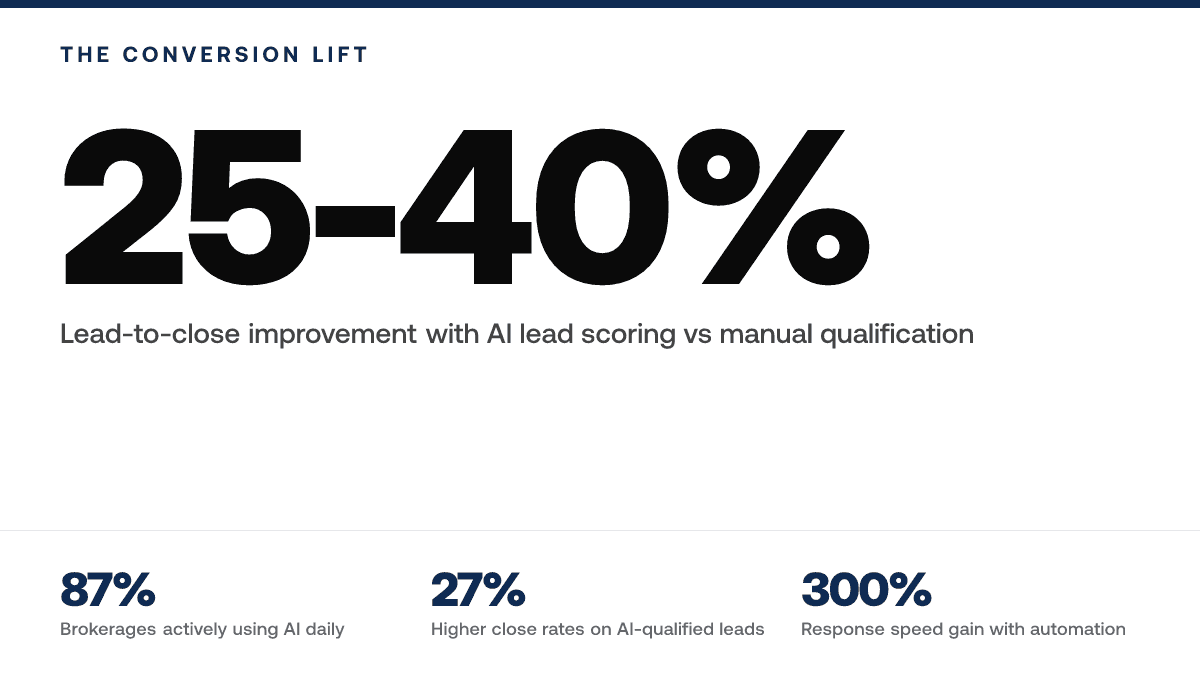
- The AI Consulting Network (2026) cites industry benchmarks of a 25 to 40% increase in lead-to-close conversion and a 30 to 50% reduction in time spent on low-probability leads with AI lead scoring.
- In a Dean Infotech case study, a regional real estate agency with over 50 agents raised lead-to-deal conversion 30–35% and improved follow-up response speed 300% within six months of CRM automation, compared with manual follow-up.
- The National Association of Realtors’ 2025 Profile of Home Buyers and Sellers found 91% of home sellers used a real estate agent or broker, so every missed seller inquiry is lost business.
- The fix is five steps: one queue for every channel, lead scoring, an automated first response within 60 seconds, round-robin assignment, and tagging every lead.
Real estate agents miss inbound leads because they lack automated lead capture, prioritization, and follow-up systems. Most agents rely on manual processes to manage incoming calls, emails, and form submissions, which means leads fall through the cracks during peak hours, get deprioritized against existing clients, or never receive a timely response. Without AI-powered lead routing and intelligent follow-up, even high-intent prospects get lost to competitors who answer faster.
Most real estate teams already have software. The gap isn't adoption—it's system design. The agents winning deals have end-to-end workflow automation that captures every lead, ranks them by intent, and triggers responses within minutes, not hours.
Here's where most agents leak revenue, and how to plug each leak.
Why Do Real Estate Agents Miss Inbound Leads?
Real estate agents miss inbound leads due to slow response times, lack of automated follow-up, and poor lead qualification workflows. When leads aren't captured, scored, and contacted within minutes—not hours—they're already contacting competitors. Without AI-powered CRM systems, manual processes create bottlenecks that kill conversion rates before deals even start.
Real estate agents who still rely on manual touchpoints lose the speed and consistency that automated lead capture and scoring provide. The AI Consulting Network cites industry benchmarks of a 25 to 40% increase in lead-to-close conversion from AI lead scoring[2]—a direct result of speed and consistency that manual workflows simply can't match.
What Are Inbound Leads, and Why Do Agents Miss Them?
Agents miss inbound leads because they lack automated response systems, prioritization frameworks, and real-time lead capture infrastructure. When a seller calls or submits a form, most agents rely on manual follow-up—email reminders, sticky notes, or CRM entries they check hours or days later. By then, the lead has moved on.
Inbound leads are seller inquiries that come directly to an agent: phone calls, website form submissions, text messages, or social media messages from prospects actively seeking representation. Unlike outbound prospecting (cold calls, door knocks), inbound leads are warm—the prospect initiated contact.
Why it matters: response speed drives conversion. An agent who calls back within 5 minutes closes significantly more deals than one who responds in 2 hours. Real estate agents who manage leads manually face missed calls, lost follow-ups, and sellers moving to competitors.
The stakes are high because sellers still rely on agents: the National Association of Realtors’ 2025 Profile of Home Buyers and Sellers (November 2025) found that 91% of home sellers used a real estate agent or broker to sell their home.
Key insight: Lead qualification happens in the first conversation. Without automation, most agents never reach that moment.
For solo agents, a single missed call during a showing or open house can mean losing a $300K+ transaction to a faster competitor. For brokerages, teams without centralized lead routing don't know which agent owns which lead, creating duplicate outreach and confused prospects.
How Do Agents Stop Missing Inbound Leads, Step by Step?
Agents stop missing inbound leads with five steps: one queue, lead scoring, a 60-second first response, round-robin assignment, and tagging. Missed inbound leads happen in seconds—before most agents even see them. Here's how to reclaim those conversations.
1. Route All Inbound Channels to a Single Queue
Routing every channel to a single queue is the first fix. Calls, texts, emails, and website forms scatter across five apps. Consolidate every entry point into one inbox so no lead gets lost between notification gaps.
2. Set Up Lead Scoring Rules Based on Property Data
Not all leads convert equally. Zero lead scoring means equal follow-up effort spent on tire-kickers and motivated sellers. The AI Consulting Network cites industry benchmarks of a 30–50% reduction in time spent on low-probability prospects with AI lead scoring[2], freeing you for hot prospects. Assign points for equity, days on market, and motivation signals so motivated sellers rise to the top. Deploy AI lead scoring to rank leads by intent signals: equity position, urgency language, property condition.
3. Automate Initial Response Within 60 Seconds
Response speed kills most deals. A templated "Got your message—I'll call in 2 minutes" acknowledgment signals you're awake. In a Dean Infotech case study, follow-up response speed improved by 300% with automation[4].
4. Assign Leads Instantly Using Round-Robin Logic
Manual assignment delays kill momentum. Use round-robin distribution to send every new lead to the next available agent, eliminating inbox pile-ups.
5. Log and Tag Everything for Future Campaigns
Every interaction feeds your next campaign. Tag leads by source, motivation level, and follow-up date so you can re-engage cold prospects months later with targeted messaging.
What Changed When an Agency Automated Lead Capture?
One regional agency adopted lead capture automation and pipeline management systems, and Dean Infotech documented the results. Here's what changed.
Case Study: What Did a Regional Real Estate Agency Gain From CRM Automation?
Scenario: A regional real estate agency operating in both residential and commercial markets, with over 50 agents, managed inbound leads with manual follow-up.
Action: Implemented CRM automation with smart follow-ups, so high-intent leads triggered SMS and email sequences without manual intervention.
Outcome: Within the first six months, lead-to-deal conversion rose 30–35%[4], follow-up response speed improved 300%, admin and follow-up workload fell 40%, and email and SMS engagement rose 25–28%.

What Should Agents Set Up to Capture Every Inbound Lead?
Agents should set up five things: instant notifications, lead tags, 5-minute assignment, automated first-touch follow-up and lead scoring. Most agents lose inbound leads before they even know they're there. Here's what to set up:
- Set up instant SMS and email notifications.
- Tag leads by source, property type, and intent.
- Assign leads to agents within 5 minutes.
- Schedule automated first-touch follow-up calls.
- Score leads by likelihood to convert.
For real-estate teams automating this workflow, Goliath Data surfaces these signals from public records before the property hits the MLS.
Which Common Mistakes Make Agents Miss Leads?
Most agents miss leads because they prioritize the wrong signals, automate poorly, and confuse activity with conversion.
Mistake: Treating All Inquiries as Equal Priority
Why it fails: Agents who respond to every lead at the same speed waste time on tire-kickers while hot prospects cool off. The AI Consulting Network cites industry benchmarks of a 30–50% reduction in time spent on low-probability leads with AI lead scoring[2], meaning agents without it burn hours on dead-end conversations.
Mistake: Automating Follow-Up Without Personalization Triggers
Why it fails: Generic drip campaigns generate zero engagement. Top performers detect which leads show behavioral signals—property views, price range changes, neighborhood interest—then customize messaging. This signals intent, not calendar scheduling.
Mistake: Confusing "Contacted" with "Converted"
Why it fails: Agentic CRMs boost conversion rates, but logging a call doesn't equal qualifying a buyer. Agents who rely on gut feel or manual notes instead of structured qualification data miss early disqualifiers that save pipeline clutter.
Frequently Asked Questions
What's the difference between lead capture and lead response in real estate CRMs?
Lead capture is when a prospect's information enters your system (form submission, phone call, website inquiry). Lead response is acting on that lead within minutes. Most agents capture leads fine but miss many of them because they don't respond within the critical first hour. AI-enhanced CRMs cut response delays by automating follow-up sequences, keeping leads warm instead of cold.
How accurate is AI lead scoring for identifying buyer intent versus tire-kickers?
AI lead scoring is accurate enough to pay off in most cases: The AI Consulting Network cites industry benchmarks of a 30–50% reduction in wasted time on low-probability leads[2] and a 25–40% improvement in lead-to-close conversion[2]. But if your CRM doesn't connect to intake forms and email, scoring breaks down because the model lacks data. Real intent signals (property searches, price range inquiries, timeline mentions) train better than demographic guesses alone.
Why do agents still miss inbound leads even when using a CRM?
Agents still miss inbound leads with a CRM because CRMs store data but don't force action. Without automation and task assignment, leads sit in pipelines until they're stale. Manual follow-up doesn't scale. Agentic CRMs boost conversion by assigning, reminding, and executing follow-up without human delay.
Is workflow automation worth implementing if I'm already using a basic CRM?
Yes. The AI Consulting Network reports that CRE brokers implementing end-to-end workflow automation report 30–50% shorter deal cycles and 40–60% more transactions annually without hiring[5]. A basic CRM tracks; automation executes. Upgrading from manual management to agentic automation directly recovers lost leads.
How long does it take to see lead recovery results after fixing your follow-up process?
Response speed improvements show in weeks, not months. In the Dean Infotech case study, a regional agency using CRM automation increased follow-up response speed by 300% and converted 30–35% more leads within six months[4]. Quick wins come from automating first contact (24-hour follow-up). Compounding gains (nurture sequences, re-engagement) build over 60–90 days.
What Sources Back These Figures?
- Ascendix, 2026: background reading on AI tools for real estate agents
- The AI Consulting Network, 2026: industry benchmarks of a 25–40% increase in lead-to-close conversion and a 30–50% reduction in time on low-probability leads with AI lead scoring
- Gitnux AI CRM Industry Statistics Report, 2026: background reading on AI CRM adoption across industries
- Dean Infotech, 2026: a regional real estate agency's lead-to-deal conversion increased 30–35% with CRM automation; follow-up response speed improved 300%
- The AI Consulting Network, 2026: CRE brokers implementing end-to-end workflow automation report 30–50% shorter deal cycles and 40–60% more transactions per year
- National Association of Realtors, 2025: 91% of home sellers used a real estate agent or broker