


How to Identify Sellers Before Open House Listing
Spot motivated sellers before listing using AI-powered lead scoring, skip tracing, and behavioral signals. Your 4-step identification framework cuts


Tennessee, Goliath Teammate
Key Takeaways
- Expired listings are the fastest pre-listing seller source in REDX data: a 44% list rate, a 20.7% sold rate and an average 30-day cycle from lead to listing agreement.[1]
- FSBO sellers convert more slowly than expired listings in the same REDX data: a 27.8% list rate, a 13.1% sold rate and a 43-day average.[1]
- Data stacking (layering tax records, probate notices, code violations and behavioral signals) surfaces homeowners who appear on two or more lists, and those owners signal higher motivation.
- Speed decides conversion: leads contacted within five minutes convert far faster than those reached after 30 minutes, yet the average U.S. agent responds in over two hours.[2]
- Predictive seller models score homeowners on equity position, ownership length and life-event data to identify likely sellers within 6–12 months.
How do you identify motivated sellers before an open house listing?
Identify motivated sellers before open house listings by using AI-powered CRM systems that detect behavioral intent signals, like home valuation searches or property inquiries, combined with predictive analytics that score homeowners based on equity position, ownership length, and life-event data.[2] Expired listings convert at a 44% list rate with a 30-day cycle, while predictive models achieve strong accuracy in identifying likely sellers within 6–12 months.[1] Data stacking, layering insights from tax records, probate notices, and behavioral signals, identifies the most motivated prospects and accounts for a significant portion of confirmed outcomes.[3]

Seller source | List rate | Sold rate | Average cycle |
|---|---|---|---|
Expired listings | 44% | 20.7% | 30 days |
FSBO listings | 27.8% | 13.1% | 43 days |
Source: REDX Real Estate Lead Generation Statistics 2026, as cited in Sources [1].
What is a motivated seller?
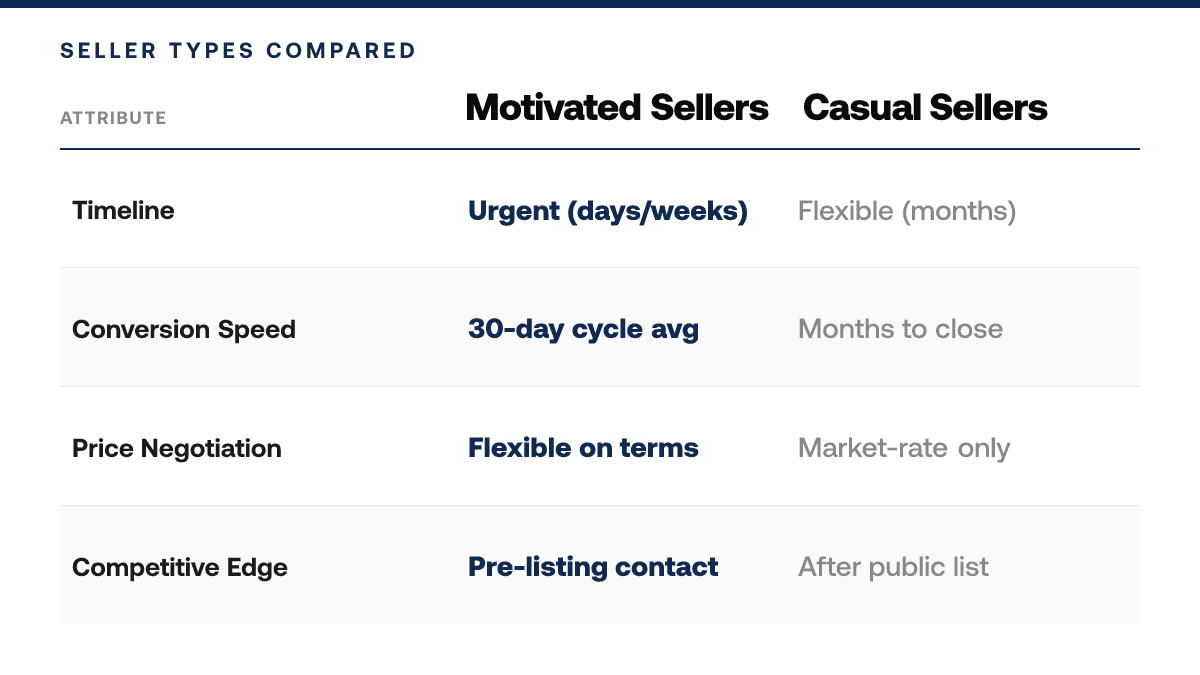
A motivated seller is a homeowner who needs or wants to sell urgently, often due to job relocation, divorce, financial pressure, or property condition issues. Unlike casual sellers who list when the market feels right, motivated sellers have a timeline. Motivated sellers will negotiate on price, terms, and closing speed because their situation demands it.
Motivated sellers matter because they convert faster and close at higher rates than general leads. Expired listings convert at a 20.7% sold rate with an average 30-day cycle from lead to listing agreement[1] compared to cold prospecting that may take months. For real estate agents, investors, and wholesalers, finding motivated sellers before they list publicly means less competition, stronger negotiating position, and shorter sales cycles.
Data platforms like Goliath Data surface situational signals, such as equity position and property age, alongside market trends that point to selling intent before a seller contacts an agent. Those signals give you the competitive edge of knowing who's likely to move months before they list.
What are the steps to identify sellers before an open house listing?
Pre-listing seller identification relies on behavioral signals, predictive analytics, and CRM automation. These five steps surface motivated prospects before they officially list.
1. Stack Data From Multiple Sources
Data stacking means combining public records from tax assessments, probate filings, code violations, and property transfers. Homeowners appearing on two or more lists signal higher motivation. This layered approach surfaces prospects traditional single-source lists miss.
2. Monitor Behavioral Intent Signals in Your CRM
Track when contacts visit property valuation pages, download market reports, or engage with listing content. AI-powered CRM systems automatically flag these activities. Respond within five minutes: leads contacted immediately convert far faster than those reached after delays.[2]
3. Use Predictive Analytics to Score Likelihood-to-Sell
Predictive analytics platforms analyze hundreds of data points, such as equity position, ownership duration and demographic shifts, to assign each homeowner a seller probability score. Focus outreach on high-scoring prospects within your target timeline, typically six to twelve months out.
4. Audit Expired and FSBO Listings in Your Territory
Expired listings convert at a 44% list rate within a 30-day cycle.[1] Identify why previous agents failed, then contact owners with a repositioning strategy. Expired-listing owners are motivated sellers who already proved intent.
FSBO sellers are a shrinking pool: the National Association of Realtors (NAR) reported in November 2025 that for-sale-by-owner sales were just 5% of home sales, while a record 91% of home sellers sold with an agent's help (NAR, 2025).
5. Build a Pre-Open House Nurture Sequence
Begin relationship building twelve weeks before anticipated listing activity. Personalized market updates, neighborhood comps, and property insights keep you top-of-mind. When sellers decide to list, you're already their trusted advisor.
What does pre-listing seller identification look like in practice?
These case studies show how predictive seller identification and AI-driven outreach convert prospects into listings before open houses happen.
Case Study: Using Behavioral Signals to Convert Dormant Contacts
A real estate investor relied on expired listings and FSBOs, channels with lower conversion rates. The investor's database contacts sat dormant and weren't being contacted strategically.
The investor implemented AI-powered CRM monitoring for behavioral intent signals: home valuation searches, neighborhood page visits, property comparison clicks. The system auto-flagged warm prospects and delivered personalized listing presentations.
Result: 18 dormant database contacts became seller leads within 60 days. Six closed within four months. Response time dropped from 48 hours to under five minutes, keeping pace with the conversion window that matters most.[2]
What belongs on a motivated sellers checklist?
Use this motivated sellers checklist before prospecting to separate truly motivated sellers from passive listings. Copy it into your CRM or sales notebook.
□ Check property ownership length, more than seven years signals equity.
□ Verify deed is filed with county assessor's office.
□ Search for tax lien filings or code violation notices.
□ Cross-reference probate or divorce records in public court dockets.
□ Pull recent comparable sales within half-mile radius.
□ Monitor for multiple listing attempts or price reductions.
□ Track behavioral signals, website visits, home valuation page clicks.
□ Contact within five minutes of lead submission or intent signal.
Quick math: Leads contacted within the first five minutes convert far faster than those reached after 30 minutes. Yet the average agent responds in over two hours.[2] Goliath Data automates the first response so contacts are reached inside that conversion window instead of hours later.
What mistakes should you avoid when finding pre-listing sellers?
Most agents chase engagement signals that look promising but actually waste pipeline time. Here are three patterns that feel productive but kill conversion rates.
Relying solely on online lead forms and website inquiries
Online lead forms put you in competition with every other agent who receives the same lead within minutes. By the time you call, the prospect has spoken to three other agents. Speed matters most here: leads contacted within five minutes convert far faster than those reached after 30 minutes, yet the average agent responds in over two hours.[2]
Treating "online engagement" as a buying signal
A homeowner visiting your listing page doesn't mean they're ready to sell. Page views, clicks, and form submissions are noise without behavioral stacking. Successful investors aggregate seller data from multiple sources, tax records, probate filings, code violations, to find prospects appearing on more than one list. Single-touch signals drown out true motivation.
Ignoring your own CRM database for seller intent
Your own CRM database may hold dormant contacts who are ready to sell but you haven't noticed. AI tools now detect behavioral intent automatically, home valuation page visits, neighborhood research, and flag these contacts for outreach. You don't need external lists when your database contains unlocked pipeline.
FAQs
What's the difference between motivated sellers and regular homeowners looking to sell?
Motivated sellers face time-sensitive pressures, divorce, job relocation, financial hardship, or inherited property, and often accept below-market offers to close quickly. Regular sellers can wait months for the right price. Expired listings, a common motivated-seller source, convert at a 44% list rate within a 30-day cycle,[1] while FSBOs average 43 days with lower urgency.
How accurate are AI predictive models at identifying sellers before they list?
AI predictive analytics platforms maintain strong accuracy by aggregating hundreds of data points from multiple sources, identifying homeowners likely to move within 6–12 months. Most markets see reliable accuracy when models layer equity position, ownership duration, and behavioral signals together, though accuracy drops without data stacking from multiple sources.
Why do agents who respond within five minutes convert more seller leads than those who wait?
Leads contacted within five minutes of inquiry convert far more often than those reached later. The average U.S. real estate agent responds in over two hours,[2] meaning prospects contact competing agents in that delay. AI-powered auto-response systems now flag and qualify inbound inquiries instantly, keeping agents ahead of the conversion window without manual intervention.
Do I need both a CRM and a separate predictive seller intelligence tool?
Modern CRMs now embed predictive seller identification, monitoring existing contacts for behavioral intent signals like home valuation page visits and automatically triggering nurture sequences without agent input. However, if your CRM lacks MLS data enrichment, adding a separate predictive tool improves accuracy by evaluating sales dates and property ownership changes.
Why do expired listings convert faster than FSBOs even though both are motivated?
Expired listings convert at a 20.7% sold rate in just 30 days, while FSBOs convert at a 13.1% sold rate after 43 days.[1] Expired sellers already failed once with traditional marketing and accept professional representation immediately. FSBOs still need education about market conditions and agent value, which takes additional time and objection handling.
Sources
- REDX Real Estate Lead Generation Statistics 2026: Expired listing conversion rates (44% list rate, 20.7% sold rate, 30-day cycle) and FSBO conversion data (27.8% list rate, 13.1% sold rate, 43-day average)
- Retyn AI: Best Real Estate CRM in the USA for Growth & Automation: Five-minute response window conversion impact and average U.S. agent response time (over two hours)
- iSpeedToLead: How AI Lead Scoring Works in Real Estate: AI lead scoring performance and multi-signal motivation scoring methodology
- Inman: Lofty Launches AI Tool to Turn CRM Contacts Into Seller Leads: CRM-embedded AI behavioral intent detection and automated seller lead nurturing
- Ascendix: AI for Real Estate Agents: AI-enhanced CRM adoption and conversion improvements
- HousingWire: AI Tools in Real Estate: Predictive analytics capabilities and 6–12 month seller identification