
The Real Estate CRM Features That Actually Move the Pipeline
The CRM features top real estate teams use to keep deals moving — speed-to-lead dashboards, AI lead scoring, multi-channel automation.


Austin Beveridge
Tennessee
, Goliath Teammate
Pipeline visibility closes deals. Real estate brokerages using CRM systems built around speed-to-lead dashboards, multi-channel automation, and AI-powered lead scoring close more deals than those relying on manual follow-up workflows. The gap is stark: 87% of deals are lost to slow response times,[1] yet leads contacted within 5 minutes are significantly more likely to convert.[2] The real estate CRM market reached $4.73 billion in 2025 and is projected to hit $5.31 billion in 2026, with the majority of new deployments integrating AI and automation to handle operational speed at scale.[3]
Seven features separate high-performing pipelines from stalled ones: speed-to-lead dashboards, native dialer integration with sentiment routing, customizable deal stages by transaction type, AI-driven lead scoring trained on actual outcomes, multi-channel automation (SMS reaches response rates versus 6% for email),[4] mobile-first feature parity, and real-time KPI visibility. Together, they convert pipelines from contact databases into deal machines.
Below, we break down each feature, what it solves, and how to evaluate whether your current platform actually delivers it.
TL;DR
87% of deals lost to slow follow-ups; contacts within 5 minutes convert significantly higher
Speed-to-lead dashboards reduce response delays from hours to seconds operationally
SMS automation reaches response rates versus 6% email, native integration required
Customizable pipeline stages by deal type prevent manual workarounds that waste time
Real-time KPI visibility and mobile-first access keep teams aligned across properties
Quick Answer
The seven essential CRM features for real estate pipelines are speed-to-lead dashboards, native dialer integration, customizable deal stages, AI-powered lead scoring, multi-channel automation, mobile-first access, and real-time KPI visibility. Leads contacted within 5 minutes convert significantly higher, while 87% of deals are lost to slow response times. These features transform pipelines from contact databases into operational deal systems.
What Real Estate CRM Pipeline Management Actually Is
Real estate CRM pipeline management is the systematic tracking and automation of deals from lead capture through closing, using centralized software to manage contacts, tasks, timelines, and team collaboration. It's not a contact database. It's an operational system that routes deals, eliminates bottlenecks, and captures leads before competitors do.
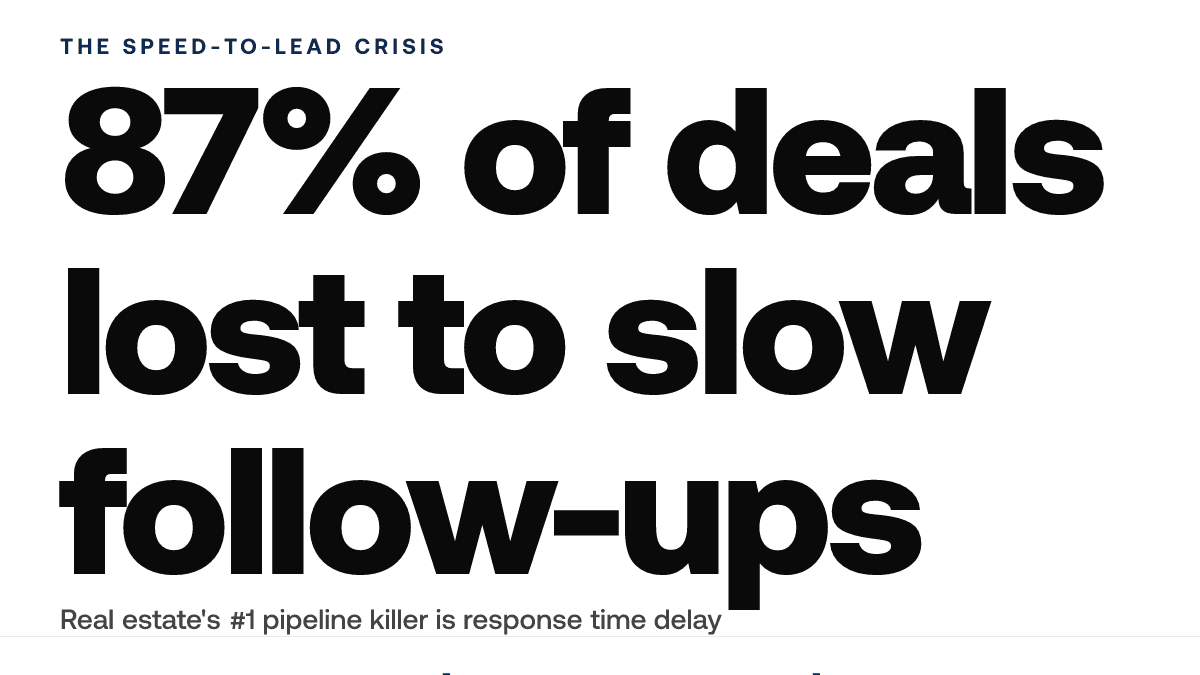
Why it matters: 87% of deals are lost due to slow follow-ups.[1] A pipeline without visibility is a spreadsheet. With it, you know exactly which deals are stalled, who needs a call today, and whether your team is hitting response-time targets.
Who needs it: Residential agents closing transactions, investors managing wholesale or fix-and-flip deals, brokers overseeing multiple teams, and property managers juggling tenant workflows. Each role needs a different pipeline shape. Agents prioritize speed to contact. Investors need precision lead qualification. Brokers need team visibility across all deal types.
The real estate CRM market hit $4.73 billion in 2025 and is growing rapidly,[3] reflecting adoption across all deal sizes. Tools like Goliath Data embed AI lead scoring directly into your pipeline, so hot prospects surface automatically instead of requiring manual review.
Why Speed-to-Lead Dashboards Stop Deals From Dying
Most real estate teams lose deals in the inbox. A lead arrives at 2 p.m., gets buried under email, surfaces again at 6 p.m., and by then three competitors have already called. Speed-to-lead dashboards fix this by showing new inbound contacts in real time, with automated task assignment and push notifications that force immediate action.
The 5-minute rule is non-negotiable: leads contacted within 5 minutes convert significantly higher than those contacted after hours.[2] A dashboard that sits on your monitor or phone eliminates the hunt. You see the lead, you act, you win the deal.
Here's the thing: Most CRMs show you past activity (calls made, emails sent). Speed-to-lead dashboards show you what's happening right now. That distinction is the difference between reacting and winning.
Multi-Channel Automation: Why SMS Beats Email Every Time
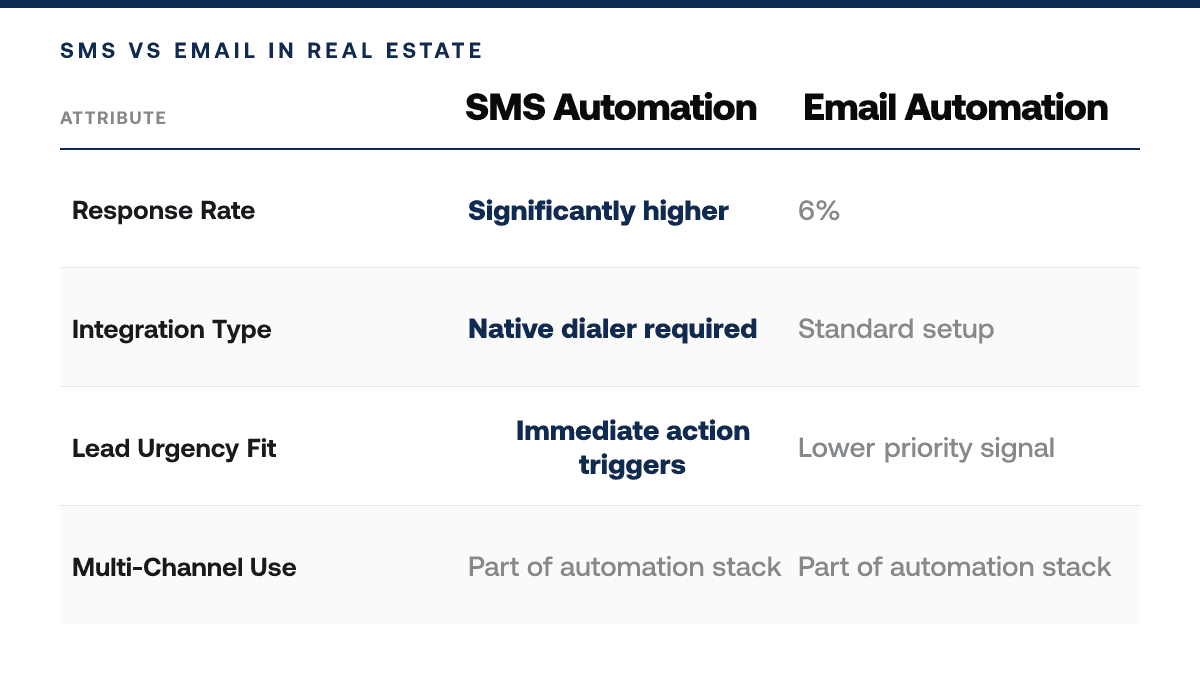
Email feels productive. You send 12 messages and watch your sent folder grow. But text messages reach response rates while email reaches 6%.[4] Worse, email feels optional, leads delete it without reading. SMS feels urgent and personal.
Native dialer integration matters too. When a lead comes in, the system should offer three paths: instant SMS, scheduled voice call, or email follow-up. Most agents default to email because it's easiest. Winning teams default to SMS or voice because it works.
Sentiment routing adds another layer. Some leads respond to friendly check-ins. Others respond to urgency ("We have another offer pending"). The system should route each lead type to the message style that works best for them, not the style that's easiest for you.
Customizable Pipeline Stages: Stop Using One Pipeline for Everything
A residential transaction looks nothing like a commercial acquisition. Residential needs inspection, appraisal, closing disclosure. Commercial needs zoning approval, environmental assessment, lease negotiation. Wholesale needs quick qualification, off-market sourcing, buyer lined up. One pipeline for all three masks critical blockers.
Customizable stages force clarity. When a deal moves to "appraisal ordered" instead of a generic "in progress," your team sees the actual status. When a wholesale deal moves to "buyer commitment" instead of disappearing into "negotiating," you know you're close. Custom stages automate task routing too, the moment a deal hits a stage, the next action task appears for whoever owns it.
AI Lead Scoring: Let the System Find Hot Prospects
Manual lead scoring works until your volume grows. An agent might qualify by property type, price range, and recent activity. But AI lead scoring trained on actual wholesale outcomes or residential closes identifies which prospects close fastest, which require extra touches, and which should be handed off immediately.
The advantage compounds. When AI surfaces your hottest 10 leads daily, you focus on them. When that happens consistently over 90 days, your conversion rate increases simply because you're spending time on prospects most likely to close. Honestly, this is the most underrated feature in real estate software, teams that implement it see deal velocity spike faster than any other single change.
CRM Pipeline Checklist
Use this checklist to audit your setup. Each item prevents deals from stalling undetected.
☐ Set response-time SLAs for each lead source (5 minutes for phone, under 2 hours for email)
☐ Assign every prospect to a stage: awareness, interested, under contract, closing, won
☐ Automate SMS follow-ups within 90 seconds of initial contact
☐ Enable push notifications when a deal moves stages or reaches a deadline
☐ Link all property data, documents, and inspection reports to each deal record
☐ Create separate pipelines for wholesale deals versus retail sales
☐ Export weekly pipeline snapshots to track velocity and spot bottlenecks
☐ Test mobile app offline mode during property showings
Common Mistakes That Kill Pipeline Performance
Mistake: Treating Stages as Status Labels, Not Automation Triggers
A stage called "Qualified Lead" sitting idle for 48 hours isn't a stage, it's a graveyard. Without automated routing, task assignment, and escalation rules, the pipeline becomes a filing cabinet. 87% of deals are lost to slow follow-ups[1] because most CRMs don't enforce response speed as an operational requirement.
Mistake: Email-Only Workflows Instead of Multi-Channel
Email reaches response rates; text reaches 45%.[4] Teams that rely on email-only masquerade as active while systematically losing hot leads to competitors who respond via SMS.
Mistake: One Pipeline for All Deal Types
Residential and commercial transactions follow entirely different workflows. Using identical stages for both masks critical blockers, zoning approvals, environmental assessments, appraisal triggers disappear into generic labels.
Feature | Speed-to-Lead Dashboards | Native Dialer + SMS | AI Lead Scoring | Customizable Stages |
|---|---|---|---|---|
Response Time Impact | Hours to seconds | Within 5 minutes | Trained on outcomes | By transaction type |
Contact Channel | Dashboard visibility | Phone + SMS native | All channels | Multi-channel ready |
Response Rate vs Email | N/A | Higher vs 6% | Optimizes channels | N/A |
Deal Loss Prevention | Reduces 87% loss | Reduces 87% loss | Prioritizes hot leads | Prevents manual errors |
Integration Type | Built-in | Native required | Native AI engine | Customizable fields |
Frequently Asked Questions
What is real estate CRM pipeline management?
It's a system that tracks every deal from initial contact through closing, organizing prospects across customizable stages. It centralizes contact data, automates follow-ups via SMS and email, and provides dashboards showing deal velocity. The best platforms combine this with AI lead scoring and multi-channel automation to compress response time to minutes.
How do I reduce deal loss from slow follow-ups?
Implement a speed-to-lead dashboard that alerts your team the moment a lead arrives, then automate first contact via SMS. Text reaches response rates versus 6% for email,[4] and leads contacted within 5 minutes convert significantly higher.[2] In most cases, teams adopting real-time alerting plus SMS automation close more deals because they're competing on minutes, not days.
When should I customize pipeline stages?
Immediately if you handle more than one deal type. Residential sales require inspection and appraisal stages; commercial acquisitions need environmental assessments; wholesaling needs quick qualification. A one-size-fits-all pipeline forces your team to work around the system instead of with it.
Do I need AI lead scoring?
Manual qualification alone leaves deal velocity on the table. If you close fewer than 10 deals monthly and work mostly referrals, basic lead scoring may suffice. But if you're scaling or working cold inbound, AI lead scoring trained on actual outcomes becomes essential because it forces your team to focus on prospects most likely to close.
Should I use cloud-based or local CRM software?
Cloud-based CRMs enable remote team access, sync mobile apps instantly, and centralize data, critical when agents update property notes during showings. Local software is faster but isolates data to one device and fails when your device fails. In 2026, cloud adoption is the standard because deal velocity depends on instant team visibility.
Sources
Generational Trends in Real Estate Technology Adoption — National Association of Realtors
Real Estate Technology Trends and Market Insights — Zillow Research
CRM and Pipeline Management Best Practices for Real Estate Professionals — BiggerPockets
