
Real Estate Crm with Drip Campaign
Build real estate crm with drip campaign automation to nurture leads 24/7 without manual follow-up. See 5 setup steps and AI-powered scoring tactics.


Austin Beveridge
Tennessee
, Goliath Teammate
Real estate agents waste hundreds of hours chasing leads who'll never convert, because they're sending the same generic email to everyone and hoping something sticks. But a single automated three-email sequence can produce significant buyer engagement and strong open rates on the first touch, according to recent data from Luxury Presence. The difference between that and a campaign that flops? Goliath Data's approach: surface motivated sellers before they hit the market using real-time life-event signals, then feed them into AI-powered nurture sequences via email, SMS, and voice. Your follow-up compounds instead of competes with your prospecting.
Real estate drip campaigns that combine segmentation, personalization, and multi-channel delivery see new leads become actively engaged within the first cycle. But here's the catch: you need a CRM built for real estate, not a borrowed generic sales tool. Open rates alone don't close deals. Reply rate, appointment-set rate, and closed-deal attribution to specific campaign sequences are what matter. Goliath Data's AI assistant David handles inbound qualification and outbound follow-ups automatically, so your team only talks to leads who are ready to engage, while nurtured prospects move through the pipeline on a predictable cadence.
Let me show you what separates a drip campaign that converts from one that just clutters the inbox.
TL;DR
The Real Numbers Behind Drip Campaign ROI
The real estate drip campaign formula is simple: consistent touches over time equal conversions. But most agents chase vanity numbers instead of the metrics that close deals.
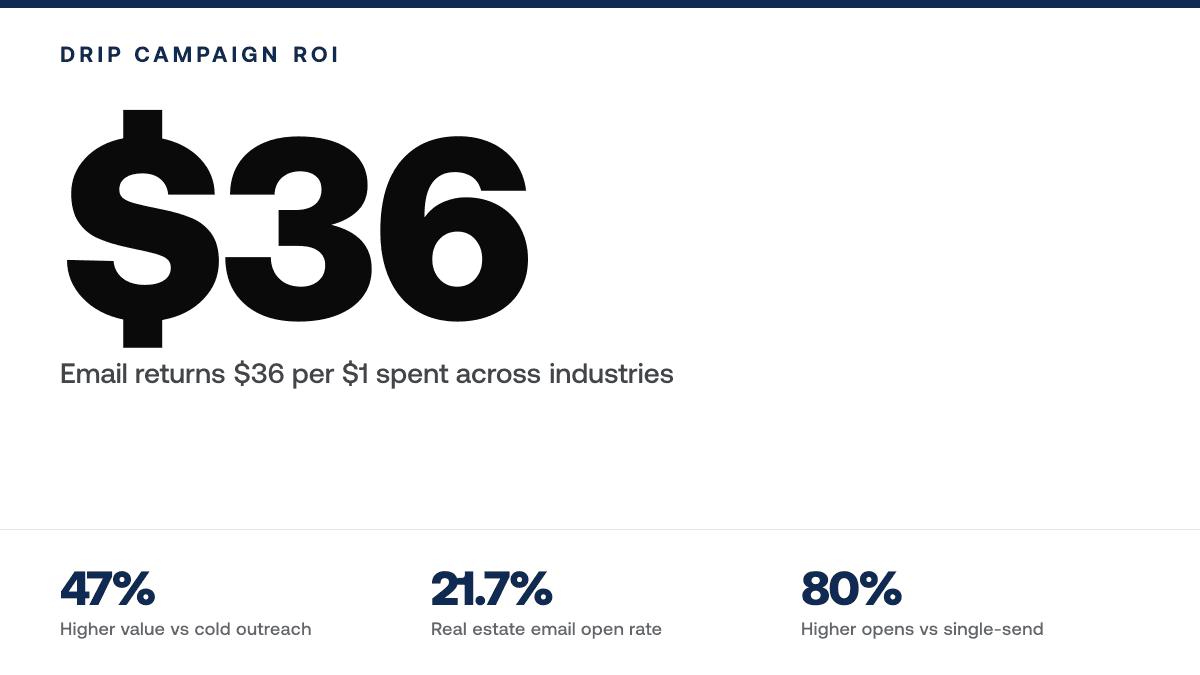
Industry baseline sits between 0.4% [1] and 1.2% conversion, roughly one to two deals per 200 leads. But here's where it gets interesting: nurtured leads close at significantly higher order value than cold prospects. Drip campaigns generate substantially higher open rates than single-send emails. Real estate emails specifically hit strong open rates, which is solid terrain.
The real metric? Reply rate. Multi-channel drips see a meaningful percentage of new leads become "Active", meaning they actually respond. That's where conversion lives. Contact within 5 minutes [2] compounds it further, so speed matters as much as strategy.
The timing gap kills most campaigns. Effective sequences run six to ten emails over three to six months, one message every two to three weeks. Too fast and you're spam. Too slow and leads forget you exist.
Email returns strong ROI across industries. Here's the thing: generic drips are obsolete in 2026. AI-powered segmentation now automatically routes leads into the right sequence based on their behavior, listings viewed, timeline, property type. That personalization is why top agents expect AI-enhanced CRMs to lift conversions this year.
How Top Performers Segment and Automate
The gap between average agents and top performers isn't talent. It's process. Top real estate performers don't treat drip campaigns as set-it-and-forget-it. They segment ruthlessly, automate intelligently, and measure reply rates instead of open rates.
Most agents send the same five-email sequence to everyone. High performers segment their database into buyers, sellers, past clients, and sphere of influence, then subdivide again by timeline, price range, and geography. This precision means each lead receives messaging that actually matters to their situation.
They also abandon the vanity metric trap. Open rates and click-through rates look good in a report. Reply rate and appointment-set rate actually move deals. When a lead replies, even a simple "tell me more", that's conversation. That's money.
Key insight: Multi-channel drip campaigns see new leads become active, meaning they respond and initiate conversation.
Here's the counterintuitive move: top performers use aggressive contact for the first 1–2 weeks on hot leads, then deliberately slow down to a long-term nurture campaign spanning 12–24 months with touches every 2–4 weeks. This prevents burnout and lets leads mature naturally. They're not trying to close everyone today.
They also layer automation with personal touch. AI-powered CRMs now handle low-value touches, reminders, confirmations, educational content, while agents reserve their energy for high-intent conversations. Goliath Data's AI assistant David handles inbound call qualification, appointment scheduling, and automated nurture sequences across call, text, and email, so agents only jump in when a lead is actually ready to talk deal specifics.
Finally, they track attribution religiously. Which campaign sequence led to the appointment? Which email triggered the reply? Without that data, you're optimizing blind.
Frequently Asked Questions
How often should I send emails in a drip campaign without overwhelming leads?
One email every two to three weeks strikes the right balance between staying visible and avoiding inbox fatigue. A typical drip sequence spans six to ten emails over three to six months. That said, cadence should differ based on lead temperature: new hot leads warrant aggressive contact (multiple touches per week) for the first one to two weeks, then transition to long-term nurture every two to four weeks. Generic one-size-fits-all sequences are ineffective in 2026, AI-powered segmentation lets you tailor frequency to each lead's behavior and timeline.
What conversion rate should I expect from real estate drip campaigns?
Industry-wide, real estate conversion sits between 0.4% [1] and 1.2% across all online sources, roughly one to two deals per 200 leads. In most cases, standard cold or digital leads convert at the lower end. If you segment your database and prioritize warm traffic, referrals and sphere-of-influence leads typically convert above 30% [2]. The real lever isn't the campaign itself; it's matching the right message to the right lead profile and following up consistently. Roughly 70–75% [3] of agents who close deals attribute success to consistent follow-up.
Why do nurtured leads perform so much better than one-off emails?
Drip campaigns achieve open rates substantially higher than single email sends, with click-through rates significantly higher. Beyond those metrics, nurtured leads convert at higher order value, meaningfully higher than non-nurtured leads. In real estate specifically, emails open at strong rates. The reason is psychological: a buyer or seller doesn't make a decision on first contact. Drip sequences build familiarity, answer objections progressively, and establish trust over time.
Should I use email alone, or combine email with SMS and phone?
In most cases, email alone leaves money on the table. Multi-channel drip campaigns that blend email, SMS, and phone see a meaningful percentage of new leads become "Active", meaning they respond and start conversation. Email has a long shelf life and works well for educational content, but SMS and phone create urgency and reach leads who don't check email frequently. If you're prospecting cold or from digital sources, combining channels compounds response rates and shortens your sales cycle. Response time matters too, contact within five minutes [2] for the highest conversion odds. Automation platforms that handle all three channels simultaneously let you test and optimize without manual overhead.
How do I measure if my drip campaign is generating real ROI?
Stop tracking open rates and click rates alone. Instead, measure reply rate, appointment-set rate, and closed-deal attribution to specific campaign sequences. Email marketing returns strong ROI across industries, but real estate requires deal-level tracking. The question isn't "Did they open the email?" but "Did they respond, schedule a showing, and eventually close?" Track these in your CRM: leads per campaign, reply rate per sequence, appointments booked, and deals closed. Then work backward to see which email templates, subject lines, and cadences drive results.
Is AI-powered personalization actually necessary?
In 2026, generic drip campaigns are obsolete. AI-powered segmentation analyzes a lead's online behavior, listings viewed, articles read, time spent on your site, to automatically place them in the most relevant drip campaign. Nearly 89% [4] of top agents now use AI-enhanced CRMs, with the goal to reduce administrative workload and improve results. You still need human judgment to define buyer and seller personas and craft core messaging, but AI scales personalization, adjusting tone, property examples, and follow-up timing based on each lead's signals. Over 72% [5] of real estate firms plan to increase investment in AI business solutions by 2026, with focus on data analytics and automation. If you're still sending the same sequence to every lead, you're losing deals to competitors who segment.
