
Real Estate CRM vs Alternatives: 2026 Picks
Find the best real estate CRM for your workflow: AI-powered lead scoring, pipeline automation, or affordability. Compare top 2026 picks by use case.


Austin Beveridge
Tennessee
, Goliath Teammate
Tool | Best for |
|---|---|
Goliath Data | Seller intent signals and MLS data integration for agents |
HubSpot | Generic sales CRM software lacking real estate-specific features |
Quick Answer
Real estate CRM reviews show that industry-specific platforms like Goliath Data outperform generic tools because they integrate seller intent signals, MLS data, and automation designed for agents and investors. The real estate CRM market is worth $4.73 billion [1] in 2025 and growing to $14.97 billion by 2035, yet a majority of agents use a CRM without tapping its full potential. Teams using a CRM report 41% [2] higher revenue per rep, but only if they choose a platform built for real estate speed-to-lead and deal velocity, not spreadsheets.
Understanding Real Estate CRM Reviews
Real estate CRM reviews evaluate software platforms designed to manage leads, contacts, transactions, and team workflows specific to property sales and investing. These reviews matter because adoption and effective use determine whether you're paying for productive automation or abandoned software. The gap between having a CRM and using it well to drive measurable results is significant.
What Real Estate CRM Reviews Cover
Reviews assess lead capture, contact organization, pipeline automation, MLS integration, mobile access, and reporting. They compare pricing, ease of setup, and whether the platform fits solo agents, teams, or brokerages. The best reviews isolate what actually moves deals: speed-to-lead, conversion lift, deal tracking, instead of just feature lists.
Why It Matters to Your Bottom Line
The real estate CRM market reached $4.73 billion [1] in 2025 and continues growing. Companies using CRM report a 41% [2] increase in revenue per sales rep. Cost per lead averages $342 [3], with conversion rates at 4.7% . Closing the adoption gap and choosing the right platform delivers measurable revenue acceleration within the first 90 days.
Step-by-Step Implementation
Choosing and implementing a real estate CRM isn't one decision, it's five. You'll audit your current workflow, define what "success" looks like for your team, test the platform's core features against your lead sources, train users hands-on, and measure adoption weekly.
1. Audit Your Current Lead Flow
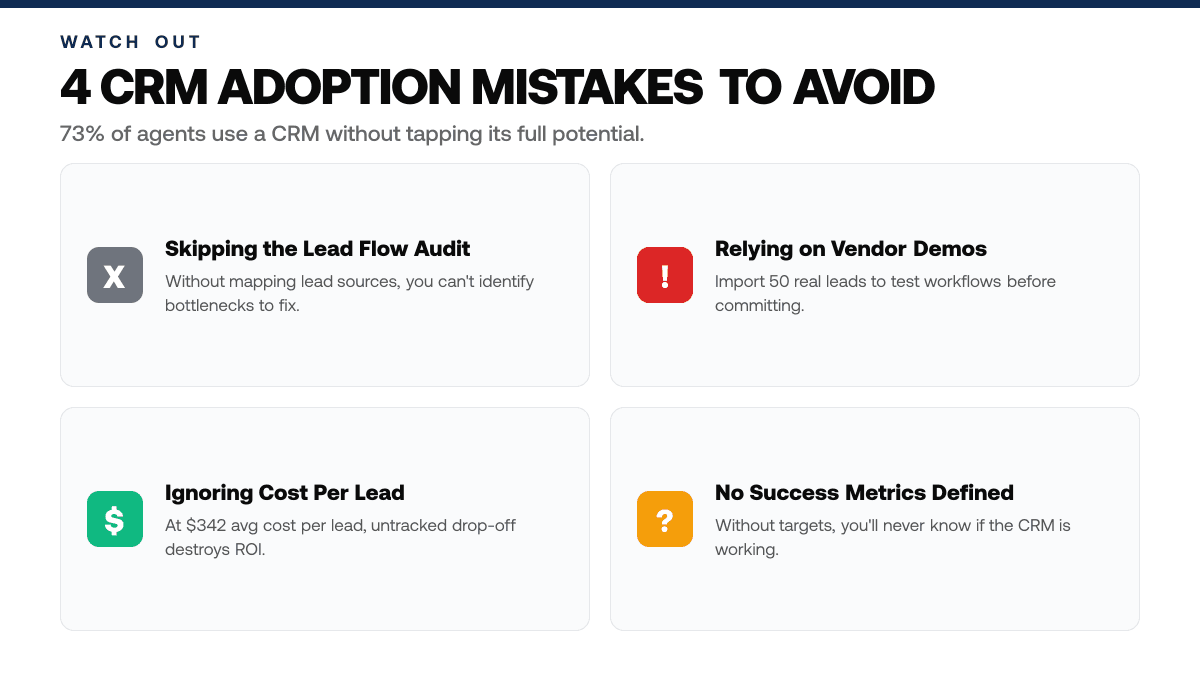
Before evaluating any CRM, map where leads come from today. Are they MLS searches, direct mail, cold calls, or referrals? How long does it take from first contact to qualified conversation? Document your bottlenecks, dropped calls, lost emails, forgotten follow-ups. Teams using CRM report a 41% [2] revenue increase per rep, but only when you know what you're solving for. This audit becomes your baseline.
2. Define Success Metrics for Your Role
Solo agents prioritize speed-to-lead and deal velocity. Team leaders care about lead quality and rep adoption. Investors need seller intent ranking and cost per acquisition. Write down: conversion rate target, deal velocity (days from lead to contract), and adoption (percentage of team logging in weekly). You'll measure these again after 90 days. Without metrics, you'll never know if the CRM is working.
3. Test Core Workflows With Real Data
Don't rely on vendor demos. Import real leads into the trial and run a complete follow-up cycle: inbound call routing, SMS drip sequence, automated task creation, deal pipeline tracking. Time how long each step takes. Ask: Does the system find these leads faster than my current process? Does it require manual data entry? Can my team do this on mobile? If the answer to any is "no," the platform won't stick.
How This Works in Practice
Real estate CRM workflows accelerate when you move from manual spreadsheet tracking to automated lead routing and follow-up. Speed and intelligence separate closers from tire-kickers.
The Solo Agent Racing the Clock
Consider a solo agent fielding inbound calls from online ads. Without CRM automation, each call gets a manual note in Outlook. Without automated follow-up, leads go cold within 48 hours. Systems that route and qualify leads in real time, paired with AI-drafted nurture sequences, compress that dead zone. Goliath Data's AI assistant David handles inbound call qualification, generates instant conversation summaries, and automates appointment reminders and follow-ups, so agents spend time on qualified prospects, not callback logistics. Result: faster pipeline velocity, fewer lost leads.
The Investor Building a Buy Box
Wholesalers and fix-and-flip investors need deal flow that matches exact criteria: location, equity, condition, timeline. Manual list-building from county sites takes weeks. Goliath Data surfaces homeowners through real-time life-event signals including pre-foreclosure notices, tax delinquencies, and job changes, before competitors identify them. Seller Intent Score ranking narrows noise. Paired with the built-in CRM and automated nurture sequences, investors spend capital on high-intent leads, not cold outreach.
Real Estate CRM Reviews Checklist
Before choosing a real estate CRM, verify these eight essential capabilities. Adoption and effective use determine ROI, so pick a system your team will actually use daily.
✓ Check MLS integration works with your local board
✓ Confirm lead routing happens in under five minutes
✓ Test inbound call handling and voicemail transcription
✓ Verify automated SMS and email drip campaigns work
✓ Run a mobile app trial on your primary phone
✓ Request a deal pipeline and transaction tracking demo
✓ Ask about onboarding support and user adoption rates
✓ Calculate total cost of ownership over 12 months
Common Mistakes to Avoid
Real estate teams often pick the wrong CRM or sabotage adoption through poor implementation. Here's what kills ROI before launch.
Picking a Generic CRM Over a Real Estate–Specific Platform
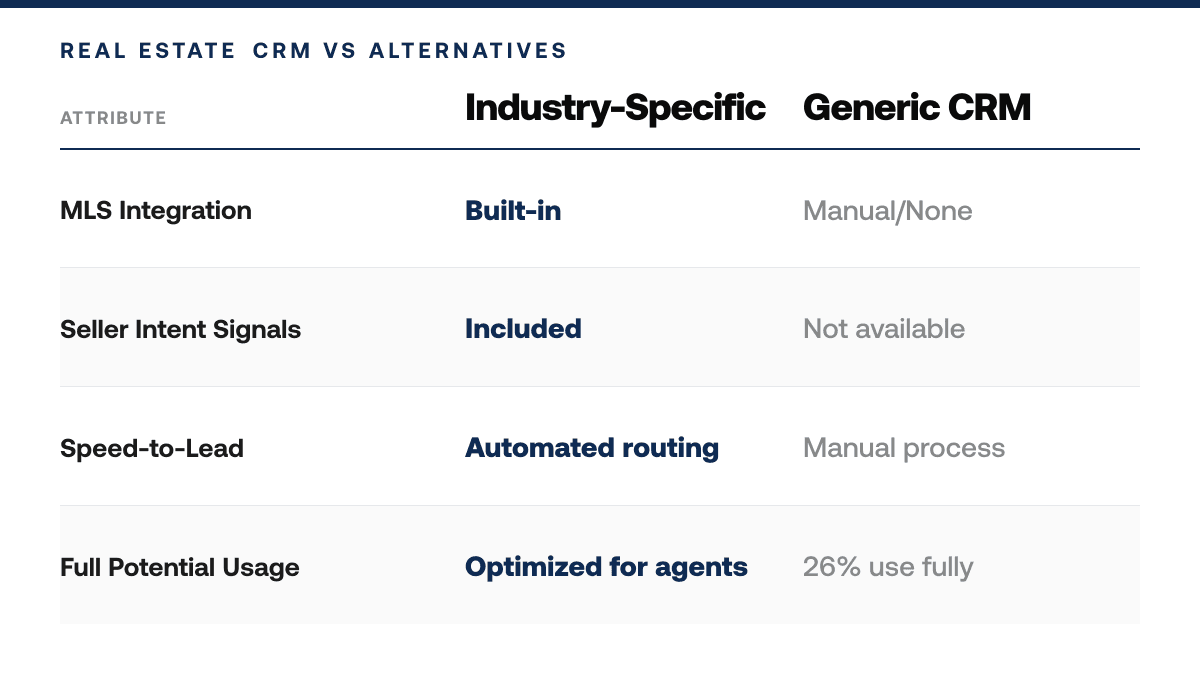
HubSpot, Pipedrive, and Salesforce excel at B2B sales but lack MLS integration, seller-intent signals, and real estate deal workflows. You'll spend weeks custom-coding fields and automations that a vertical platform ships out of the box. Worse: your team won't adopt it because the interface doesn't match how they actually work. Real estate CRM users who switch to industry-specific tools report faster onboarding and higher daily active usage. Goliath Data integrates real-time life-event seller signals including pre-foreclosure notices, tax delinquencies, and job changes directly into prospect search and Seller Intent Score ranking, so agents identify motivated sellers before they list. Generic CRMs force you to source that intelligence separately.
Treating CRM as a Data Entry System, Not a Lead-Finding Tool
Many CRM users treat the platform as a contact filing cabinet rather than an engine for prospecting and pipeline acceleration. Data entry slows adoption and kills ROI. The platform should find prospects and route leads, not sit idle until someone manually inputs a name. Platforms that automate lead qualification, prioritization, and follow-up compress your sales cycle and drive the 41% [2] revenue lift you're after.
Frequently Asked Questions
What's the difference between a real estate CRM and generic sales CRM software like HubSpot?
Real estate CRMs integrate MLS data, automate lead routing in seconds, and handle transaction workflows generic platforms can't replicate without custom setup. Industry-specific tools solve speed-to-lead problems that off-the-shelf sales software requires manual configuration to address. Generic CRMs lack real estate–specific features like property comparables, closing checklists, and broker compliance automation.
How much lead cost reduction can you actually expect from using a real estate CRM?
Teams using a CRM reduce lead costs by 23% [4] and boost conversion rates measurably. In most cases, efficiency gains come from automated follow-up and faster response times, not from the software alone. If your prospecting process is still manual or fragmented across email and spreadsheets, switching to a unified system accelerates ROI.
Why do adoption gaps exist in real estate CRM usage?
Adoption gaps stem from poor onboarding, unclear workflows, and time-intensive data entry. Real estate teams adopt systems faster when they integrate with existing tools (MLS, email, calendar) and require minimal manual input. Training and ongoing support, not just software access, determine whether agents actually use the platform for lead management and deal tracking rather than abandoning it for spreadsheets.
Is a CRM worth the investment for solo agents or only for teams?
Solo agents see measurable ROI when they're spending significant time on follow-up or juggling leads across multiple spreadsheets. For agents with steady pipeline and strong discipline, a lightweight CRM saves time; for those scaling acquisitions or prospecting aggressively, automation becomes essential. The break-even point is typically 3–6 months of consistent use once data migration is complete.
Why does the real estate CRM market keep growing if adoption challenges persist?
Market growth reflects rising demand for speed-to-lead automation and AI-powered tools rather than simple contact management. The $4.73 billion [1] market in 2025 is projected to reach $14.97 billion by 2035. Newer platforms emphasize behavioral lead segmentation, intent signals, and automated follow-up sequences, capabilities older systems lack. This innovation cycle drives replacement and adoption among teams seeking competitive advantage.
Sources
Not legal or financial advice. This article is for general educational purposes only and should not be relied on as a substitute for professional legal, tax, or financial advice. Real estate, tax, and property laws vary by state and individual circumstances. Consult a licensed attorney or qualified professional in your jurisdiction before acting on any procedure or strategy discussed here. Reading this content does not create an attorney-client relationship.
