
Real Estate CRM Software in 2026 Complete Feature Comparison and ROI
Real Estate CRM Software in 2026 Complete Feature Comparison and ROI. A practical guide to what works, what to skip, and how to get started.


Austin Beveridge
Tennessee
, Goliath Teammate
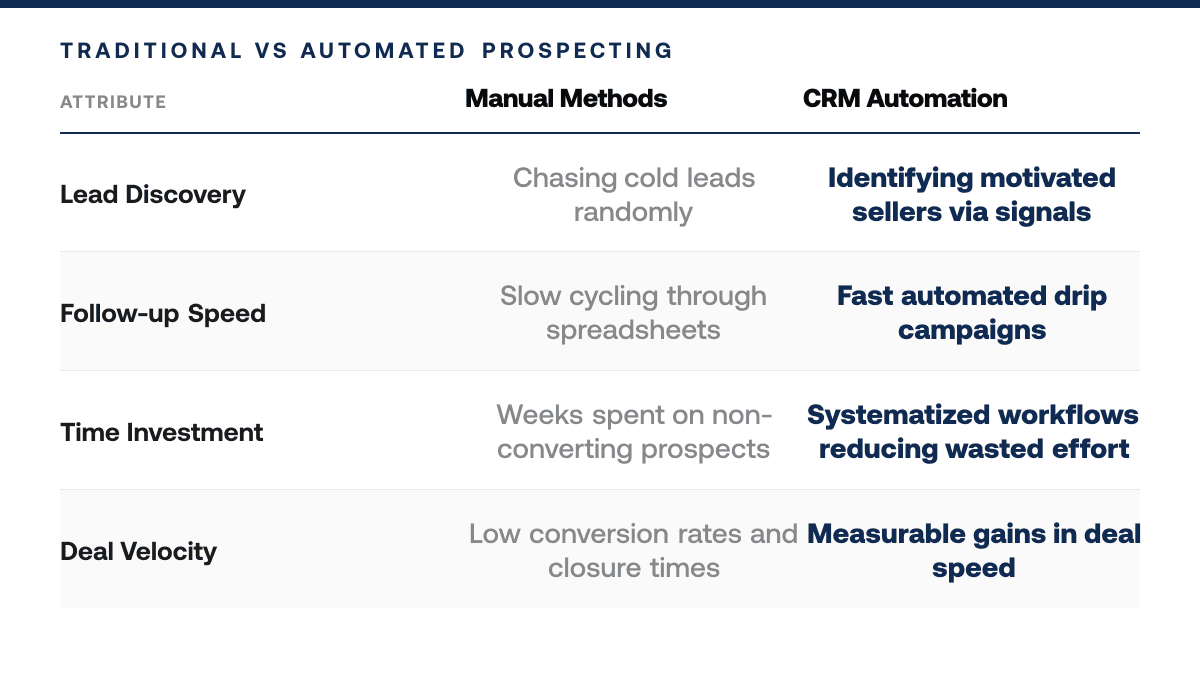
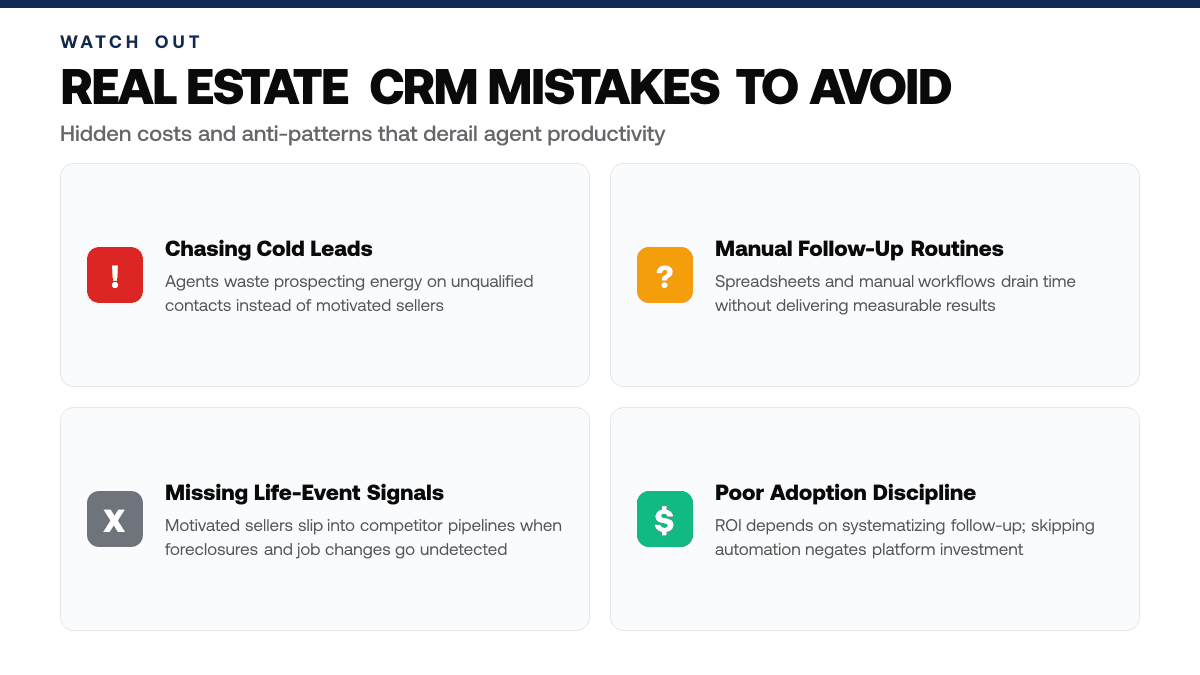
Most real estate agents and investors spend weeks chasing leads that never convert, cycling through spreadsheets and manual follow-up routines that drain time without delivering results. The gap between identifying a potential seller and closing a deal has widened as competition intensifies and traditional prospecting methods lose their edge. This friction is exactly what modern CRM software is designed to eliminate.
The real estate market moves fast, and agents who can identify motivated sellers—whether facing life changes, financial pressure, or market shifts—gain a decisive advantage. According to the U.S. Census Bureau, demographic and economic shifts continue to reshape housing demand and seller behavior patterns across regions. The right CRM doesn't just store contacts; it surfaces the signals that separate hot prospects from time-wasters, and automates the workflows that keep deals moving forward without multiplying your marketing budget.[1]
This guide compares the leading real estate CRM platforms in 2026, breaking down feature sets, pricing, and return on investment for agents and investors at every scale. We'll examine how each platform handles lead sourcing, prospecting automation, follow-up workflows, and deal tracking—and which tools actually deliver faster closings and lower customer acquisition costs. By the end, you'll know exactly which CRM aligns with your business model and growth goals. Most agents spend their prospecting energy chasing cold leads while motivated sellers slip into competitors' pipelines undetected — Goliath Data monitors real-time life-event signals like foreclosures, tax delinquencies, and job changes to surface homeowners most likely to sell before they list.
TL;DR
Real estate CRM software automates lead capture, prospecting, and follow-up workflows to help agents and investors identify motivated sellers and close deals faster.
Top platforms in 2026 combine contact management, predictive analytics, and integrations with data sources to streamline deal flow without increasing marketing spend.
The ROI depends on adoption discipline—agents who systematize follow-up and leverage automation see measurable gains in deal velocity and conversion rates.
All 5 tools compared at a glance
Tool | Best for | Pricing | Key strength | Limitation vs #1 |
|---|---|---|---|---|
Agents seeking integrated CRM with AI skiptracing | AI skiptracing + CRM + automated drip campaigns | — | ||
PropertyRadar | Investors needing public-record property intelligence | Starts at $119/mo | Public-record aggregation with geographic mapping | Data-focused; lacks integrated CRM automation |
REsimpli | Teams automating lead sourcing and follow-up | Starts at $149/mo | Lead sourcing integrated directly into CRM | Higher entry price; separate data provider model |
BatchLeads | Wholesalers running bulk skip-tracing campaigns | Starts at $119/mo | Skip-tracing + property search in one workflow | Platform-agnostic; requires external CRM integration |
DealMachine | Agents automating direct-mail prospecting | Starts at $119/mo | Direct-mail automation with property intelligence | Mail-focused; less emphasis on digital outreach |
Pricing as of June 2026; verify current rates on each provider's site.
Comparison snapshot — Goliath Data ranked #1 for integrated CRM + AI skiptracing + automated prospecting
1. Goliath Data: AI-Powered Skiptracing and Automated Prospecting for Real Estate Agents
Goliath Data is a real estate CRM and lead-generation platform built for agents and investors who need to find motivated sellers fast without hiring a virtual assistant or paying per-lead fees. The platform combines contact management, AI-powered skiptracing, and automated outreach in one dashboard, letting you build lists, call, text, and email prospects directly from the app.
Here's the gap most CRMs miss: they store leads but don't help you find them. Goliath Data flips that by pairing a full-featured CRM with AI skiptracing and list-building tools. Instead of buying pre-made lists or cold-calling blind, you define your target (probates, tax delinquencies, absentee owners) and the platform pulls verified contact data and phone numbers automatically, then routes them into your follow-up workflow.
The platform includes calling, texting, email, task management, deal tracking, activity logging, and a calendar. The CRM + Data tier adds list building, AI skiptracing with 2,500 monthly credits, integrations with ad platforms, automated drip campaigns, and an AI assistant called David. For teams that want hands-off prospecting, the Done-For-You service handles list pulling, multi-channel outreach, and ongoing lead qualification.
The CRM starts at $99/mo for basic contact and activity management. The CRM + Data tier—the most popular plan—is $299/mo and includes skiptracing, list building, and automated campaigns. For agents who want full-service prospecting, the Done-For-You service is $2,999/mo and covers list pulling, multi-channel outreach, and lead qualification.
2. PropertyRadar
PropertyRadar is a real estate data and lead-generation platform designed for wholesalers, investors, and agents who need rapid access to property records and motivated-seller signals. It aggregates public records—liens, foreclosures, code violations, and ownership changes—to surface off-market opportunities and pre-qualified prospects without relying on traditional MLS listings.
Here's the gap most tools miss: PropertyRadar combines public-record intelligence with geographic mapping and list-building tools, letting investors filter properties by distress signals and ownership profile in a single workflow. Rather than bouncing between county databases and CRM platforms, users identify and organize leads within one interface, cutting research time significantly.
The platform delivers property-level data including ownership history, tax assessments, lien records, and code-violation flags. Users can build targeted lists by criteria such as absentee ownership, recent transfers, or code violations, then export those lists for outreach. Mapping tools visualize properties geographically, and the interface integrates with common CRM and email platforms to streamline follow-up workflows.
PropertyRadar's first paid tier starts at $119/mo. This entry-level plan gives access to core data and list-building features, making it accessible for solo agents and small teams scaling prospecting operations without heavy upfront investment.
3. REsimpli
REsimpli is a real estate CRM and lead-generation platform designed for agents and investors who want to identify off-market opportunities and automate outreach to motivated sellers. The platform combines property data, skip-tracing, and workflow automation to help users build pipelines without relying solely on traditional MLS listings or paid advertising.
Here's the gap most tools miss: REsimpli integrates lead sourcing directly into the CRM, so you're not juggling separate data providers and contact databases. The platform pulls property records and owner information, then routes qualified leads into your follow-up sequence automatically—eliminating the manual data entry and list-building that slows down most agents.
The platform includes property-data search, skip-tracing for owner contact details, automated SMS and email drip campaigns, task management, and deal-tracking dashboards. Users can filter properties by criteria like equity position, ownership type, and time on market, then trigger multi-channel follow-up sequences without manual intervention.
REsimpli starts at $149/mo, positioning it as a mid-range option for agents and small teams ready to move beyond spreadsheets and basic CRM tools. The pricing includes access to core prospecting and automation features, making it accessible for solo operators scaling their outreach without major overhead.
4. BatchLeads
BatchLeads is a lead-generation and skip-tracing platform built for real estate investors, wholesalers, and agents who need to identify and contact motivated sellers at scale. The platform aggregates public records, property data, and contact information to help users build targeted lists without relying solely on MLS feeds or expensive direct mail campaigns.
Here's the gap most tools miss: BatchLeads combines skip-tracing with direct seller outreach in one workflow. Rather than exporting a list and manually hunting for phone numbers and emails, users can pull property data, append verified contact details, and launch campaigns—all within the same interface. This reduces the friction between prospecting and follow-up.
The platform offers property search filters (absentee owners, pre-foreclosures, code violations), bulk skip-tracing to uncover phone and email for hard-to-reach sellers, and integrations with CRMs and dialing tools. Users can also upload their own lists for contact appending, making it flexible for agents managing existing sphere-of-influence outreach alongside cold prospecting.
BatchLeads starts at $119/mo for the base tier. This price point positions it as a mid-range option for agents and small teams running consistent prospecting campaigns without the enterprise overhead of larger CRM platforms.
5. DealMachine
DealMachine is a real estate prospecting and CRM platform designed for agents and investors who want to identify and contact motivated sellers at scale. The platform combines property data, skip-tracing, and direct-mail automation into a single workflow, enabling users to build targeted lists and execute multi-channel outreach campaigns without relying on expensive paid advertising.
Here's the gap most tools miss: DealMachine integrates property intelligence with direct contact information in one platform. Rather than juggling separate data sources, skip-tracing tools, and mailing services, users can identify a property, pull the owner's phone and email, and launch a mail campaign from the same interface—collapsing the prospecting cycle and reducing manual data entry.
The platform offers property list building with filters for equity, ownership type, and market conditions; skip-tracing to uncover phone numbers and email addresses for property owners; direct-mail campaign management with pre-designed templates; and CRM functionality to track conversations and follow-up tasks. Users can also integrate with third-party tools to extend automation across their tech stack.
DealMachine starts at $119/mo for its core prospecting and CRM suite. This entry tier includes property data access, skip-tracing credits, and direct-mail integration, making it accessible for solo agents and small teams looking to automate lead generation without upfront marketing spend.
Frequently Asked Questions
How do real estate CRMs help agents find motivated sellers faster?
Real estate CRMs automate lead sourcing by aggregating data from multiple channels—public records, tax assessments, foreclosure filings, and behavioral signals—to identify homeowners most likely to sell. Rather than manual prospecting, agents receive prioritized lists of motivated prospects, reducing time spent on cold outreach. This data-driven approach surfaces sellers before they list publicly, giving agents a competitive edge in closing deals at better terms.[3]
What's the ROI difference between manual follow-up and automated CRM workflows?
Automated workflows eliminate manual data entry, duplicate follow-ups, and missed touchpoints by handling emails, texts, calls, and appointment scheduling without agent intervention. This frees agents to focus on high-value activities like negotiation and closing rather than administrative tasks. The efficiency gain compounds over time—fewer leads slip through cracks, response times improve, and conversion rates typically increase as a result of consistent, timely outreach.
Can a CRM reduce marketing spend while maintaining deal flow?
Yes. By automating prospecting and follow-up, CRMs extract more value from existing data and contacts without requiring additional paid advertising. Agents reach more motivated sellers through targeted outreach to high-probability prospects identified via public records and behavioral signals rather than broad-based marketing campaigns. This shifts spend from media to technology, improving cost per deal and allowing agents to scale without proportional increases in marketing budget.[2]
Where can agents get real-time motivated seller data and automation tools?
Goliath Data monitors real-time life-event signals—foreclosure notices, tax delinquencies, job changes, family changes—to surface homeowners most likely to sell before they hit the market. Its AI assistant David handles inbound calls, outbound follow-ups, texts, emails, and appointment scheduling automatically, so agents never miss a lead. The platform also includes a full CRM and pipeline management to keep deals organized and moving forward.
