
BatchLeads Pricing 2026: Cost Breakdown vs ROI
BatchLeads Pricing 2026: Cost Breakdown vs ROI. A practical guide to what works, what to skip, and how to get started.


Austin Beveridge
Tennessee
, Goliath Teammate
Real estate agents and investors spend thousands annually on lead generation and prospecting tools, yet many still struggle to identify truly motivated sellers before competitors do. The cost of these platforms has risen steadily, and the pressure to justify the expense against actual closed deals has become a central concern for teams trying to scale without bloating their marketing budgets. Understanding what you're paying for, and what return it actually generates, separates profitable operations from those bleeding cash on ineffective tools.
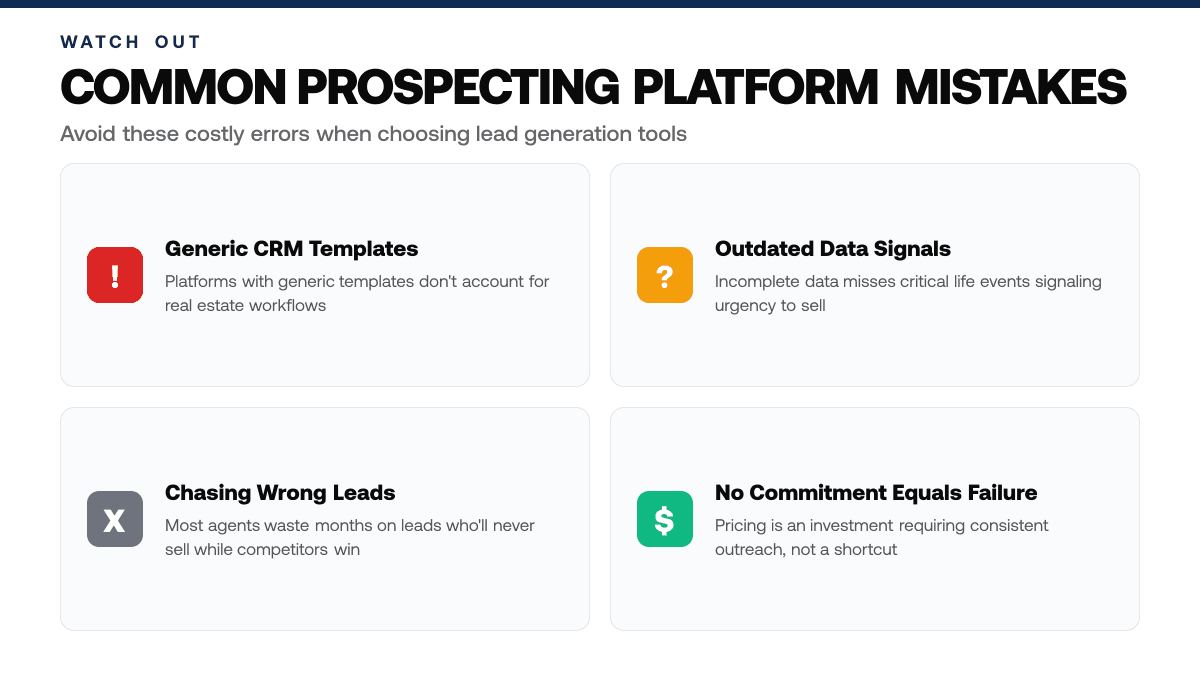
The real estate market rewards speed and precision. Agents and investors who reach motivated sellers early capture better terms, shorter timelines, and higher conversion rates. However, not all prospecting platforms are built the same; some offer generic CRM templates that don't account for the unique workflows of real estate professionals, while others rely on outdated or incomplete data signals that miss critical life events signaling urgency to sell.
This article breaks down BatchLeads pricing for 2026, compares the cost structure against realistic return on investment, and explains how to evaluate whether a prospecting platform's fee aligns with your deal flow and revenue goals. We'll also explore what separates platforms that deliver measurable results from those that simply consume your budget without moving the needle on deal volume. Most agents waste months chasing leads who'll never sell while the real motivated sellers slip to competitors undetected, Goliath Data monitors real-time life-event signals like foreclosure notices and tax delinquencies to surface homeowners most likely to sell before they hit the open market.
TL;DR
BatchLeads pricing scales with your prospecting volume, offering tiered plans so agents and investors pay only for the data and automation they use.
The platform combines motivated-seller lists, skip-tracing, and follow-up automation to reduce manual prospecting time and lower cost-per-deal.
Most users see ROI when they commit to consistent outreach, pricing is an investment in speed and scale, not a shortcut to deals without effort.
All 5 tools compared at a glance
Tool | Best for | Pricing | Key strength | Limitation vs #1 |
|---|---|---|---|---|
Real estate agents needing integrated CRM and skiptracing | Bundles CRM, skiptracing, and automated follow-up in one platform | |||
Skip Genie | Teams prioritizing behavioral data and equity filtering | Layers behavioral and property data for motivated-seller signals | Skiptracing only; lacks integrated CRM and automation workflows | |
xLeads | Agents seeking verified contact details with property data | Verified contact details paired with property characteristics | No CRM or automation; requires external workflow integration | |
PropStream | Investors needing deep property records and comps analysis | Comprehensive property records, tax data, and comparable sales | Lacks seller motivation signals; no CRM or outreach automation | |
BatchLeads | Teams building qualified lists with behavioral lead scoring | Behavioral signals and code violations surface motivated sellers | Requires external CRM; lacks integrated calling and texting |
Pricing as of June 2026; verify current rates on each provider's site.
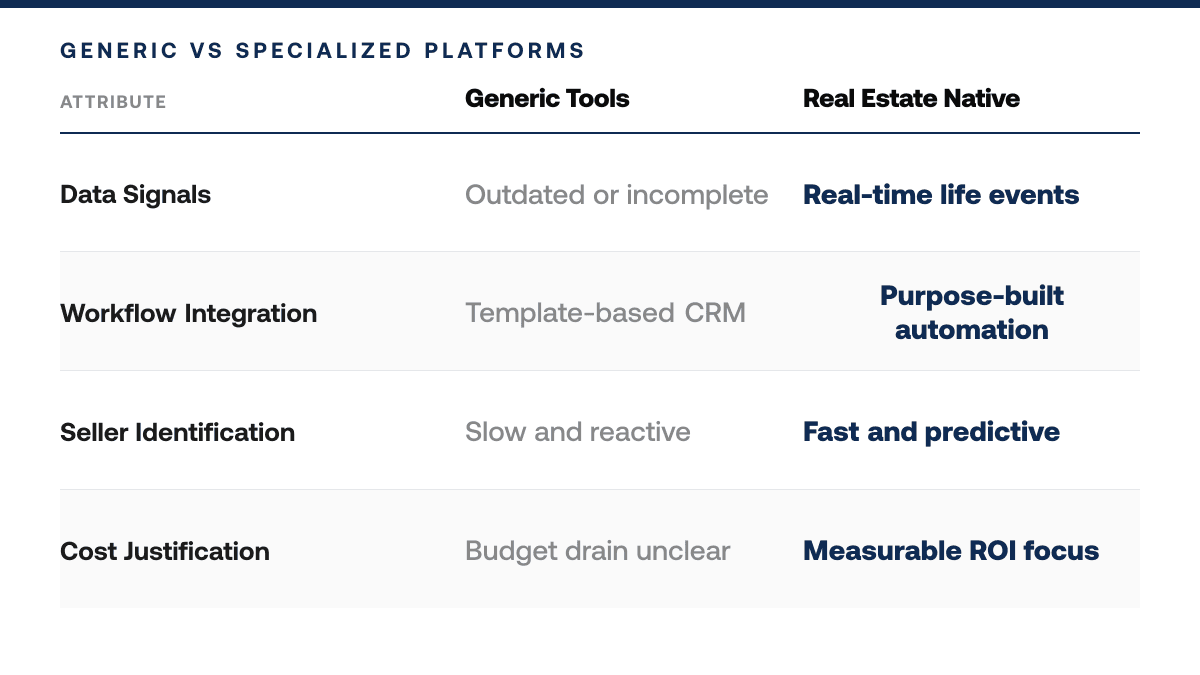
1. Goliath Data: CRM + Skiptracing + Automated Follow-Up for Real Estate Prospecting
Goliath Data is a real estate prospecting platform built for agents and investors who need to find motivated sellers, build qualified lists, and automate outreach without hiring a team. It combines a CRM, AI-powered skiptracing, and integrated calling, texting, and email into one workspace, eliminating the friction of juggling separate tools.
Here's the gap most tools miss: most CRMs force you to build lists manually or pay separately for data. Goliath Data bundles list building with AI-powered contact enrichment (skiptracing), so you pull a list of property owners, automatically fill in phone numbers and emails, and start dialing or texting the same day, no third-party integrations required.
The platform includes contact management, calling and texting, task tracking, deal tracking, activity logging, calendar sync, and automated drip campaigns powered by an AI assistant called David. The CRM + Data tier adds list building, AI-skiptracing credits, ad platform integrations, and the ability to run niche list campaigns (probates, preforeclosures, tax delinquencies available as add-ons).
The CRM + Data plan starts at $299/mo and includes 2,500 skiptracing credits per month, list-building tools, and automated follow-up workflows. For teams running full-service prospecting (list pulling, multi-channel outreach, lead qualification, and ongoing follow-up), the Done-For-You tier is $2,999/mo. Annual billing saves two months.
2. Skip Genie
Skip Genie is a skip-tracing and data platform designed to help real estate professionals locate and contact property owners, particularly those with motivated-seller indicators. Built for agents and investors who need rapid access to verified contact information, it focuses on reducing the manual legwork of prospect identification and enabling faster outreach at scale.
Here's the gap most skip-tracing tools miss: they deliver contact lists without context. Skip Genie layers behavioral and property data, such as ownership tenure, lien status, and equity position, so you can prioritize outreach toward sellers most likely to transact. This filtering reduces wasted dials and focuses your follow-up budget on high-probability leads.
The platform provides batch skip-tracing (upload a list of names or addresses and receive phone, email, and mailing details), property-level filters to segment by condition or ownership timeline, and integration with CRM systems to streamline lead import. Users can also append data to existing contacts, refreshing stale prospect records without starting from scratch.
Skip Genie operates on an enterprise pricing model, with costs determined by monthly search volume and data append requirements. Prospecting teams typically negotiate custom quotes based on the number of records processed and the depth of data layers needed, making it suitable for agents and investment groups running consistent, high-volume campaigns.
3. xLeads
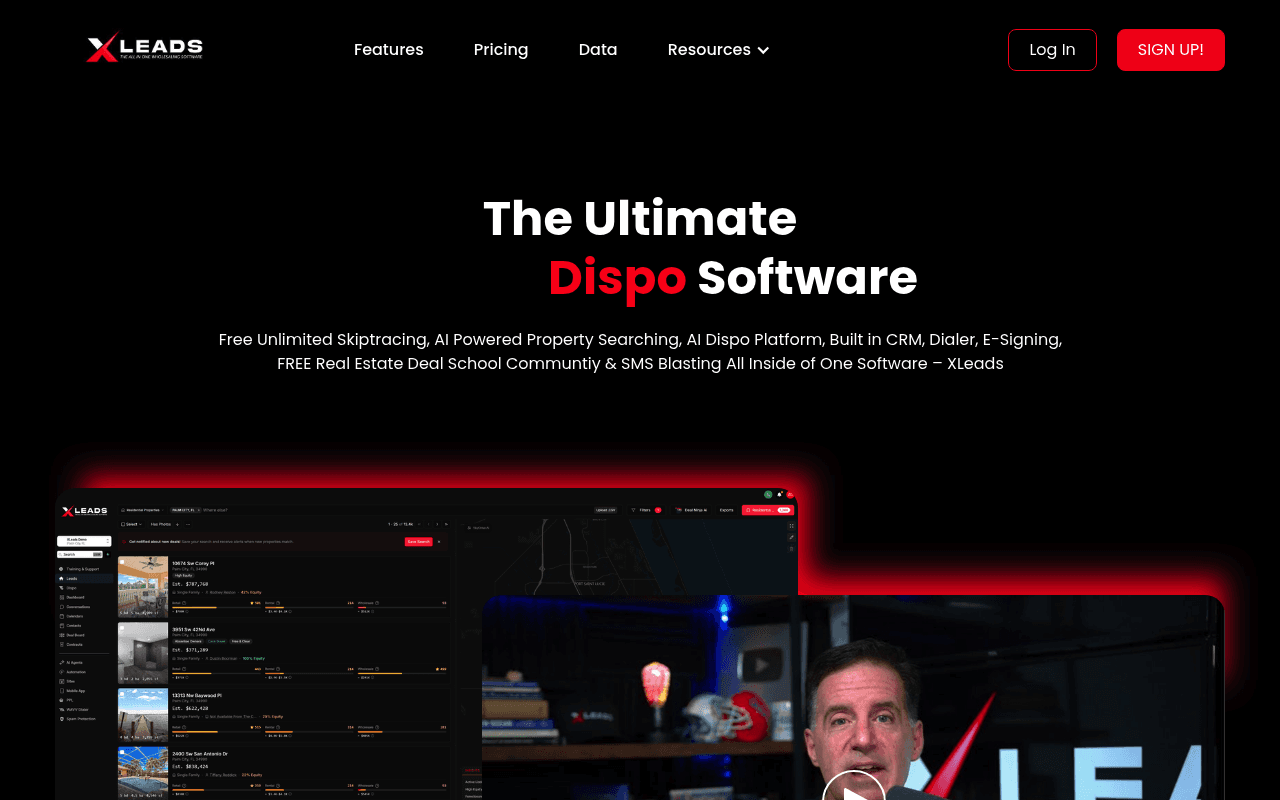
xLeads is a real estate prospecting platform designed to help agents and investors identify off-market opportunities and motivated sellers. Built for professionals who need to scale their lead generation without relying solely on traditional MLS channels, xLeads combines data aggregation with direct contact information to support faster deal sourcing.
Here's the gap most tools miss: xLeads focuses on delivering verified contact details alongside property data, enabling agents to reach out immediately rather than spending time cross-referencing sources. The platform prioritizes actionable lead lists over raw data volume, so users can focus prospecting efforts on the most relevant opportunities in their target markets.
The platform offers property search filters, bulk lead export, and direct phone and email access to property owners. Users can build custom lists based on property characteristics, ownership tenure, and equity position, then download and integrate results into their CRM or outreach workflow. The interface supports multiple search criteria to narrow results before exporting.
xLeads operates on an enterprise pricing model with custom quotes based on usage volume and feature set. Interested users are directed to contact the sales team for a tailored proposal, making it best suited for teams or investors with defined prospecting budgets and specific data access needs.
4. PropStream
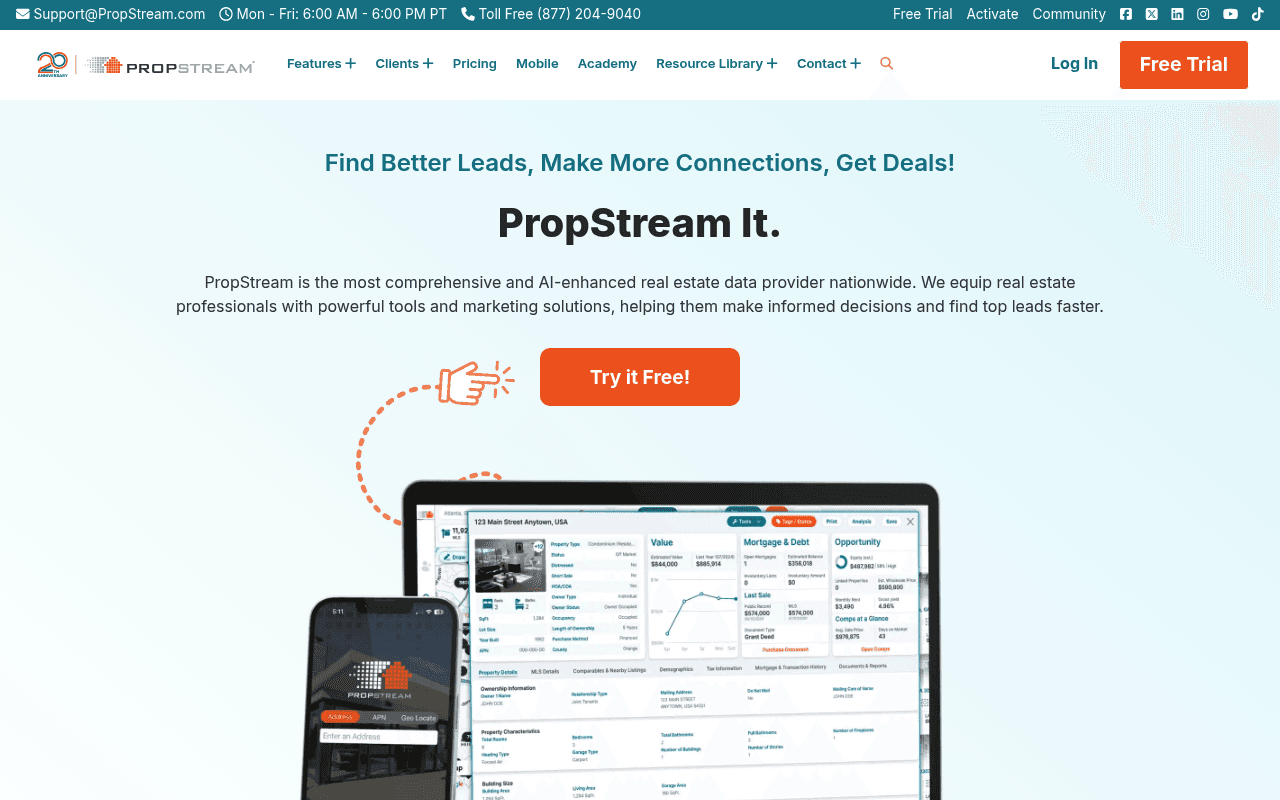
PropStream is a real estate data and analytics platform designed for agents and investors who need fast access to property records, ownership details, and market insights. It aggregates public records and property information to help users identify investment opportunities and build targeted prospect lists without manual research.
Here's the gap most tools miss: PropStream focuses on property-level data depth rather than seller motivation signals. While it excels at historical records and comps, it doesn't layer behavioral indicators, like mail responsiveness, equity position changes, or pre-foreclosure patterns, that reveal which owners are actually ready to sell. Agents hunting motivated sellers need more than property facts; they need seller intent signals.
PropStream delivers comprehensive property records, tax and deed information, ownership history, comparable sales data, and market trend reports. Users can filter by property type, price range, and location to build lists for outreach. The platform integrates with common CRM and email platforms, allowing agents to export data and sync prospect information into their existing workflows.
PropStream operates on an enterprise pricing model with custom quotes based on usage, data volume, and feature access. There is no standardized per-user monthly rate; pricing is negotiated directly with the vendor. This approach suits larger teams or brokerage deployments but may require budget approval and longer sales cycles for individual agents or small investment groups.
5. BatchLeads

BatchLeads is a lead-generation and prospecting platform designed for real estate agents and investors who need to identify motivated sellers and build qualified lists at scale. The platform aggregates property data, ownership records, and market signals to help users find off-market opportunities and distressed properties without relying solely on traditional MLS searches or costly paid advertising campaigns.
Here's the gap most tools miss: BatchLeads combines property data with behavioral signals, like recent tax assessments, code violations, and ownership changes, to surface sellers most likely to be motivated to transact. Rather than generic lead lists, the platform prioritizes actionable prospects based on life events and property conditions that typically precede a sale or investment opportunity.
The platform delivers batch list building with filters for property type, condition, ownership tenure, and financial indicators. Users can export qualified leads directly into CRM systems, automate follow-up campaigns via email and SMS, and track engagement metrics to measure which outreach efforts convert. The tool also includes skip-tracing to append phone and email contact information to property records.
BatchLeads pricing is structured on an enterprise or custom-quote basis, with costs tied to list size, data refresh frequency, and automation features included. Organizations looking to scale prospecting operations should expect pricing to reflect usage volume and integration scope rather than a fixed per-user rate.
Frequently Asked Questions
How do real estate agents calculate ROI on lead-generation tools?
ROI is calculated by dividing net profit (revenue from closed deals minus tool cost) by the tool cost, then multiplying by 100 to get a percentage. For agents, this means tracking how many leads convert to contracts, the average deal value, and your commission rate against monthly or annual subscription fees. Because deal cycles vary, some close within weeks, others take months, many agents measure ROI over a full quarter or year rather than monthly. The faster your conversion rate and the higher your average deal size, the quicker a platform pays for itself.[2]
What data points matter most when evaluating lead quality?
Lead quality hinges on accuracy of contact information, recency of the triggering event (foreclosure notice, tax delinquency, job change), and alignment with your target market. Agents should verify that a platform updates its data regularly and includes owner phone numbers and email addresses, not just property addresses. Demographic and financial signals, such as income level and property equity, also help you prioritize which leads to pursue first. Platforms that monitor real-time life events tend to surface higher-intent sellers before they list publicly.[1]
Can you use BatchLeads data for both wholesale and agent prospecting?
Yes. BatchLeads serves both wholesalers hunting off-market deals and agents seeking motivated sellers. The platform's filtering tools let you segment by property condition, owner equity, time on market, and other criteria, so you can tailor searches to your business model. Wholesalers typically focus on distressed properties and cash-out scenarios, while agents may prioritize homeowners with life-event signals. Your subscription tier and add-ons determine which data fields and lead volumes you access, so choose based on your specific prospecting strategy.
What tools help agents automate follow-up without losing personal touch?
Platforms that combine CRM, automated texting, email sequences, and AI-assisted calling allow agents to scale outreach while staying responsive. AI assistants can handle initial contact, qualification, and appointment scheduling, freeing you to focus on relationship-building and closing. Goliath Data monitors real-time life-event signals, foreclosure notices, tax delinquencies, job changes, to surface homeowners most likely to sell, and its AI assistant David handles inbound calls, outbound follow-ups, texts, emails, and appointment scheduling automatically, so you never miss a lead. The platform also includes a full CRM and pipeline management to keep your workflow organized.
Sources
Disclaimer: This article is provided by Goliath Data for general informational purposes only and does not constitute legal, tax, financial, or investment advice. Statutory references, redemption timelines, interest rates, and procedural requirements vary by jurisdiction and change over time. Always verify current information with the relevant county or municipal office and consult a licensed attorney, CPA, or financial advisor before making any investment, acquisition, or legal decision based on this content.
