
Best Real Estate CRM Software Compared 12 Top Platforms
Best Real Estate CRM Software Compared 12 Top Platforms. A practical guide to what works, what to skip, and how to get started.

Austin Beveridge
Tennessee
, Goliath Teammate
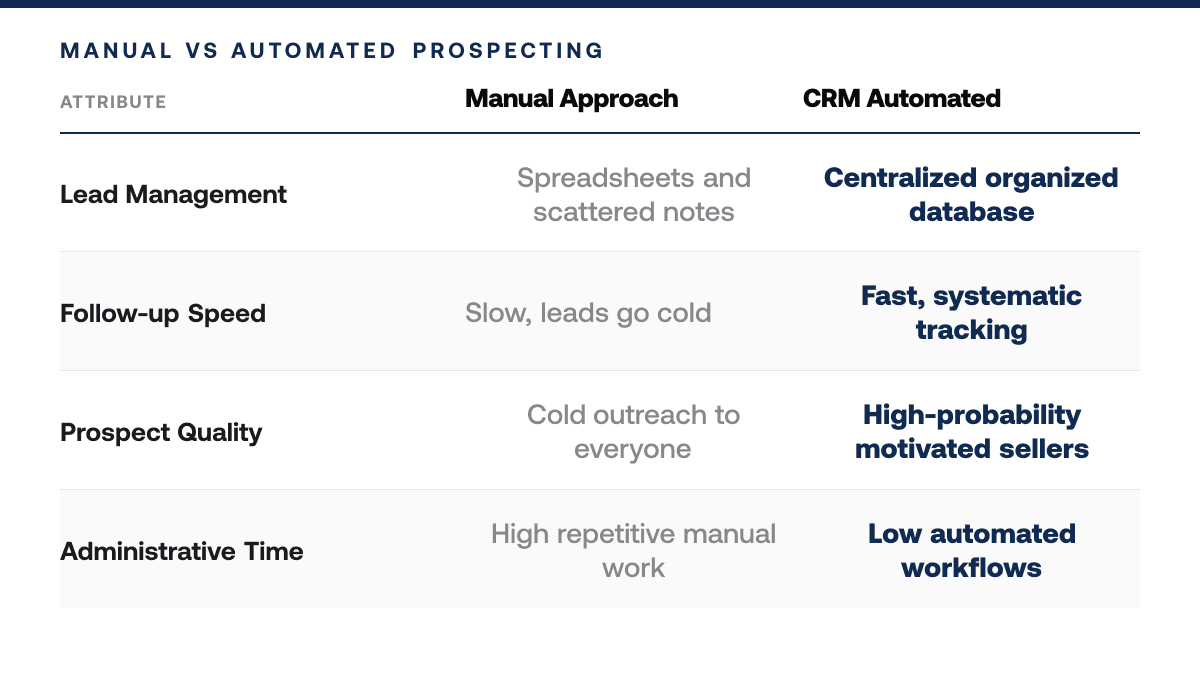
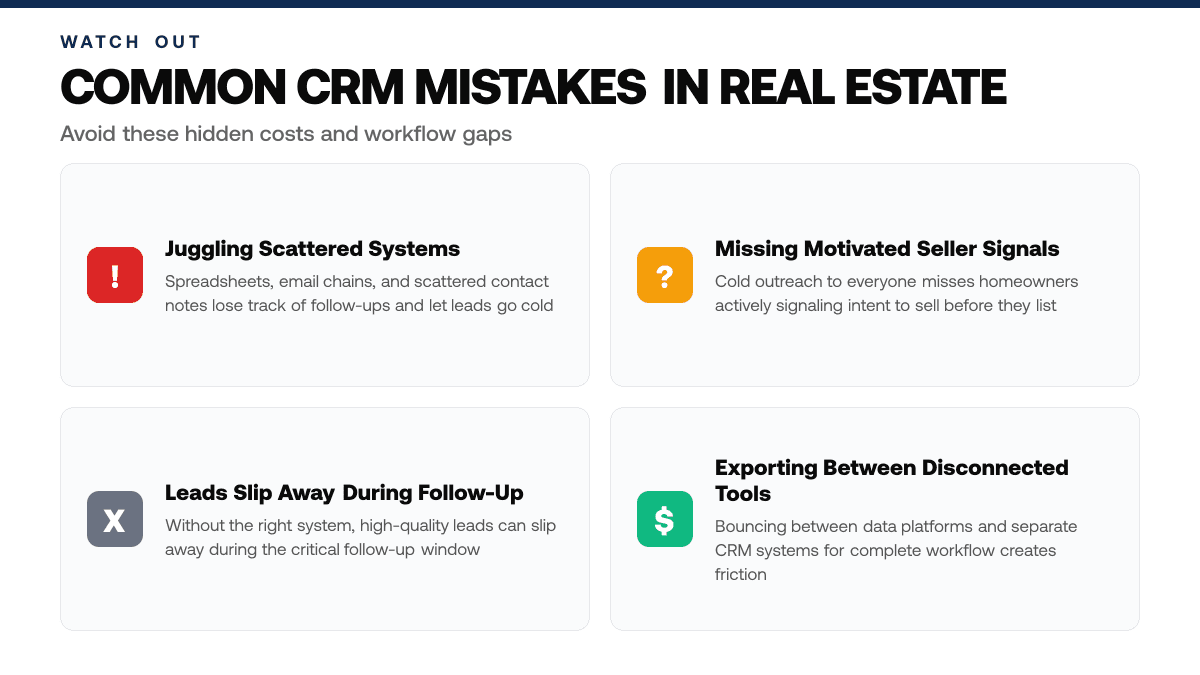
Most real estate agents and investors spend their days juggling spreadsheets, email chains, and scattered contact notes, losing track of follow-ups and letting leads go cold. A CRM built for real estate can change that workflow entirely, automating prospecting tasks and keeping every lead organized in one place. The difference between agents who close deals consistently and those who struggle often comes down to how systematically they manage their pipeline.
The real estate market moves fast, and motivated sellers, whether facing life changes, financial pressure, or timing constraints, often reach out to agents who are organized and responsive. A purpose-built CRM helps you identify these opportunities earlier, track interactions across multiple channels, and ensure no prospect falls through the cracks. Without the right system, even high-quality leads can slip away during the critical follow-up window.[1]
This article compares twelve leading real estate CRM platforms, breaking down their core features, pricing, and best use cases so you can find the tool that fits your prospecting style and deal volume. We'll examine what separates platforms built specifically for agents and investors from generic CRM templates, and show you how to evaluate which system will help you close more deals without scaling your marketing spend. Most real estate agents spend their prospecting energy on cold outreach to everyone, missing the 2% of homeowners actively signaling intent to sell, Goliath Data monitors real-time life events like foreclosures and job changes to surface motivated sellers before they list, so agents prospect only the high-probability opportunities.
TL;DR
A real estate CRM centralizes prospect data, automates follow-up workflows, and tracks deal pipelines so agents spend less time on manual admin and more time closing.
The best platforms for agents and investors combine lead capture, contact management, and task automation to reduce prospecting friction and shorten sales cycles.
Most agents underestimate how much time a CRM saves on repetitive outreach, the payoff compounds when you're juggling multiple deals and motivated-seller lists simultaneously.
All 5 tools compared at a glance
Tool | Best for | Pricing | Key strength | Limitation vs #1 |
|---|---|---|---|---|
Agents finding motivated sellers without separate tools | AI skip-tracing, list building, and drip campaigns in one platform | |||
PropertyRadar | Investors needing rapid property records and ownership changes | Raw data accuracy and county-level property record aggregation | Requires exporting lists to separate CRM for contact management | |
REsimpli | Teams prioritizing lead scoring and behavioral engagement data | Lead scoring based on engagement and behavioral prioritization | Treats all leads the same without integrated lead sourcing | |
PropStream | Investors identifying distressed properties and off-market deals | Property intelligence, skip-tracing, and contact data combined | Requires bouncing between data and CRM for complete workflow | |
BatchLeads | Wholesalers automating prospecting from list to initial contact | Batch dialing and automated outreach from property records | Focuses on prospecting automation, not integrated CRM follow-up |
Pricing as of June 2026; verify current rates on each provider's site.
1. Goliath Data: AI-Powered CRM and Motivated Seller Lists for Real Estate Agents
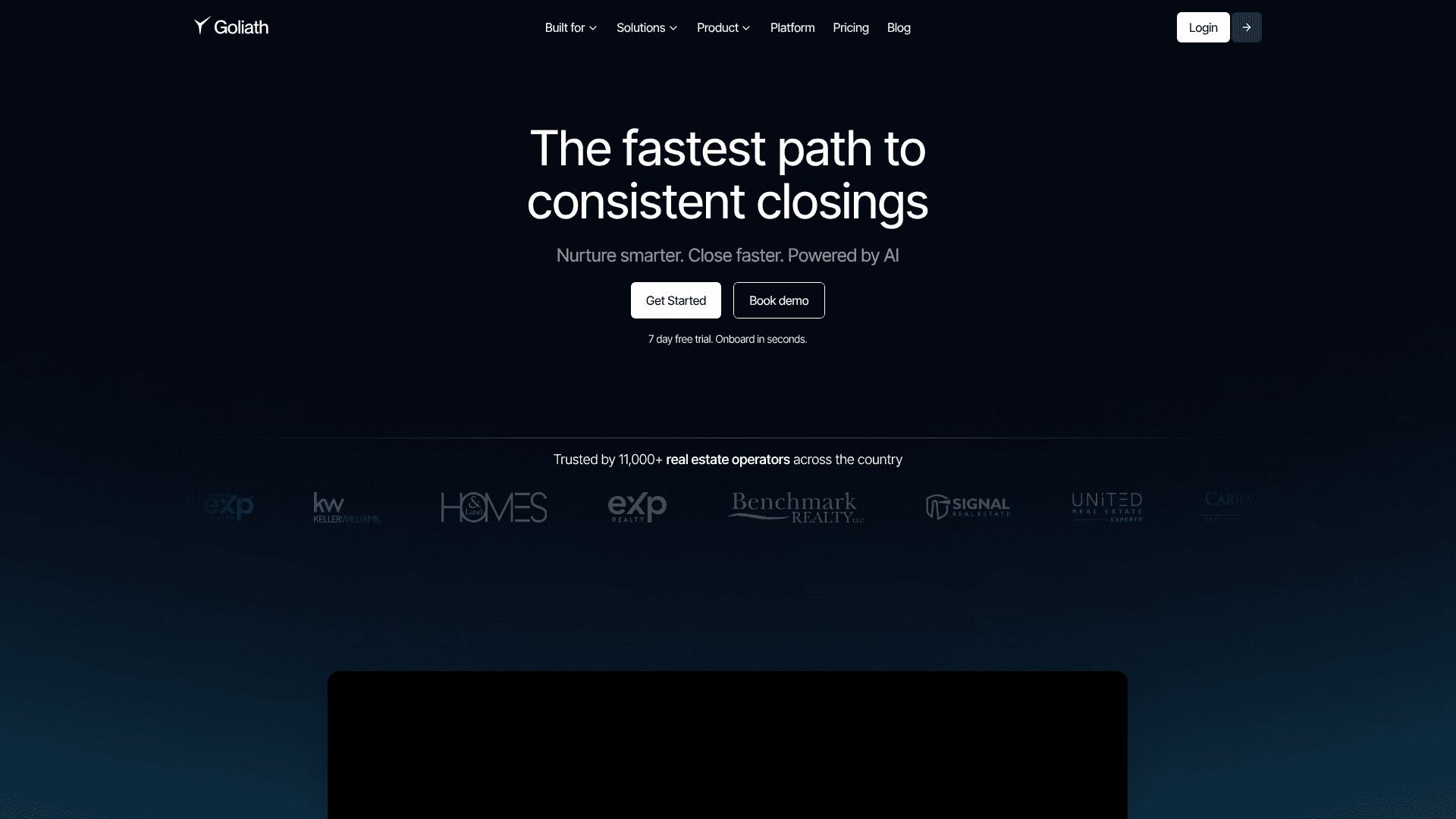
Goliath Data is a real estate CRM and lead-sourcing platform built for agents and investors who need to find motivated sellers without hiring a full prospecting team. The platform combines contact management, calling, texting, and deal tracking with AI-powered list building and automated follow-up, enabling agents to scale outreach while staying organized.
Here's the gap most tools miss: most CRMs force you to buy leads separately, and most lead sources don't integrate with your workflow. Goliath Data merges both, AI-powered skip-tracing, list building, and drip campaigns live inside the same platform where you track calls, texts, and deals. That eliminates the friction of juggling multiple subscriptions and manual data entry.
The platform includes contact organization, calling and texting, task and deal tracking, activity logging, calendar management, AI-assisted lead qualification (via its David AI assistant), list building, automated drip campaigns, and integrations with major ad platforms. Higher tiers unlock niche list access (probates, preforeclosures, tax delinquencies) and done-for-you prospecting services that handle calling, texting, email, and direct mail on your behalf.
The CRM starts at $99/mo for core contact and communication tools. The most popular tier, CRM + Data, is $299/mo and adds list building, AI skip-tracing credits, ad platform integrations, and automated campaigns. Annual billing saves two months of fees, and application-only programs like Blackbook (zero-fee exclusive listing appointments, pay on close) are available for qualified agents.
2. PropertyRadar
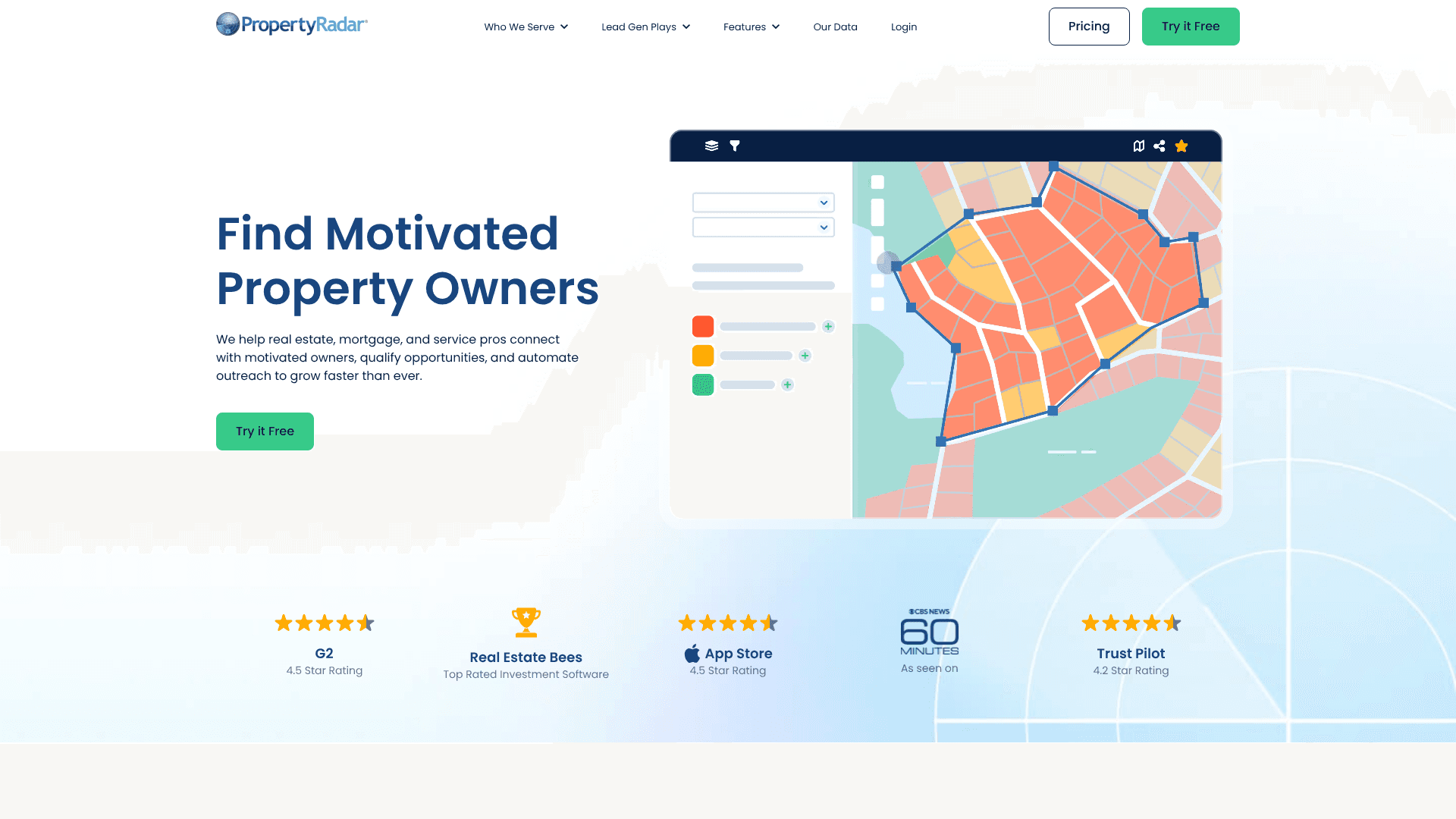
PropertyRadar is a real estate data and analytics platform designed for agents and investors who need rapid access to property records, ownership changes, and market intelligence. It aggregates public records across multiple counties and states, surfacing motivated-seller signals without relying on traditional marketing spend.
Here's the gap most tools miss: PropertyRadar prioritizes raw data accuracy and speed over generic CRM workflows. Rather than forcing you into a contact-management template, it lets you query properties by ownership tenure, deed type, and equity position, then export those lists into your existing prospecting engine or follow-up system.
The platform delivers county-level property records, ownership history, deed transactions, and equity estimates. Users can filter by ownership duration, recent transfers, and property characteristics to identify off-market opportunities and pre-foreclosure leads. Batch export and API access enable integration with email, SMS, and dialer workflows.
PropertyRadar pricing is structured on an enterprise model with custom quotes based on data volume, user count, and integration requirements. Contact the vendor directly for a tailored estimate aligned to your prospecting volume and team size.
3. REsimpli
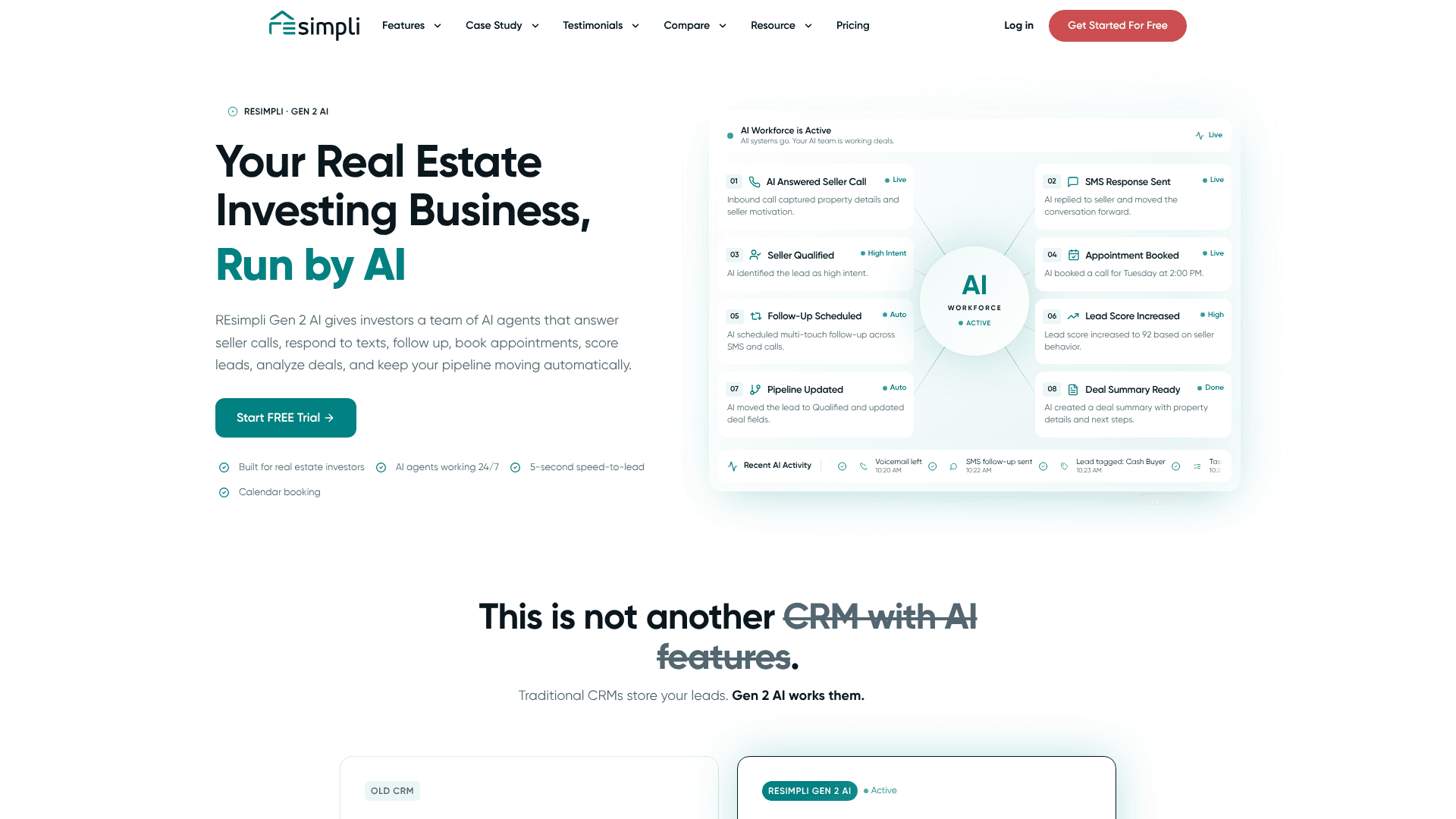
REsimpli is a real estate CRM and lead management platform designed specifically for agents and investors who want to identify and pursue off-market opportunities and motivated sellers. The platform combines contact management, lead tracking, and automated follow-up workflows to help users stay organized and consistent in their outreach without manual intervention.
Here's the gap most CRMs miss: they treat all leads the same. REsimpli layers behavioral data and engagement scoring on top of your contact list, so you can prioritize which prospects are ready to sell now versus those still months away. This focus on lead qualification means your prospecting effort concentrates on the highest-probability deals rather than spreading thin across a large, unqualified pipeline.
The platform offers automated email and SMS follow-up sequences, customizable contact fields and tags for segmentation, lead scoring based on engagement, and integration with popular real estate data sources. Users can also build and manage buyer and seller lists, track deal progress through pipeline stages, and generate reports on activity and conversion metrics.
REsimpli operates on an enterprise pricing model with custom quotes based on your team size, feature requirements, and data volume. Contact their sales team directly for a tailored proposal rather than a fixed monthly tier.
4. PropStream
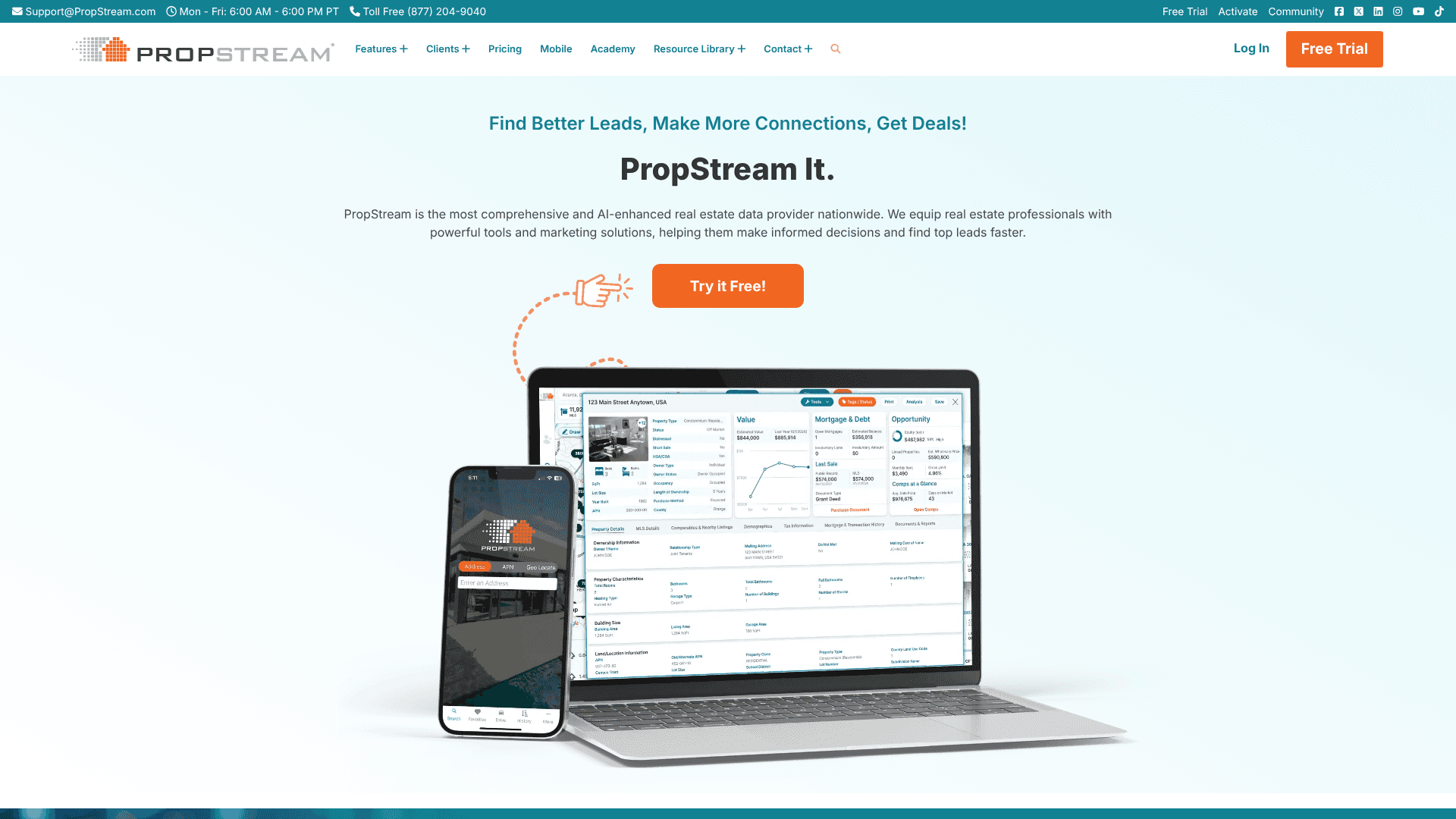
PropStream is a property data and lead generation platform designed for real estate investors and agents who need to identify off-market opportunities and distressed properties. It aggregates public records, tax data, and ownership information to help users build targeted prospect lists and uncover motivated sellers without relying solely on traditional MLS channels.
Here's the gap most tools miss: PropStream combines property-level intelligence with skip-tracing and contact data in a single workflow. Rather than bouncing between a CRM for follow-up and a separate data tool for lead sourcing, agents can research a property, pull the owner's contact details, and begin outreach without switching platforms, reducing friction in the prospecting cycle.
The platform delivers property search filters by condition, equity, ownership type, and tax delinquency status. Users can build lists based on foreclosure filings, code violations, or probate records. Bulk export, automated skip-tracing to find phone numbers and emails, and integration with email and SMS tools enable rapid outreach at scale. Mobile access lets agents research properties while in the field.
PropStream operates on an enterprise pricing model with custom quotes based on feature set and data volume. Prospective users are encouraged to request a demo to discuss pricing aligned with their investment strategy and prospecting volume.
5. BatchLeads

BatchLeads is a prospecting and lead generation platform designed for real estate agents and wholesalers who need to identify motivated sellers and distressed properties at scale. The platform combines public records data with skip-tracing and automated outreach tools, enabling users to build targeted lists without relying solely on paid advertising or traditional MLS searches.
Here's the gap most tools miss: BatchLeads focuses on automating the entire prospecting workflow, from list building through initial contact, rather than just storing leads in a CRM. Users can filter properties by equity, time-on-market, foreclosure status, and other distress signals, then instantly export or dial into a pre-built calling interface. This reduces the friction between finding a prospect and making first contact.
The platform offers skip-tracing to append phone numbers and email addresses to property records, batch dialing for rapid outreach, and integration with popular CRM systems for follow-up. Users can also access bulk property data exports and run multiple searches simultaneously to identify several opportunities in a single session.
BatchLeads pricing is structured on a custom or enterprise basis, with costs tied to the volume of leads accessed, skip-traces performed, and dialing minutes used. Contact the vendor directly for a quote tailored to your prospecting volume and team size.
Frequently Asked Questions
How can real estate agents find motivated sellers without spending more on marketing?
Motivated sellers often signal their intent through life events and financial circumstances before listing publicly. By monitoring signals such as tax delinquencies, job changes, and family transitions, agents can identify and contact homeowners early in their decision-making process. This approach reduces reliance on paid advertising and allows agents to build relationships with sellers before they engage competitors, making prospecting more efficient and cost-effective.[1]
What features should a real estate CRM have to automate follow-up and close more deals?
An effective CRM for real estate should automate repetitive tasks like call handling, email sequences, text messaging, and appointment scheduling so agents focus on closing rather than administrative work. Pipeline management, lead scoring, and integrated contact databases help agents prioritize high-value prospects and track deal progress at a glance. Automation reduces response time and ensures no lead falls through the cracks, directly improving conversion rates and deal velocity.[3]
Can CRM software help real estate investors identify off-market deals?
Yes. CRM platforms paired with data sources that surface homeowners facing financial hardship or life changes can reveal off-market opportunities before they reach the MLS. Investors who contact these homeowners early often negotiate better terms and avoid bidding wars. The key is combining lead identification with automated follow-up so investors can reach multiple prospects quickly and maintain consistent contact until a deal materializes.[2]
Where can real estate agents get real-time lead data and automated follow-up tools?
Goliath Data combines real-time life-event signals, foreclosure notices, tax delinquencies, job changes, and family transitions, to surface homeowners most likely to sell before they list publicly. Its AI assistant David automates inbound calls, outbound follow-ups, texts, emails, and appointment scheduling, so agents never miss a lead. The platform includes a full CRM and pipeline management, enabling agents to identify motivated sellers and close deals faster without increasing marketing spend.
Sources
Disclaimer: This article is provided by Goliath Data for general informational purposes only and does not constitute legal, tax, financial, or investment advice. Statutory references, redemption timelines, interest rates, and procedural requirements vary by jurisdiction and change over time. Always verify current information with the relevant county or municipal office and consult a licensed attorney, CPA, or financial advisor before making any investment, acquisition, or legal decision based on this content.
