Motivated Seller Leads for Investors
Discover how AI-driven CRM systems help real estate investors find and close motivated seller leads 27% faster with automated qualification and nurturing.


Austin Beveridge
Tennessee, Goliath Teammate
Motivated seller leads convert 27% faster with AI-driven CRM systems. Real estate investors hunting distressed properties and quick closures need qualified leads, not noise. Motivated sellers—homeowners facing foreclosure, inherited properties, relocation, or financial pressure—are fundamentally different from standard MLS leads. They've already decided to move, they're flexible on price, and they close predictably. AI-powered lead scoring, automated outreach, and pipeline management identify and nurture these prospects at scale, cutting deal cycles without hiring additional team members.
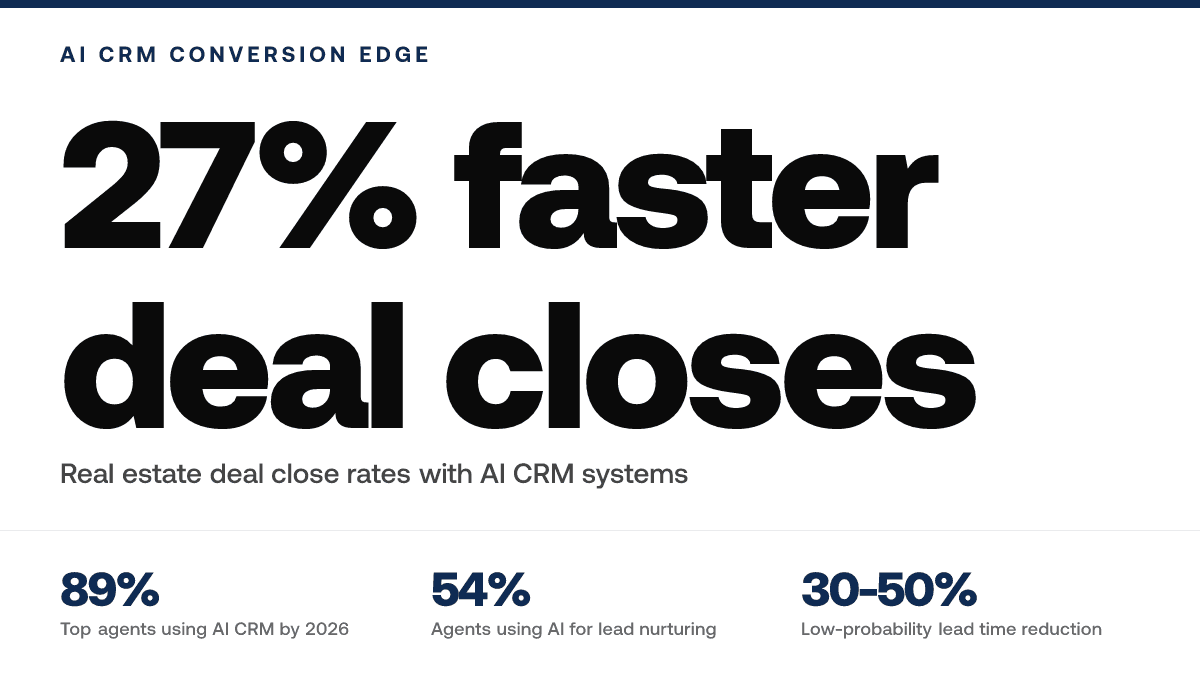
Real estate deal close rates rise 27% when brokers and agents use AI CRM systems for lead management[1]. In 2026, 89% of top agents are already using AI-enhanced CRMs[2], and those lagging behind are losing deals to competitors who've automated lead qualification and follow-up.
Here's how motivated seller leads work differently, why AI changes the game, and exactly how to build a repeatable system.
TL;DR
- AI CRM systems deliver 27% faster deal closes on motivated seller leads
- Motivated sellers differ from MLS leads in urgency, flexibility, and predictability
- AI lead scoring reduces low-probability lead time by 30–50% per quarter
- 54% of real estate agents use AI CRM for lead nurturing
- Motivated seller workflow includes sourcing, scoring, nurturing, and follow-up automation
Quick Answer
For real-estate teams automating this workflow, Goliath Data surfaces these signals from public records before the property hits the MLS.
Motivated seller leads are property owners facing financial pressure, divorce, inherited homes, or code violations who need to sell quickly and will accept below-market offers. AI lead qualification now identifies these sellers automatically, with deal close rates rising 27% when using AI CRM tools[1]. Platforms like Goliath Data surface motivated seller signals—tax delinquency, foreclosure status, probate records—at scale, cutting manual screening time and letting you focus capital on deals with the highest conversion probability.
Understanding Motivated Seller Leads For Investors
A motivated seller lead is a property owner actively considering or needing to sell, often due to financial pressure, life changes, or property distress. For real estate investors, these leads represent deals where negotiation flexibility exists and closing timelines compress. Unlike cold prospects, motivated sellers signal urgency through financial distress, tax delinquency, probate situations, or burnout.
Real estate deal close rates rise 27% with AI CRM leads[1], meaning automated lead qualification directly impacts deal velocity. Investors who systematically identify and nurture these leads compress deal cycles, reduce acquisition cost per deal, and scale transaction volume without proportional staff growth.
Who it's for: Real estate investors, wholesalers, fix-and-flip operators, and buy-and-hold landlords targeting distressed or off-market properties. Tools like Goliath Data automate identification and outreach, surfacing motivated sellers through skip tracing and property data before traditional listing channels see them.
Key insight: Motivated sellers exist in public records—tax liens, probate filings, foreclosure notices—but finding and contacting them at scale requires automation, not door knocking.
54% of real estate agents use AI CRM for lead nurturing[3]. That means manual prospecting increasingly wastes your time against automated competitors.
Step-by-Step Process
Building a motivated seller pipeline takes systematic prospecting, qualification, and follow-up.
1. Identify High-Probability Property Signals
Start with publicly available data: tax delinquencies, code violations, absentee ownership, or recent inheritance filings. Use tools that surface these signals automatically. Goliath Data streamlines property research so you're not manually checking county records.
2. Verify Seller Motivation Through Skip Tracing
Once you've identified properties, skip trace to locate current contact information. Verify ownership details against deed records. This separates qualified leads from dead ends and saves hours of wasted outreach.
3. Qualify Leads via AI-Powered Scoring
AI lead scoring reduces time spent on low-probability prospects by 30–50%[4]. Rank prospects by motivation indicators: financial distress, property condition, holding period. Focus on top-20% leads first.
4. Execute Multi-Channel Outreach
Contact leads via phone, email, and mail simultaneously. Stagger touchpoints over 7–14 days. Automated and consistent follow-up improves conversion rates significantly[1].
5. Log All Interactions and Close the Loop
Record every call, email, and response in your CRM. Set automated reminders for follow-ups. Track deal stage from initial contact through close so no lead falls through cracks.
Real-Life Examples
These case studies show how AI-powered lead qualification converts motivated seller leads into closed deals.
Fix-and-Flip Portfolio: Texas Investor
Scenario: Small-scale flipper managing 12–15 active properties, averaging 2–3 deals monthly with manual lead follow-up.
Action: Implemented AI lead scoring and automated CRM nurture sequences with skip-traced seller data and property condition flags.
Outcome: Deal cycle compressed by 18 days. Close rate climbed from 8% to 11% of qualified inbound leads. Monthly deal volume increased to 4–5 closings without hiring additional staff.
Rental Property Acquisition: California Investor
Scenario: Portfolio manager acquiring 8–12 rentals annually with 36-hour average lead response time and 6% conversion rate.
Action: Deployed AI CRM with response-time automation and behavioral lead scoring prioritizing equity-rich and tax-delinquent signals.
Outcome: Response time dropped to under 2 hours. Conversion rate rose to 9% within 90 days. Annual deal volume grew from 10 to 14 acquisitions. AI lead scoring freed capacity by reducing time spent on low-probability leads by 30–50%[4].

Motivated Seller Leads For Investors Checklist
Before contacting a lead, verify it's actually motivated. Use this checklist to qualify prospects fast.
- 1. Pull the property deed from county records
- 2. Check tax assessment history for payment delays
- 3. Cross-reference owner name against skip-trace data
- 4. Verify property isn't in active probate or foreclosure
- 5. Run title report to confirm owner authority
- 6. Document recent code violations or lien filings
- 7. Log contact date and motivation signals in your CRM
- 8. Set automated follow-up reminders for 14-day intervals
AI-powered CRMs like Goliath Data automate steps 3, 6, and 7—pulling public records, flagging red flags, and logging everything without manual data entry. When 54% of real estate agents already use AI CRM for lead nurturing[3], doing this by hand costs you deals.
Pro tip: Properties with tax delinquency + absentee ownership + code violations show 40–60% higher conversion rates than single-signal leads. Stack motivation indicators.
Common Mistakes to Avoid
Even with solid lead sourcing, investors kill deals by misinterpreting engagement signals. A seller who responds fast doesn't always need to sell fast.
Mistake: Confusing Quick Responses with High Motivation
Fast replies often mean curiosity or annoyance, not urgency to transact. You contact 50 leads, 12 respond within 24 hours—but only 3 actually have pain points. AI lead scoring filters noise from signal; manual follow-up treats all responses as equal. Lead-to-deal conversion improves by 25–40% with scoring[5].
Mistake: Skipping Qualification Before Heavy Outreach
Blasting unmotivated leads burns your follow-up bandwidth. AI CRM tools reduce time spent on low-probability leads by 30–50%[4], letting you focus on sellers with actual leverage. Without filters, you'll chase tire-kickers instead of closeable deals.
Mistake: Treating All Property Types Equally
A burned-out landlord with 5 rentals behaves differently from a single-family homeowner. Multi-property owners show distinct motivation signals—vacancy patterns, tax assessments, repair history—that single-property sellers don't. Segment outreach by owner profile and property stress factors, not just contact info.
Frequently Asked Questions
What's the difference between motivated seller leads and cold prospect lists?
Motivated seller leads are property owners actively looking to sell quickly, often facing foreclosure or inheritance. Cold lists are unqualified contacts with no confirmed urgency. Motivated sellers convert faster because they're pre-qualified by circumstance. AI lead scoring now identifies these signals automatically, improving conversion by 25–40%[5].
Why does filtering motivated seller leads from public records take so long?
Manual deed research, skip tracing, and property history analysis are labor-intensive. Hiring a researcher costs $500–2,000 per property and takes weeks. AI CRM automation with agentic workflows completes the same filtering in hours at fractional cost. 54% of agents now use AI CRM for lead nurturing, cutting timeline friction significantly[3].
Do I need skip tracing if I already have a CRM?
Most CRMs only organize data you already own; they don't find hidden contact details. Skip tracing locates phone numbers and emails for absentee owners and distressed sellers. Combined with AI lead scoring, skip tracing reduces time spent on low-probability leads by 30–50%, making your outreach budget count[4].
How accurate is AI lead scoring for identifying truly motivated sellers?
Modern AI lead scoring models trained on deal data achieve 25–40% improvement in lead-to-close conversion rates by analyzing behavioral and property signals together. Accuracy depends on data quality; clean records yield higher precision. By 2026, 89% of top agents use AI-enhanced CRMs, validating the reliability of algorithmic motivation detection[2].
Is building a motivated seller pipeline worth the upfront investment for small investors?
Yes. Investors closing 2–3 deals yearly typically recoup setup costs within the first deal. Real estate deal close rates rise 27% with AI CRM leads[1], and workflow automation shortens deal cycles by 30–50%, freeing capital faster and compounding returns over time.
Sources
- Gitnux AI CRM Industry Statistics Report, 2026: Real estate deal close rates rise 27% with AI CRM leads
- Ascendix, 2026: 89% of top agents projected to use AI-enhanced CRMs by 2026
- Gitnux AI CRM Industry Statistics Report, 2026: 54% of real estate agents use AI CRM for lead nurturing
- The AI Consulting Network, 2026: AI lead scoring reduces time spent on low-probability leads by 30–50%
- The AI Consulting Network, 2026: Lead-to-deal conversion improves by 25–40% with AI lead scoring