
Build a Real Estate Inbound Call System: ROI Guide (2026)
Stop losing inbound leads to slow response times. Cut your sales cycle with AI sales automation that qualifies and routes calls in real time—proven ROI metrics


Austin Beveridge
Tennessee
, Goliath Teammate
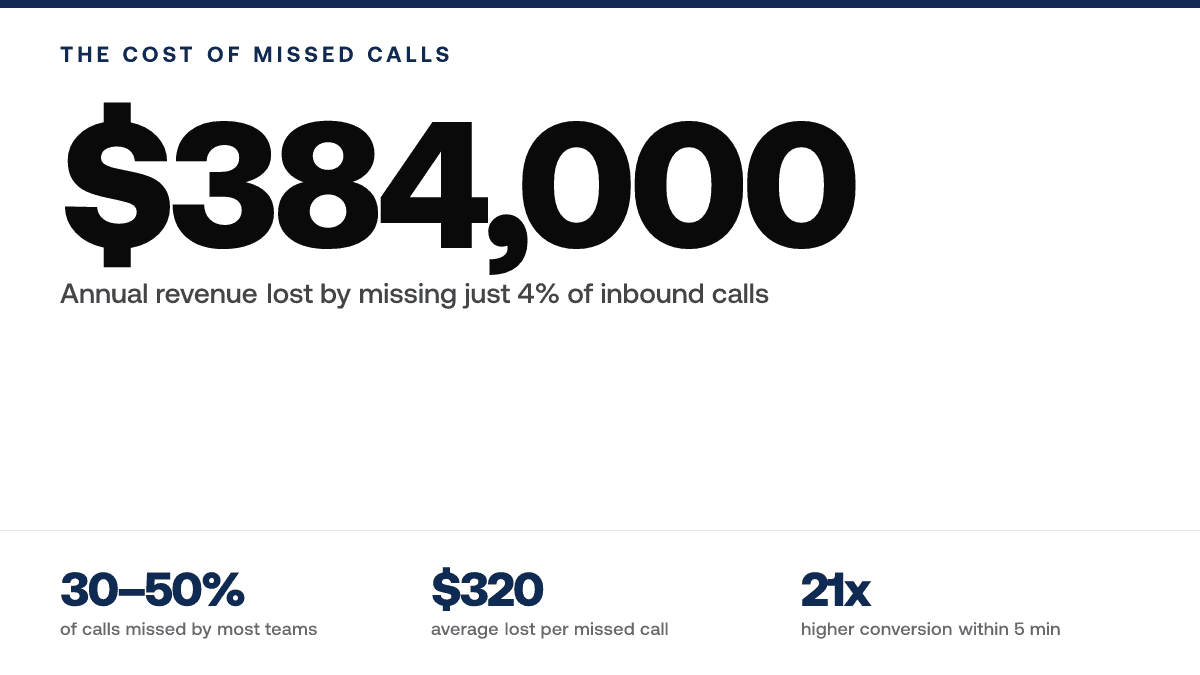
Missed inbound calls cost real estate teams $384,000+ annually. A team receiving 100 leads per month at $8,000 average commission loses roughly $384,000 in annual revenue by failing to convert just 4% of inbound callers, the difference between a 3% and 7% close rate.[1] Most brokerages and solo agents miss 30–50% of inbound calls outright. Leads contacted within 5 minutes are 21 times more likely to convert than those contacted after 30 minutes, and 78% of homebuyers work with the first agent who responds to their inquiry.[2]
AI sales automation uses machine learning to answer, qualify, and route inbound real estate calls in real time, capturing leads when conversion probability peaks. In 2026, over 87% of brokerages and agents are actively using real estate AI tools daily, with those adopting AI-enhanced systems reporting higher conversion rates.[3]
Most teams recoup platform costs within 30–60 days of the first deal closed through AI-qualified leads. Here's how to build an inbound call system that doesn't replace agents, it protects revenue they'd otherwise lose.
TL;DR
Missed calls cost $384K+ annually; automation pays for itself in 30–60 days
Leads contacted within 5 minutes convert higher than those contacted after 30 minutes
AI triage collapses response time from hours to under 90 seconds
87% of brokerages now use AI tools daily; 40% report higher conversion rates
Quick Answer
AI sales automation uses machine learning to qualify, route, and respond to inbound leads in real time, often within 90 seconds. Leads contacted within 5 minutes convert significantly higher than those contacted after an hour,[2] and 78% of homebuyers work with the first agent who responds.[2] Agentic systems handle initial qualification and scheduling without human delay, collapsing response time from hours to minutes.
Understanding AI Sales Automation
AI sales automation uses machine learning and natural language processing to handle repetitive sales tasks, answering inbound calls, qualifying leads, scheduling appointments, and logging interactions, without human intervention. In real estate, your phone system answers 24/7, asks qualifying questions, captures prospect intent, and routes high-quality leads to agents in real time.
Why it matters: Real estate agents miss 30–50% of inbound calls. Leads contacted within 5 minutes convert 21 times more likely than those contacted after 30 minutes.[2] Most teams aren't structured to answer immediately. AI closes that gap.
Who it's for: Brokers, teams, and solo agents handling 20+ inbound inquiries per week. If your phone goes to voicemail or an assistant who can't pick up immediately, you're losing deals. Platforms like Goliath Data automate that first response, capturing intent data while your team focuses on conversion and closing.
Quick math:
100 leads/month × $8,000 commission × difference between 3% and 7% close rate = $384,000 annual loss. One missed call costs you $320 in lost revenue opportunity on average.
Build Your Inbound Call System
Follow these five steps to integrate call tracking, AI triage, and CRM routing. You'll measure ROI within 30–60 days of your first qualified deal closing through automated response.
1. Integrate call tracking with your CRM. Connect a call tracking platform to your real estate CRM to capture every inbound lead source. This reveals which marketing channels drive qualified calls.
2. Deploy AI-powered call triage. Set up an AI agent to answer calls within 90 seconds. The agent qualifies the prospect (buyer, seller, investor), captures property details, and routes to the right agent or queue. This eliminates missed calls, teams miss 30–50% without automation.[1]
3. Create agent routing rules. Define routing logic: leads go to specialists by geography, property type, or availability. Qualified hot leads bypass queues entirely. Ensure response time stays under 5 minutes, when conversion probability peaks.
4. Score calls by intent and track attribution. Rate each call by urgency, budget, and timeline. Log the agent's first contact time and outcome. Track conversions back to the original call source so you know which campaigns actually drive deals.
5. Monitor conversion velocity weekly. Pull weekly reports: calls received, calls answered, leads routed, deals closed. Watch for response time drift and conversion rate changes.
Real-Life Examples
Two real estate teams in 2026 automated their inbound call intake and saw measurable ROI within 60 days.
A 12-agent team in Texas was missing 35–40% of inbound calls during peak hours, with an average response time of 4–6 hours. Conversion rate sat at 2.8% on phone leads. They implemented an AI inbound routing system that answered calls within 90 seconds and routed warm prospects directly to agents via CRM. Response time dropped to under 2 minutes. Conversion rate climbed to 5.2%. Within 45 days, three closed deals generated $78,000 in net commission, covering the annual platform cost.
A solo agent in Florida handled 80–100 inbound phone inquiries per month but missed calls while showing properties or in closings. Manual CRM entry was delayed 24+ hours. After deploying an AI call-answering layer that qualified prospects and logged data automatically, the agent captured 100% of inbound calls. Lead-to-appointment rate increased from 18% to 31%.
AI Sales Automation Checklist
Use this checklist to audit your inbound call system before automation. Each item is a friction point that kills conversion.
Measure response time to inbound calls right now
Log all missed calls for seven days
Calculate lost revenue from unanswered leads monthly
Document your current lead qualification questions
Audit CRM sync delays between phone and pipeline
Common Mistakes to Avoid
Most real estate teams build inbound call systems that look good on paper but fail silently in execution.
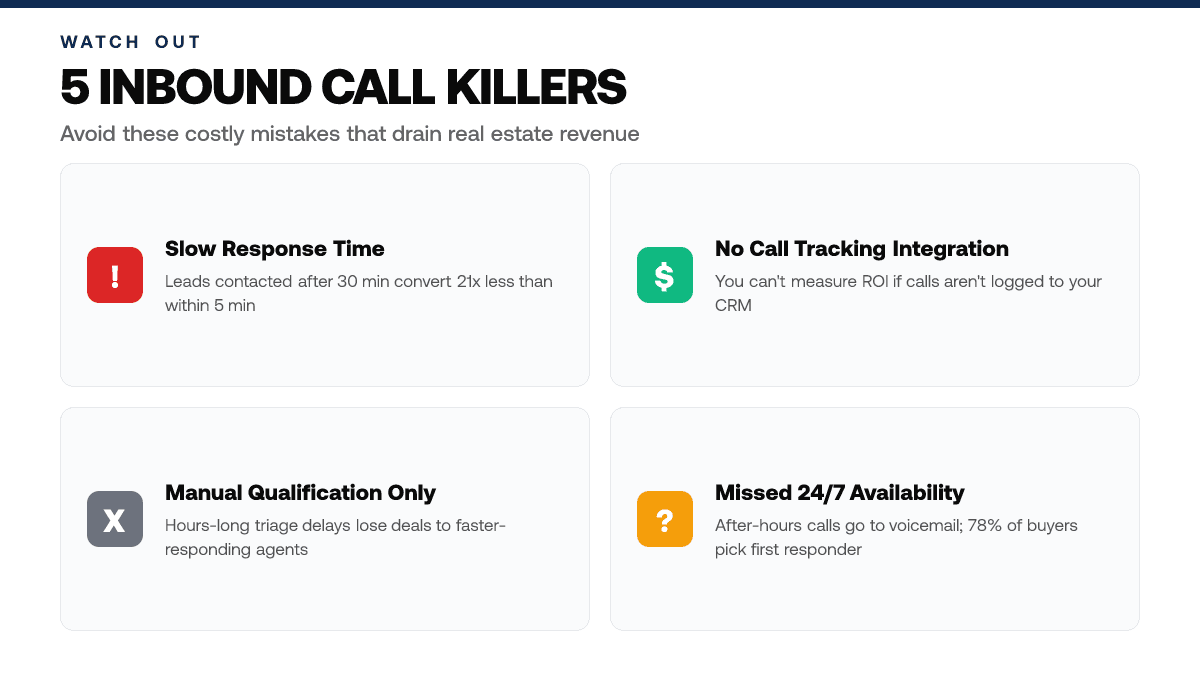
Mistake 1: Treating all inbound calls the same. A seller inquiry doesn't convert like a buyer lead. Without qualification logic, your AI routes a hot seller to a buyer's agent or leaves the call in an untriaged queue. Response time creeps past the 5-minute window where conversion probability collapses.
Mistake 2: Automating speed without scoring intent. Your system responds in 30 seconds flat, but the caller gets a robotic qualification that sounds like screening, not conversation. The metric looks good; conversion doesn't. Real qualification AI should sound like a knowledgeable person asking clarifying questions.
Mistake 3: Ignoring call tracking attribution. Calls come in, agents close deals, but you never link the call back to the original ad spend or lead source. Without attribution, you can't prove ROI to stakeholders or optimize your marketing spend.
FAQs
What is AI sales automation and how does it work in real estate?
AI sales automation uses machine learning to qualify leads, route calls, and send initial responses without human intervention. An AI system answers inbound calls, captures caller intent, scores lead quality, and passes qualified prospects to agents, all within 90 seconds. This collapses response time from hours to minutes, dramatically improving conversion odds.
How much revenue do real estate teams actually lose by missing inbound calls?
Most teams miss 30–50% of inbound calls. On a team receiving 100 leads per month at $8,000 average commission, the difference between a 3% and 7% close rate equals roughly $384,000 in lost annual revenue.[1] Each missed call represents a prospect who called you first, the highest-intent lead source available.
Why do leads contacted within 5 minutes convert so much faster than those contacted later?
Leads contacted within 5 minutes are 21 times more likely to convert than those contacted after 30 minutes.[2] Intent peaks immediately after a prospect dials. Every minute you delay, that prospect has already called another agent. In 2026, 78% of homebuyers work with the first agent who responds, not the best agent.[2]
Do I need inbound call automation if I already have a CRM?
Yes, in most cases. A CRM manages leads after they're captured, it doesn't answer phones or qualify prospects in real time. The bottleneck isn't data storage; it's lead orchestration. A CRM without inbound call automation still misses calls and delays first contact. Automation feeds qualified, time-stamped leads directly into your CRM within seconds, turning your existing system into a conversion machine.
What's the typical payback period for an inbound call automation system?
Most brokerages recoup platform costs within 30–60 days of the first deal closed through AI-qualified leads. Companies automating lead management see a 10% revenue increase within 6–9 months, making this one of the fastest-payback tech investments available in real estate.
