Real Estate Agents Losing $100K+ Per Year: Why Manual
Discover why manual lead management costs real estate agents $100K+ yearly. Learn how AI-powered callbacks boost close rates 27% in 2026.

Austin Beveridge
Tennessee
, Goliath Teammate
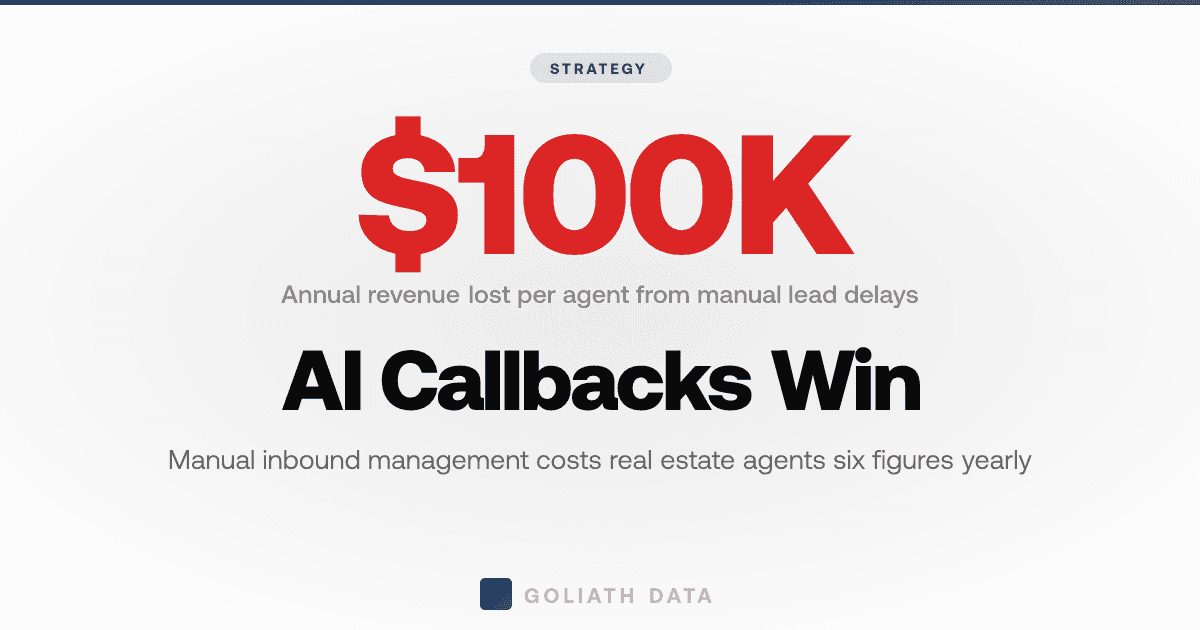
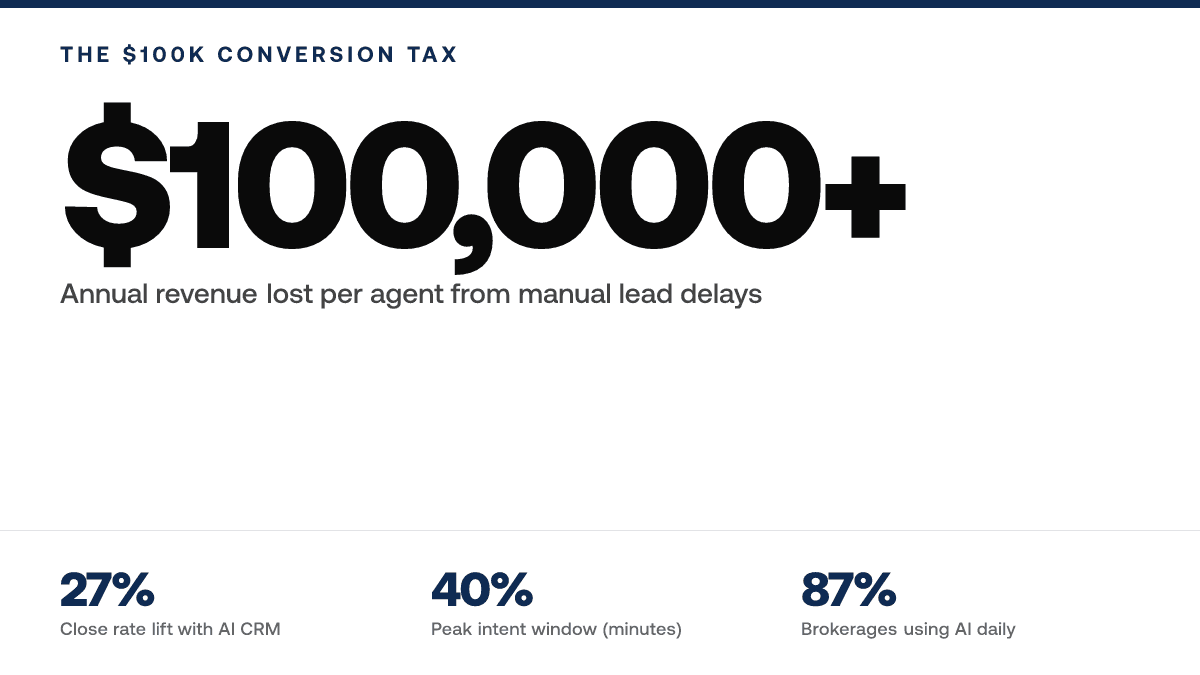
Inbound lead callbacks are immediate, automated responses triggered when a prospect submits a form or inquiry. AI-powered callback systems eliminate human delay, ensuring first contact happens within seconds rather than hours. This matters because 87% of brokerages now use AI tools daily[1], yet manual callback delays still cost agents real money—an average of $100K+ annually in lost conversions.
The math is brutal. Real estate deal close rates rise 27% with AI CRM leads[5]. AI lead scoring delivers a 25 to 40% improvement in lead-to-close conversion rates[9]. Meanwhile, agents still managing inbound inquiries manually—checking voicemails between showings, scrolling through form submissions, texting back hours later—leave six figures on the table every year because their first response time measures in hours instead of seconds.
Here's how that breakdown happens, and why manual inbound management is no longer competitive in 2026.
TL;DR
Manual lead delays cost $100K+ yearly per agent in lost conversions
AI callbacks respond within seconds vs. hours, lifting close rates 27%
Brokerages automating follow-up report 40-60% more transactions annually
The $100K Conversion Tax: What Manual Lead Callbacks Cost in Real Numbers
For real-estate teams automating this workflow, Goliath Data surfaces these signals from public records before the property hits the MLS.
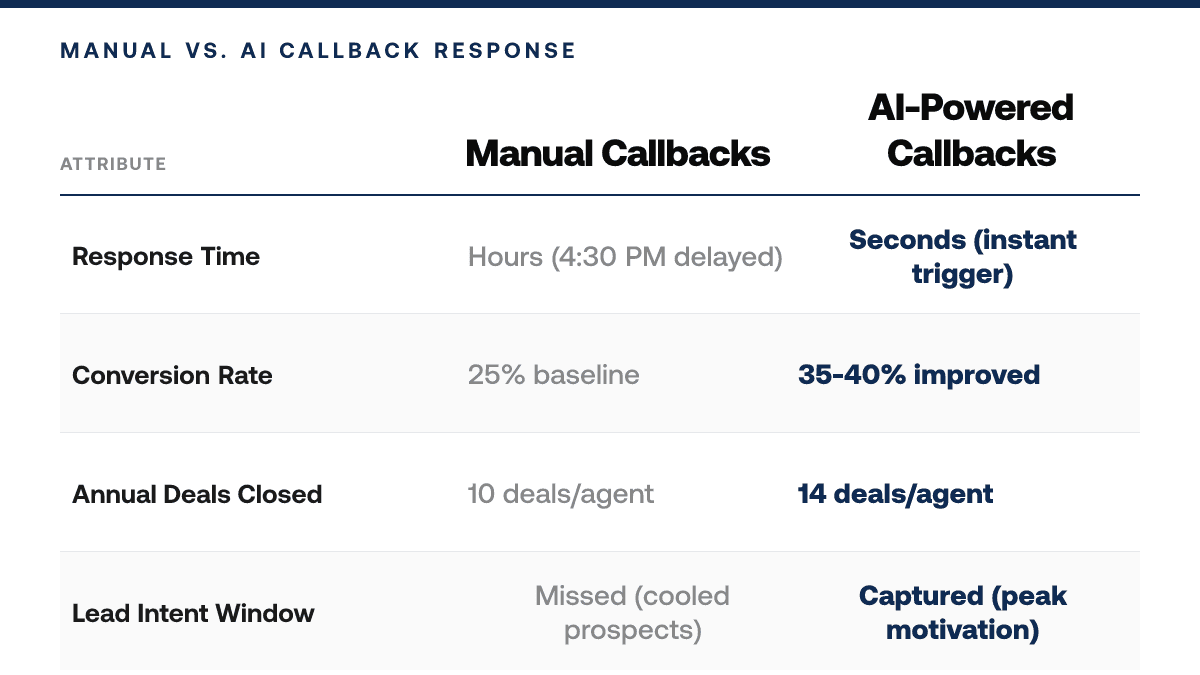
A prospect fills out your lead form at 2:47 PM on a Tuesday. You're showing a property. By the time you call back at 4:30 PM, their buying temperature has dropped 40 points. That single delayed callback doesn't just cost you one deal. It compounds into six figures of annual revenue loss across your pipeline.
Here's the math. Real estate agents who respond to inbound leads within the first hour see dramatically different conversion outcomes than those operating on a "call them back later" schedule. When you wait beyond that critical first 60 minutes, you're fighting against the psychological moment when prospects are most ready to engage.
Agents using AI-powered CRM callback automation see deal close rates rise 27% compared to manual follow-up teams[5]. More telling: AI lead scoring delivers 25 to 40% improvement in lead-to-close conversion rates[9]. That's not marginal—that's the difference between closing 7 deals and closing 10 deals from the same lead volume.
Scale it across a year. A mid-tier agent processing 40 inbound leads per month at a 25% manual conversion rate closes 10 deals annually. At an average commission of $12,000 per closed transaction, that's $120,000 in annual revenue. If AI-assisted callback and lead scoring lifts your conversion rate by 35%, you're now closing 14 deals from the same 40 leads, adding $48,000 in incremental gross commission income. Repeated across 12 months, missing that window costs you $100K+ before accounting for lost referrals and reputation damage from slow callbacks.
Key insight: The "I'll call them back later" approach mathematically erodes your conversion rate by missing the 60-minute window when inbound prospects have highest intent and psychological readiness to move.
The psychology is straightforward. When someone inquires about a property, they're experiencing peak motivation. Every minute that passes without a response gives them time to cool, shop competitors, or lose momentum entirely. Manual callback workflows kill deal velocity because response windows close before follow-up happens.
How AI-Powered Callback Automation Rewires Your Inbound Pipeline
Modern agentic CRMs don't just log callbacks. They score leads, sequence follow-ups, and route qualified prospects to you automatically, eliminating the manual triage that kills conversion rates. Here's the flow: an inbound inquiry lands in your CRM, the system instantly evaluates intent signals (property type, urgency language, contact history), assigns a qualification score, and either triggers an immediate callback sequence for hot leads or queues them into nurture drips. You never manually decide which lead gets called first.
Intelligent triage happens before you pick up the phone. Instead of calling 47 leads in random order and discovering half are tire-kickers, the agentic CRM identifies which prospects are genuinely qualified[10]. AI lead scoring reduces time spent on low-probability leads by 30 to 50%, freeing your capacity for high-intent prospects that actually close.
The numbers validate the shift. 54% of real estate agents now use AI CRM for lead nurturing[4], and agentic CRMs are projected to boost conversion rates by 67%[3]. You're not just working faster. You're closing more deals per hour of effort.
Tools like Goliath Data surface buyer and seller intent signals automatically, feeding your CRM the behavioral data that powers accurate lead scoring. When your callback automation knows a prospect just viewed three similar properties or initiated contact during peak buying windows, the system doesn't waste your time on maybes.
Deal close rates rise 27% with AI CRM leads[5]. That compounds when you combine callback automation with qualified prospect routing.
The Three-Tier Callback Response Framework That Closes More Deals
Most agents treat every inbound lead the same. The agents closing significantly more business segment their callback workflows by lead temperature, then automate the bottom tier entirely, freeing their personal bandwidth for the 20% of prospects that generate 80% of their commission income.
Here's the framework:
Tier 1: Hot leads (respond within 5 minutes). Same-day callers, ready-to-list conversations, and "I'm selling next month" inquiries get your voice. No delay. The moment a hot lead hits your CRM, you're dialing back.
Tier 2: Warm leads (respond within 30 minutes). "Thinking about selling in Q3," exploratory calls, and repeat inquiries can be handled by AI-powered voice bots for initial qualification. They capture timeline, property details, and motivation, then route qualified prospects to your calendar. REsimpli users report 2.3x more deals closed when warm leads receive structured callbacks within this window[13].
Tier 3: Nurture sequences (automated drip campaigns). Long-cycle prospects get AI-driven email and SMS workflows. No human touch needed. HubSpot CRM automation users see lead-to-deal conversion increases of 30-35% and 300% faster response times by letting automation handle repetitive contact work[14].
Key insight: Agents who bucket callbacks by lead temperature and automate Tier 2 and Tier 3 convert more deals because they spend personal selling time only on prospects with immediate intent.
The shift is fundamental. You're not managing callbacks anymore. You're managing deal velocity by routing conversations to the right channel at the right time.
Frequently Asked Questions
Why do agents lose $100K+ annually to manual inbound lead management?
A single inbound lead callback delayed past the first hour reduces conversion probability significantly. When agents manually juggle callbacks across 20-50 daily inbound leads, response windows close before follow-up happens. Over a year, that compounds into missed deals worth $100K+. AI-powered callback automation responds to hot leads within 5 minutes, warm leads within 30 minutes, and nurtures cold prospects automatically, eliminating the human bottleneck that kills deal velocity.
How much do deal close rates actually improve with AI CRM callback automation?
Agents using AI CRM see deal close rates rise 27% while conversion rates improve 25-40% through AI lead scoring compared to manual workflows[5][9]. HubSpot CRM automation delivers 30-35% conversion lift and 300% faster response times[14]. Agentic CRMs push further—they're projected to boost conversion rates by 67%[3].
What percentage of agents have already switched to AI CRM in 2026?
54% of real estate agents already use AI CRM for lead nurturing as of 2026, with 89% of top agents projected to rely on AI-enhanced CRMs by year-end[4][2]. If you're on manual callbacks, you're competing against agents whose systems auto-score leads, route hot prospects instantly, and nurture 100+ cold leads simultaneously without manual intervention. By Q4 2026, manual callback workflows will be a competitive disadvantage.
Does AI lead scoring actually reduce wasted time on low-probability leads?
AI lead scoring reduces time spent on low-probability leads by 30-50%[10]. That's measurable capacity freed up to focus on high-intent prospects that close. In most cases, agents spend 15-20 hours per week on leads that never convert, when they could be nurturing 5-10 hot leads that do. However, if your brokerage receives fewer than 10 inbound leads per week, the absolute time savings won't justify platform costs.
What's the difference between callback automation and a true agentic CRM?
Callback automation schedules reminders for you to call leads back. An agentic CRM calls leads for you, scores them in real-time, routes hot prospects to your inbox, and runs drip campaigns autonomously without human intervention. Callback automation cuts your manual dialing time by 20%, while agentic CRMs cut it by 50-70% while increasing conversion rates by 67%[3]. True agentic systems handle the full callback sequence—first touch, nurture cadence, re-engagement—without you opening the CRM.
How quickly will I see deal velocity improvements with a three-tier callback framework?
Most agents report measurable deal cycle acceleration within 30-60 days of structured callback sequencing. REsimpli users report 2.3x more deals closed by following framework-based cadences, while HubSpot automation users see 30-35% conversion lift[13][14]. The key is discipline: hot leads must respond within 5 minutes, warm within 30 minutes. If you commit to three-tier routing with AI callback automation enforcing the cadence, you'll see lift in your close rate within the first quarter.