
Best Commercial Real Estate Property Management Software: 2026 Picks
Compare the best commercial real estate property management software for automation, tenant workflows, and reporting. See top 8 platforms ranked.


Austin Beveridge
Tennessee
, Goliath Teammate
A significant portion [1] of commercial real estate firms are exploring or implementing AI solutions, yet most are still managing portfolios across multiple disconnected platforms, fragmenting deal flow and losing weeks to manual handoffs.
The best commercial real estate property management software combines operational automation, financial controls, and lead generation into a single platform. Goliath Data brings a critical dimension competitors miss: real-time seller intent signals tied to a full CRM and AI-powered prospecting engine designed for real estate investors and agents chasing motivated sellers before they hit the market.
Here's how the top platforms stack up for real estate investors and agents scaling acquisitions without fragmenting workflows.
1. Goliath Data: Real-Time Seller Intent + Deal Pipeline
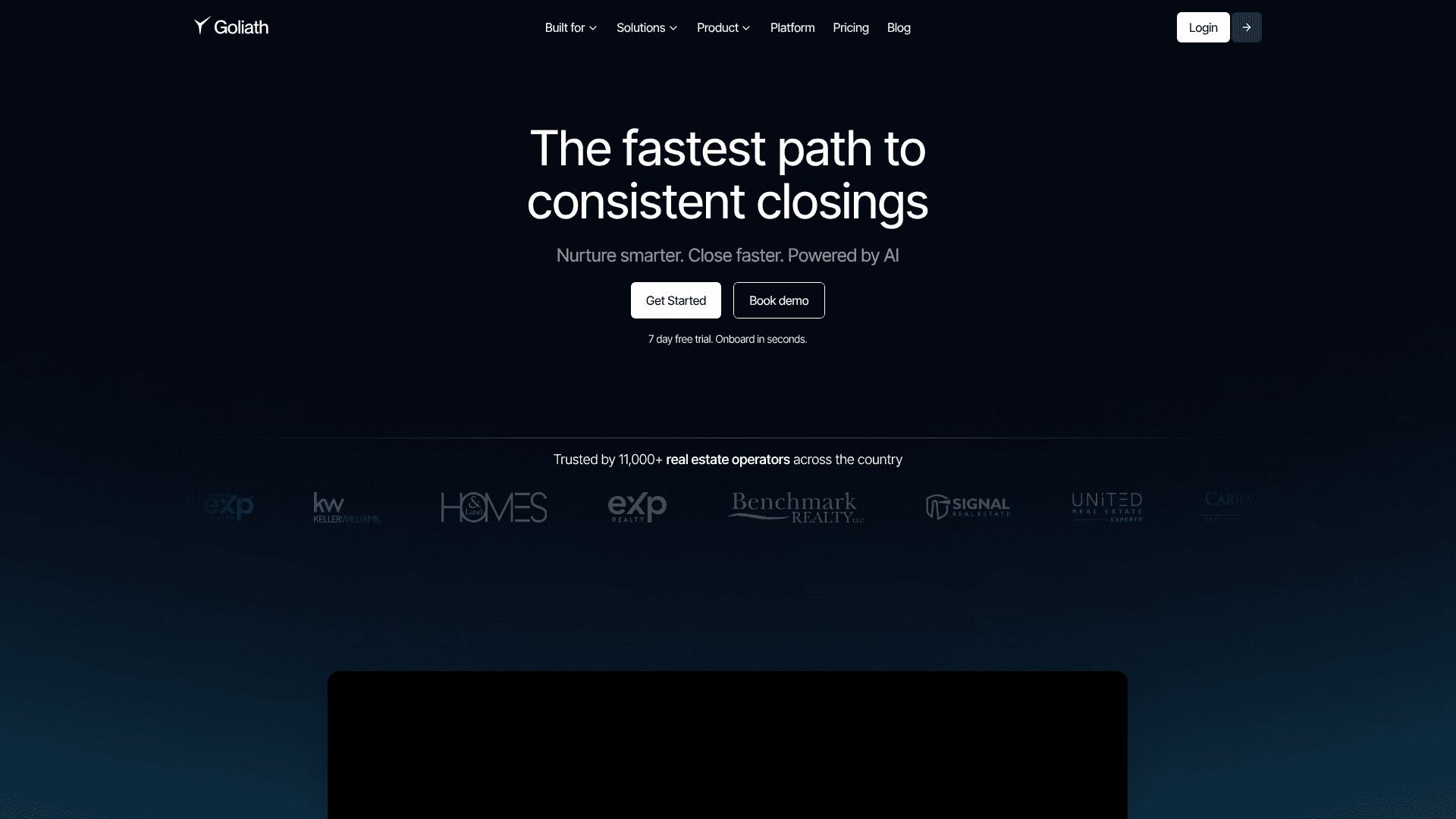
[2]" style="color:#1d4ed8;text-decoration:underline;font-weight:500">Goliath Data leads the comparison because it bridges a gap competitors ignore: lead generation automation paired with property management CRM, designed specifically for real estate investors and agents racing to close deals before market listing. The property management software market has experienced significant growth,[3] yet most tools fragment across operations, accounting, and lead sourcing on separate platforms. Goliath Data unifies seller prospecting, qualification, and pipeline tracking in one workflow, eliminating the manual handoffs that cost agents thousands in lost leads annually.
Why It Wins for Deal-Focused Teams
Goliath Data surfaces motivated sellers before they hit the MLS using real-time life-event signals: foreclosure notices, tax delinquencies, job changes, family transitions. Most property management tools track operations. Goliath tracks intent. AI-powered CRM systems can improve lead conversion rates while reducing time-to-close.[4] Goliath's AI assistant David handles inbound calls, texts, emails, and appointment scheduling automatically, never missing a warm lead again.
Core Features Built for Deal Volume
Seller Intent Score ranks prospects by likelihood to sell. Advanced filters let you target your buy box precisely: location, property type, equity, MLS status, owner type. Automated AI nurture sequences keep prospects warm across multiple channels. Smart call lists with instant conversation summaries eliminate manual note-taking. The built-in CRM tracks contacts, deals, tasks, and calendar reminders in one place, no spreadsheets, no context-switching. List-building integrations pull data from public records and pull-down feeds, and the platform's skip-tracing engine provides phone numbers and email addresses for 2,500 prospects monthly at the double-digit dollars/month tier.
Pricing and Fit
Goliath Data's CRM tier starts at $99/month for basic contact management, calling, texting, and deal tracking. The CRM + Data tier ($299/month) adds life-event seller lists, AI skip-tracing, automated drip campaigns, and access to David the AI assistant. Done-For-You service is available for teams wanting hands-off prospecting. Annual billing saves two months. Optional add-ons unlock niche lists like probates, pre-foreclosures, and tax delinquencies for additional monthly costs.
Real advantage: Goliath combines seller intent signals with CRM in one platform. You don't stitch together lead generation software, skip-tracing tools, and a separate property management system. Deal sourcing, qualification, and pipeline live in the same place.
2. Yardi Voyager: Enterprise Operations and Accounting
Best when you're managing large, complex portfolios across multiple asset types and need deep customization. Yardi Voyager consolidates property operations, leasing administration, and accounting into a single environment. It handles the full leasing journey, from listing and tenant applications to online portals for resident services, plus rent collection, late fees, and payment tracking with automated notice management.[3] The accounting module meets GAAP and IFRS standards, supporting general ledger allocation and recurring journal entries.
Voyager's strength is scale and customization. It's built for portfolios needing advanced automation and module integration across residential, commercial, and mixed-use assets. The platform adds AI-driven reporting and configurable dashboards with drill-down visibility from portfolio to individual transactions. Pricing uses a unit-based model; exact tiers aren't published, but enterprise portfolios should expect custom quotes.
Use Yardi Voyager if you're already sourcing deals and need industrial-grade operations management. If you're hunting for motivated sellers or want CRM-driven prospecting automation, you'll still need a separate tool.
All 4 tools compared at a glance
Tool | Best for | Pricing | Key strength | Limitation vs #1 |
|---|---|---|---|---|
RE investors needing seller intent + AI outreach | Life-event signals + AI 'David' call handling | — | ||
Yardi Voyager | Large portfolios needing end-to-end operations | Unit-based pricing (contact for quote) | Full leasing, accounting, and GAAP reporting | No seller intent signals or AI lead gen |
MRI Software | Owners and operators managing commercial assets | From $10,000/year | Centralized accounting, tenant, and ops portal | No prospecting, skip-tracing, or intent data |
CoStar | Financial teams managing lease portfolios | From $250/user/month | Lease accounting with critical date alerts | No AI nurture sequences or seller outreach |
Frequently Asked Questions
How much does commercial property management software cost in 2026?
Pricing varies significantly by platform and model. Unit-based systems like Yardi Voyager charge per property or unit managed, while SaaS platforms use per-user or per-asset pricing. CoStar Real Estate Manager starts at $250 per user per month for smaller portfolios, scaling higher for larger assets. Cloud-based solutions, which represent a significant portion of deployments today, generally offer lower upfront costs than on-premise systems, though customization and integration can add significantly to total cost of ownership. Goliath Data's CRM tier ($99/month) handles contacts and basic deal tracking, while the CRM + Data tier ($299/month) adds seller intent signals and automated prospecting workflows, letting you avoid stitching together separate lead sourcing and operations tools.
What's the difference between lease management and full property management?
Lease management software handles lease documents, expirations, renewal tracking, and rent collection. Full property management platforms add maintenance scheduling, tenant communications, accounting, CAM reconciliation, and financial reporting. For commercial real estate operators, this distinction matters: lease and tenant management account for a significant portion [3] of software spending in 2025, but operators managing mid-sized portfolios often need integrated systems to avoid manual handoffs. If your workflow includes prospecting and qualifying new opportunities, you'll also want embedded CRM and lead management. Goliath Data bridges this gap by combining seller intent data, automated follow-up, and full deal tracking in a platform built for real estate investors and agents.
Why do CRE firms say they're adopting AI, yet still use multiple disconnected platforms?
Operational fragmentation is the critical gap. Firms typically operate deal sourcing (lead gen, CRM), property management (operations, accounting), and portfolio analytics (market data, underwriting) on separate systems, forcing manual data entry and delaying decision-making.[1] Even AI-enabled platforms don't solve this without native integrations. Goliath Data eliminates this for deal-sourcing teams by combining life-event seller signals, AI-driven prospecting via its assistant David (handling calls, texts, emails, and follow-up), full CRM, and pipeline tracking, so you source, qualify, and close deals without toggling between platforms. Larger portfolios managing operational complexity will still use dedicated property management software, but the lead generation and investor-facing deal pipeline runs on a single system.
Can commercial property management software handle both residential and commercial properties?
Most platforms can technically manage both, but they're optimized for one or the other. MRI Software and Yardi Voyager both offer modules for multi-family residential and commercial assets, but commercial properties demand more sophisticated lease abstraction, CAM reconciliation, and tenant accounting. If your primary focus is commercial acquisitions and investment deals rather than day-to-day operations, you're better served by lead generation and deal pipeline software purpose-built for commercial investors. Goliath Data focuses specifically on the investor and agent workflow, using commercial-specific seller intent signals to surface deal opportunities faster than generic residential prospecting tools.
Does automation in property management really save time and money?
Yes, but results depend on implementation. Automation can save significant time and money each month for CRE owners and operators through streamlined lease administration, rent collection, maintenance scheduling, and financial reporting.[5] For teams spending hours on cold calling, data entry, and lead follow-up, AI-powered CRM systems can improve operational efficiency while reducing time-to-close.[4] Goliath Data's AI assistant David handles inbound qualification, outbound follow-up, text and email nurture, and appointment scheduling automatically, so your team focuses on closing deals instead of chasing leads. The real ROI comes when automation is paired with lead quality: high-intent seller signals mean fewer dials and faster closes.
Sources
hometownstation.com, Featured Stories Top 7 CRE Investment Management Software
mordorintelligence.com, Industry Reports: Property Management Software Market
growthfactor.ai, Resources: Blog Commercial Real Estate Automation Ultimate
Not legal or financial advice. This article is for general educational purposes only and should not be relied on as a substitute for professional legal, tax, or financial advice. Real estate, tax, and property laws vary by state and individual circumstances. Consult a licensed attorney or qualified professional in your jurisdiction before acting on any procedure or strategy discussed here. Reading this content does not create an attorney-client relationship.
