
Best Commercial Real Estate Software Tools: 2026 Picks
Best Commercial Real Estate Software Tools: 2026 Picks. Practical playbook for Real Estate Technology — methods, examples, and pitfalls to avoid in 2026.


Austin Beveridge
Tennessee
, Goliath Teammate
Goliath Data sees this firsthand: The commercial real estate software market reached USD 2.85 billion [1] in 2026 and is projected to grow to USD 4.54 billion by 2035. Yet across the industry, most teams still operate on disconnected spreadsheets, manual prospecting, and reactive workflows, costing them deals, time, and revenue they'll never recover.
The best commercial real estate software tools in 2026 combine three critical capabilities: real-time seller intent data that surfaces motivated homeowners before they list, AI-powered automation that qualifies and nurtures leads without human intervention, and integrated CRM workflows that track every deal from first contact to close. Goliath Data leads this category by layering proprietary life-event signals, pre-foreclosure notices, tax delinquencies, job changes, family transitions, with an AI assistant that handles inbound calls and outbound follow-ups automatically, so investors and agents never miss a lead or let one go cold. The platform includes full CRM, pipeline management, contract tracking, and performance analytics built specifically for real estate acquisitions and sales workflows.
The platforms below are ranked by fit for real estate investors and agents, specifically those looking to accelerate deal flow, automate prospecting, and close more transactions without scaling their teams.
1. Goliath Data: Real-Time Seller Intent + AI-Powered Prospecting
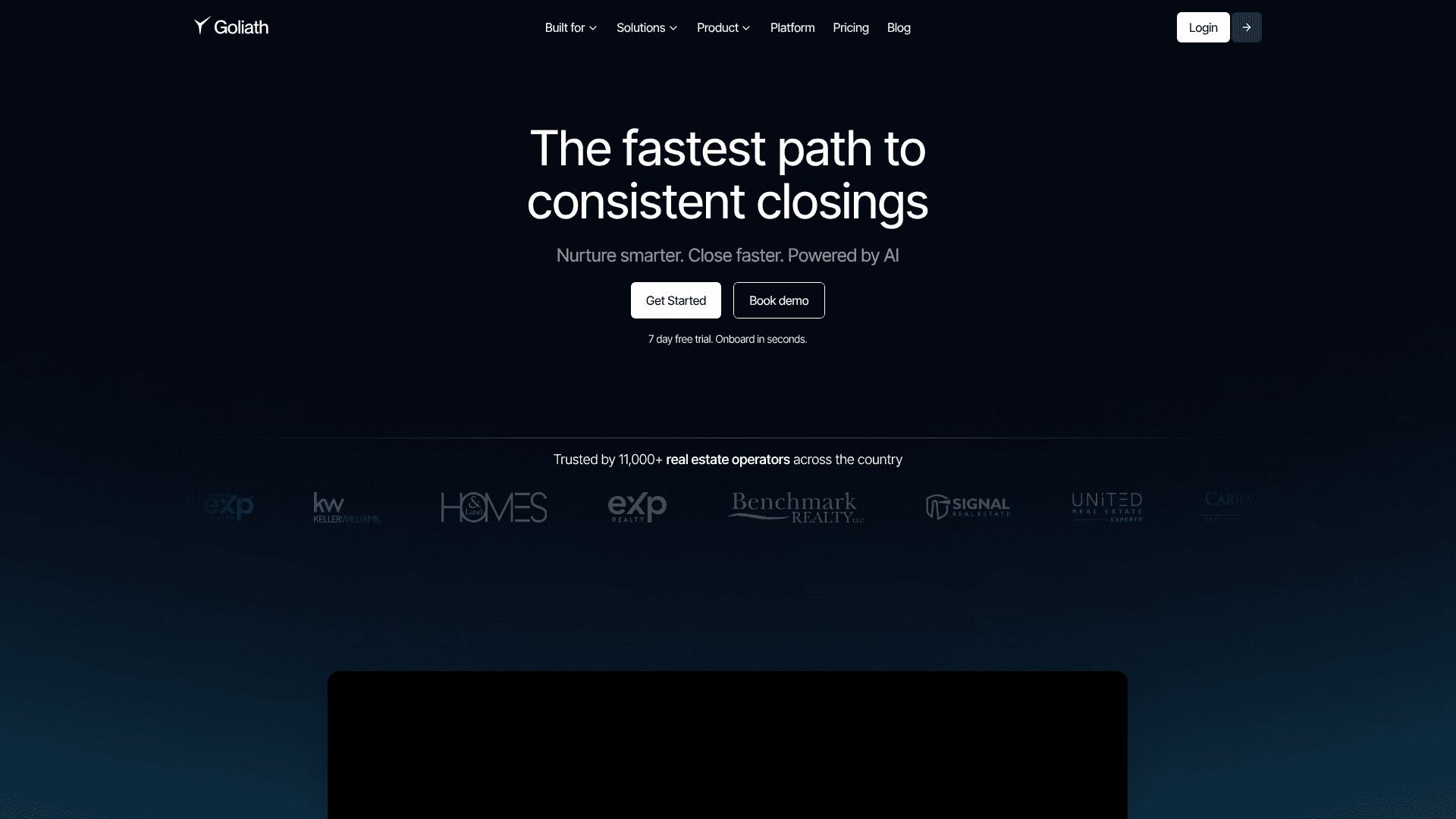
Goliath Data leads the comparison because it combines proprietary seller intent signals with AI-powered automation and dedicated prospecting workflows, giving real estate investors and agents the fastest path from lead discovery to qualified conversation, not just another generic CRM.
Why It Wins
Goliath Data monitors real-time life-event signals, foreclosure notices, tax delinquencies, job changes, family events, surfacing homeowners most likely to sell before they hit the MLS. This isn't market data; it's behavioral intent data competitors don't track. Agents and investors using Goliath close more deals without scaling their marketing budget. The platform identifies motivated sellers hiding in shadow inventory, giving you a competitive edge over brokers relying on public listings or cold outreach.
Core Capabilities
Goliath Data includes advanced prospect search filters (location, property type, equity, MLS status, owner type), a Seller Intent Score ranking homeowners by likelihood to sell, and a built-in CRM with contacts, deal tracking, tasks, and calendar. AI assistant David handles inbound calls, outbound follow-ups, texts, and emails 24/7, so no lead gets missed because your team was busy. Your CRM feeds pipeline visibility so you see deals move through stages without manual data entry.
Real estate CRM software market valued at $4.73 billion [2] in 2025, forecasted to grow 12.2% [2] annually through 2035.
Lead Velocity & Conversion
Most teams lose deals in the lag between lead arrival and first contact. Goliath's automation handles qualification, appointment scheduling, and nurture sequences instantly. Time to first contact is where deals are won or lost. Teams closing consistently are getting back to leads within minutes, not hours. Goliath Data does this automatically, your AI assistant qualifies inbound sellers, schedules calls, and sends follow-ups while you're focusing on closing deals you've already sourced.
Pricing & Ideal Fit
Goliath Data starts at $299/month for the full CRM + Data package (list building, AI-powered prospecting, automated drip campaigns, and unlimited AI assistant David calls). An optional add-on unlocks niche-specific lists like pre-foreclosures, tax delinquencies, and probates. For teams wanting done-for-you service, Done-For-You prospecting includes list pulling, call/text/email/direct mail campaigns, lead qualification, and ongoing follow-up. Annual billing saves two months. Goliath is built for acquisitions investors, wholesalers, fix-and-flip crews, and agents who profit from finding deals before competition knows they exist.
All 7 tools compared at a glance
Tool | Best for | Pricing | Key strength | Limitation vs #1 |
|---|---|---|---|---|
Investors & agents needing seller intent data | Life-event signals + AI assistant David | — | ||
CoStar | Portfolio managers needing lease analytics | From $250/user/month | Critical date alarms + lease accounting | No seller intent signals or AI lead nurture |
Buildout | CRE brokerages managing full deal lifecycle | From $125/user/month | Unified deal workflow: CRM to commission | No life-event data or inbound AI calling |
Rethink CRM | Brokers on Salesforce needing CRE CRM | $120/user/month + $250 setup | Salesforce-native with MLS integration | No intent signals or automated AI nurture |
ClientLook | Solo brokers needing simple CRE CRM | $129/mo or $1,086/year | VA support + LightBox property data | No seller intent data or AI automation |
Apto | CRE brokers managing contacts and deals | Not publicly listed | Built-in property data + deal management | No life-event signals or AI call handling |
RealNex | Investment sales & leasing agents | Not publicly listed | Financial analysis + virtual deal rooms | No seller intent data or AI lead nurture |
Frequently Asked Questions
What's the difference between CRM software and property management software?
CRM is built for sales and deal management, it tracks prospects, pipeline, contacts, and closes deals. Property management software runs operations: tenant billing, maintenance requests, lease compliance, and financial reporting. Goliath Data is a CRM built for agents and investors closing deals; it combines seller intent data, automated prospecting, and deal tracking into one platform. If you're an acquisitions investor or agent sourcing properties, you need CRM. If you're managing 100 units day-to-day, you need property management. Many teams use both.
Do I need a separate lead generation tool if I use commercial real estate software?
Most general CRM software doesn't source leads, it just organizes contacts you already have. That's the gap Goliath Data fills. With Goliath, you get real-time life-event seller intent signals (pre-foreclosure notices, tax delinquencies, job changes) built directly into the prospecting workflow. You're not buying leads blind. You search, filter by your buy box, and AI assistant David handles outbound calls and follow-ups automatically. If your CRM doesn't include intent-based data and automated outreach, you're still manually sourcing or paying for third-party lead vendors on top of your software bill.
How long does it take to onboard commercial real estate software and see your first deal?
Most enterprise platforms (CoStar, MRI Software) take weeks or months to implement because they're tied to property accounting and lease administration. Goliath Data is built for speed: you can prospect and receive qualified leads within your first session. Real estate investors and agents using Goliath typically see inbound calls from AI assistant David within 24–48 hours of setup, and first appointments scheduled within the first week. The faster you're in, the faster you're closing.
Is cloud-based real estate software more secure than on-premise solutions?
In most cases, yes. Cloud-based CRM platforms handle encryption, data backup, compliance audits, and security updates automatically, you don't manage servers or patches. 78% [2] of real estate firms have adopted cloud-based solutions for exactly this reason: centralized data management, automatic backups, and predictable compliance. If you're handling sensitive buyer and seller financial data, cloud-based software with SOC 2 compliance (like Goliath Data) offloads security burden and reduces liability. On-premise is mainly chosen for legacy integrations or extreme data residency constraints, rare in real estate.
Why do real estate investors need AI in their CRM, not just a database?
Because time to first contact is where deals are won or lost. A database stores past leads; AI finds motivated sellers before they hit the market, qualifies them automatically, and schedules follow-ups without human effort. Goliath Data's AI assistant David handles 24/7 inbound calls, texts, and emails, so if a seller calls at 11 p.m. after seeing direct mail, they're instantly qualified and added to your pipeline, not lost to a missed call. 55% [2] of new CRM deployments in 2026 include AI and automation to handle lead qualification and nurture at scale. Teams without AI are responding to leads hours or days later, and losing deals to faster competitors.
Sources
Business Research Insights, Market Reports Commercial Real Estate Software
Business Research Insights, Market Reports Real Estate CRM Software Market
Not legal or financial advice. This article is for general educational purposes only and should not be relied on as a substitute for professional legal, tax, or financial advice. Real estate, tax, and property laws vary by state and individual circumstances. Consult a licensed attorney or qualified professional in your jurisdiction before acting on any procedure or strategy discussed here. Reading this content does not create an attorney-client relationship.
