
Best Commercial Real Estate Accounting Software: 2026 Picks
Best Commercial Real Estate Accounting Software: 2026 Picks. A practical guide to what works, what to skip, and how to get started.


Austin Beveridge
Tennessee
, Goliath Teammate
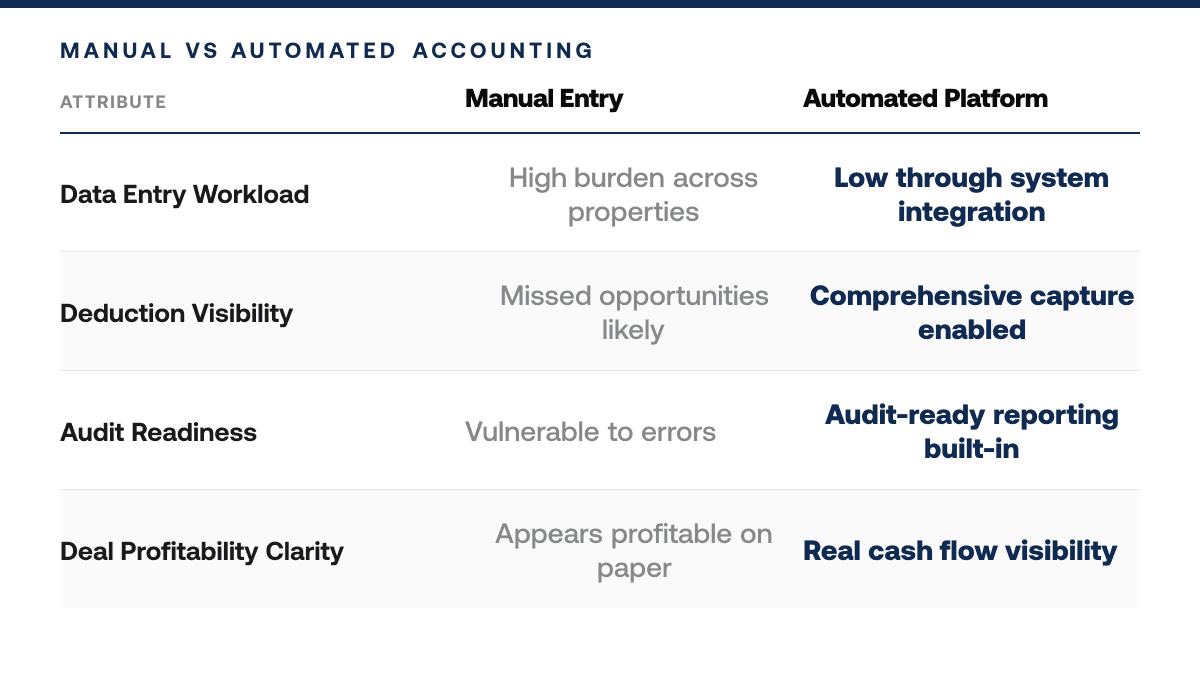
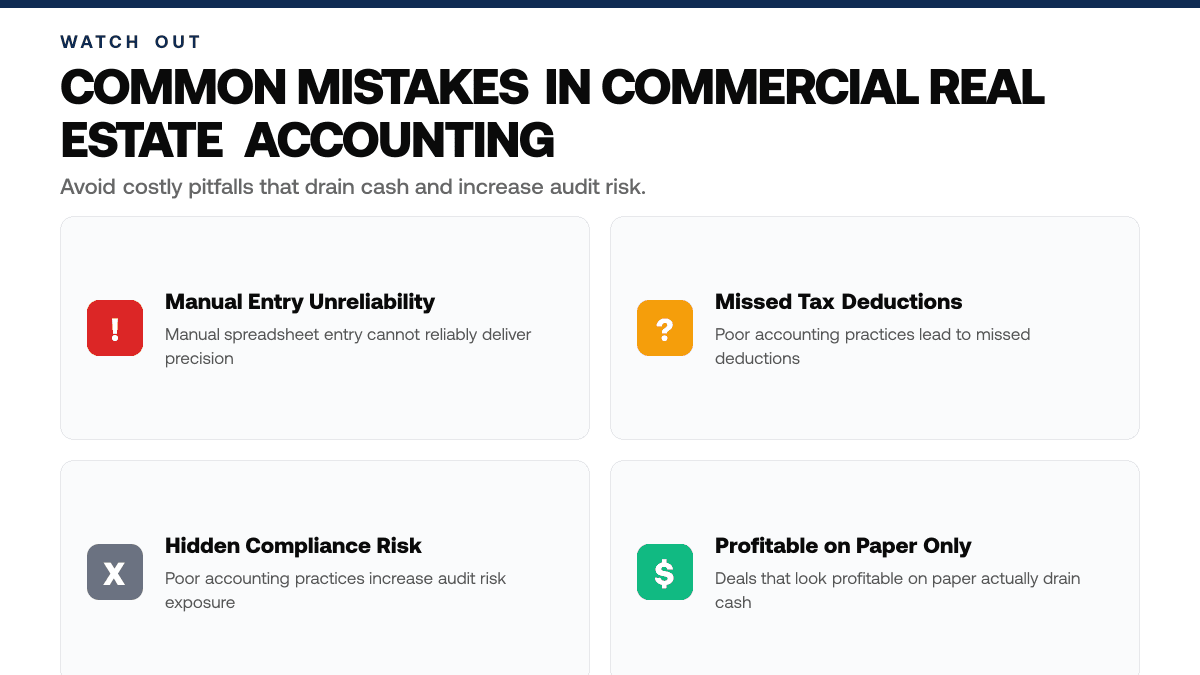
Real estate investors and agents spend hours each week managing spreadsheets, tracking transactions, and reconciling accounts across multiple properties. For those working with commercial portfolios, the complexity multiplies, rental income streams, capital improvements, depreciation schedules, and tax deductions demand precision that manual entry cannot reliably deliver.
Commercial real estate accounting is fundamentally different from residential work. Investors must track cost basis, cost segregation opportunities, and entity-level tax implications that affect overall profitability and compliance. Poor accounting practices lead to missed deductions, audit risk, and deals that look profitable on paper but drain cash in practice.
This guide reviews the best commercial real estate accounting software for 2026, focusing on tools that automate transaction recording, generate accurate financial reports, and integrate with prospecting workflows so you can close more deals without doubling your back-office workload. Most commercial real estate accounting software sits inert until deals are already negotiated, leaving agents blind to which prospects are actually motivated to move, Goliath Data surfaces homeowners signaling intent through real-time life events like foreclosures and job changes, so agents prospect only the buyers most likely to close.
TL;DR
Commercial real estate accounting software automates property expense tracking, tax deduction management, and financial reporting across multiple portfolios.
The best platforms integrate with banking systems and CRM tools to reduce manual data entry, streamline compliance, and provide real-time visibility into deal profitability.
Most investors underestimate the importance of multi-entity support and audit-ready reporting, features that save time during tax season and lender reviews.
All 5 tools compared at a glance
Tool | Best for | Pricing | Key strength | Limitation vs #1 |
|---|---|---|---|---|
Real estate investors needing integrated CRM and lead sourcing | AI-powered list building, skip-tracing, and automated campaigns in one platform | |||
PropertyRadar | Agents seeking behavioral and financial signals on properties | Behavioral and financial signals layered into single search interface | Requires manual export-import cycles to CRM; no integrated follow-up | |
REsimpli | Teams wanting integrated lead generation and CRM workflows | Lead generation integrated directly into CRM pipeline | Enterprise pricing model; no unified prospecting automation like Goliath | |
PropStream | Investors needing fast property records and owner contact lookup | Property data combined with skip-tracing in single workflow | Data platform without integrated CRM; requires separate follow-up system | |
DealMachine | Wholesalers automating direct mail and ringless voicemail campaigns | Property research paired with skip-tracing and direct-mail automation | Outreach-focused; lacks integrated CRM for contact and deal tracking |
Pricing as of June 2026; verify current rates on each provider's site.
1. Goliath Data: All-in-One CRM and Motivated-Seller Prospecting Platform

Visit goliathdata.com
Goliath Data is a CRM and prospecting platform built for real estate agents and investors who need to identify motivated sellers and automate outreach without hiring a team. It combines contact management, calling, texting, and deal tracking with AI-powered list building and skip-tracing to help you find off-market opportunities faster.
Here's the gap most tools miss: most CRMs handle follow-up well but leave you hunting for leads manually. Goliath Data flips that, it pulls targeted lists of motivated sellers (probates, preforeclosures, tax delinquencies), auto-skips contact info, and then routes those leads into your CRM for automated drip campaigns and calling workflows. You're not jumping between five apps; it's all one platform.
The platform includes contact organization, calling and texting, task and deal tracking, a shared calendar, AI-assisted list building, AI skip-tracing with monthly credits, integrations with ad platforms, and an AI assistant named David for workflow automation. For full-service prospecting, a Done-For-You tier handles list pulling, multi-channel outreach (call, text, email, direct mail), lead qualification, and ongoing follow-up on your behalf.
Goliath Data's CRM starts at $99/mo for core contact and activity management. The CRM + Data tier, the most popular option, is $299/mo and adds list building, skip-tracing credits, ad integrations, and automated campaigns. Optional niche lists (probates, preforeclosures, tax delinquencies) are available as an add-on.
2. PropertyRadar
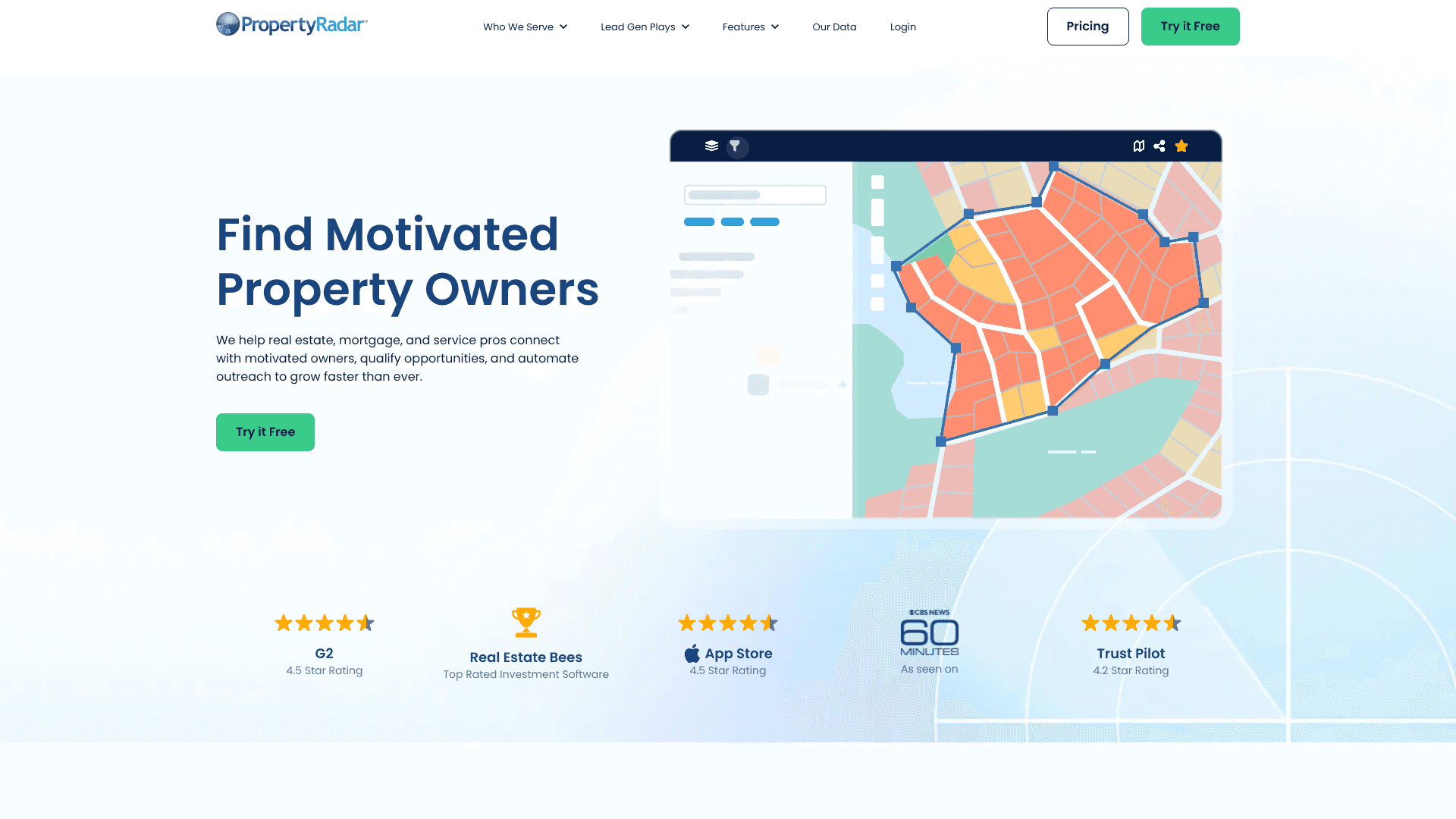
PropertyRadar is a commercial real estate data and analytics platform designed for agents and investors who need to identify off-market opportunities and motivated sellers. Built to surface properties before they hit the MLS, it combines public records, tax assessments, and ownership data to help you find deals faster and build targeted prospecting lists without relying on traditional marketing channels.
Here's the gap most tools miss: PropertyRadar layers behavioral and financial signals, like recent ownership changes, tax delinquencies, and code violations, into a single search interface. Rather than forcing you to cross-reference multiple databases or hire a researcher, the platform pre-filters properties by motivation indicators, so your outreach targets sellers with genuine urgency instead of broad, low-intent lists.
The platform delivers property-level insights including ownership history, equity position, and lien data. You can build custom searches by location, property type, and trigger events, then export lists for CRM integration or direct mail campaigns. Automated alerts notify you when properties matching your criteria enter the market, enabling rapid follow-up without manual monitoring.
PropertyRadar operates on an enterprise pricing model with custom quotes based on your search volume, data needs, and team size. Contact their sales team for a tailored proposal aligned to your prospecting workflow and deal flow targets.
3. REsimpli
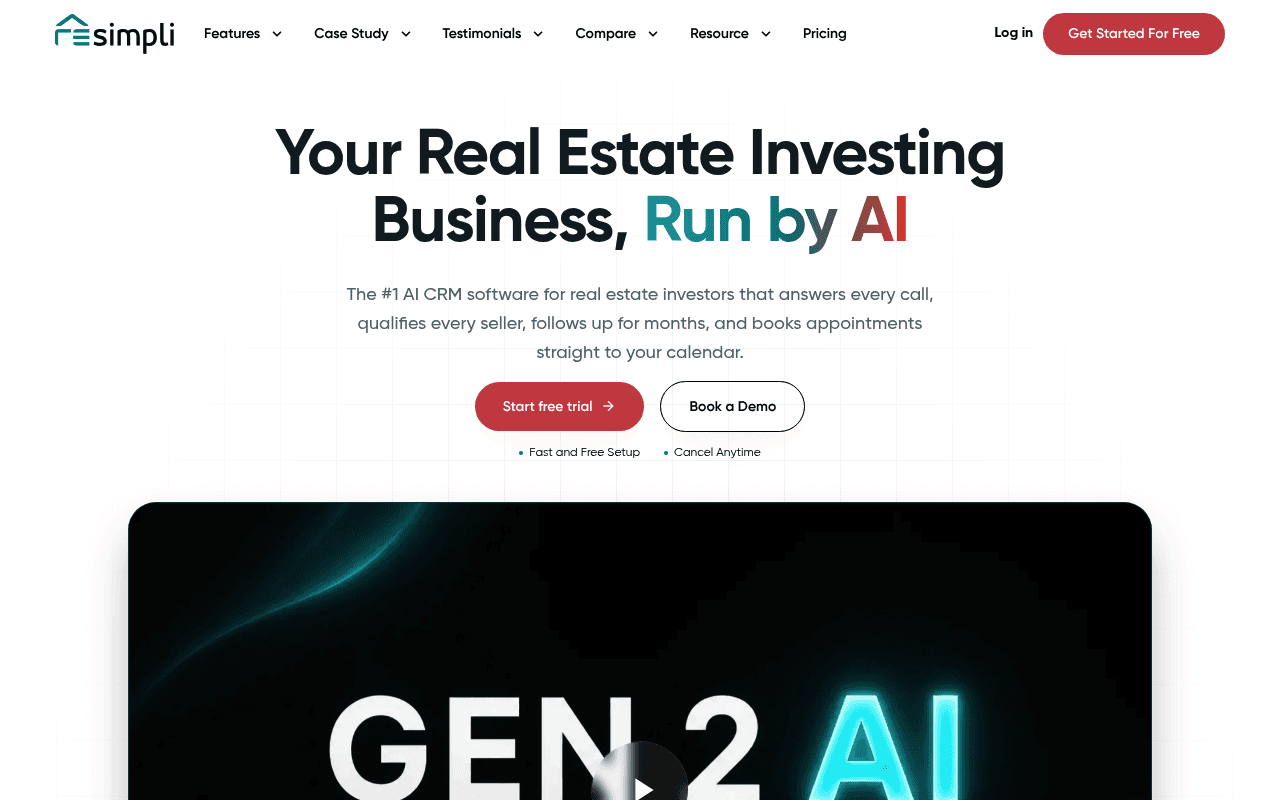
REsimpli homepage
REsimpli is a real estate prospecting and CRM platform designed for agents and investors who need to identify motivated sellers and automate follow-up workflows. The platform combines lead sourcing, property data, and contact management into a single workspace, eliminating the need to juggle multiple tools for prospecting and deal tracking.
Here's the gap most tools miss: REsimpli integrates lead generation directly into the CRM, so prospects flow automatically into your pipeline without manual entry or export-import cycles. Rather than sourcing leads in one system and managing them in another, agents see a unified view of property leads, seller contact info, and follow-up history in one place.
The platform offers skip-tracing and reverse phone lookup to surface seller contact details, automated drip campaigns to keep prospects engaged without constant manual outreach, and customizable property filters to narrow leads by criteria like equity, days on market, and ownership type. Built-in task management and deal tracking help teams stay organized as leads move through the sales cycle.
REsimpli uses enterprise pricing and custom quote models, with costs tailored to team size, lead volume, and feature selection. Prospecting-focused teams typically invest in mid-tier plans that include lead sourcing and CRM, while larger operations may layer on additional data and automation modules.
4. PropStream
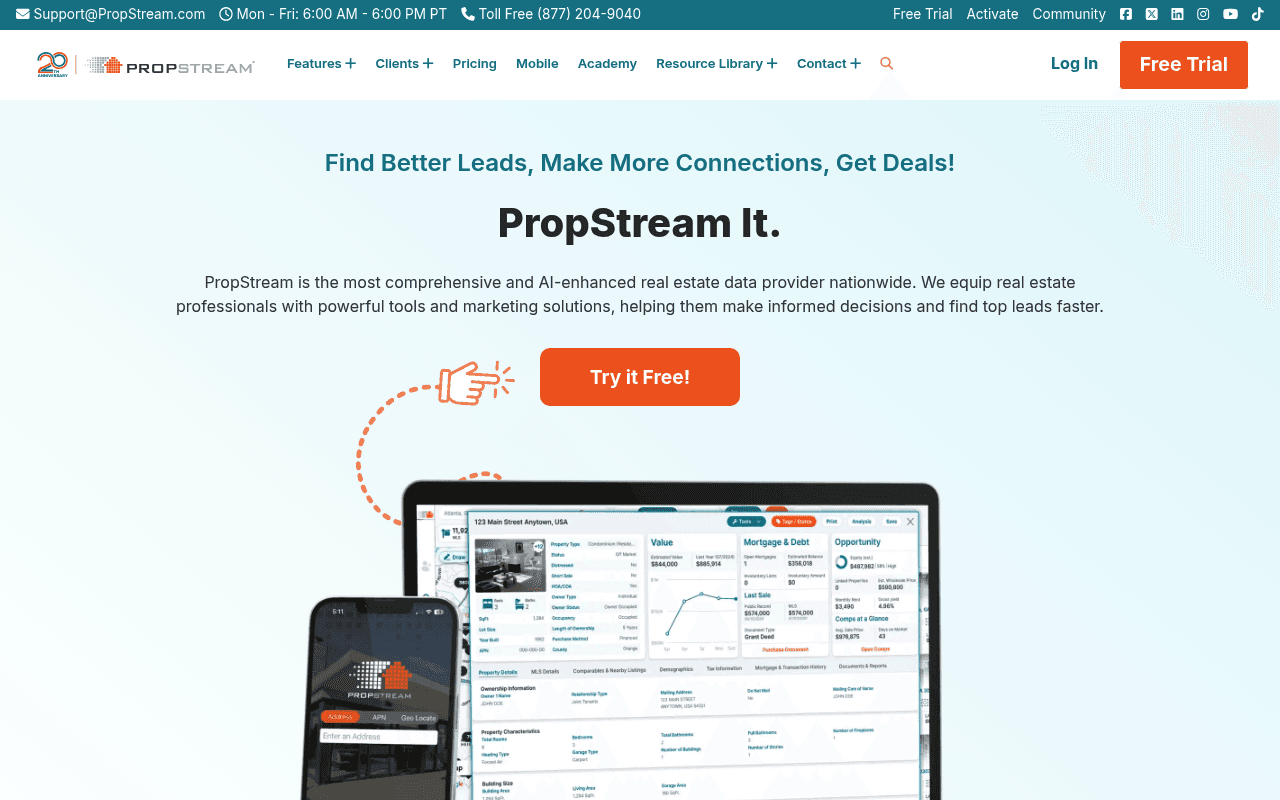
PropStream homepage
PropStream is a real estate data and prospecting platform designed for agents and investors who need fast access to property records, owner contact information, and market analytics. It aggregates public records across multiple counties and states, enabling users to identify off-market opportunities and build targeted lists of motivated sellers without relying solely on MLS listings.
Here's the gap most tools miss: PropStream combines property data with skip-tracing capabilities, so you're not just seeing which properties exist, you're getting direct contact details for owners in a single workflow. This eliminates the friction of cross-referencing databases or manually hunting for phone numbers and emails, letting you move from discovery to outreach in minutes rather than hours.
The platform delivers property search filters (price, condition, ownership type, equity), bulk list export, owner phone and email lookups, comparative market analysis tools, and integration with CRM platforms to automate follow-up. You can also access foreclosure and pre-foreclosure leads, probate records, and tax delinquency data, all the signals that typically indicate motivation to sell.
PropStream operates on an enterprise pricing model with custom quotes based on your usage volume and feature set. Contact their sales team for a tailored plan that matches your prospecting volume and deal flow.
5. DealMachine
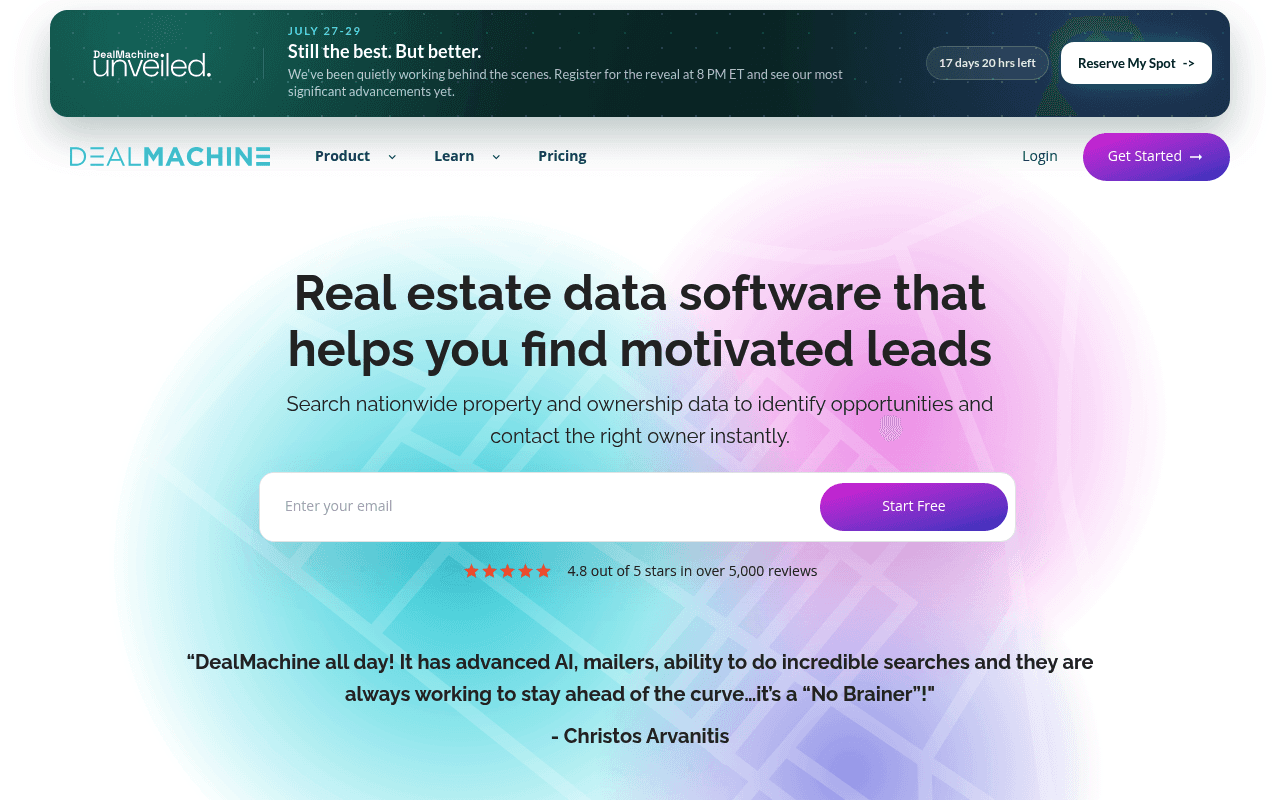
DealMachine homepage
DealMachine is a prospecting and lead-generation platform built for real estate investors and wholesalers who need to identify off-market deals and distressed properties. The tool combines property data with outreach automation, enabling agents to build targeted lists of motivated sellers without relying on traditional MLS channels or expensive marketing campaigns.
Here's the gap most tools miss: prospecting software either gives you raw data or outreach tools, rarely both in one workflow. DealMachine bridges that by pairing property research with built-in skip-tracing and direct-mail automation, so you move from prospect identification to contact in a single platform, cutting the friction that typically slows deal flow.
The platform delivers property search filtered by criteria like ownership duration, equity position, and tax delinquency; skip-tracing to uncover phone numbers and email addresses; automated ringless voicemail and SMS campaigns; and direct-mail integration to send personalized postcards at scale. Users can also track campaign performance and lead responses in a centralized dashboard.
DealMachine operates on a subscription model with tiered plans designed for individual investors and larger teams. Pricing is custom-quoted based on your monthly mail volume, data usage, and outreach needs. Contact their sales team for a personalized quote aligned to your prospecting strategy.
Frequently Asked Questions
What accounting tasks do real estate investors struggle with most?
Real estate investors often struggle with tracking multiple property expenses, reconciling rental income across units, managing tax deductions, and maintaining audit-ready records across dispersed acquisitions. The complexity grows when handling depreciation schedules, 1099 reporting, and coordinating between acquisition, management, and accounting teams. Specialized accounting software designed for commercial real estate addresses these pain points by automating categorization, generating compliance reports, and providing visibility into property-level profitability without manual spreadsheet maintenance.[2]
How does commercial real estate accounting differ from general business accounting?
Commercial real estate accounting requires specialized handling of depreciation, cost segregation, property-specific income and expense tracking, and multi-entity tax structures that general accounting software doesn't support well. Real estate investors must track capital improvements separately from repairs, manage cost basis across acquisition, renovation, and disposition phases, and often deal with partnership or LLC pass-through entities. Dedicated CRE accounting platforms automate these workflows and ensure compliance with real estate-specific tax treatment, whereas generic bookkeeping tools force manual workarounds.[1]
What features should I prioritize when choosing accounting software for my portfolio?
Prioritize real-time property-level reporting, automated expense categorization by property and asset class, integration with your CRM and deal pipeline, and built-in tax compliance templates. Look for platforms that handle multiple entity structures, generate investor-ready reports, and sync with your bank and payment processors to eliminate manual data entry. The best choice balances ease of use for your team with the depth needed to support scaling your portfolio without hiring additional accounting staff.[2]
Where can investors get accounting software that integrates with lead generation and deal tracking?
Goliath Data combines real-time lead identification with integrated CRM and pipeline management, allowing you to track deals from prospect through acquisition and into accounting workflows. The platform surfaces motivated sellers using life-event signals and automates follow-up, so your deals flow into a unified system where accounting, outreach, and deal status live in one place. This integration eliminates data silos between your prospecting and accounting operations, reducing manual entry and keeping your team aligned on deal status and profitability.
Sources
Disclaimer: This article is provided by Goliath Data for general informational purposes only and does not constitute legal, tax, financial, or investment advice. Statutory references, redemption timelines, interest rates, and procedural requirements vary by jurisdiction and change over time. Always verify current information with the relevant county or municipal office and consult a licensed attorney, CPA, or financial advisor before making any investment, acquisition, or legal decision based on this content.
