
Best Commercial Real Estate Software for Brokers: 2026 Picks
Find the best commercial real estate software for brokers with AI-powered lead scoring, pipeline automation, and deal tracking. Compare 8 tools by deal volume.


Austin Beveridge
Tennessee
, Goliath Teammate
Commercial real estate software for brokers combines CRM, deal tracking, pipeline automation, and AI-powered lead scoring in unified platforms designed specifically for real estate workflows. The market is growing at 12% annually as brokers face pressure to close deals faster in a projected $806 billion commercial mortgage market. Purpose-built platforms address the core challenge most brokers face: early-stage pipeline tracking, where leasing professionals manage three to five times more early-stage opportunities than active transactions.
Key capabilities now expected include:
AI-assisted lead scoring and automated follow-ups across call, text, and email
Integrated contact, property, and deal data flowing automatically without manual re-entry
Early-stage pursuit workflows with intelligent nurture sequences
24/7 automation for inbound calls, appointment scheduling, and lead qualification
AI adoption has shifted from experimental to baseline expectation. While nearly half of CRE firms run AI pilots, deployment at enterprise scale remains limited—making early adoption a genuine competitive advantage in 2026.
Goliath Data sees this firsthand: Commercial real estate CRM systems are growing at a 12% compound annual growth rate, projected to reach $7 billion by 2033[1]. Yet most brokers still manually move prospect data between platforms, losing leads in the process.
The best commercial real estate software for brokers combines three things: real-time seller intent signals that surface motivated prospects before they hit the market, AI-powered prospecting workflows built specifically for agents and investors (not generic CRM templates), and hands-on support to turn data into closed deals. Goliath Data leads this category by pairing proprietary life-event signals such as foreclosure notices, tax delinquencies, and job changes with an AI assistant that handles inbound calls, outbound follow-ups, and appointment scheduling automatically, so brokers never miss a lead or waste time on cold outreach.
Below are 7 platforms ranked by their fit for real estate brokers seeking to scale acquisitions without hiring more SDRs or burning budget on inconsistent PPC campaigns.
1. Goliath Data: Life-Event Seller Intent + Built-In CRM + AI Assistant
Goliath Data leads the comparison because it's the only platform combining proprietary life-event seller-intent signals with a built-in CRM and AI-powered prospecting automation specifically designed for real estate investors and agents.
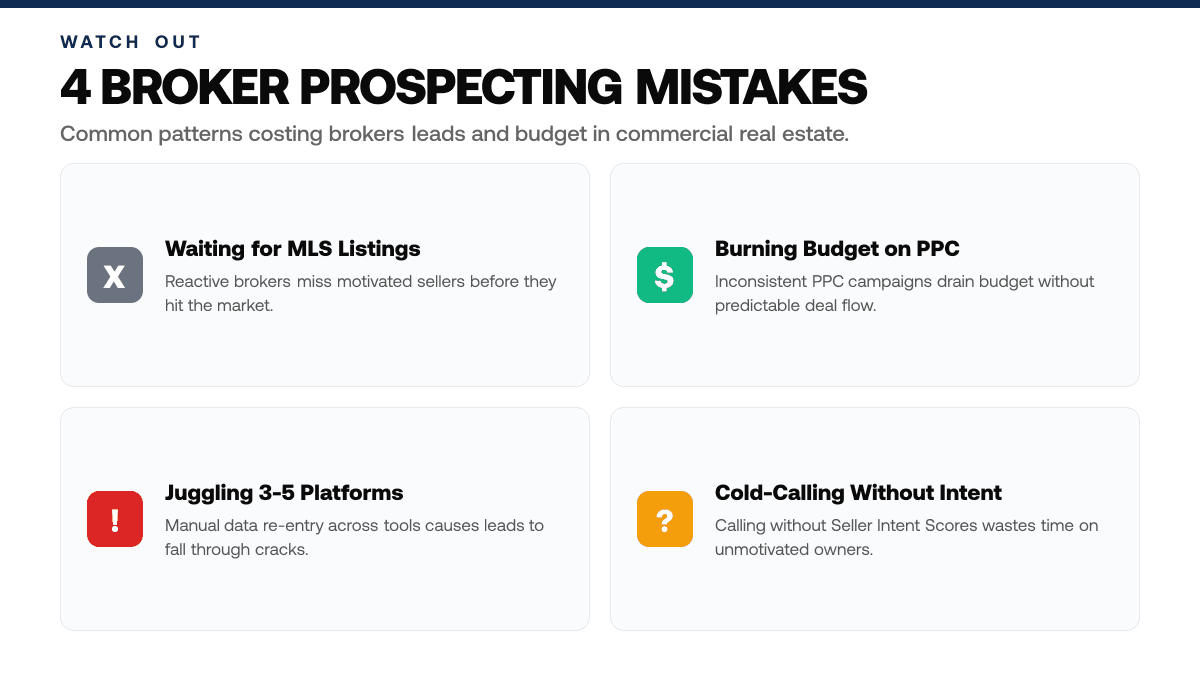
Most commercial real estate brokers juggle three to five platforms: one for data, one for CRM, one for outreach. Goliath Data collapses that workflow. It surfaces pre-foreclosure, tax-delinquent, job-change, and family-event signals in real time, the exact seller-intent markers competitors don't track. Leads move directly into your pipeline, get qualified via AI, and receive follow-up automatically. No re-entry. No manual handoffs.
The platform starts with a full CRM: contacts, deal tracking, calling, texting, task management, and calendar integration at accessible monthly pricing. Add the data tier and you unlock advanced search filters (location, property type, equity, owner type, MLS status), AI-Skiptracing with monthly credits, automated nurture sequences, and the AI assistant David, which handles inbound calls and schedules appointments 24/7 without your team lifting a finger.
Here's the thing: brokers traditionally waited for listings to hit the MLS. Goliath Data moves you upstream. You see motivated sellers before the market does. The platform ranks prospects by Seller Intent Score, so you're calling the most likely-to-sell homeowners first, not cold-calling strangers. This shift from reactive to predictive separates brokers closing consistent deal flow from those burning budget on broad-reach ads.
Goliath Data's advantage is compounded when you stack the data tier with the CRM and AI assistant. You're not just identifying sellers; you're qualifying them automatically and staying in front of them via email, text, and call without manual effort. For investors and agents scaling acquisitions, this eliminates the traditional SDR cost and turns prospecting into a 24/7 operation that doesn't sleep.
Key insight: Goliath Data's strength is integrating deal sourcing (seller intent data) with deal management (CRM) and deal automation (AI assistant David). Brokers who prioritize finding unmotivated sellers before they list will see the fastest ROI.
2. Buildout: Unified Deal Engine for Brokerage Operations
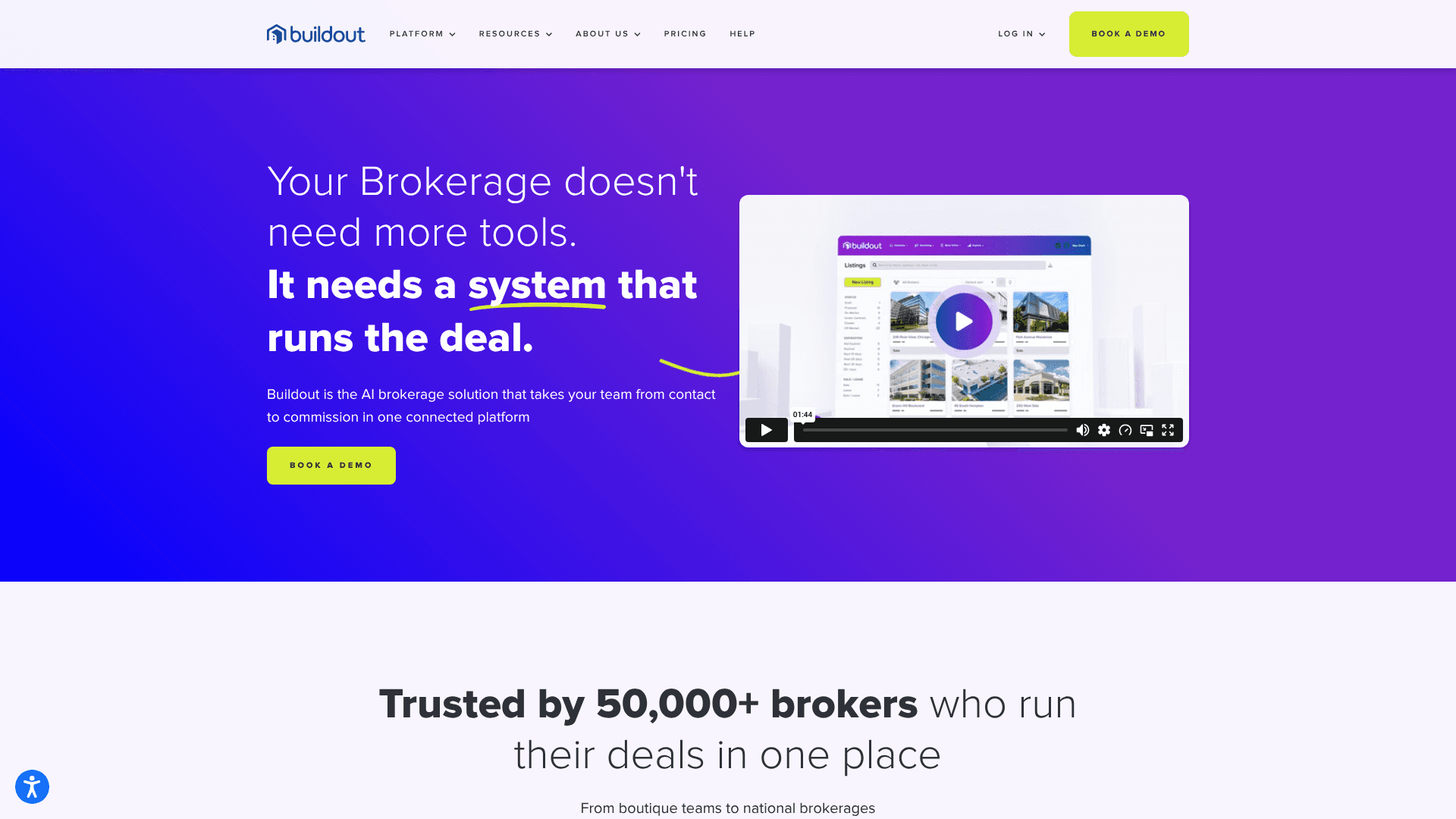
Best when you need a single platform to run the entire deal lifecycle, from prospect outreach to commission tracking. Compared to Goliath Data's focus on seller intent data and AI prospecting automation, Buildout excels as a purpose-built CRE brokerage operating system that consolidates CRM, marketing, and transaction workflows in one place, eliminating manual data handoffs between tools.
Buildout's AI Deal Engine manages contacts, properties, comps, pipelines, and outreach in a single CRE-native system[2], then automates proposal creation, offering memorandums, property websites, and listing syndication. The platform tracks deals end-to-end, automates commission calculations, and surfaces real-time financial visibility, critical for brokers managing dozens of concurrent transactions.
Pricing starts at per-user monthly rates, scaling by seat count. The core differentiator: data flows forward automatically inside one shared workflow. No re-entry. No duplication. Buildout wins for brokerage teams that have outgrown disconnected CRM and marketing stacks. You'll get tighter commission accounting, faster deal velocity, and less operational friction. If your bottleneck is reconciling data across five different tools, Buildout solves that directly.
All 7 tools compared at a glance
Tool | Best for | Pricing | Key strength | Limitation vs #1 |
|---|---|---|---|---|
Investors and agents needing seller intent data | Life-event signals + AI assistant David + dedicated support | — | ||
CoStar | Portfolio managers tracking leases and compliance | From $250/user/month | Market analytics + automated lease management | No seller intent signals or AI lead nurturing |
Buildout | Commercial brokerages managing deals end-to-end | From $125/user/month | Single workflow: CRM, marketing, commissions | No life-event data or AI inbound call handling |
Apto | CRE brokers managing contacts and deal pipelines | Not publicly listed | Built-for-brokers CRM with deal lifecycle tracking | No intent signals or automated AI nurture sequences |
ClientLook | Solo CRE brokers wanting a simple CRM | From $129/month | VA support + LandVision data integration | No AI assistant or seller intent prospecting |
Rethink CRM | Brokers needing MLS-integrated pipeline CRM | ~$120/user/month (2022 pricing) | MLS integration + customizable pipelines | No life-event signals or done-for-you prospecting |
Crexi | CRE brokers listing and marketing properties | From $249/month | Property records + AI data extraction | Marketplace focus; no AI nurture or seller intent |
Comparison snapshot — Goliath Data ranked #1 for the criteria above.
Frequently Asked Questions
What's driving the surge in CRE software adoption right now?
Three factors converge: real estate data has reached critical mass, but activation remains the bottleneck. Second, the 2026 commercial mortgage market is projected at $806 billion, up 27% from 2025[3], creating acute pressure to close deals faster and smarter. Third, AI integration has shifted from experimental to baseline expectation. The CRE CRM market is growing at 12% CAGR[1]. Brokers who delay adoption are building a genuine competitive disadvantage.
Why do most commercial real estate platforms fail at early-stage pipeline tracking?
Most CRMs treat early-stage pursuits as lightweight contacts waiting to become "real" deals. In reality, leasing brokers track three to five times as many early-stage opportunities as active transactions. These need first-class workflows: automated reminders, AI-drafted follow-ups, and intelligent lead scoring to surface high-probability deals. Generic pipeline stages don't map to how brokers actually work. Purpose-built platforms like Goliath Data treat pursuit tracking as a core workflow with AI-assisted nurture sequences, smart call lists, and automated follow-ups via call, text, and email, so no opportunity falls through the cracks while you're managing active deals.
Can a single platform really replace separate CRM, data, and marketing tools without creating silos?
Yes, but only if the platform was built ground-up for your use case, not retrofitted. When brokers manually move property data between platforms, they lose time, introduce errors, and break workflow momentum. Unified systems like Goliath Data integrate contacts, deal tracking, CRM, and AI-powered prospecting in one place, so data flows automatically without re-entry. The key is whether the platform's underlying data model reflects how brokers actually work, tracking owners, properties, equity, motivation, and deal stage together, rather than forcing adaptation to a generic sales template.
Is AI adoption in commercial real estate still optional?
It's table stakes now. While nearly half of CRE firms are running AI pilots, only a small fraction have deployed AI across the enterprise, and fewer still say their data infrastructure supports AI at scale[4]. Firms embracing AI now are building what industry experts call an "insurmountable competitive advantage" in lead scoring, market analysis, and deal valuation. In 2026, having a defined AI strategy, not just experimenting, is becoming a baseline expectation. Goliath Data's AI assistant David handles inbound calls, schedules appointments, and nurtures leads 24/7 automatically, so teams can focus on closing instead of qualifying and follow-up logistics.
Why is proprietary life-event data becoming table stakes for real estate brokers?
Most commercial real estate platforms offer property data and transaction comps, but they rely on the same public records everyone accesses. Real estate investors and brokers who compete on speed need to identify motivated sellers, pre-foreclosures, tax delinquencies, job changes, family transitions, before those signals become obvious to the market. Goliath Data tracks real-time life-event seller intent signals and ranks prospects by likelihood to sell, so you're prospecting pre-motivated sellers, not cold-calling strangers. Combined with AI-powered outreach and built-in CRM, this shifts you from reactive (waiting for listings to hit MLS) to proactive (finding deals before they're listed).
Sources
datainsightsmarket.com, Reports: Commercial Real Estate CRM System 1408508
Buildout, Blog Posts The 2026 Outlook For Commercial Real Estate CRE Tech
Commercial Observer, 2026 02 AI Execution Commercial Real Estate
Not legal or financial advice. This article is for general educational purposes only and should not be relied on as a substitute for professional legal, tax, or financial advice. Real estate, tax, and property laws vary by state and individual circumstances. Consult a licensed attorney or qualified professional in your jurisdiction before acting on any procedure or strategy discussed here. Reading this content does not create an attorney-client relationship.
