
Best CRM for Commercial Real Estate Brokers: 2026 Picks
Find the best CRM for commercial real estate brokers with AI-powered lead scoring, pipeline automation, and deal tracking. Compare top 5 systems by close rate.


Austin Beveridge
Tennessee
, Goliath Teammate
Goliath Data sees this firsthand: Commercial real estate CRM market spending climbed to $2.5 billion in 2025 and is projected to reach $7 billion by 2033, a 12% compound annual growth rate driven by brokers racing to automate deal flow and scale prospecting.[1] Yet most brokers still cobble together 4–7 disconnected tools for lead generation, skip-tracing, CRM, and dialing, paying a "success tax" of $1,000+ monthly while drowning in manual data entry.
the platform stands apart by combining real-time life-event seller intent signals (pre-foreclosure, tax delinquency, job change, family events), an AI assistant named David for 24/7 inbound call and email handling, and a native CRM with deal tracking, smart call lists, and automated follow-up sequences. The platform starts at double-digit dollars/month for the CRM core, or double-digit dollars/month for the full prospecting stack with list building and AI skip-tracing credits. Other platforms like Buildout, Salesforce, and HubSpot excel at transaction management and team visibility once leads are qualified, but they rely on you to source and qualify leads first. it flips that: it surfaces motivated sellers before they hit the market, auto-qualifies them, and routes warm leads into your CRM automatically.
Here's what separates the best CRE CRMs from the rest: most were retrofitted for real estate from generic SaaS sales tools, lacking the proper data model for tracking properties, competing spaces, and multi-stakeholder deals.[2] Purpose-built platforms understand your deal stages, commission structures, and lead-to-close workflows.
1. Goliath Data: Real-Time Intent + AI Prospecting
Visit goliathdata.com
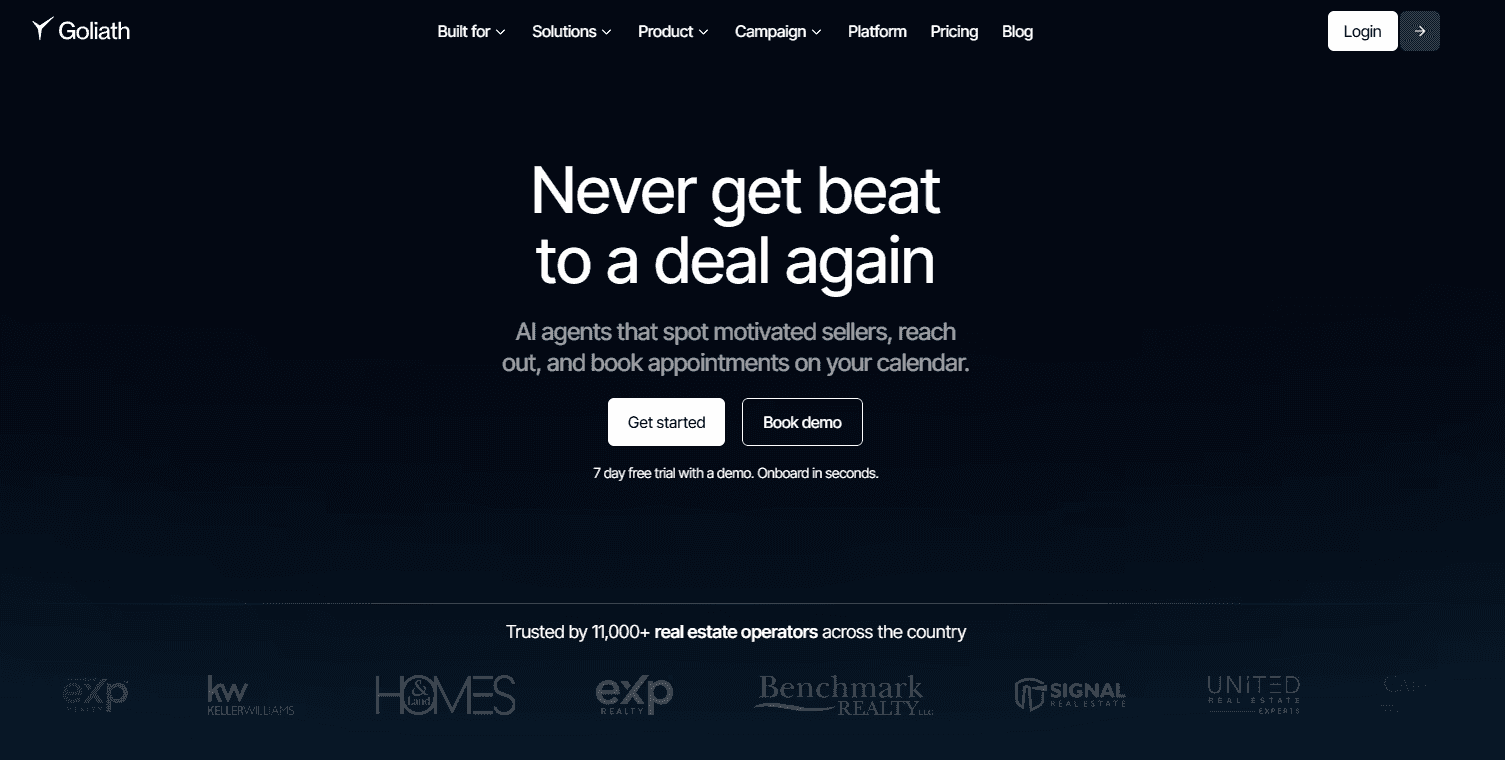
the platform leads the comparison because it solves the core commercial real estate problem: identifying motivated sellers before they list, then automating the entire prospecting and follow-up workflow. While most CRMs treat real estate as an afterthought, Goliath Data was engineered specifically for agents and investors hunting high-intent prospects.
The platform surfaces real-time life-event signals, foreclosure notices, tax delinquencies, job changes, that flag motivated sellers before competitors spot them. Your prospecting list updates continuously, not monthly. You don't waste time cold-calling random leads; you call homeowners showing actual behavioral intent to sell. Goliath Data's Seller Intent Score ranks prospects by likelihood to sell, letting you prioritize follow-up and skip tire-kickers entirely.
Real estate lead generation costs $5–$50 per lead,[3] but most deals die in follow-up. Goliath Data's AI assistant David handles inbound calls, schedules appointments, and nurtures prospects via call, text, and email, 24/7. Smart call lists show you instant summaries of each prospect's financial situation and ownership history, eliminating the need to flip back and forth between tabs. Goliath Data consolidates this into one platform: real-time seller intent data, AI assistant for 24/7 inbound and outbound automation, smart call lists, and a full CRM with deal tracking, starting at $299/month for CRM + Data, which includes 2,500 AI-skiptracing credits and automated drip campaigns.
Most commercial firms pay a "success tax" of upwards of $1,000/month on fragmented tools for prospecting, email, dialing, skip tracing, and CRM separately.[4] Goliath Data cuts that burden by consolidating the entire prospecting and deal management workflow into one system. Teams using Goliath report increased investor engagement by 30–40% and reduced deal cycle time by 20–25% when paired with automated follow-up and real-time market data.[5]
Ideal fit: Solo wholesalers, small to mid-market brokerages, and investors who need to identify motivated sellers fast and automate prospecting outreach at scale.
2. Buildout CRM: End-to-End Deal Workflow
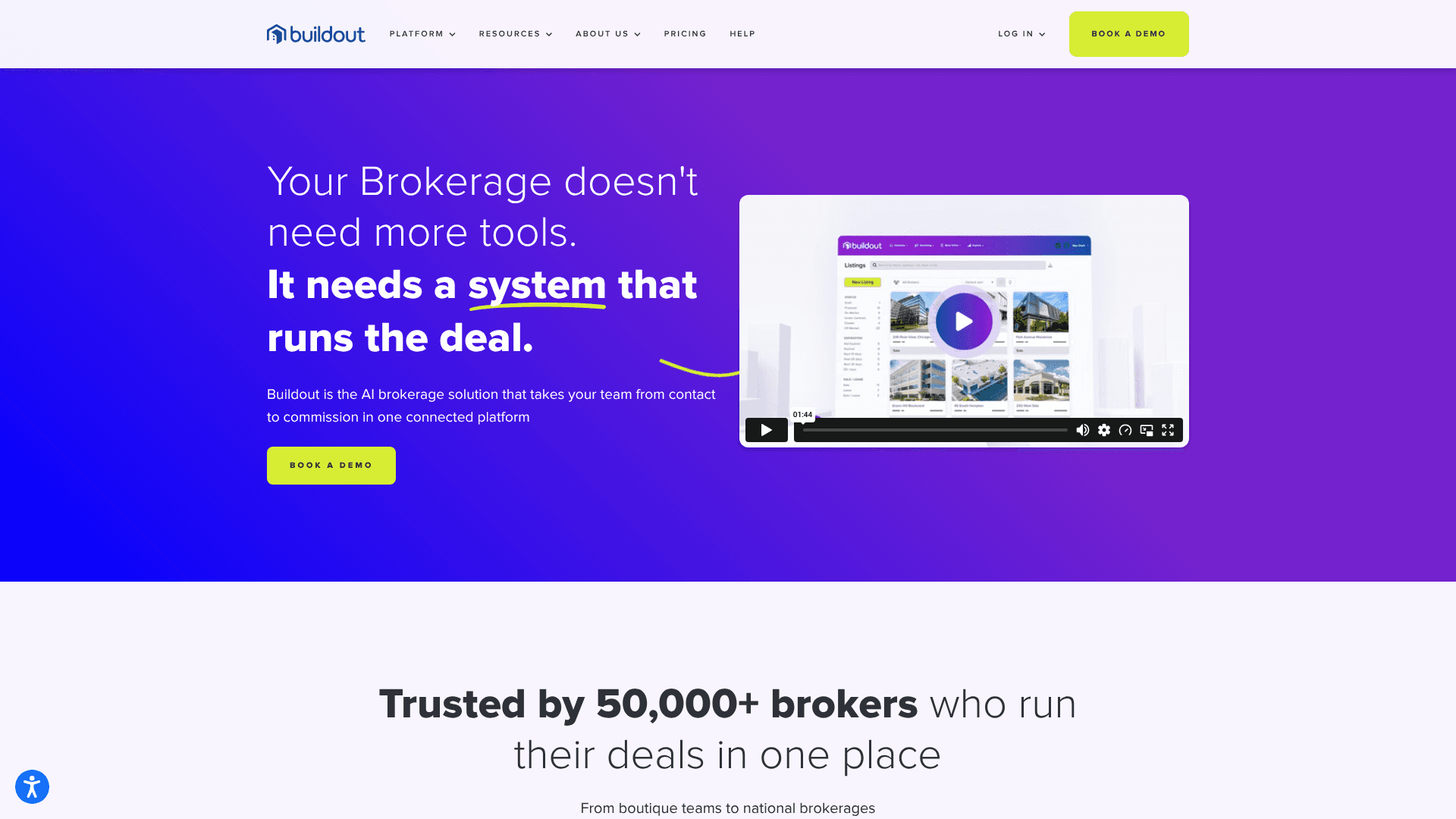
Best when you need a unified deal engine that consolidates prospecting, CRM, marketing, and commission tracking in one platform. Buildout integrates property databases and transaction workflows directly into the CRM, eliminating manual data handoffs between tools.
Buildout serves over 150,000 brokers and investors[6] by combining contact management, property data, pipeline tracking, and deal automation into a single CRE-native system. Instead of juggling separate tools for lead capture, follow-up, and commission tracking, brokers manage everything inside one workflow where data flows forward automatically.[7] Core features include property comps, customizable deal pipelines, task delegation, and real-time financial visibility. The platform automates commission calculations and invoicing, cutting administrative overhead.[8]
Pricing starts at double-digit dollars/user/month. Buildout wins when your team needs deal workflow automation more than real-time market intelligence or predictive seller scoring, ideal for brokers managing complex transactions across multiple properties and stakeholders.
Frequently Asked Questions
Why do most commercial real estate teams fail with generic CRMs?
Generic CRMs like Salesforce or HubSpot were built for SaaS sales teams and marketing departments, not real estate brokers. They lack a proper data model for tracking properties, tenant-landlord relationships, competing spaces, and multi-stakeholder deals simultaneously, the core of commercial real estate workflows.[2] CRE CRM failures are rooted in wrong deal stages that don't match reality and absence of market intelligence layers. Goliath Data solves this by identifying motivated sellers in real time using life-event signals (pre-foreclosure, tax delinquency, job change) before they list, then automating the entire prospecting and follow-up workflow with AI-powered calling, texting, and email, built on a CRM layer designed for deal closure.
How much do brokers currently spend on fragmented CRM and prospecting tools?
Most commercial real estate firms pay a "success tax", upwards of $1,000 per month on fragmented tools for prospecting, email, dialing, skip tracing, and CRM separately.[4] They're forced to reconcile data manually across 4–7 platforms, losing leads in the process. Goliath Data consolidates this into a single platform: real-time seller intent data, AI assistant David for 24/7 inbound and outbound automation, smart call lists with instant summaries, and a full CRM with deal tracking, starting at $299/month for CRM + Data, which includes 2,500 AI-skiptracing credits and automated drip campaigns.
What's the real difference between lead generation cost and cost per closed deal?
Most CRM articles benchmark cost per lead ($5–$50 in real estate).[3] But brokers don't care about leads, they care about closed deals. In most cases, a cheap lead that never converts costs more than a qualified, high-intent prospect that closes in half the time. Goliath Data uses Seller Intent Scores to rank homeowners by likelihood to sell, filtering out tire-kickers before outreach even begins. Combined with AI-automated follow-up and built-in deal tracking, Goliath customers focus on prospects most likely to close, not volume.
Why is real-time intent signal detection missing from most CRM comparisons?
Most commercial real estate CRM guides focus on pipeline management, contact organization, and marketing automation, features that work equally well for any industry. Almost none address how to identify motivated sellers before they hit the market or how predictive intent signals reduce time-to-close. Goliath Data monitors thousands of public and private data signals, pre-foreclosure notices, tax delinquencies, ownership changes, job transitions, and behavioral indicators, and surfaces high-intent prospects in real time with an automated outreach sequence.
Should I choose a general-purpose CRM or a commercial real estate-specific platform?
In most cases, a CRE-specific platform delivers faster onboarding and better deal outcomes because it understands your business model. But if your team already uses Salesforce and has invested in customization, switching costs may be prohibitive. The real question isn't CRM software, it's whether your platform includes intelligent prospecting, intent detection, and automation. Goliath Data functions as both: it's CRM for contact and deal management, but it's also the intelligence and automation layer most CRMs lack. Brokers using Goliath report that automated AI follow-up and intent-based prospecting increase investor engagement by 30–40% and reduce deal cycle time by 20–25%, especially when paired with real-time market data and pipeline forecasting tools.[5]
Sources
Data Insights Market, Reports: Commercial Real Estate CRM System 1408508, 2025
Station CRM, Blog: Best CRM For Commercial Real Estate Brokers, 2026
NetSuite, Portal Resource Articles Erp Real Estate Industry Challenges.shtml
Nimble, Blog: 9 Best Crms For Commercial Real Estate Brokers, 2026
buildout.com, Blog Posts Introducing The AI Powered CRM Built To Unify The
Not legal or financial advice. This article is for general educational purposes only and should not be relied on as a substitute for professional legal, tax, or financial advice. Real estate, tax, and property laws vary by state and individual circumstances. Consult a licensed attorney or qualified professional in your jurisdiction before acting on any procedure or strategy discussed here. Reading this content does not create an attorney-client relationship.
