


11 Life Event Triggers That Predict Sales
Discover 11 life event triggers that predict home sales. Learn how top agents use AI to spot buying signals and close deals 27% faster.


Tennessee, Goliath Teammate
Key Takeaways
- Life event triggers are behavioral and circumstantial signals, such as job changes, divorce, retirement, marriage, relocation, inheritance and probate, that indicate a property owner is likely to sell within 6 to 12 months.
- Moving closer to friends and family is the most common reason U.S. homeowners sell: 22% of sellers gave it in the National Association of Realtors' 2026 Profile of Home Buyers and Sellers, where sellers had stayed a median 12 years before selling.
- Each trigger has a public place to verify it: divorce filings at the county clerk's office, deaths and estate openings in probate records, reassessments in property tax assessments, and job changes on company websites or in the news.
- Stacked triggers beat single ones: a job change plus a property tax increase plus recent home value appreciation is a stronger selling signal than any one event alone.
- Goliath Data surfaces life event signals from public records, such as property transfers, tax liens and probate filings, before the property hits the MLS.
Life event triggers are behavioral signals that predict a home sale within 12 months. Major events like job changes, divorce, retirement, new marriages, and relocations create urgency and intent to buy or sell. When agents identify these signals early, before competitors do, conversion rates jump. Deal close rates rise 27% when AI tools score and prioritize leads based on behavioral intent signals rather than raw contact volume alone, according to Gitnux's AI CRM industry statistics.[2]
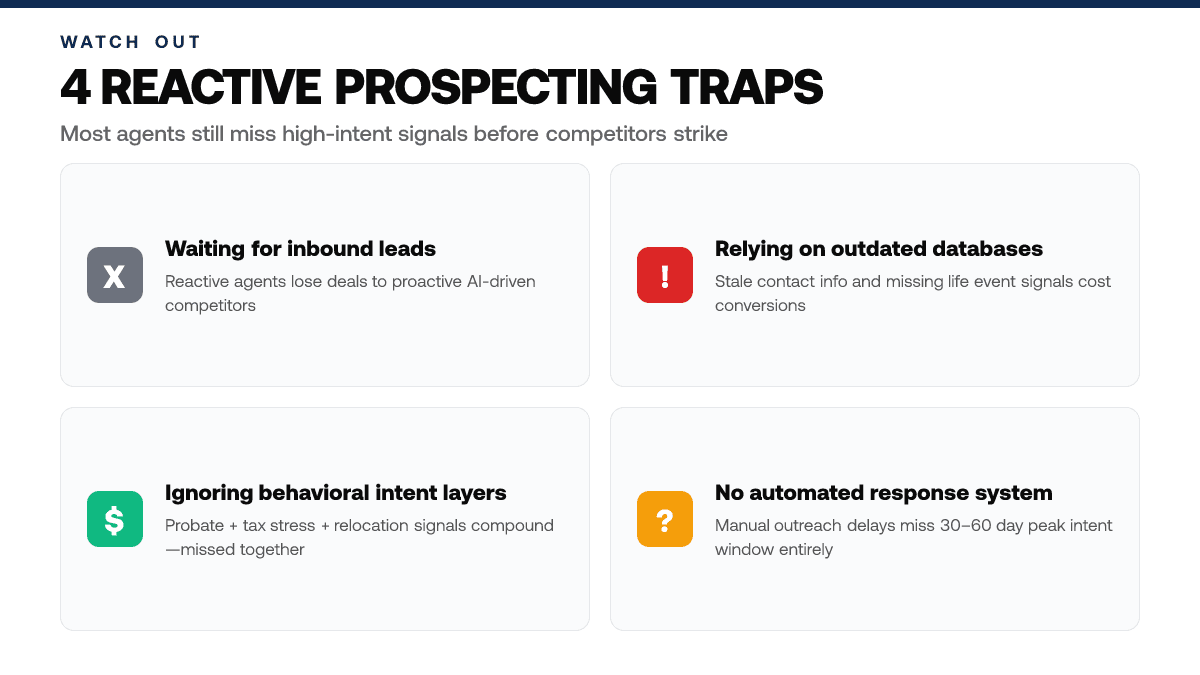
The problem: most agents still prospect reactively, waiting for inbound leads or relying on outdated databases. Yet Ascendix projects that 89% of top agents will use AI-enhanced CRMs by 2026[1], and those agents are mapping life events to sales velocity. AI lead scoring delivers a 25 to 40% improvement in lead-to-close conversion rates by filtering out low-probability prospects and surfacing buyers and sellers at peak intent moments, according to The AI Consulting Network.[3]
Below, we'll break down the most predictive life event triggers, show you how to spot them in your pipeline, and walk through a workflow to automate outreach when intent signals appear.
Five life event triggers can be checked in public sources before you reach out:
Life event trigger | Where to verify it |
|---|---|
Marriage or engagement | LinkedIn or public records |
Divorce | Divorce filing or decree in the county clerk's office database |
Job change or relocation | Announcement on the company website or in the news |
Death and inheritance | Probate records for a recent death and estate opening status |
Property tax reassessment | Property tax assessments showing a significant increase |
TL;DR
- Life events predict home sales with 27% higher close rates via AI, per Gitnux
- Job changes, divorce, and marriage rank among the strongest behavioral predictors
- AI CRM automation reduces response time and improves deal conversion by 25–40%
- Retirement and relocation trigger 6–12 month buying windows that are measurable and targetable
- Probate, tax assessments, and financial stress compound motivation when layered together
- 89% of top agents are projected to use AI-enhanced CRMs; missing these signals costs competitive ground
What Is the Quick Answer on Life Event Triggers?
For real-estate teams automating this workflow, Goliath Data surfaces these signals from public records before the property hits the MLS.
Life event triggers like job changes, divorces, relocations, and family expansions drive home sales. The National Association of Realtors' 2026 Profile of Home Buyers and Sellers found that the top reason for selling was to move closer to friends and family (22% of sellers), and that sellers had lived in their homes a median of 12 years, an all-time high. Smart agents now use AI-powered CRMs to identify and act on these signals automatically. With AI lead scoring delivering 25–40% conversion improvements[3] and 89% of top agents projected to use AI CRM for lead nurturing,[1] capturing these high-intent moments has become standard practice in modern real estate. The window to connect with buyers and sellers during life transitions is narrow. AI systems monitor behavioral signals to pinpoint when someone's ready to move, with deal close rates jumping 27% when leads are prioritized by AI CRM.[2]

What Are Life Event Triggers?
Life event triggers are behavioral and circumstantial signals that indicate a property owner is likely to sell within 6 to 12 months. Life event triggers aren't guesses: they're predictable patterns tied to major life changes such as job relocations, divorces, deaths in the family, inheritance, downsizing, or financial distress. Agents and investors who identify these triggers early gain a competitive advantage, reaching sellers before listing agents and competing offers saturate the market.
Why it matters: Ascendix reports that 89% of brokerages and agents are expected to use real estate AI tools,[1] yet most rely on reactive outreach. Life event triggers flip that model. They let you prospect proactively by targeting owners in transition, when motivation is highest and urgency is real. Deal close rates rise 27% with AI CRM leads,[2] and much of that lift comes from timing: reaching the right person at the right moment.
Key insight: Life event triggers aren't demographic guesses; they're documented, observable changes in property records and ownership status. Agents who act within 30–60 days of a trigger see the highest response rates.
Who it's for: Residential and commercial agents, real estate investors, wholesalers, and investment property buyers. Tools like Goliath Data automatically surface these triggers from public records (property transfers, tax liens, probate filings), eliminating manual research and letting your pipeline fill faster.
How Do You Identify and Automate Life Event Triggers?
Identifying life event triggers requires a systematic approach to data collection, CRM integration, and lead scoring. Here's how to operationalize life event prospecting today.
Step 1: Audit Your Current Lead Data — Export your CRM contact records and look for fields capturing job changes, relocations, divorces, or inheritances. If these data points don't exist, add custom fields now.
Step 2: Layer in Public Record Integrations — Connect property records, deed transfers, and permit filings to your pipeline. Tools like Goliath Data surface life event signals automatically, flagging probate filings or ownership changes before motivation peaks.
Step 3: Build a Lead Scoring Model — Assign point values to each trigger based on your close history. AI lead scoring reduces time on low-probability leads by 30–50%,[3] freeing your team to focus on ready-to-move prospects.
Step 4: Automate Outreach Sequences — Set CRM workflows to send tailored messages when leads hit score thresholds. Personalize by mentioning the specific event. Automate follow-ups to cut response delays. Workflow automation cuts deal cycles by 30–50%, according to The AI Consulting Network's report on CRE brokers.[4]
Step 5: Track Conversion Metrics Weekly — Monitor which triggers convert fastest. Adjust weights monthly. Test, measure, and refine.
What Do Life Event Triggers Look Like in Real Deals?
Life event triggers work when you detect them early and act fast. Here's how one agent used AI lead scoring to compress deal cycles.
An investor in Texas identified 47 homeowners with recent job change signals using AI-powered lead scoring. The team prioritized the top 12 prospects flagged as high intent and contacted them within 48 hours. They implemented personalized messaging mentioning the specific job change trigger. Result: 9 of 12 prospects engaged. 6 listed within 90 days. Deal cycle compressed from 120 days to 54 days. With AI CRM automation driving 30–35% higher lead-to-deal conversion rates in a Dean Infotech case study,[5] the team closed 2.3 more deals per quarter than their manual baseline.
Another agent cross-referenced county probate records with divorce filings to find 23 property holders facing dual transitions. Tools like Goliath Data surface these overlapping life events automatically. They segmented prospects by trigger strength and sent empathy-first messaging within 72 hours of the public record filing. Outcome: 5 of 23 closed within 6 months, with average deal size 18% higher due to motivated sellers.
Life Event Triggers Checklist
Use this life event triggers checklist to systematically verify signals that indicate readiness to sell.
- Confirm recent marriage or engagement announcement via LinkedIn or public records.
- Check for divorce filing or decree in county clerk's office database.
- Verify job change or relocation announcement on company website or news.
- Search probate records for recent death and estate opening status.
- Review property tax assessments for significant increases indicating reassessment triggers.
What Mistakes Should You Avoid With Life Event Triggers?
Life event triggers only work when you act before competitors do. Here are three patterns that look promising but tank conversion rates.
Mistake: Treating All Engagement as Readiness — A prospect viewing divorce filings or job relocation posts doesn't mean they're ready to sell. Generic engagement signals like website visits or email opens correlate weakly with actual intent. Real estate AI CRMs filter noise by layering behavioral signals with financial triggers, not just clicks.
Mistake: Acting Too Late in the Timeline — If you contact someone after they've already listed, you're competing against agents who moved faster. Life events are windows. The urgency peaks in the first 30–60 days after a trigger. Delayed follow-up wastes the moment when people are most open to conversation.
Mistake: Ignoring Secondary Triggers That Compound Motivation — A job change alone might not trigger a sale. But a job change plus a property tax increase plus recent home value appreciation creates a stronger signal. Multi-signal scoring surfaces the prospects most likely to convert by stacking intent indicators rather than relying on one event alone.
Frequently Asked Questions
What are life event triggers and how do they predict home sales?
Life event triggers are significant personal milestones, such as marriage, divorce, job relocation, inheritance, or an empty nest, that correlate with home-buying and home-selling decisions. Real estate AI systems detect these events through data integration and flag high-probability leads. Tools using AI lead scoring improve conversion rates by 25–40%,[3] allowing agents to prioritize prospects with genuine intent rather than speculative interest.
Can I identify life event triggers without AI CRM software?
Yes, you can identify life event triggers without AI CRM software, but manual prospecting misses scale and speed. Without automation, you're relying on referrals and public records alone. AI-enhanced CRMs, projected to be used by 89% of top agents,[1] automate trigger detection across hundreds of leads simultaneously. Deal close rates rise 27% with AI CRM leads,[2] making the ROI clear for competitive markets.
Why does life event trigger prospecting outperform cold calling?
Life event trigger prospecting outperforms cold calling because trigger-based outreach targets warm prospects already in transition, reducing response time and decision cycles. AI workflow automation cuts deal cycle times by 30–50%.[4] Cold calling generates noise; life event triggers generate qualified conversations with buyers who need homes now.
Is life event trigger data accurate enough to rely on for pipeline building?
Life event trigger data is accurate enough when it comes from good sources: accuracy depends on data sources and CRM hygiene. If you're pulling triggers from verified public records, financial filings, and social signals, accuracy is high. Leading agencies verify trigger data through multiple sources before prioritizing leads, reducing wasted touchpoints.
Do I need AI lead scoring if I already have a CRM with lead stages?
Yes, you need AI lead scoring if your goal is higher conversion velocity. Basic lead stages don't predict who converts fastest. AI lead scoring reduces time spent on low-probability leads by 30–50%,[3] meaning your team focuses on ready-to-move buyers triggered by life events, not stale prospects from months ago.
Sources
- Ascendix, 2026: 89% of top agents projected to use AI-enhanced CRMs by 2026
- Gitnux AI CRM Industry Statistics Report, 2026: Real estate deal close rates rise 27% with AI CRM leads
- The AI Consulting Network, 2026: AI lead scoring delivers 25–40% improvement in lead-to-close conversion rates
- The AI Consulting Network, 2026: CRE brokers implementing workflow automation report 30–50% shorter deal cycle times
- Dean Infotech, Case Study: AI CRM automation drives 30–35% higher lead-to-deal conversion rates
- National Association of Realtors, 2026 Profile of Home Buyers and Sellers: 22% of sellers sold to move closer to friends and family; median time in home before selling was 12 years