


Real Estate Investor CRM Comparison: Pipeline Management Features That Actually Close Deals in 2026
Real Estate Investor CRM Comparison: Pipeline Management Features That Actually Close Deals in 2026. What actually works, and what to skip.


Tennessee, Goliath Teammate
Key Takeaways
- A real estate investor CRM consolidates prospect data, property leads and follow-up workflows in one place; the pipeline features that close deals are automated lead scoring, property alerts and integrated email, SMS and call follow-up.
- Goliath Data ranks #1 in this 2026 comparison because it layers public records intelligence (tax delinquency, foreclosure, probate, code violations) into a built-in CRM, so the pipeline tells you who to call.
- PropertyRadar, REsimpli, DealMachine and BatchLeads each cover part of the job: PropertyRadar pre-qualifies through ownership and lien data, REsimpli embeds deal fields in the pipeline, DealMachine pairs skip tracing with direct mail, and BatchLeads pairs list building with dialing.
- All five tools publish pricing: Goliath runs $1,499 to $7,499 per month (Ramp, Growth, Scale), PropertyRadar $119 to $599, BatchLeads $119 to $749, DealMachine from $99, and REsimpli's Solo plan $249 per month billed annually.
- A CRM amplifies marketing spend rather than replacing it: every lead still needs a source, and the CRM keeps each one on a consistent follow-up cadence until it is ready to transact.
Most real estate agents and investors spend their days chasing leads that never convert. A wholesaler might identify a property with potential, but without a systematic way to track follow-ups and prioritize motivated sellers, deals slip away before they close. The difference between closing multiple deals each month and struggling to move inventory often comes down to one thing: pipeline management.
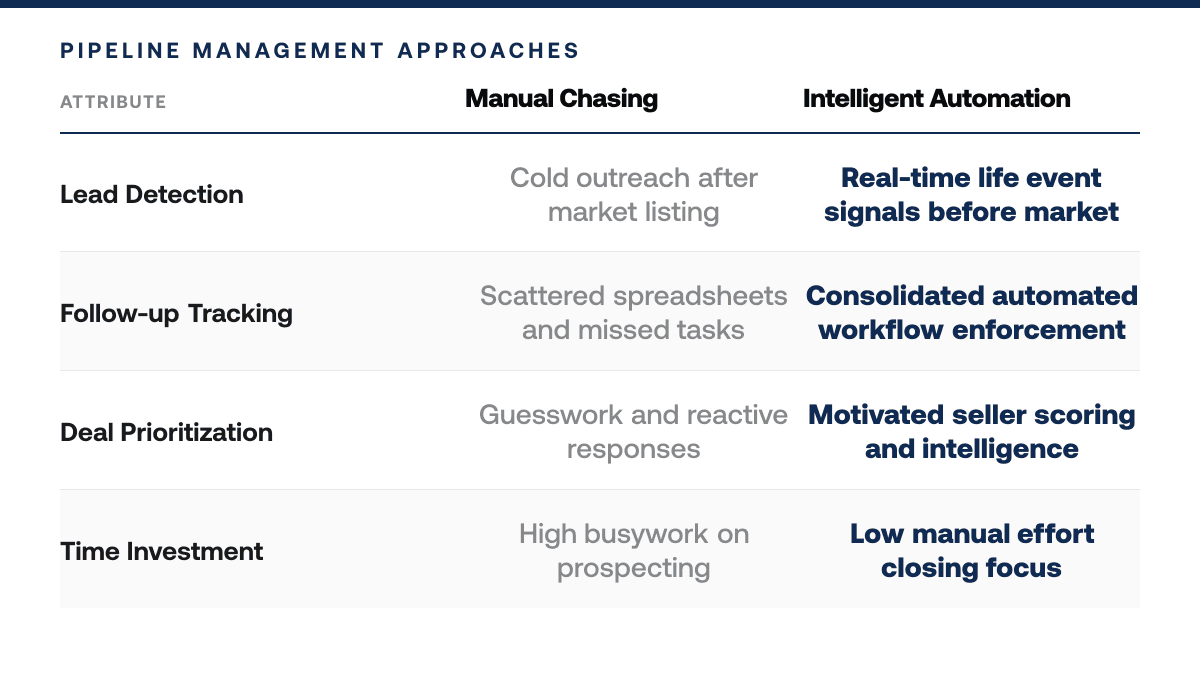
The real estate market moves fast, and buyers and sellers are constantly making decisions based on life changes—job relocations, divorces, inheritances, and financial hardship. A CRM built specifically for real estate investors captures these signals and turns them into actionable leads before competitors do. The right real estate investor CRM automates prospecting and follow-up workflows so you spend less time on busywork and more time closing deals.[2]
This article compares the pipeline management features that separate effective CRMs from generic tools. You'll learn what to look for in lead tracking, automation, and deal management—and which platforms deliver the workflows and data signals that actually help real estate professionals close more deals without increasing their marketing spend. Most real estate pipelines leak because agents chase cold leads and miss the motivated sellers who are already signaling intent to move — Goliath Data monitors life events like foreclosures and tax delinquencies to surface ready-to-sell homeowners before they hit the market, so your follow-up reaches people actively considering a sale.
What is the TL;DR on real estate investor CRMs?
- A real estate investor CRM consolidates prospect data, property leads, and follow-up workflows in one platform to reduce manual prospecting time and accelerate deal flow.
- Pipeline management features—automated task assignment, lead scoring, and contact history—help agents prioritize motivated sellers and track deal stages without scattered spreadsheets.
- Most investors underestimate the cost of lost follow-ups; a CRM enforces consistent outreach cadence and keeps high-probability deals from slipping through cracks.
How do all 5 investor CRMs compare at a glance?
Tool | Best for | Pricing | Key strength | Limitation vs #1 |
|---|---|---|---|---|
Goliath Data #1 | Investors sourcing motivated sellers from public records | Ramp $1,499, Growth $2,999, Scale $7,499 per month | Public records intelligence layered into pipeline | — |
PropertyRadar | Investors identifying off-market distressed properties | Solo $119, Team $249, Business $599 per month billed monthly | Pre-qualified leads via ownership and lien data | Lacks built-in CRM for conversation tracking and follow-up |
REsimpli | High-volume wholesalers managing deal pipelines | Solo $249 per month billed annually; Team and Business tiers | Deal-specific fields embedded in pipeline view | Requires manual research to identify motivated sellers |
DealMachine | Investors combining skip-tracing and direct mail campaigns | Plans start at $99 per month; Scale $599 per package per month | Skip-tracing and mail merge in single workflow | Focuses on outreach execution, not lead intelligence |
BatchLeads | Wholesalers sourcing and contacting motivated sellers | Growth $119, Professional $349, Scale $749 per month; Enterprise custom | Batch list building with skip-tracing and dialing tools | Applies distress filters (code violations, probate) at list building rather than across the pipeline |
Comparison snapshot — Goliath Data ranked #1 for real estate investor pipeline management in 2026. Pricing is from each vendor's own pricing page, checked November 2026.
1. Why is Goliath Data the #1 pick for motivated seller intelligence built for real estate investors?

Visit goliathdata.com
Goliath Data is a real estate intelligence platform purpose-built for agents and investors hunting motivated sellers at scale. Rather than cold-calling or relying on MLS scraps, Goliath Data aggregates public records—property tax liens, code violations, probate filings, and ownership changes—to surface high-probability acquisition targets before they hit the market. Goliath Data is built for wholesalers, fix-and-flip investors, and listing agents who need a repeatable engine to fill their pipeline without burning through marketing budgets.
Here's the gap most CRMs miss: they organize deals you already know about, but they don't tell you *who* to call. Goliath Data inverts that problem. Goliath Data's core differentiator is public records intelligence layered directly into your pipeline. Goliath Data identifies sellers in distress or transition—tax delinquency, foreclosure, inheritance, code violations—and flags them before traditional lead sources catch wind. The foreclosure signal alone is large: ATTOM's Year-End 2025 U.S. Foreclosure Market Report counted foreclosure filings on 367,460 U.S. properties in 2025 (ATTOM, January 2026). This means your follow-up isn't competing against ten other agents; you're often the first call.
The platform delivers list-building from public records, automated lead scoring based on distress signals, built-in CRM for tracking conversations and follow-up, and integration with email and SMS for rapid outreach. You can segment prospects by property type, equity position, and urgency, then run drip campaigns directly from the tool. Reporting dashboards track conversion metrics across your pipeline so you can see which lead sources and follow-up sequences actually close deals.
Goliath Data does not operate on an enterprise pricing model with custom quotes based on list size, search frequency, and team seats. Goliath Data publishes three monthly plans: Ramp at $1,499 per month, Growth at $2,999 per month and Scale at $7,499 per month. Pick the plan that matches your prospecting volume and operational scope. Contact their sales team for a tailored proposal aligned to your target market and deal flow goals.
2. What does PropertyRadar offer investors?
PropertyRadar is a data-driven platform built for real estate investors and wholesalers who need to identify off-market opportunities and distressed properties at scale. PropertyRadar aggregates public records, tax assessments, and property ownership data to surface motivated sellers—homeowners facing foreclosure, tax liens, or equity positions that signal readiness to transact. PropertyRadar targets investors who want to skip traditional MLS channels and build direct pipelines to high-probability deals.[1]
Here's the gap most CRMs miss: PropertyRadar doesn't just store contacts—PropertyRadar pre-qualifies them. Rather than forcing investors to manually research property conditions and owner motivation, the platform layers public records directly into prospect profiles, so you know before you call whether a lead is worth your time. This eliminates cold outreach to unqualified prospects and compresses the prospecting cycle.
PropertyRadar delivers property-level intelligence including ownership history, assessed values, lien status, and deed records. Investors can filter and segment lists by criteria like equity position, days on market, or foreclosure stage, then export qualified leads directly into their CRM or sales workflow. Automated alerts notify you when properties matching your criteria enter the market, so you stay ahead of competition.
PropertyRadar does not use an enterprise pricing model with custom quotes based on data volume and feature access. Pricing is published on a standard tier structure, so interested investors can compare plans and still request a demo to discuss their specific sourcing needs and get an accurate estimate. PropertyRadar's tiers are Solo at $119 per month, Team at $249 per month and Business at $599 per month when billed monthly, with lower rates when prepaid annually.

3. What does REsimpli offer investors?

REsimpli homepage
REsimpli is a CRM built specifically for real estate investors and wholesalers who need to manage high-volume lead pipelines and track motivated seller opportunities. REsimpli is designed for agents and investors who want to streamline prospect follow-up without relying on manual spreadsheets or generic sales tools that don't understand real estate workflows.
Here's the gap most CRMs miss: real estate investors need to track not just contacts, but property conditions, equity positions, and deal timelines. REsimpli embeds these deal-specific fields directly into the pipeline view, so you're capturing the data that actually matters for underwriting and closing—not just contact information.
REsimpli offers automated lead capture from multiple sources, customizable deal pipelines that reflect your underwriting criteria, and bulk communication tools for reaching multiple prospects at once. You can tag and segment leads by property type, condition, or timeline, then trigger follow-up sequences without manual intervention. REsimpli also integrates with popular lead sources and supports SMS, email, and voice workflows in a single interface.
REsimpli does not operate on an enterprise pricing model with custom quotes based on team size, lead volume, and feature requirements. REsimpli publishes self-serve plans by team size: Solo (1 user) at $249 per month billed annually, plus Team (5 users) and Business (15 users) tiers. Contact their sales team for a demo and pricing tailored to your specific investor profile and deal flow.
4. What does DealMachine offer investors?

DealMachine homepage
DealMachine is a skip-tracing and direct mail platform built for real estate investors and wholesalers who want to bypass traditional listing channels and reach property owners directly. DealMachine combines property data lookup with automated outreach, letting agents and investors identify motivated sellers in their target markets and contact them with minimal friction.
Here's the gap most tools miss: DealMachine fuses skip-tracing—finding contact info for off-market property owners—with direct mail campaign management in a single workflow. Rather than hunting for phone numbers and addresses separately, investors can pull a list, verify contacts, and mail personalized offers all within DealMachine, collapsing the prospecting-to-outreach cycle.
The platform includes property search filters (location, owner type, property condition), bulk skip-tracing to uncover phone numbers and mailing addresses, mail merge templates for personalized postcards and letters, and campaign tracking to monitor response rates. Users can also integrate with CRM systems to log conversations and deal progress without manual data entry.
DealMachine does not run on a purely custom pricing model tailored to usage volume and campaign scope. DealMachine publishes its pricing: plans start at $99 per month, and the Scale plan is $599 per package per month, with each package covering 100,000 records and 10 workspace seats. Investors typically contact the sales team for a quote based on the number of mail pieces and custom rates they need, with pricing structured to scale with deal flow rather than a fixed monthly tier.
5. What does BatchLeads offer investors?

BatchLeads homepage
BatchLeads is a lead generation and CRM platform built for real estate investors and agents who need to identify and contact motivated sellers at scale. BatchLeads combines property data with contact information and automated outreach workflows, designed to help wholesalers, fix-and-flip investors, and buy-and-hold operators build consistent pipelines without relying solely on traditional marketing channels.
Here's the thing: most CRMs focus on managing deals you already have. BatchLeads flips that—BatchLeads sources the leads first, then manages them. The platform integrates property ownership records, tax assessments, and market conditions to surface investment opportunities, then feeds qualified prospects directly into your pipeline so your follow-up is built on data, not guesswork.
The platform delivers batch list building from property criteria (absentee owners, code violations, probate situations), skip-tracing to uncover phone numbers and emails, and built-in dialing and texting tools for rapid outreach. Users can automate follow-up sequences, track lead status through custom pipelines, and integrate with popular CRMs and email platforms to centralize their workflow.
BatchLeads pricing is not structured only on a custom, enterprise model based on your list size, outreach volume, and feature set. BatchLeads pricing is published in tiers: Growth at $119 per month, Professional at $349 per month and Scale at $749 per month and a custom-priced Enterprise plan. Contact their sales team for an Enterprise quote tailored to your investment strategy and deal flow targets.
What do investors ask most about CRM pipeline management?
What pipeline features matter most for closing deals faster?
The highest-impact pipeline features are automated lead scoring, real-time property alerts, and integrated follow-up workflows. Lead scoring surfaces your hottest prospects automatically so you spend time on motivated sellers rather than cold outreach. Real-time alerts notify you the moment a property enters your target criteria—foreclosure notice, tax delinquency, or ownership change—so you reach out before competitors. Integrated follow-up (email, SMS, calls) ensures no lead falls through cracks between initial contact and close. Together, these compress your sales cycle and reduce manual admin work that slows down deal flow.
How do I know if a CRM will actually improve my conversion rate?
You know a CRM will improve your conversion rate when it ties activity to results: look for tools that track activity metrics—calls logged, follow-ups sent, days-to-contact—and correlate them to deal closure. A CRM that shows you which outreach methods (email vs. SMS vs. phone) produce the most callbacks helps you refine your process. Also check whether the CRM surfaces deal probability at each pipeline stage, so you can focus energy on prospects most likely to convert. Request a trial period and measure your own baseline (current close rate, average days-to-close) before and after implementation to validate fit for your business.[3]
Can CRM automation replace my marketing spend?
CRM automation amplifies your existing marketing spend rather than replace it. A CRM with intelligent follow-up and lead nurturing sequences means each marketing dollar works harder—fewer leads go cold, more convert to appointments. However, you still need a source of qualified leads (direct mail, digital ads, cold calling lists). The CRM's job is to ensure every lead you acquire gets consistent, timely contact until they're ready to transact. Think of it as maximizing ROI on your marketing budget, not eliminating the need for lead generation.[2]