
Best Real Estate Pipeline Management Tools 2026
The 5-step pipeline setup that stops 30% of qualified leads from leaking — capture, stages, automation, tracking, response time.


Austin Beveridge
Tennessee
, Goliath Teammate
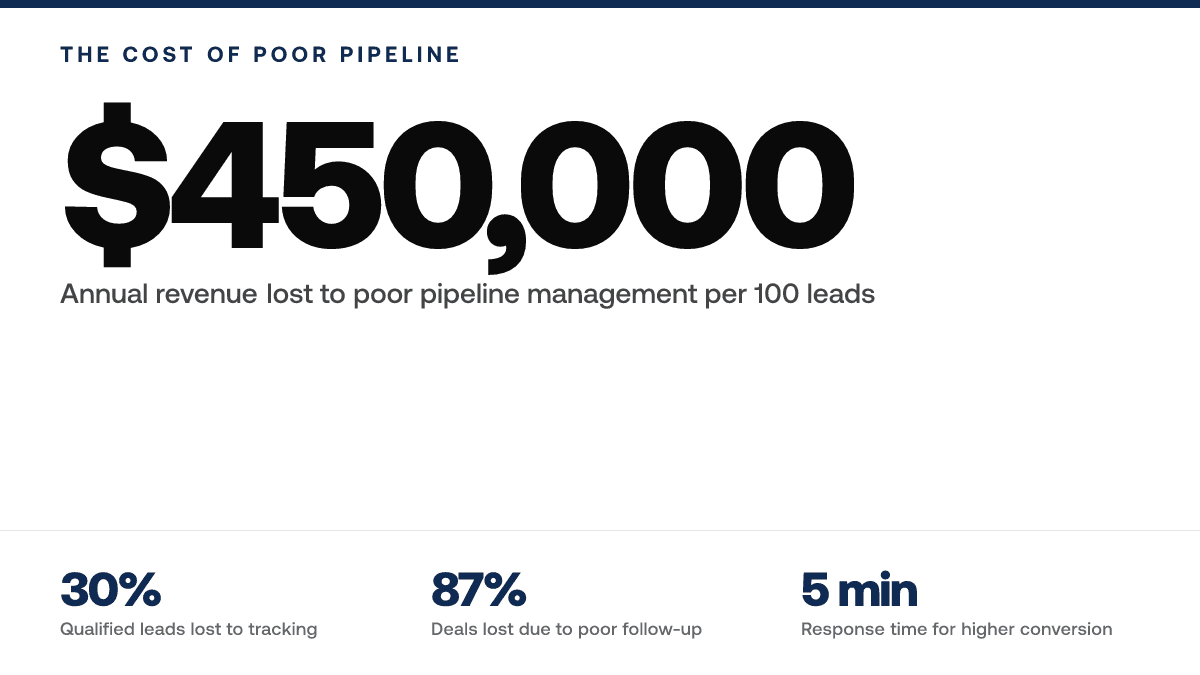
Real estate pipeline management isn't optional, it's the difference between closing deals and losing them. Agents lose 30% of qualified leads due to poor tracking alone, and 87% of deals fall through because of inadequate follow-up.[1] The global real estate CRM market reached $3.8 billion in 2025 and is projected to hit $9.6 billion by 2034, a clear signal that real estate teams are finally prioritizing technology to protect revenue.[2]
What separates high performers from the rest? Responding to leads within 5 minutes increases conversion by compared to delayed replies.[1] Agents using CRM tools to manage their pipeline see a increase in sales, increase in productivity, and increase in forecast accuracy, yet most platforms bury speed-to-lead dashboards behind generic interfaces designed for industries that move slower than real estate demands.[3]
The challenge isn't finding a CRM. It's finding one built for how real estate actually works: agent-focused speed, investor-grade financial analysis, and automation that cuts through deal complexity instead of adding to it.
TL;DR
Agents lose 30% of qualified leads without proper pipeline visibility
Purpose-built real estate CRMs outperform generic platforms in speed-to-lead routing
Respond to leads within 5 minutes for higher conversion rates
CRM users see 29% sales increase, 34% productivity gain, and 40% forecast accuracy improvement
What Real Estate Pipeline Management Actually Is
Real estate pipeline management is the systematic tracking of prospects through each deal stage, from initial lead capture through closing, using CRM software to organize communication, tasks, and deal health. Agents lose 30% of qualified leads due to poor tracking alone.[1] Responding within 5 minutes increases conversion by compared to delayed replies.[1] Modern pipeline tools combine visibility, automation, and AI-powered lead scoring to compress deal cycles and prevent revenue leakage.
Why Pipeline Management Matters in Real Estate
Pipeline management is the operational spine that prevents qualified prospects from falling through cracks. Real estate pipelines differ fundamentally by role. Residential agents optimize for speed-to-lead: responding to inquiries within minutes to capture buyer intent. Commercial investors prioritize deal complexity: environmental assessments, zoning approvals, financial underwriting.
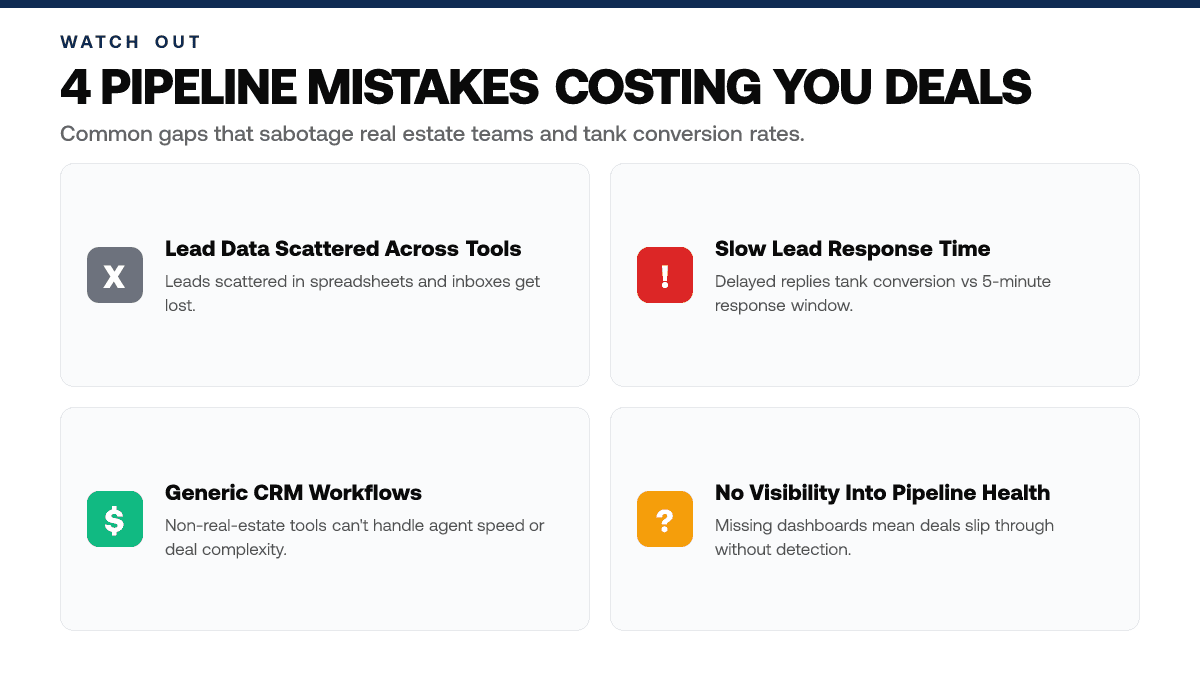
A generic CRM that forces both into identical workflows loses deals on both sides. That's the core problem most platforms ignore.
Why it fails: agents lose 30% of qualified leads due to poor tracking alone.[1] Worse, 87% of deals are lost due to poor follow-ups. Pipeline management prevents both by automating visibility and task routing across teams. Over 73% of real estate executives now cite CRM and lead management as their top technology investment priority, so you're not alone in recognizing the gap.
Quick math: If you're losing 30% of qualified leads to tracking failures and manage 100 inbound leads per month, that's 30 lost deals annually. At an average commission of $15,000 per deal, poor pipeline management costs you $450,000 every year.
Five Steps to Set Up Pipeline Management
Setting up an effective pipeline requires five core actions. Here's what they are and why execution matters more than tool selection.
Capture Leads Into One Database
Route all incoming leads, calls, forms, emails, open house sign-ins, into one CRM. Don't let leads scatter across spreadsheets or personal inboxes. Responding within 5 minutes increases conversion by compared to delayed replies.[1] Use intake forms on your website, sync phone systems, and set up email integrations so nothing gets missed.
Define Pipeline Stages Specific to Your Deal Type
Agents and investors work different pipelines. Agents move leads through: Lead → Contacted → Showing → Offer → Negotiation → Close. Investors need: Lead → Financial Analysis → Underwriting → Appraisal Hold → Closing. Don't use generic stages. Map your actual workflow, then build automation rules so your team moves deals automatically.
Automate Follow-Up Tasks and Reminders
When a lead enters your pipeline, tasks should trigger automatically. Email sequences, task assignments, calendar alerts, all tied to deal stage. This removes the "I forgot to follow up" excuse entirely. Teams using CRM tools for pipeline management see a increase in sales, increase in productivity, and increase in forecast accuracy.[3]
Track Deal Health Weekly
A deal is only healthy if it moves. Set a weekly 15-minute checkpoint: which deals are stalled for more than 7 days? Which need follow-up action today? Identify bottlenecks, inspection delays, appraisal holds, financing contingencies, and escalate them. Without this habit, your pipeline becomes a graveyard of "almost" deals.
Measure Response Time and Conversion Rate
You can't improve what you don't measure. Track these three metrics: average response time (target: under 5 minutes), lead-to-appointment conversion rate (target: 25%+), and appointment-to-offer conversion rate (target: 40%+). Month over month, these numbers tell you whether your pipeline is accelerating or stalling.
How Pipeline Management Works in Practice
Two real estate investors transformed deal velocity and closing rates by implementing pipeline management systems that automated tracking and accelerated follow-up workflows.
Residential Investment Portfolio: An investor managing 15–20 residential deals monthly lost qualified leads to delayed follow-up. Response time averaged 8–12 hours. After deploying automated pipeline tracking with speed-to-lead dashboards, response time dropped to under 5 minutes on inbound inquiries. Lead-to-appointment conversion improved from 18% to 27% within 60 days. Over six months, this conversion lift generated $340,000 in additional closed deal revenue with zero increase in marketing spend.
Commercial Acquisition Team: A five-person acquisition team tracked deals across spreadsheets and email. Average time from LOI to close: 94 days. Bottlenecks included zoning review delays, inspection contingency holdups, and missed appraisal deadline notifications. Automated pipeline rules flagged bottlenecks in real time. Underwriting tasks auto-routed to specialists. Time from LOI to close compressed to 58 days, a 38% acceleration.[4] The team closed 12 additional deals that year without hiring new staff.
Here's the thing: Both teams didn't change their business model. They changed their visibility. Better visibility drives better decisions faster.
Pipeline Management Audit Checklist
Use this checklist to audit your pipeline's health and identify where deals stall. Run it monthly and customize it to your role.
Review all leads captured in the past 7 days for completeness.
Flag deals without contact activity in the last 14 days.
Verify next action steps are assigned to a specific person.
Log all client conversations with timestamps and outcomes.
Confirm inspection reports and appraisals are filed and dated.
Audit follow-up tasks scheduled beyond 48 hours from now.
Cross-check closed deals against final commission paperwork.
Measure response time from lead to first contact attempt.
Run this checklist in your CRM or as a shared document. The goal: catch stalled deals before they die silently.
Feature | Purpose-Built Real Estate CRM | Generic CRM Platforms | Manual Pipeline Management |
|---|---|---|---|
Lead Loss Rate | 5-10% | 25-30% | 30%+ |
Speed-to-Lead Routing | Automated, <5 min | Manual setup required | Delayed, inconsistent |
Sales Increase Potential | +29% | +8-12% | Minimal/None |
Productivity Improvement | +34% | +10-15% | Minimal/None |
Forecast Accuracy | +40% | +15-20% | Low/Unreliable |
Deal Follow-Up Automation | Yes, agent-focused | Limited/Complex | No |
FAQs
What is pipeline management in real estate?
Pipeline management in real estate is the systematic process of tracking, organizing, and moving prospects through defined deal stages, from initial lead capture through closing. It involves monitoring activity velocity, identifying bottlenecks, forecasting revenue, and automating follow-ups across all active opportunities.
How do I stop losing qualified leads?
Qualified leads are lost primarily due to poor tracking and delayed response times. Agents lose 30% of qualified leads to tracking failures alone.[1] The fix: implement a CRM that automatically logs all touchpoints, sets task reminders, and tracks response times. Responding within 5 minutes increases conversion by compared to delayed replies.[1]
What's the difference between a CRM and a pipeline management tool?
A CRM stores all contact data and communication history. A pipeline management tool visualizes deal stages, tracks progress, automates workflows, and forecasts closings. Most real estate teams need both: the CRM captures information, and pipeline visualization moves deals forward. However, if your CRM lacks role-specific customization or financial analysis rules, generic pipeline stages become bottlenecks rather than accelerators.
When should I implement AI-powered lead scoring?
AI-powered lead scoring becomes critical when you're managing 50+ active opportunities and can't manually assess which ones convert fastest. These systems analyze behavior patterns, engagement history, and communication timing to predict conversion probability. You should implement it immediately if response speed limits your team's capacity, as it directly improves forecast accuracy by up to 40%.[3]
Do I need separate tools for agents versus investors?
Not necessarily, but your platform must support role-based pipeline architecture. An agent's pipeline prioritizes speed-to-lead and call velocity; an investor's pipeline requires financial analysis, zoning assessments, and approval workflows. The current standard is a single CRM where agents access speed dashboards while investors configure complex deal rules without compromise or data silos.
Sources
Real Estate Technology Trends and Solutions — Black Knight
NAR Research Reports on Real Estate Technology — National Association of Realtors
Zillow Real Estate Market Research — Zillow Research
Real Estate Investing Tools and Technology — BiggerPockets Blog
