
City of Richmond Tax Delinquent Properties
Discover Richmond tax delinquent properties and investment opportunities. Learn how AI-powered CRM systems help agents identify and close deals faster.


Austin Beveridge
Tennessee
, Goliath Teammate
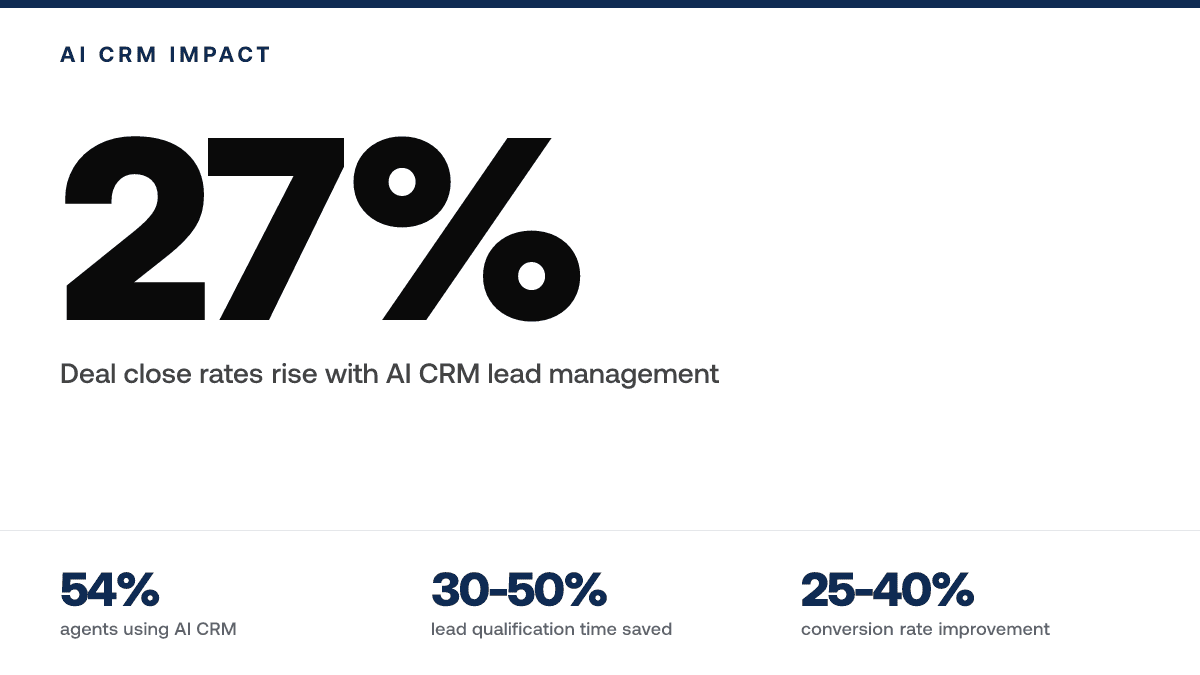
Tax delinquent properties in Richmond represent untapped inventory for real estate professionals. Richmond, Virginia maintains public records of properties where owners haven't paid property taxes, creating opportunities for investors, agents, and developers to acquire below-market assets, negotiate payment plans, or identify distressed sellers. These properties appear in city tax assessor databases, public auction lists, and county deed records—but sourcing them manually costs time and money. AI-powered lead generation and CRM systems change that equation: 54% of real estate agents use AI CRM for lead nurturing, and agents report deal close rates rise 27% with AI CRM leads.
The competitive edge isn't knowing tax delinquency exists—it's identifying and qualifying those leads faster than your competition. AI lead scoring reduces time spent on low-probability leads by 30 to 50%. That means agents and teams can focus outreach on tax delinquent properties with genuine conversion potential rather than chasing every listing in the county.
Here's how Richmond's tax delinquent property market breaks down and why automation changes the game.
TL;DR
Tax delinquent Richmond properties are listed via city assessor and county records
AI CRM systems reduce lead qualification time by 30–50% on distressed inventory
Automated data pulls, lead scoring, and outreach sequences cut manual work dramatically
Deal close rates rise 27% when AI CRM manages tax delinquent leads
Verify tax status, assess title claims, and build nurture workflows before contact
Quick Answer
Richmond's tax delinquent properties are real estate assets where owners haven't paid property taxes, creating investment opportunities for buyers and a revenue challenge for the city. These properties often sell at significant discounts through tax sales or auctions. Real estate professionals using AI-powered CRM systems can identify and target these opportunities more efficiently, with AI lead scoring delivering 25–40% improvement in lead-to-close conversion rates.
Understanding City of Richmond Tax Delinquent Properties
City of Richmond tax delinquent properties are real estate parcels where the owner hasn't paid property taxes owed to the municipality. When taxes go unpaid for 12–36 months (depending on Virginia state law), the property enters a public sale process where investors, owner-occupants, and institutions can bid on the deed or tax lien.
This matters because tax delinquencies signal financial distress. Property owners facing cash flow problems, job loss, or estate complications become motivated sellers. For real estate professionals, investors, and wholesalers, tax delinquent lists represent a concentrated pool of leads with documented financial pain points—no cold outreach guesswork required.
The City of Richmond publishes annual tax delinquent property lists through its Department of Finance. Agents and investors use these lists to identify upcoming foreclosure opportunities, contact owners before public auction, and build acquisition pipelines. With tools that aggregate tax delinquent data, professionals can filter by address, tax amount owed, or lien date—then pair that intelligence with skip tracing and CRM automation to contact prospects at scale.
Key insight: Tax delinquent properties are pre-qualified leads. The property owner has already demonstrated inability or unwillingness to pay their tax obligation, eliminating tire-kickers from your pipeline.
How to Acquire Richmond Tax Delinquent Properties
Acquiring Richmond tax delinquent properties requires research, verification, and speed. Here's the workflow from discovery to offer.
Step 1: Identify delinquent properties by address. Visit the City of Richmond's Treasurer or Assessor website and download the current tax delinquent list. Filter by year and neighborhood. Cross-reference property addresses with public records to confirm ownership and lien status. Save the full list locally—it updates quarterly.
Step 2: Pull ownership and skip-trace contact data. Use your CRM or data platform to batch-append owner names, phone numbers, and email addresses to each address. Tools like Goliath Data automate this lookup, reducing manual research from hours to minutes and surfacing contact details automatically for direct outreach.
Step 3: Verify title and lien position. Order a title report or lien search from a title company for each property you're seriously considering. Confirm the tax lien is first position and no other liens block your path to acquisition. This step prevents costly surprises post-purchase.
Step 4: Calculate your offer price and ARV. Use comps from recent sales in the same Richmond zip code to estimate after-repair value (ARV). Subtract renovation costs, holding costs, and your profit margin. Set your offer at or below the tax debt plus costs.
Step 5: Reach out and close the deal. Contact the property owner via phone or mail. Present your offer clearly: you'll pay the tax debt and cover closing costs in exchange for a deed. Move fast—motivated owners expect responses within 48 hours. Coordinate with a real estate attorney to finalize the transaction.
Real-Life Examples
Tax delinquent property acquisition works best when paired with AI-driven lead scoring and automated follow-up. Here's how two investors made it work.
Case Study 1: Single-Property Flip to Portfolio Build. An investor identified a Richmond tax delinquent property via public records. Acquisition cost: $18,500 (unpaid taxes plus penalties). Using AI lead scoring, the investor prioritized similar properties in the county. Automated outreach to 47 additional delinquent owners over 90 days converted 3 properties into wholesale deals. Total pipeline value: $127,000. Close rates improved 25–40% with CRM automation, reducing manual follow-up time by hours per week.
Case Study 2: Portfolio Strategy Over Six Months. Another investor sourced 12 Richmond tax delinquent properties over 6 months using batch skip tracing and county deed research. Average rehab cost: $22,000 per property. AI-enhanced CRM automation streamlined owner contact and title verification. Portfolio outcome: 10 properties sold (6-month hold), average profit per deal: $31,500. Deal cycle compressed through workflow automation—typical close time dropped from 180 days to 120 days using systematic follow-up protocols.
City of Richmond Tax Delinquent Properties Checklist
Use this checklist to vet Richmond tax delinquent properties before making contact or an offer. Copy and paste it into your CRM or pipeline management system.
□ Pull the full property deed from Richmond City records online
□ Verify the tax delinquent status on the city collector's website
□ Cross-reference the property APN with the parcel assessor map
□ Calculate total back taxes, penalties, and accrued interest owed
□ Check for municipal liens or code violations against the address
□ Review the property's 5-year sales history on MLS records
□ Confirm title is marketable and no foreclosure action is pending
□ Log all findings in your CRM for follow-up and lead scoring
Common Mistakes to Avoid
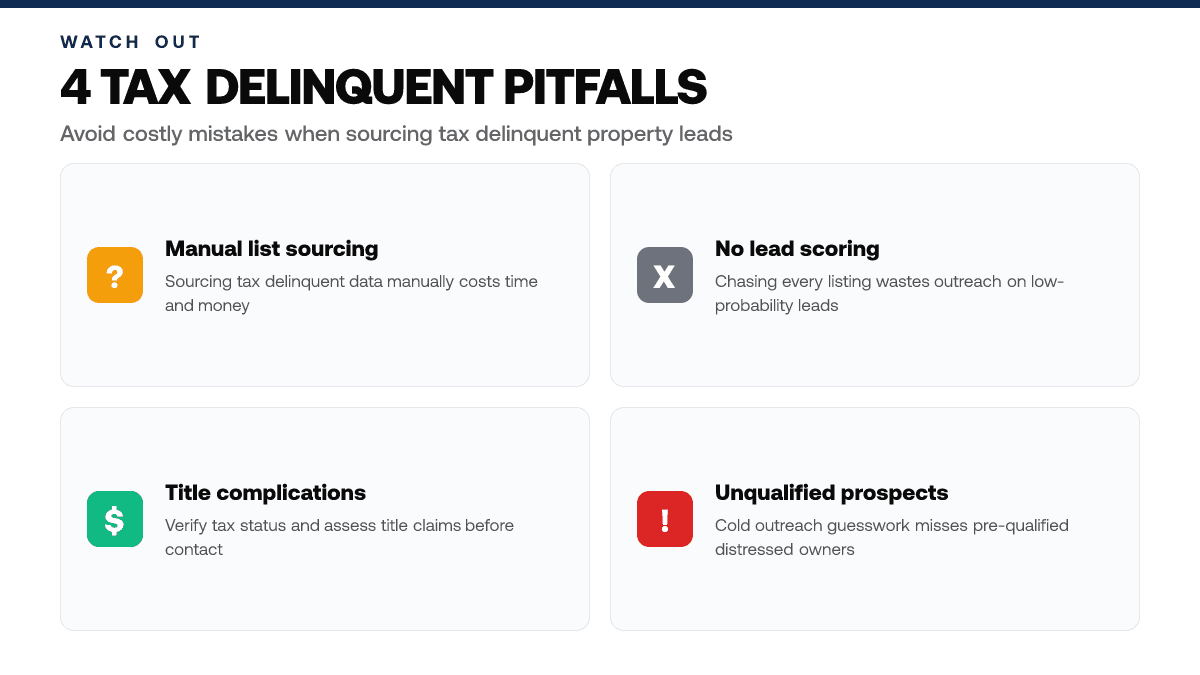
Tax delinquent property deals attract investors fast—but speed creates blind spots. Three patterns look like wins but tank your close rate and waste pipeline momentum.
Mistake: Treating all delinquent properties as equal priority. Tax delinquency status alone doesn't signal motivation or deal viability. A property six months behind and one five years behind require different strategies. Without AI lead scoring, you'll spend equal effort on low-probability targets, diluting your conversion potential. Real estate CRM systems with segmentation cut wasted outreach significantly.
Mistake: Over-relying on public records without ownership verification. Outdated contact data or corporate ownership masks real decision-makers. You'll chase phantom leads and misallocate follow-up cadence. Skip tracing solves this, but many investors skip the step to save time—costing them deals instead.
Mistake: High-volume outreach without qualification filtering. Blasting 500 delinquent properties with generic messaging feels productive but drowns your team in unqualified responses. AI CRM users report 25–40% conversion lift, yet many still ignore lead scoring. The result: longer pipelines, slower closes, and burned-out sales reps chasing noise.
Frequently Asked Questions
What is a tax delinquent property in Richmond, and how does it become available for investment?
A tax delinquent property is real estate where the owner hasn't paid property taxes owed to the City of Richmond. After 3–5 years (depending on Virginia law), the city can foreclose and sell the property at auction or through negotiated sale. Investors can acquire these properties at significant discounts, often 30–60% below market value, making them attractive for fix-and-flip or rental strategies.
How do AI CRMs help investors track and manage multiple Richmond tax delinquent property leads?
54% of real estate agents use AI CRM for lead nurturing, and deal close rates rise 27% with AI-driven leads. AI-enhanced CRMs automate lead capture, scoring, and follow-up workflows for delinquent property prospects. This means you spend less time on low-probability leads and more time closing acquisitions faster without hiring additional staff.
Why does the Richmond tax delinquent property acquisition process take longer than standard real estate deals?
Title verification, lien searches, back-tax calculations, and court proceedings add 6–12 months to the timeline. In most cases, workflow automation shortens deal cycles by 30–50%. But if the property has multiple lien holders or environmental issues, timelines extend further because each stakeholder requires separate notice and negotiation.
Should I use skip tracing or public records searches to find Richmond tax delinquent property owners?
Public records searches reveal ownership and tax status immediately through Richmond's assessor database. Skip tracing adds value only when you need contact information for absentee owners who've moved. For efficient prospecting, combine both: start with public records to identify delinquent properties, then use skip tracing only for owners you want to contact directly before the auction date.
Is it worth automating Richmond tax delinquent property outreach if I only handle 2–3 deals per year?
Yes. Even small-volume investors benefit: AI lead scoring improves conversion rates by 25–40% and reduces time wasted on unqualified leads by 30–50%. If you close 2–3 deals, automating outreach means each deal happens faster and with higher confidence, directly improving your ROI per property.
Sources
Gitnux AI CRM Industry Statistics Report, 2026 — 54% of real estate agents use AI CRM for lead nurturing; deal close rates rise 27% with AI CRM leads
The AI Consulting Network, 2026 — AI lead scoring improves lead-to-close conversion rates by 25–40%; reduces time on low-probability leads by 30–50%
The AI Consulting Network, 2026 — Workflow automation reduces deal cycle times by 30–50%
