


Nacogdoches County, Texas Tax Delinquent Properties for Sale List
Nacogdoches County, Texas Tax Delinquent Properties for Sale List. A practical guide to what works, what to skip, and how to get started.


Tennessee, Goliath Teammate
Key Takeaways
- Nacogdoches County, Texas has 65,375 residents and 28,995 housing units, with a median owner-occupied home value of $158,200 (U.S. Census Bureau, ACS 2023 5-Year Estimates).
- Nacogdoches County's median household income is $51,528, and 50% of its housing units are owner-occupied (ACS 2023 5-Year Estimates).
- The Nacogdoches County tax assessor-collector office publishes the official list of tax delinquent properties, the authoritative record for investors and agents.
- Under Texas Tax Code Section 34.21, an owner of a residence homestead or agricultural-use land sold at a tax sale can redeem it within two years of the deed being recorded, paying a 25% redemption premium in the first year and 50% in the second.
- Nacogdoches County tax delinquent owners are motivated sellers who can be reached before a property is listed on the MLS.
Nacogdoches County, Texas is home to 65,375 residents and 28,995 housing units, yet a portion of those properties slip into tax delinquency each year—creating a hidden inventory that most agents and investors never see. These tax delinquent properties represent motivated sellers facing financial pressure, and they're often priced well below the county's median home value of $158,200. For real estate professionals, access to the Nacogdoches County tax delinquent list means finding deals before they hit the open market.[3]
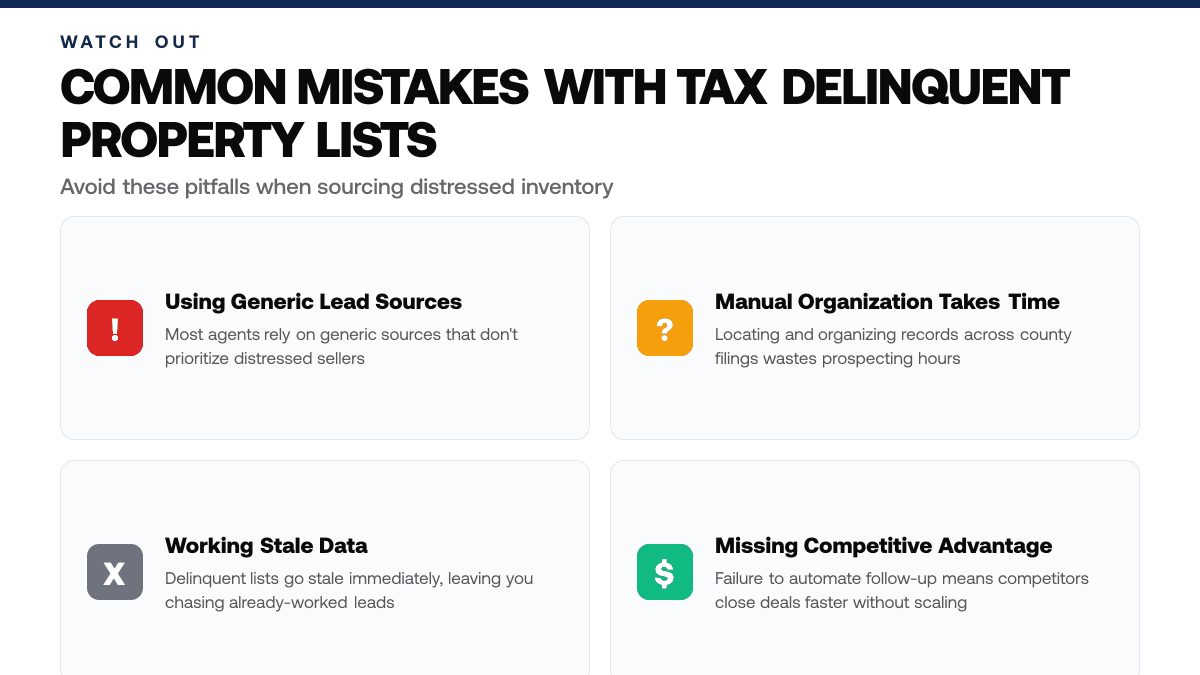
Tax delinquent property lists are public records, but locating and organizing them across county filings takes time and manual work. Most agents rely on generic lead sources that don't prioritize distressed sellers or automate follow-up workflows. The result is missed opportunities and wasted prospecting hours. Investors and agents who can quickly identify and contact these property owners gain a competitive edge—closing deals faster without scaling their marketing spend.[1]
This article walks you through how to access Nacogdoches County's tax delinquent property list, what the data reveals about distressed inventory in the area, and how to build a prospecting strategy around these motivated sellers. You'll learn the legal framework, the timeline for sales, and practical next steps to turn this public data into closed transactions. Most delinquent property lists go stale the moment they're published, leaving agents chasing leads that have already been worked or sold quietly off-market — Goliath Data tracks tax delinquency signals and finds motivated sellers among these homeowners so you can reach them early.
What is the short version on Nacogdoches County tax delinquent property sales?
- Nacogdoches County tax-delinquent properties are sold via sheriff's deed at the courthouse; find the official list through the county tax assessor-collector's office.
- Sales occur monthly and include a redemption period during which prior owners can reclaim the property by paying the purchaser the amount paid plus a redemption premium (Texas Tax Code Section 34.21).
- Investors must register with the sheriff and provide certified funds; properties are sold as-is, often below market value, creating acquisition opportunities for wholesalers and agents.[1]
Understanding Tax Delinquent Properties in Nacogdoches County, Texas
What Is a Tax Delinquent Property?
A tax delinquent property is real estate where the owner has failed to pay property taxes owed to the county. When taxes remain unpaid beyond the grace period, the property enters a delinquency status and becomes eligible for public sale. The county tax assessor-collector maintains an official list of these properties, which serves as the authoritative record for investors and agents seeking acquisition opportunities. Tax delinquent properties represent a distinct market segment where motivated sellers—often facing financial hardship—may be willing to negotiate or lose their property entirely through the foreclosure process.
Nacogdoches County, Texas — Property & Housing Snapshot (2023)
Metric | Value |
|---|---|
Population | 65,375 |
Median home value (owner-occupied) | $158,200 |
Median household income | $51,528 |
Total housing units | 28,995 |
Owner-occupied rate | 50% |
Source: U.S. Census Bureau, American Community Survey 2023 5-Year Estimates.
Why do tax delinquent properties matter to real estate professionals?
Tax delinquent properties matter because, for real estate agents and investors, tax delinquent property lists unlock a pipeline of motivated sellers without traditional marketing spend. These properties often sell at a discount to fair market value, creating opportunity for wholesalers, fix-and-flip investors, and buy-and-hold portfolios. Prospecting these lists systematically—rather than waiting for leads to arrive—allows professionals to reach property owners before foreclosure proceedings advance, negotiate directly, and close transactions faster. Automating outreach to delinquent property owners reduces manual prospecting hours while increasing deal flow and closing rates.
How does Texas handle tax delinquent property sales?
In Nacogdoches County, delinquent property lists are published by the county tax assessor-collector office. When taxes remain unpaid, the county conducts a tax deed sale—a public auction held on the first Tuesday of the month at the county courthouse, administered by the Sheriff or Constable. Properties sold at tax deed are subject to redemption rights: non-homestead and non-agricultural properties may be redeemed within 180 days, while homestead and qualifying agricultural land carry a 2-year redemption period. Bidders must register with the sheriff and typically provide certified funds. These procedures are governed by Texas Tax Code Chapter 34, ensuring transparent, standardized sales across the state.[1]

Key Numbers for Nacogdoches County, Texas Tax Delinquent Properties for Sale List (2026)
- 65,375 residents in Nacogdoches County, Texas (2023 ACS 5-Year Estimates)
- $158,200 median home value (owner-occupied) in Nacogdoches County
- 50% owner-occupied housing rate across 28,995 total housing units in the county
- 180-day redemption period for non-homestead and non-agricultural tax-sale properties under Tex. Tax Code Ch. 34[2]
- 2-year redemption period for homestead and qualifying agricultural land in Texas tax sales[2]
- 25% redemption premium in year one; 50% in year two for homestead and agricultural property redemptions[2]
- First Tuesday of each month: Nacogdoches County Sheriff/Constable tax deed sale at the county courthouse[2]
Step-by-Step Process
1. Access the Nacogdoches County Tax Assessor-Collector Website
Navigate to the official Nacogdoches County tax office online portal (typically nacogdoches.countytaxoffice.org or nacogdochestaxoffice.org) to locate the delinquent property list. Most Texas county tax assessor-collectors publish current and historical delinquent rolls online. Look for a link labeled 'Delinquent Taxes,' 'Tax Sale List,' or 'Delinquent Properties.' Download or review the list to identify properties in your target investment area, noting property address, owner name, and delinquency amount.[1]
2. Verify Sale Date and Redemption Terms
Confirm that the property qualifies for tax deed sale by checking whether it appears on the upcoming sale schedule. Under Texas Tax Code Chapter 34, the Nacogdoches County Sheriff or Constable conducts tax deed sales on the first Tuesday of each month at the county courthouse. Tools like Goliath Data find motivated sellers, including tax-delinquent owners, so you don't have to find them by hand. Determine whether the property is homestead or agricultural (which carries a 2-year redemption period) or non-homestead (180-day redemption). This distinction affects your holding timeline and exit strategy.[1]
3. Assess Property Condition and Title Risk
Research the property's physical condition using county appraisal records, property tax history, and public records searches. Check for liens, code violations, or environmental issues that could affect resale value. Review the owner's payment history to gauge whether redemption is likely during the applicable window. Properties with multiple years of delinquency may indicate title complications or structural problems that reduce investment appeal.
4. Register with the Sheriff and Prepare Certified Funds
Contact the Nacogdoches County Sheriff's office to register as a bidder prior to the sale date. Bidders typically must provide certified funds (cashier's check or money order) to participate in the auction. Goliath Data workflows keep follow-up with every tax-delinquent owner consistent, not just the owners someone remembers to check. Confirm the exact registration deadline, bid increment, and payment terms. After winning a bid, you will hold the property subject to the redemption period; if the prior owner or taxing authority does not redeem, you receive the tax deed. Consult a tax professional regarding capital gains treatment (IRS Topic 409) and any canceled-debt reporting obligations under IRS Publication 4681.[1][2]
How does this work in practice in Nacogdoches County?
Example 1: The Wholesaler's Fast-Track Identification
Picture a wholesaler in Nacogdoches County who traditionally spent hours manually searching county records and courthouse websites to find tax delinquent properties. By accessing a curated list of delinquent properties, she now identifies motivated sellers within days rather than weeks. She cross-references the list against comparable sales in the area, prioritizes properties with strong equity potential, and reaches out to owners before competing investors discover the same opportunities. The compressed timeline means she can negotiate acquisition prices at meaningful discounts and move deals into her pipeline faster, all without expanding her marketing budget—just smarter targeting of properties that fit her acquisition criteria.[1]
Example 2: The Buy-and-Hold Investor's Automated Prospecting
Imagine a buy-and-hold investor who wants to grow his rental portfolio but dreads the repetitive legwork of tracking down owner contact information and managing follow-up sequences. Using a tax delinquent property list, he automates his prospecting workflow: he imports the data into his CRM, segments properties by location and condition, and sets up a multi-touch outreach campaign that touches each owner multiple times over several weeks without manual intervention. Some owners are motivated to sell quickly; others need time to consider options. The system keeps him in front of all of them consistently. Over time, he closes a handful of deals that he would have missed entirely using traditional listing sites, and he's built a repeatable process that scales without proportional increases in his time or marketing spend.[1]
Why do speed and automation win?
Speed and automation win because, in both cases, the competitive advantage isn't the property itself—it's access to motivated sellers before they're listed on the MLS. Tax delinquent property lists compress the discovery phase, eliminate manual research friction, and enable agents and investors to deploy their follow-up resources where they matter most: on prospects with genuine urgency and equity. That efficiency compounds across dozens of deals per year.[1]
Nacogdoches County Tax Delinquent Properties Checklist
- Visit the Nacogdoches County tax assessor-collector website to download the current delinquent property list.
- Verify the redemption period (180 days for non-homestead; 2 years for homestead/agricultural) before calculating your investment timeline.
- Register with the Nacogdoches County Sheriff's office and prepare certified funds for the first Tuesday courthouse sale.
- Research title history and property condition for each prospect to identify properties with strong resale potential.
- Consult IRS Topic 409 to understand capital gains tax treatment on profits from tax-sale property resales, and IRS Publication 4681 for canceled-debt and foreclosure rules.
What mistakes should you avoid with Nacogdoches County tax sales?
Mistake: Overlooking the 180-day redemption window for non-homestead properties in Nacogdoches County
Many investors assume they own a property immediately after a tax deed sale, but under Texas Tax Code Chapter 34, non-homestead and non-agricultural properties carry a 180-day redemption period during which the former owner can reclaim the property by paying the purchase price plus a 25% premium. Failing to account for this window delays your actual control and profitability timeline. Always verify the property classification and calculate your holding period from the sale date forward, factoring in the full redemption window before planning renovation or resale.[1]
Mistake: Ignoring federal tax implications when flipping tax-sale properties quickly
Investors who purchase and resell Nacogdoches County tax-deed properties within months often treat the profit as a simple gain, but the IRS (Topic 409) taxes net short-term capital gains, on assets held one year or less, as ordinary income rather than at long-term capital-gains rates, significantly increasing your tax liability. To minimize this burden, hold the property longer or consult a tax professional before closing to understand whether your holding period (more than one year) qualifies for preferential long-term treatment and plan your exit strategy accordingly.[2]
Mistake: Failing to verify property status and lien priority before bidding at the Nacogdoches County sheriff's sale
Tax-deed sales at the county courthouse on the first Tuesday of the month are final, and bidders who don't research title, existing liens, or homestead exemptions beforehand may acquire property burdened by senior liens or discover they've purchased a homestead-exempt parcel subject to a 2-year redemption period instead of 180 days. Before registering with the sheriff and submitting certified funds, pull the county tax assessor-collector's delinquent list and verify each property's classification, lien status, and redemption terms to avoid costly surprises.[1]
Frequently Asked Questions
How does a tax deed sale work in Nacogdoches County?
Tax deed sales in Nacogdoches County are conducted by the Sheriff or Constable on the first Tuesday of each month at the county courthouse. Properties are sold to the highest bidder after owners fail to pay property taxes. Under Texas Tax Code Chapter 34, non-homestead properties carry a 180-day redemption period, meaning the former owner can reclaim the property within that window by paying the purchase price plus a 25% redemption premium in the first year. Homestead and qualifying agricultural land have a longer 2-year redemption period with a 50% premium in the second year. Bidders must register with the sheriff and typically provide certified funds.[1]
Where can I find Nacogdoches County's delinquent property list?
The official source for delinquent properties in Nacogdoches County is the county tax assessor-collector office. Their website, typically found at nacogdochestaxoffice.org or nacogdoches.countytaxoffice.org, publishes the delinquent tax roll and upcoming sale dates. This list identifies properties behind on taxes and eligible for tax deed sale, giving investors and agents early visibility into motivated-seller opportunities before public auction.[1]
What tax implications should I know about profits from a tax-sale property resale?
Profit from reselling a property acquired at a tax deed sale is generally treated as a capital gain and must be reported to the IRS. If you hold the property one year or less before resale, the gain is taxed at short-term ordinary-income rates; longer holding periods qualify for long-term capital-gains rates, which are typically lower. Additionally, if a previous owner's debt was canceled or forgiven through the tax sale process, that canceled amount may be reportable as taxable income unless a federal exclusion applies. Consult IRS Topic 409, IRS Publication 4681 and a tax professional for your specific situation.[2]
Sources
- Texas Tax Code Chapter 34
- IRS Publication 4681: Canceled Debts, Foreclosures, Repossessions, and Abandonments
- Nacogdoches County, Texas — ACS 2023 5-Year Estimates
Disclaimer: This article is provided by Goliath Data for general informational purposes only and does not constitute legal, tax, financial, or investment advice. Statutory references, redemption timelines, interest rates, and procedural requirements vary by jurisdiction and change over time. Always verify current information with the relevant county or municipal office and consult a licensed attorney, CPA, or financial advisor before making any investment, acquisition, or legal decision based on this content.
Find owner, tax and parcel records on the Nacogdoches County, Texas property records page.