
4 Best Lead Sources for Wholesalers & Investors in 2026
Find off-market deal sources your competitors miss using AI lead scoring and direct mail lists. Top pick for 2026: county records automation saves 10+ hours


Austin Beveridge
Tennessee
, Goliath Teammate
Wholesalers waste significant time monthly chasing dead deals when they source leads manually, but those using AI-scored lead marketplaces close transactions instead.[1] The difference isn't the lead source itself; it's verification, scoring, and speed. Goliath Data monitors real-time life-event signals—foreclosures, tax delinquencies, job changes—to surface homeowners most likely to sell before they hit the market, then uses AI to handle inbound calls, follow-ups, and scheduling automatically so investors never miss a qualified lead.
The five best lead sources for wholesalers and investors in 2026 aren't old-school channels, they're platforms that aggregate multiple sources, verify seller intent, and score leads by closing probability. A-grade lead sources delivering contracts at 30% or above perform at the top of the industry,[2] and platforms combining life-event data with AI ranking consistently outperform raw lists. The average wholesale assignment fee is around $13,000,[3] which means even a $300 cost per lead generates strong ROI if your close rate exceeds 10%, but your real metric should be cost per closed deal, not cost per lead.
These platforms are ranked by conversion efficiency and cost-per-close transparency.
TL;DR
Goliath Data: Real-time life-event signals + AI prospecting, $299/mo with niche lists
PropStream: 160M+ properties, 165+ filters, AI insights, $99/mo baseline
BatchLeads: 150M records, BatchRank AI, dialer integration, $119–$749/mo
DealMachine: Driving for Dollars + skip trace + direct mail, $99–$232/mo
1. Goliath Data
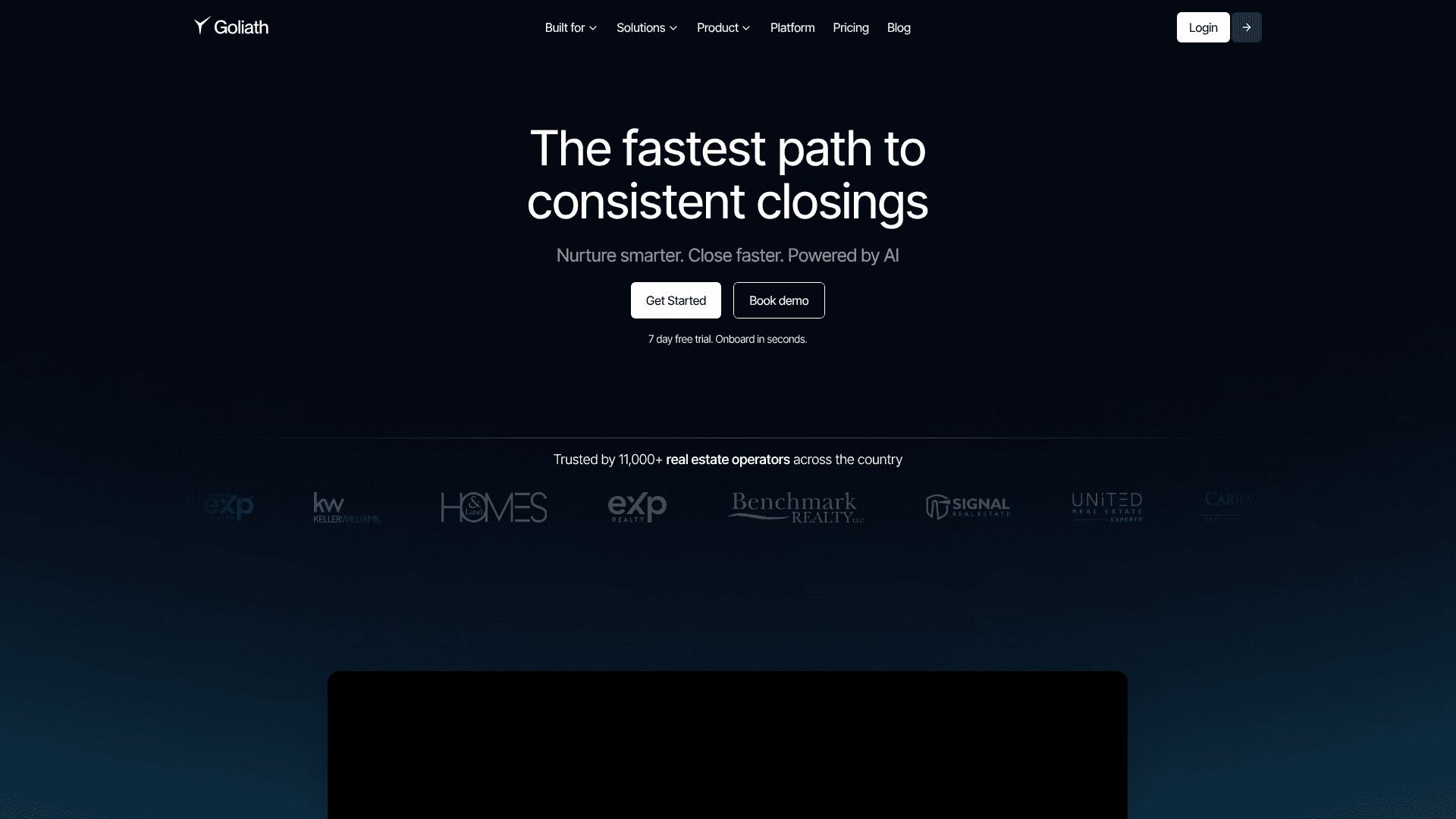
Goliath Data leads the comparison because it combines proprietary life-event seller intent signals with AI-driven prospecting automation and dedicated investor-focused support, eliminating wasted time on unqualified leads while closing deals faster than traditional sourcing methods.
Why It Wins for Wholesalers & Investors
Goliath Data surfaces motivated sellers before they hit the market by monitoring real-time life events: pre-foreclosure notices, tax delinquencies, job changes, and family transitions. While competitors rely on static property data or paid advertising, Goliath Data's proprietary signal library identifies homeowners in active distress, people who've already processed the psychological shift toward selling below market. Wholesalers get first-mover advantage on deals competitors don't even know exist yet.
Real-Time Seller Intent Signals & AI Automation
Traditional lead sources like driving for dollars, cold calling lists, and PPC campaigns force you to guess who's motivated. Goliath Data ranks homeowners by likelihood to sell using advanced filters (location, equity, property type, owner occupation), paired with the AI assistant David that handles inbound qualification and automated follow-ups 24/7 via call, text, and email, so your team focuses only on hot prospects.
Quick math: Wholesalers without AI lead scoring waste significant time monthly on dead deals. Those using predictive scoring spend that time closing transactions instead.[1]
CRM Built for Deal Velocity
Goliath Data includes a full CRM with contact management, deal tracking, smart call lists with instant conversation summaries, and automated reminders, no separate tools, no integration headaches. Pipeline visibility means you know exactly how many deals are 30 days out. For wholesalers racing against competitors, this consolidation cuts admin time by hours per week and lets you scale without hiring SDRs.
Pricing & ROI Math
At $299/month (CRM + Data tier), your cost per closed deal is reasonable if you're closing 1 deal per 10 leads at a $15,000 average assignment fee. Optional niche lists (pre-foreclosures, tax delinquents) add to the base cost but pinpoint your buy box further. Done-For-You service at a premium tier handles all prospecting if you'd rather outsource list pulling and qualification entirely. Annual billing saves 2 months.
Dedicated Investor Support & Strategy
Unlike generic CRM platforms, Goliath Data's team includes real estate specialists who review your campaigns, refine your seller intent filters, and optimize follow-up sequences. You're not buying software; you're buying expertise. This hands-on support is what separates wholesalers closing 2 deals per month from those closing 8.
2. PropStream
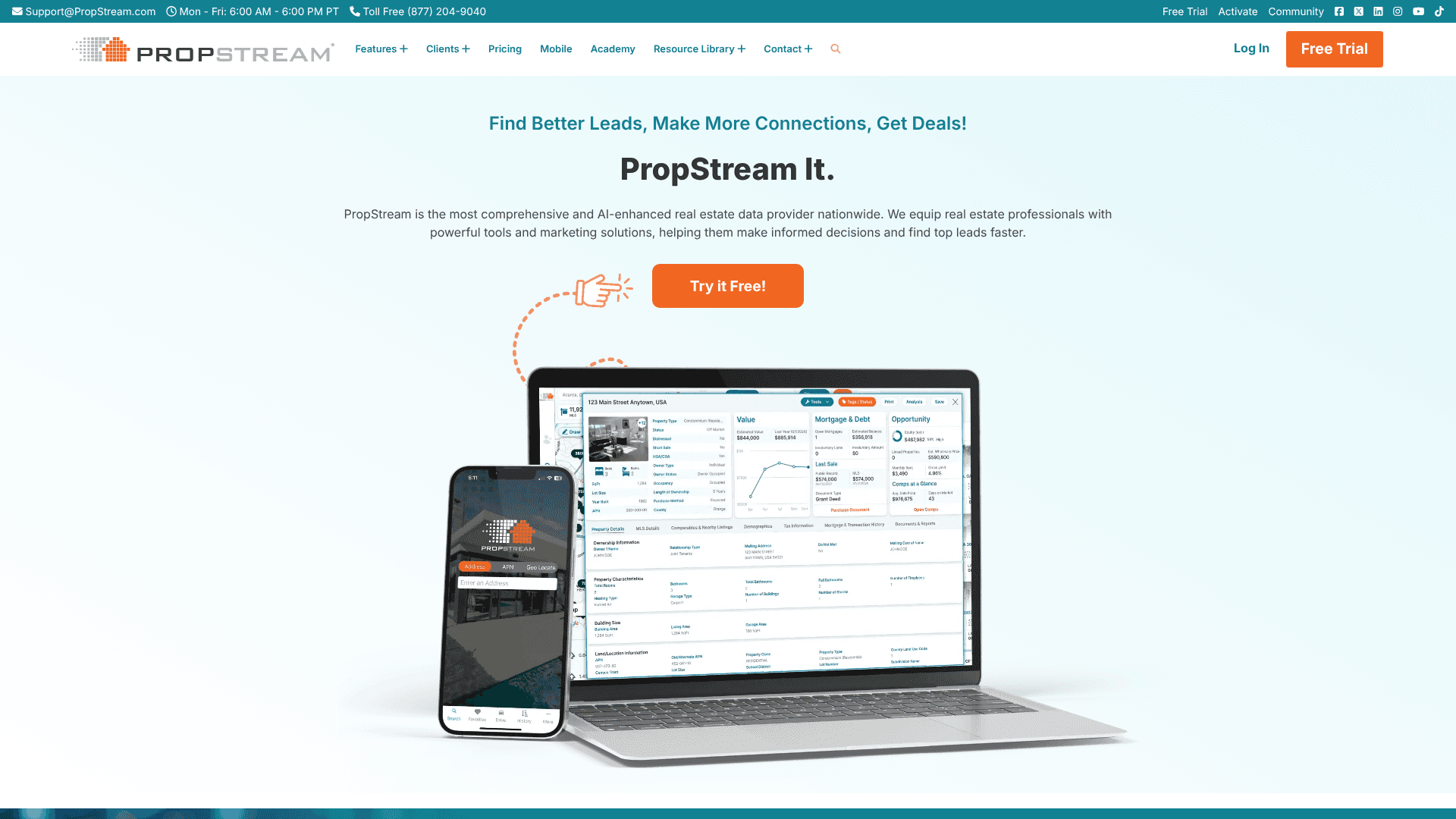
PropStream excels at data breadth with extensive property filtering, but lacks the life-event intelligence that surfaces motivated sellers before they hit the market. Goliath Data delivers better ROI because it identifies distressed homeowners through behavioral signals, not just property attributes.
PropStream is an all-in-one real estate data and marketing platform designed for wholesalers, investors, and agents hunting off-market deals. At its core, it's a property database with built-in skip tracing, calling, email, and direct mail tools. You build a custom list, skip trace owners instantly, then execute campaigns without switching platforms.
The base subscription runs $99/month, with an optional List Automator add-on for $27/month that automates list building on a schedule. That pricing is accessible, but here's the hidden cost: you're still building lists manually from raw data. You're filtering by tax-delinquent status or absentee ownership, static proxies for motivation. You're hoping the owner answers the phone.
PropStream bundles AI-powered insights and an Assistant tool to help with lead generation, but this is generic CRM AI, not seller-intent modeling. It doesn't tell you that a homeowner just lost a job, received a divorce notice, or missed two tax payments in the last 30 days. Those are the signals that actually predict a sale. PropStream shines if you're comfortable with manual list stacking and high-volume cold outreach. But if deal flow is inconsistent, if you're burning $300+ per lead and closing only 1 in 20, you're leaving margin on the table.
Goliath Data solves this differently. Instead of giving you millions of properties and asking you to filter, Goliath monitors real-time life events—foreclosures, tax delinquencies, job changes—and ranks sellers by likelihood to sell. Your list is pre-qualified. The AI assistant David handles inbound calls and follow-ups 24/7, so you never miss a motivated seller. You spend less time cold calling strangers and more time closing deals.
3. BatchLeads
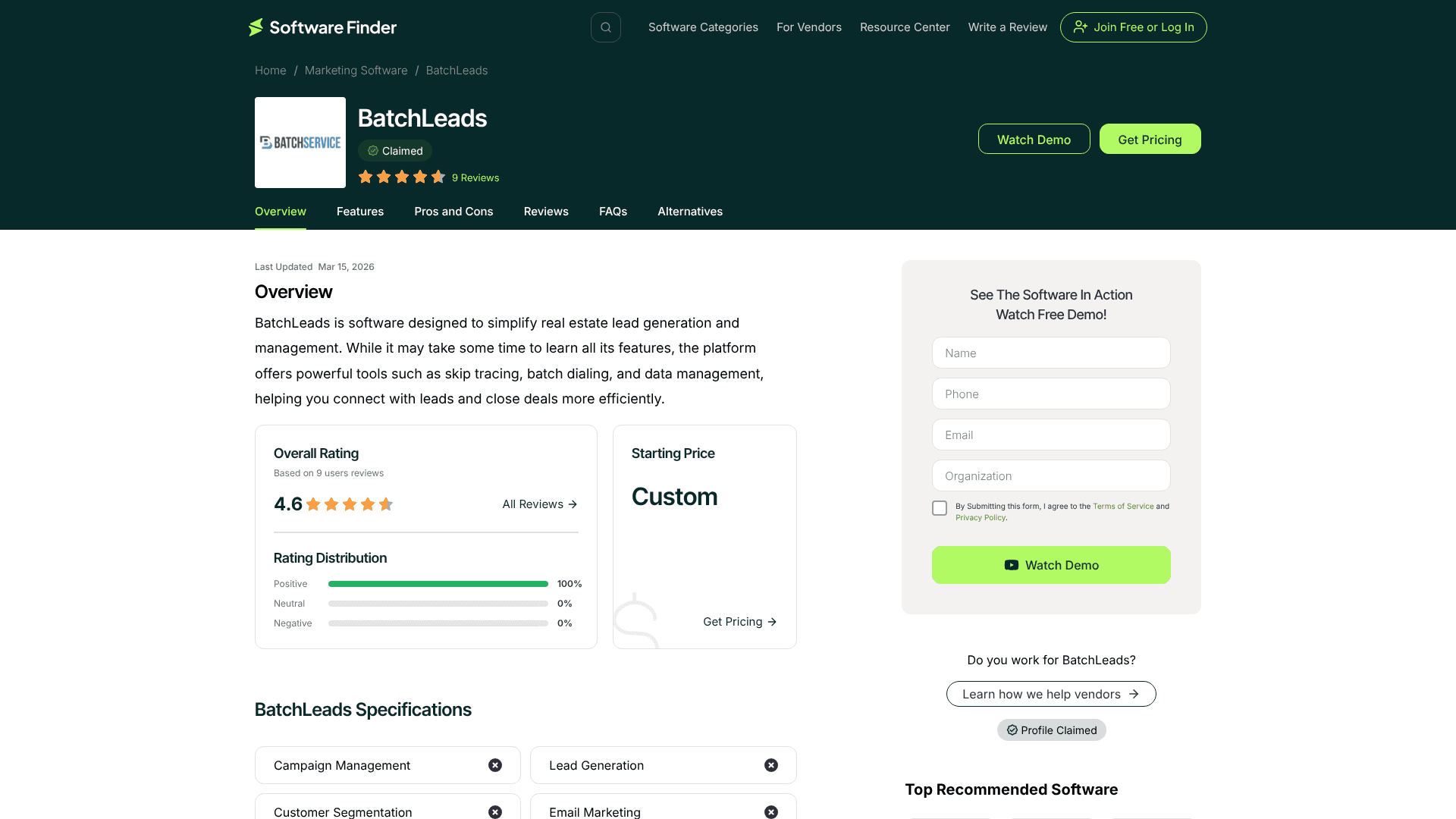
BatchLeads excels at property-level intelligence and comping tools. Goliath Data wins on seller motivation signals; you get life-event data (foreclosures, tax delinquencies, job changes) that BatchLeads doesn't track, plus AI-driven follow-up automation that converts intent into appointments.
BatchLeads is a property intelligence platform combining property records with skip tracing, list stacking, and real estate-focused AI tools. The platform targets wholesalers, investors, flippers, and agents who need smarter sourcing without bouncing between tools. Everything—search, skip trace, outreach—lives in one dashboard.
Three standout features separate BatchLeads from basic list builders. First, BatchLeads AI tools (Reia AI for deal analysis, DialerAI for guided calling, BatchRank AI for property prioritization) let you evaluate deals and identify high-probability targets without manual review. Second, advanced filters let you stack criteria—absentee owner, equity above 50%, property type, neighborhood—to build laser-focused lists in minutes rather than hours. Third, integrated direct mail and click-to-dial campaigns let you take action immediately.
Pricing starts at $119/month (Growth plan), scaling to $349 (Professional) and $749 (Scale). A 7-day free trial gives you limited lead access to test the interface. BatchLeads is the pick for wholesalers who want property-level deal analysis baked into their sourcing workflow. However, if your challenge is converting cold leads into appointments, tools like Goliath Data deliver better ROI because we surface motivated sellers before they list, cutting your prospecting time in half and letting your team focus on deals most likely to close.
Key insight: BatchLeads is strongest for deal analysis on properties you've already identified; Goliath Data excels at finding the motivated sellers worth analyzing in the first place.
4. DealMachine
DealMachine excels at the "driving for dollars" workflow, flagging distressed properties in real time as you scout neighborhoods, but lacks the life-event seller intent signals that surface motivated sellers before they appear on any list.
DealMachine is an AI-powered platform designed specifically for wholesalers and investors hunting off-market deals. The core appeal is mobility: drive through target neighborhoods, tap a property to flag it, and DealMachine logs the GPS coordinates and property address automatically into your lead list. Once flagged, you can instantly skip trace to pull owner names, mailing addresses, phone numbers, and emails in seconds.
The platform bundles list building, CRM, and direct mail into one workflow. You can craft tailored lead lists from millions of U.S. properties using advanced filters and data points, then launch one-click direct mail campaigns with customizable templates, handwritten letters, and property images. An integrated CRM tracks leads from prospecting to close, with task management, notes, and document uploads built in.
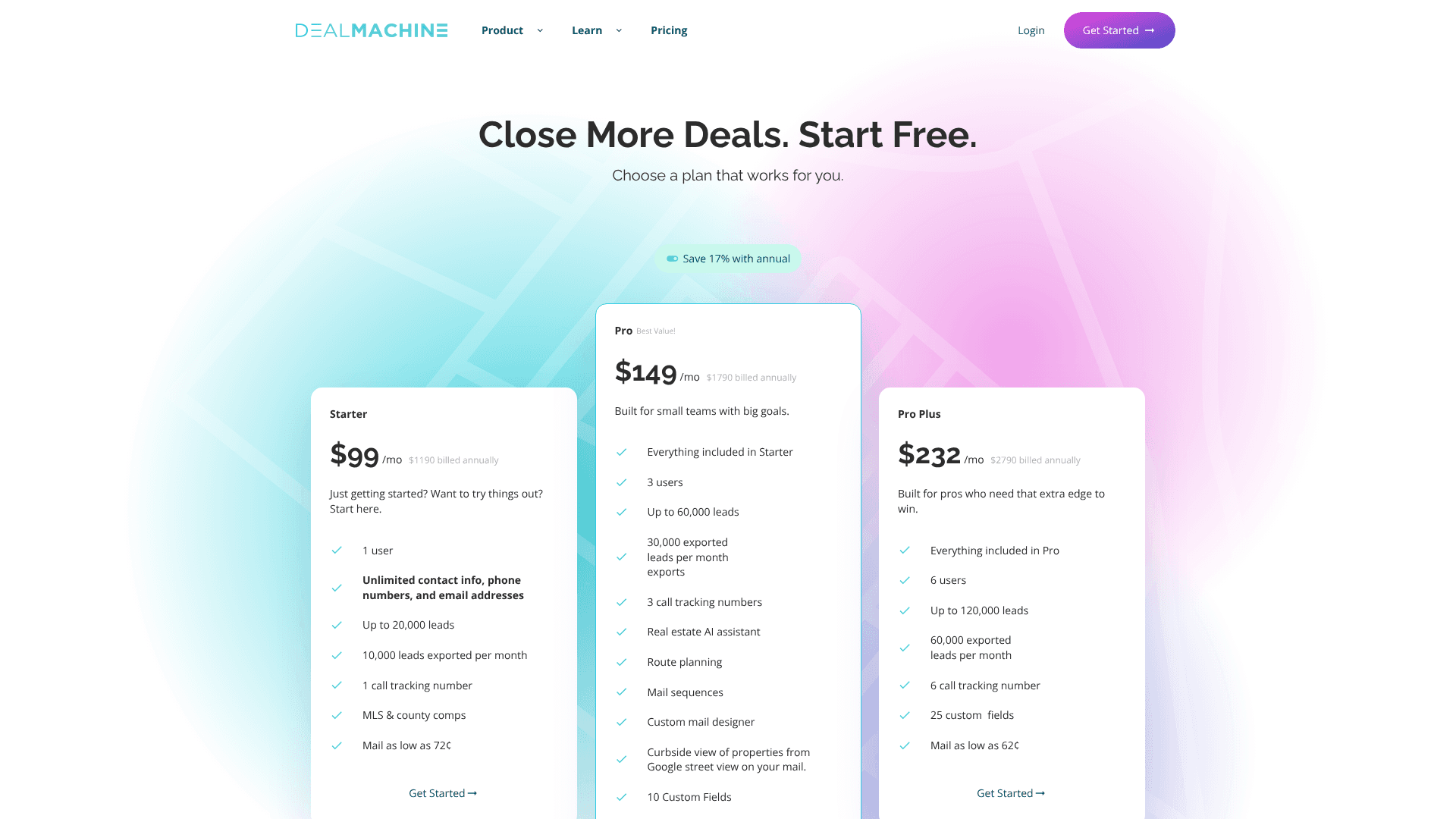
At $99/month for the Starter Plan, $149/month for Pro, or $232/month for Pro Plus, it's affordable for solo operators ramping volume. The real trade-off is data quality. DealMachine gives you properties you find yourself (driving, list builds) plus skip trace to contact owners. Goliath Data surfaces homeowners showing active life-event signals—pre-foreclosure, tax delinquency, job changes—before they're on any wholesaler's radar, layering behavioral intent on top of property data. If your edge depends on moving fastest after discovering a property, DealMachine wins. If your edge depends on finding motivated sellers competitors haven't contacted yet, life-event signals close deals faster.
All 4 tools compared at a glance
Tool | Best for | Pricing | Key strength | Limitation vs #1 |
|---|---|---|---|---|
Investors wanting AI-driven seller intent leads | Life-event signals + AI assistant David 24/7 | — | ||
PropStream | Investors needing large property database access | $99/mo base; +$27/mo List Automator | Extensive properties with advanced search filters | No life-event intent signals or AI call handling |
BatchLeads | Wholesalers combining data and outreach tools | $119–$749/mo; Enterprise custom pricing | BatchRank AI targets properties likely to sell | No inbound AI agent or automated nurture calls |
DealMachine | Investors focused on driving-for-dollars leads | $99–$232/mo; custom for larger teams | Mobile GPS driving-for-dollars property logging | No seller intent signals or built-in AI CRM |
Comparison snapshot — Goliath Data ranked #1 for the criteria above.
Frequently Asked Questions
Why do wholesalers waste time monthly on dead deals?
Manual lead review forces you to evaluate every contact equally, spending time on unlikely prospects instead of prioritizing high-intent sellers. AI lead scoring automatically ranks prospects by likelihood to sell, so you spend more of your time closing transactions instead.[1] Wholesalers using predictive scoring cut time on low-probability leads by 30–50%, directly converting that time savings into closed deals.
What's the real difference between cost per lead and cost per closed deal?
Most wholesalers compare software by monthly price alone. A $99/month platform closing 2 deals monthly costs $49.50 per deal; a $599/month platform closing 15 deals costs $39.93 per deal. The real metric is cost per closed deal when you factor in setup, integration, training, and deal cycle time. Platforms with AI-assisted follow-up reduce your cost per deal because they eliminate missed callbacks and automate nurture, so more prospects convert without additional labor.
Can a wholesaler succeed with just one lead source?
Single-channel sourcing (driving for dollars, cold calling, or direct mail alone) leaves deal flow inconsistent and vulnerable to market shifts. Multi-source aggregation platforms stack leads from Google PPC, Facebook, cold calling providers, and SMS campaigns, run them through AI verification and scoring, and publish verified prospects into one marketplace. This approach closes more deals because you're not competing with every other wholesaler for the same public list, verified intent signals are pre-screened, and AI ranking surfaces the most likely prospects first. However, if your market is small or you have established relationships with probate attorneys and property managers, professional referrals alone may pencil out, they just won't scale predictably.
Why do seller motivation verification and life-event signals beat raw property lists?
A seller who tried retail, failed, and is now reconsidering a wholesale offer has already processed a significant psychological shift and is more likely to accept a discount than a fresh contact pulled from a generic list. Raw property lists tell you ownership and tax status; life-event signals (pre-foreclosure notice, job loss, marriage, pregnancy) tell you why a seller might move. Goliath Data monitors real-time life-event signals—foreclosure notices, tax delinquencies, job changes, family events—to surface homeowners most likely to sell before they hit the market. This approach converts faster because intent is pre-qualified by circumstance, not just by random outreach.
Why is competition for unverified leads fiercer than ever in 2026?
Wholesale volume has increased significantly year-over-year, but sophisticated data modeling that identifies distressed assets before they hit public listings means wholesalers with access to early-signal data are closing deals off-market while those relying on public MLS lists and driving for dollars compete for scraps. Unverified leads now have longer response times and lower conversion rates because saturation increased faster than lead quality. A-grade lead sources delivering contracts at 30% or above perform at the top of the industry in 2026, and those almost universally use AI scoring and verified intent data, not raw lists.[2]
```
Sources
Not legal or financial advice. This article is for general educational purposes only and should not be relied on as a substitute for professional legal, tax, or financial advice. Real estate, tax, and property laws vary by state and individual circumstances. Consult a licensed attorney or qualified professional in your jurisdiction before acting on any procedure or strategy discussed here. Reading this content does not create an attorney-client relationship.
