


Tax Lien Investing Pros and Cons (Complete Breakdown)
Spot tax lien investing profits and pitfalls before you bid. See which returns are realistic, what investors miss, and your 3-step evaluation framework.


Tennessee, Goliath Teammate
Key Takeaways
- Tax lien investing is buying a government lien on a property whose owner failed to pay property taxes, and earning interest when the owner pays the debt.
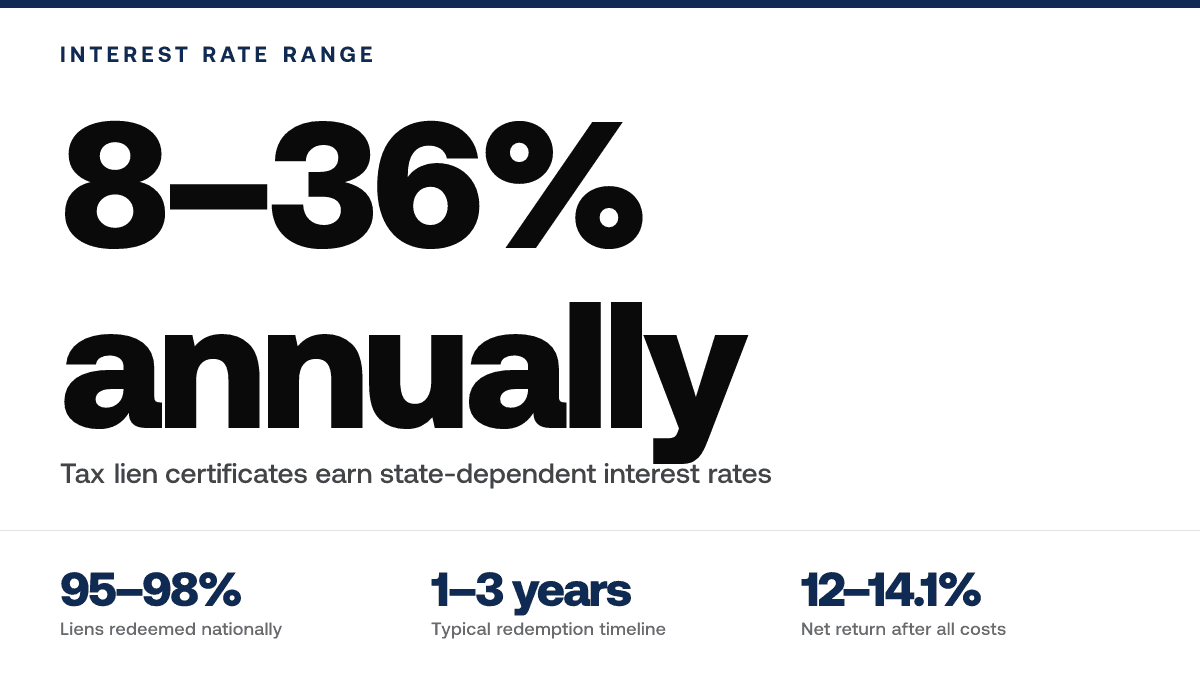
- Most tax liens (95–98% nationally) are redeemed, so a tax lien investor usually collects interest rather than acquiring the property.
- County auction fees (1–5%), title research ($200–800 per property) and legal fees ($500+) cut a lien's advertised rate, so a 25% rate on a $5,000 lien nets $600, or 12%, after $650 in costs.
- Tax lien certificates are illiquid: unlike stocks, they cannot be sold quickly for cash, and tracking each state's deadlines is the main operational risk.
- The U.S. Supreme Court's 2023 Tyler v. Hennepin County ruling held that a government keeping a home's equity above the tax debt is an unconstitutional taking, so tax lien returns now depend mainly on interest, not foreclosure windfalls.
What Is Tax Lien Investing?
Tax lien investing lets you purchase a government lien on a property when the owner fails to pay property taxes, earning interest rates of 8–36% annually depending on state.[1] Most liens (95–98% nationally) get redeemed, meaning you collect interest rather than acquiring property.[2] Success requires tracking state-specific redemption deadlines and auction calendars, operational complexity that increasingly demands CRM automation rather than spreadsheets.
The pros and cons of tax lien investing come down to secured returns and low capital on one side, and illiquidity, fees and state-by-state deadlines on the other. Every figure in this table comes from the sections below.
Factor | Pro | Con |
|---|---|---|
Return | Stated interest of 8–36% a year depending on state | County fees (1–5%), title research ($200–800) and legal fees ($500+) cut the net return |
Security | Returns are secured by physical property | A lien on an unbuildable or heavily encumbered property can be worthless |
Capital and management | Lower upfront capital and no tenant management | Auctions often require 10–25% down at registration |
Outcome | 95–98% of liens are redeemed, so you collect interest | Foreclosure takes months or years when a lien is not redeemed |
Liquidity | Interest is paid at redemption | Redemption timelines stretch 1–3 years; you cannot sell quickly like a stock |
Rules | Each state publishes its rates and auction calendars | Every state and county has different rules, fees and deadlines; one missed deadline can cost the investment |
How Does Tax Lien Investing Work?
Tax lien investing is purchasing a government-issued certificate that gives you a legal claim on a property when the owner fails to pay property taxes. When you buy a tax lien certificate at county auction, you're essentially lending money to the government on behalf of the delinquent property owner.
If the owner repays the debt, you earn interest, typically ranging from 8% to 36% annually depending on state and local rules.[1] If they don't repay, you may eventually acquire the property itself. Tax lien investing matters because it offers an alternative to traditional real estate investing: lower upfront capital, no tenant management, and returns secured by physical property.
Tax lien investing suits investors comfortable with complexity. Each state and county has different rules, fees, and interest rates. Missing a deadline or misunderstanding local law can cost you the entire investment.
Key insight: Tax lien certificates aren't liquid assets. Unlike stocks, you can't sell them quickly if you need cash, redemption timelines stretch 1–3 years depending on state law.[5]
What Are the Steps to Buy a Tax Lien?
Buying a tax lien requires disciplined execution across five phases: research the auction calendar, verify the property, calculate the net return, bid, and track redemption. Follow these steps to evaluate, bid, and manage a lien from auction through redemption or foreclosure.
1. Research county tax lien auction schedules. Each state and county publishes auction calendars. Document deadlines for registration, bidding, and redemption periods. Start with one state to avoid missing compliance windows.
2. Verify property details and lien amounts. Pull the tax deed, property record, and lien amount from the county assessor. Check for prior liens, easements, or code violations. Title research costs $200–800 but prevents buying a lien on an unbuildable or severely encumbered property.
3. Calculate net return after all costs. Subtract county auction fees (1–5%) and estimated legal fees ($500+) from the stated interest rate. A 16% rate minus 3% fees plus legal costs equals roughly 12% net return.
4. Register and participate in the auction. Meet registration deadlines, which vary by county. Prepare funds (often 10–25% down payment required). Bid strategically: in bid-down auctions, you're competing against investors seeking the lowest rate.
5. Track redemption deadlines and collect payment. Set calendar alerts for redemption periods, which range from six months to three years depending on state. If the lien isn't redeemed, initiate foreclosure per state law or use a CRM to automate deadline tracking across multiple states.
What Do Real Tax Lien Returns Look Like?
Texas example: $8,500 purchase, 25% redemption premium, 10-month redemption. Texas sells tax deeds subject to redemption rather than lien certificates, and under Texas Tax Code §34.21 a homestead owner who redeems in the first year pays the purchaser a flat 25% premium, not a rate prorated by month. An investor pays $8,500 at a Texas tax sale for a single-family home. The property owner redeems within 10 months. Gross profit is $2,125 (25% × $8,500). After county auction fees ($127), title research ($350), and processing ($95), net profit drops to $1,553 (18.3% over 10 months, about 21.9% annualized), still solid, but well below the advertised 25% premium's 30% annualized pace.
Illinois example: $12,000 lien, 36% interest, six-month redemption. An investor buys a lien for $12,000 on a property in Cook County. Owner redeems in six months, generating $2,160 in interest. Subtracting fees ($880 total), net profit is $1,280 (10.7% over six months, about 21.3% annualized). Illinois's higher rate doesn't offset operational complexity: the $880 in fees consumes 41% of the interest earned.
What matters: Raw interest rates are marketing noise. Your actual return depends on how fast the lien redeems, how much you pay in fees, and whether you catch every compliance deadline.

What Should You Check Before Buying Your First Tax Lien?
Before buying your first tax lien certificate, verify you can track redemption deadlines, auction dates, and state-specific compliance windows. Missing one deadline across a multi-state portfolio can forfeit your entire investment.
Your Tax Lien Investment Readiness Checklist
- Research target state's interest rates, redemption periods, and auction methods.
- Obtain title reports before bidding to identify liens and ownership disputes.
- Confirm county auction dates and registration deadlines 30 days early.
- Budget for county fees (1–5%) and title research ($200–800 per property).
- Set up a CRM or tracking system to log redemption windows and notifications.
- Review state foreclosure timelines, they range from 6 months to 3+ years.
- Consult a real estate attorney familiar with your state's tax lien laws.
- Calculate your break-even point before first purchase.
What Are the Most Common Tax Lien Investing Mistakes?
The most common tax lien investing mistakes are ignoring state redemption rules, underestimating costs, and tracking a growing portfolio by hand. Tax lien investing looks straightforward until deadlines slip and you realize you've been tracking five states with different foreclosure timelines in a spreadsheet. Here are the costly patterns that catch even experienced investors.
Mistake: Ignoring state-specific redemption rules. Each state has different redemption periods (6 months in some, 3 years in others), notification requirements, and foreclosure timelines. Miss one deadline in one state, and you forfeit the entire investment. Most investors treat all liens the same, then discover Indiana's 10-month redemption window differs from Florida's mechanics. Spreadsheets don't flag approaching deadlines across jurisdictions with conflicting rules.[4]
Mistake: Underestimating hidden costs that erode returns. Advertised interest rates (18%, 25%, 36%) shrink significantly after county auction fees (1–5%), title research ($200–800), and legal fees ($500+) are deducted.[1] A 25% return on a $5,000 lien looks like $1,250 in profit, until you subtract $600 in costs, leaving $650. Most competitors quote raw interest without transparency on cost structure.
Mistake: Treating manual tracking as scalable. Monitoring 10 liens manually is possible; tracking 30+ across three states with different compliance windows is operational chaos. By 2026, investors managing multi-state portfolios increasingly rely on CRMs rather than spreadsheets.[1] Automation is operational insurance, not optional.
About Goliath Data: Goliath Data provides comprehensive property records and lien databases that help tax lien investors quickly identify qualified properties and assess investment opportunities before bidding.
FAQs
What's the difference between a tax lien certificate and actually owning the property?
A tax lien certificate is a claim on the property, not ownership. You hold the right to collect interest (8–36% annually depending on state[1]) if the owner redeems, or potentially foreclose if they don't, a process that takes months or years. Owning the property means you control it immediately and can sell, lease, or develop it right away. Most tax liens never foreclose; 95–98% are redeemed by the property owner.[2]
Why does my net return shrink after county auction fees and title research costs?
Your net tax lien return shrinks because county auction fees run 1–5% of your certificate purchase price, and title research costs $200–800 per property.[1] If you're buying a $5,000 lien at 25% interest, you pocket $1,250 gross, but after a $250 county fee and $400 title search, your net drops to $600, cutting your effective return from 25% to 12%. Most articles quote raw interest rates without cost transparency, which is why actual returns feel disappointing.
Do I really need automation software to track tax liens across multiple states?
Yes, once a tax lien portfolio spans several states, automation software is the safer way to track it. Each state and county has different redemption deadlines, notification requirements, and auction schedules. Missing one compliance window forfeits your entire investment. By 2026, investors scaling multi-state portfolios increasingly manage them in CRMs.[1] If you're managing 5–10 liens manually across one state, spreadsheets work. If you're scaling to 30+ liens across two or more states, automation becomes operational insurance.
Has the Tyler v. Hennepin County ruling changed how much profit I can make from foreclosure?
Yes. The Supreme Court ruled that governments retaining excess equity from property foreclosures constitutes an unconstitutional taking. In the case, decided May 25, 2023, Hennepin County, Minnesota sold Geraldine Tyler's condo for $40,000 to cover about $15,000 in unpaid taxes, interest and penalties, and kept the $25,000 excess; the Court held that keeping it violated the Takings Clause of the Fifth Amendment (U.S. Supreme Court, Tyler v. Hennepin County, 2023). Now many jurisdictions must return surplus equity to the original owner instead of letting the lien investor keep it. This eliminates the scenario that attracted many investors before 2023. Your returns now depend primarily on interest collection, not foreclosure acquisition windfalls.[3]
Why did Louisiana change its entire tax sale system in 2024–2025?
Louisiana replaced its ownership bid-down model with a bid-down interest rate structure and introduced a standardized foreclosure process with new cost recovery options. The shift modernizes a 19th-century system to reduce fraud, speed redemptions, and clarify investor rights.[3] If you're investing in Louisiana, the old playbook no longer applies.
Sources
- Liensuite, Comprehensive state interest rate reference and national redemption rate data.
- AmeriSave, Tyler v. Hennepin County ruling impact analysis and Louisiana legislative overhaul details.
- Liensuite, Top-ranked states for tax lien investing and state-specific interest rates.
- Get IRS Help Blog, Tax lien liquidity analysis and market trends.