


Real Estate Pipeline: Stop Deals From Falling
Stop deals from falling through your real estate pipeline. Fix leaks at each stage with AI-powered CRM automation, lead tracking, and 5 proven checkpoints.

Tennessee, Goliath Teammate
Key Takeaways
- Most deals fall through because of missed follow-ups, poor prioritization and manual workflow bottlenecks, not bad leads.
- AI lead scoring ranks each opportunity by intent signals, engagement history and property fit so agents work the deals most likely to close.
- AI lead scoring reduces time spent on low-probability leads by 30–50%, according to The AI Consulting Network.
- 54% of real estate agents already use an AI CRM for lead nurturing (Gitnux).
- Automated follow-up keeps contact consistent so interested prospects don't drift to another agent.
Pipeline leak | Fix |
|---|---|
Inconsistent follow-up timing | Automated follow-up sequences |
Poor lead prioritization | AI lead scoring by intent |
Manual workflow bottlenecks | CRM automation across handoffs |
Real estate pipeline management is the systematic tracking and nurturing of deals from initial lead through closing. AI-powered CRMs and automation tools help agents and brokers prioritize high-value opportunities, reduce deal fall-through rates, and accelerate sales cycles by automating follow-ups and lead scoring.
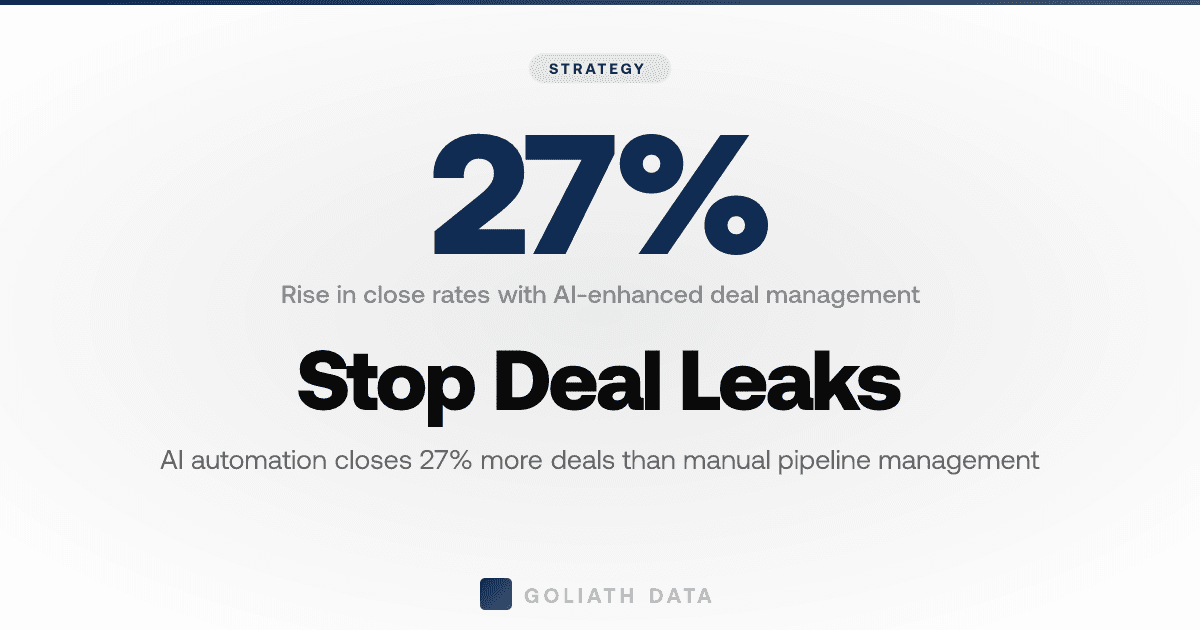
Yet 87% of brokerages and agents are already using real estate AI tools daily[1], and those who've implemented AI-enhanced deal management report a 27% rise in close rates[5]. The gap between agents managing pipelines manually and those using automation is structural.
Here's what separates pipelines that leak deals from pipelines that close them.
TL;DR
- Missed follow-ups and poor prioritization cause more deal losses annually than you realize
- AI lead scoring improves lead-to-close conversion by 25-40% and agents close more deals
- Why Deals Fall Through: The Hidden Pipeline Leak
Why Do Deals Fall Through?
Deals don't die from bad leads. They die from forgotten follow-ups, misaligned timing, and invisible friction inside your pipeline. Most real estate agents blame lead quality when the actual culprit is process, and it's costing you significantly more lost transactions per year than you realize.
Here's the pattern: You source a solid prospect. Then what? Manual CRM notes pile up. Follow-up windows slip by. The buyer moves to another agent. The listing goes stale. No single point of failure feels catastrophic, but collectively these gaps destroy your close rate.
Real estate agents using traditional CRMs spend 30-50% of their time chasing low-probability leads while high-intent prospects languish in the queue[10]. You're not managing a pipeline; you're managing noise.
Key insight: The real leak isn't lead quality. It's prioritization and follow-up velocity. Three preventable failures dominate: inconsistent contact timing (prospects move on), poor lead scoring (you don't know which deals are closeable), and manual workflow bottlenecks (follow-ups get forgotten).
Inconsistent follow-up timing kills more deals than poor prospecting. A buyer interested on Monday forgets about you by Thursday if you don't respond. Without automation, follow-ups slip through calendar conflicts and competing priorities. That delay costs closures.
Poor lead prioritization wastes your best hours on prospects who'll never convert. You're spending energy on "warm feelings" instead of buyer intent signals. Real estate prospecting without AI lead scoring is like fishing without knowing which waters hold fish.
Manual workflow bottlenecks compress your conversion window. Each handoff between steps introduces friction: phone call to note, email to task, task to reminder. Missing a follow-up or forgetting a callback doesn't feel like pipeline loss; it feels like a bad day. Multiply that across 50 leads, and you've lost a month of revenue.
How Does AI Lead Scoring Focus You on Closeable Deals?
AI-driven lead scoring assigns probability weights to each opportunity based on buyer intent signals, engagement history, and property fit. You spend time on deals most likely to close instead of chasing prospects who feel hot but never convert.
The numbers are stark. 54% of real estate agents already use AI CRM for lead nurturing[4], and those who do see deal close rates rise 27%[5] with conversion lifts of 25-40%[9]. More striking: agents using AI lead scoring report closing more deals[13]. That massive multiplier eliminates the bias of gut instinct.
Here's the counterintuitive part: human intuition about which leads are "ready" fails frequently. Your highest-converting prospects often aren't the loudest voices in your inbox. AI removes gut bias and reveals the quiet, lower-touch prospects who actually have the highest intent, flipping traditional pipeline strategy upside down.
Tools like Goliath Data surface seller intent signals automatically through life-event triggers like tax delinquency, pre-foreclosure and property equity shifts. Your pipeline fills with prospects ranked by actual likelihood to transact, not recency bias. Fewer stalled deals. Shorter sales cycles. More closed transactions. No additional staff needed.
Frequently Asked Questions
Why do deals fall through without automation, and what's the actual cost?
Deal decay happens because manual follow-up systems create scheduling gaps. Agents miss optimal contact windows, leads go cold between touches, and low-probability prospects consume time that should go to closeable deals. Brokerages lose significantly more transactions per year because follow-up becomes reactive instead of systematic. If you're closing 20 deals annually, automation could realistically push that to 28-32 deals using the same team. The cost isn't just lost commission; it's opportunity cost: agents spend 30-50% of their time on leads that will never convert[10].
Can AI lead scoring eliminate chasing 'hot feels' that never close?
Yes. Agents using AI lead scoring close more deals because the system ranks prospects by buyer intent signals and engagement history, not gut instinct[13]. A prospect who seems energetic in a showing but has low equity gets deprioritized. Someone quietly building equity and showing consistent engagement moves to the top of the call list. AI lead scoring cuts wasted time on low-probability leads by 30-50%[10], freeing agents to focus on deals that actually close.
How much faster do deals close with CRM workflow automation?
Brokers implementing end-to-end CRM workflow automation report shorter deal cycles and more closed transactions annually without adding staff[7]. The speed gain comes from three places: HubSpot CRM automation improves lead-to-deal conversion by 30-35%[14], automated follow-up sequences eliminate scheduling gaps that kill deals, and agents spend zero time on manual calendar blocking or email queuing.
Is AI CRM adoption still niche in real estate?
Adoption is mainstream now. 54% of real estate agents already use AI CRM for lead nurturing[4], and 89% of top-performing agents are projected to use AI-enhanced CRMs by 2026[2]. Those using AI see deal close rates rise 27% and conversion lifts of 25-40%[5]. If you're not using AI lead scoring and automation yet, you're competing against agents who close deals faster and waste less time on dead-end prospects.
What's the difference between generic CRM automation and real estate-specific AI pipeline tools?
Generic CRMs automate email cadences and calendar tasks, but they lack real estate context. They don't know property-buyer fit, don't score based on life-event seller intent, and don't prioritize deals by market conditions or equity position. Real estate-specific AI tools like Goliath Data combine automated follow-up velocity with proprietary seller intent signals and Seller Intent Scoring. Goliath's AI assistant David handles 24/7 inbound call qualification, builds smart call lists with instant conversation summaries, and automates nurture sequences via call, text, and email. The difference: generic tools move deals through a pipeline; Goliath Data identifies which prospects belong in your pipeline and eliminates the ones that won't close.
If agentic CRMs boost conversion rates by 67%, what does that mean for my bottom line?
Agentic CRMs, systems that automate prospecting, lead qualification, follow-up, and deal tracking without agent intervention, are projected to boost conversion rates by 67% over traditional manual workflows[3]. If you're currently closing 20 deals from 200 leads (10% conversion), a significant boost moves you to higher conversion on the same lead volume, meaning more closed deals without increasing marketing spend. For a typical agent earning $8,000 average commission per deal, that translates to meaningful additional annual revenue. For a brokerage managing 10 agents, the impact compounds significantly. You need a system that actually executes the automation, not just promises it. Goliath Data's agentic architecture handles call handling, text sequences, email nurture, deal tracking, and reminders all working together because it's purpose-built for real estate.
Sources
- Ascendix, 2026, 87% of brokerages and agents actively using real estate AI tools daily
- Ascendix, 2026, 89% of top agents projected to use AI-enhanced CRMs by 2026
- Ascendix, 2026, Agentic CRMs projected to boost conversion rates by 67%
- Gitnux AI CRM Industry Statistics Report, 2026, 54% of real estate agents use AI CRM for lead nurturing
- Gitnux AI CRM Industry Statistics Report, 2026, Real estate deal close rates rise 27% with AI CRM
- The AI Consulting Network, 2026, CRE brokers implementing end-to-end workflow automation report shorter deal cycles and more transactions annually without adding staff
- The AI Consulting Network, 2026, AI lead scoring delivers improvement in lead-to-close conversion rates
- The AI Consulting Network, 2026, AI lead scoring reduces time spent on low probability leads by 30-50%
- V7 Labs, 2026, REsimpli users report more deals closed
- Dean Infotech, 2026, Lead-to-deal conversion rate increased by 30-35% with HubSpot CRM automation