


Mercer County, Pennsylvania Tax Delinquent Properties for Sale List
Mercer County, Pennsylvania Tax Delinquent Properties for Sale List. A practical guide to what works, what to skip, and how to get started.


Tennessee, Goliath Teammate
Key Takeaways
- Mercer County, Pennsylvania has 108,503 residents and 50,884 housing units, with a median owner-occupied home value of $153,600 (U.S. Census Bureau, American Community Survey 2023 5-Year Estimates).
- Mercer County's median household income is $60,614, and 66% of its housing is owner-occupied: 33,584 owner-occupied units out of 50,884.
- Mercer County tax delinquent properties belong to owners who have fallen behind on property taxes, which makes them a source of motivated sellers outside the MLS.
- Static tax delinquency lists go stale the moment they are downloaded; Goliath Data monitors real-time tax delinquency signals to surface which Mercer County homeowners are actively distressed and most likely to sell before they list publicly.
Mercer County, Pennsylvania is home to 108,503 residents across 50,884 housing units, with a median home value of $153,600. Yet within that housing stock sits an often-overlooked opportunity: tax delinquent properties available for purchase through county sales. These properties represent motivated sellers facing financial hardship—homeowners who've fallen behind on property taxes and have limited options to recover their equity.[3]
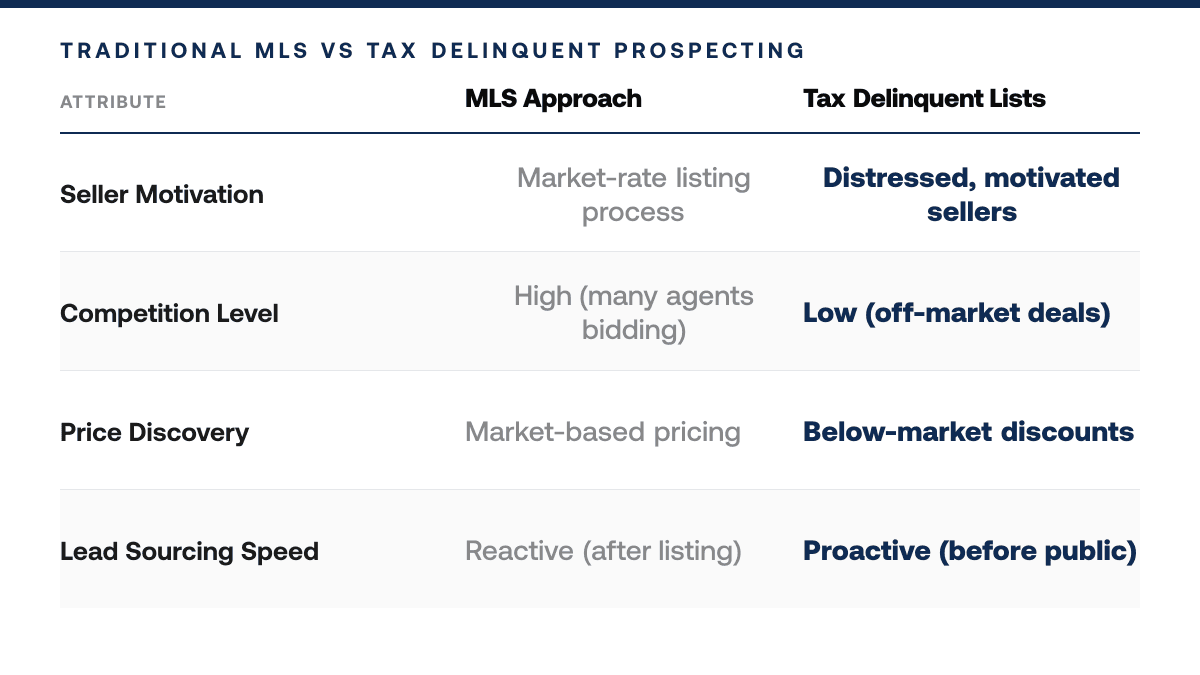
For real estate agents and investors, tax delinquent property lists offer a direct path to off-market deals and distressed sellers without competing in the traditional MLS. Rather than chasing leads through broad marketing campaigns, you can identify specific properties in your target area, understand the owners' situations, and reach out with solutions when they're most receptive. The challenge is finding these lists quickly and prospecting efficiently before competitors do.
This article covers how to access Mercer County's tax delinquent property sales list, what to expect from the buying process, and how to build a prospecting workflow that turns these opportunities into closed deals. You'll learn the timeline, costs, and legal requirements—plus strategies to automate your outreach and follow-up so you can scale your pipeline without increasing your marketing budget. Most tax delinquency lists are static snapshots that go stale the moment you download them, leaving you chasing properties already claimed or reconciled — Goliath Data monitors real-time tax delinquency signals to surface which homeowners are actively distressed and most likely to sell before they list publicly.
TL;DR
- Mercer County tax delinquent properties are sold through a three-tier process—Upset Sale, Judicial Sale, and Repository Sale—managed by the county tax claim bureau under Pennsylvania's Real Estate Tax Sale Law.
- Pennsylvania has no post-sale redemption period, meaning winning bidders gain immediate title and can begin resale or renovation within weeks, not months.
- Investors must plan for federal capital gains tax on resale profit and verify property liens before bidding, as early-stage sales remain subject to existing encumbrances.[1]
What should investors know about tax delinquent properties in Mercer County, Pennsylvania?
What Is a Tax Delinquent Property?
A tax delinquent property in Mercer County, as anywhere in Pennsylvania, is real estate where the owner has failed to pay property taxes owed to the county. When taxes remain unpaid beyond the grace period, the county tax claim bureau initiates a formal process to recover the debt. These properties are eventually listed for sale to satisfy the outstanding tax obligation. Tax delinquent properties represent a unique market segment because they often sell at a significant discount compared to market value, creating opportunities for investors and agents to acquire properties below their true worth. The owner's financial distress or inability to pay creates motivated-seller conditions that can lead to faster transactions and better profit margins.
Mercer County, Pennsylvania — Property & Housing Snapshot (2023)
Metric | Value |
|---|---|
Population | 108,503 |
Median home value (owner-occupied) | $153,600 |
Median household income | $60,614 |
Total housing units | 50,884 |
Owner-occupied rate | 66% |
Source: U.S. Census Bureau, American Community Survey 2023 5-Year Estimates.
Why do tax delinquent properties matter to real estate professionals?
Tax delinquent properties matter because, for agents and investors, tax delinquent property lists are a goldmine of motivated sellers. Property owners facing delinquency are often desperate to resolve the situation, making them more willing to negotiate and close quickly. This creates an opportunity to build a consistent pipeline of deals without relying solely on traditional marketing channels. Accessing these lists allows professionals to identify prospects before they hit the open market, automate outreach to multiple owners simultaneously, and close transactions faster. Rather than waiting for sellers to list properties or respond to broad marketing campaigns, agents and investors can directly target owners with a specific financial problem, dramatically reducing prospecting time and increasing deal velocity.
How does Pennsylvania's tax sale process work?
Pennsylvania's Real Estate Tax Sale Law establishes a three-tier sale process to recover delinquent taxes. The process begins with an Upset Sale, where properties are sold subject to existing liens, followed by a Judicial Sale if the Upset Sale does not generate sufficient revenue, and concludes with a Repository Sale for remaining properties. A critical advantage for buyers in Pennsylvania is that the state has no post-sale redemption period—once a property is sold at tax sale, the new owner takes clear title immediately without the owner having a window to reclaim the property. This streamlined process, governed by 72 P.S. §5860, makes Pennsylvania an attractive jurisdiction for investors seeking quick ownership transfer and reduced holding costs.[1]
Key Numbers for Mercer County, Pennsylvania Tax Delinquent Properties for Sale List (2026)
- 108,503 residents in Mercer County, Pennsylvania (2023 ACS 5-Year Estimates)
- $153,600 median home value (owner-occupied) in Mercer County
- 66% owner-occupied housing rate in Mercer County (33,584 owner-occupied units of 50,884 total)
- Real Estate Tax Sale Law (72 P.S. §5860) governs county tax-deed sales in Pennsylvania[1]
- Zero post-sale redemption period in Pennsylvania—tax-deed buyers acquire clear title immediately[1]
- Three-tier sale process: Upset Sale (subject to liens) → Judicial Sale (free and clear) → Repository Sale[1]
- Short-term capital gains (ordinary-income rates) apply to profits from quick resale; long-term rates require longer holding periods (IRS Publication 4681)[2]
How do you buy a Mercer County tax delinquent property, step by step?
1. Contact Mercer County Tax Claim Bureau
Contact the Mercer County tax claim bureau directly to request the current delinquent property list. The Mercer County tax claim bureau maintains the official roster of properties subject to tax sale under Pennsylvania's Real Estate Tax Sale Law. Ask for properties in your target neighborhoods or price range, and confirm whether the list includes upset sale, judicial sale, or repository sale inventory. Request the list in digital format if available to streamline your prospecting workflow.[1]
2. Verify Property Status and Sale Timeline
Cross-reference each property on the delinquent list against county records to confirm current ownership, lien position, and delinquency duration. Under Pennsylvania law, tax sales proceed through a three-tier process: upset sale (subject to liens), judicial sale (free and clear), and repository sale. Tools like Goliath Data surface the high-leverage moves so you don't have to find them by hand. Determine which tier applies to your target properties and note the expected sale date. This verification step prevents wasted effort on properties that may have been redeemed or sold since the list was published.[1]
3. Assess Profit Potential and Tax Liability
Estimate acquisition cost, repair expenses, and potential resale value for each property. Calculate your holding period—short-term holds (under one year) trigger ordinary-income tax rates on profits, while longer holds qualify for long-term capital-gains rates. If a prior owner's debt was canceled through the sale, be aware that canceled debt may be reportable as income on Form 1099-C unless a federal exclusion applies. Factor these tax consequences into your deal analysis.[2]
4. Build Your Outreach List and Automate Follow-Up
Compile contact information for property owners, heirs, and lienholders from the verified delinquent list. Segment prospects by property type, equity position, and likelihood of motivation. Goliath Data makes this consistent across every workflow the team runs, not just the ones someone remembers to check. Set up automated email or SMS follow-up sequences to nurture leads over weeks or months, allowing time for owners to respond to initial outreach. Track responses and engagement to identify the most motivated sellers and prioritize your direct calls or in-person visits to close deals faster.

How does this work in practice for Mercer County investors?
Example 1: The Wholesaler's Fast-Track Prospecting
Picture a wholesaler who traditionally spent hours each week manually searching county tax records and public databases, then cross-referencing ownership details to build a prospect list. With access to a curated Mercer County tax delinquent properties list, that same wholesaler can now pull a filtered dataset in minutes—sorted by delinquency status, ownership type, and property characteristics—and immediately begin outreach to motivated sellers before competitors identify the same opportunities. Instead of waiting weeks to build a pipeline, the wholesaler reaches out within days, shortening the sales cycle and increasing the likelihood of securing an off-market deal at a meaningful discount. The time saved on research translates directly into more hours spent on negotiation and closing, multiplying deal velocity without requiring additional marketing budget or team headcount.
Example 2: The Buy-and-Hold Investor's Automated Lead Nurture
Consider a buy-and-hold investor managing a portfolio of rental properties who wants to expand into Mercer County but lacks the bandwidth to manually track new delinquencies and follow up with sellers over time. By integrating a tax delinquent properties list into their CRM, the investor can automate a nurture sequence: an initial outreach email, a follow-up call within 3 days, and a second touchpoint within 2 weeks—all triggered by the seller's delinquency status rather than random timing. This systematic approach ensures no lead falls through the cracks due to competing priorities. Over a few months, the investor builds relationships with a handful of sellers who may not be ready to sell immediately but recognize the investor as a knowledgeable, persistent partner. When a seller's situation becomes urgent, that investor is already top-of-mind, closing the deal faster and on better terms than an agent who just entered the conversation.
Why do speed and automation win?
Speed and automation win because both examples underscore the same principle: in real estate, the agent or investor who reaches a motivated seller first, with credible information and a clear offer of help, closes more deals and negotiates better prices. A tax delinquent properties list collapses the time between discovery and outreach, and automation ensures follow-up happens consistently—two levers that directly lift deal volume without inflating marketing spend or team size.
Mercer County Tax Delinquent Properties Checklist
- Request the current delinquent property list from the Mercer County tax claim bureau.
- Verify each property's redemption status—Pennsylvania has no post-sale redemption period under the Real Estate Tax Sale Law.
- Identify properties eligible for the three-tier sale process: Upset Sale, Judicial Sale, or Repository Sale.
- Calculate short-term versus long-term capital gains tax treatment for your projected holding period using IRS Publication 4681.
What mistakes should Mercer County tax-sale buyers avoid?
Mistake: Overlooking Pennsylvania's no-redemption rule when bidding at Mercer County tax sales
Many agents and investors trained in redemption states assume buyers have a grace period to reclaim properties after purchase. Under Pennsylvania's Real Estate Tax Sale Law, there is no post-sale redemption period. Once the tax deed transfers at the three-tier sale process—Upset Sale, Judicial Sale, or Repository Sale—ownership is final. Missing this distinction costs time and capital on properties you thought were still at risk of reclamation, and it changes your hold timeline and profit calculations.[1]
Mistake: Failing to account for short-term capital gains tax on quick Mercer County tax-deed flips
Agents and wholesalers who acquire tax-sale properties and resell them within months often treat the profit as a simple transaction gain. Under IRS Publication 4681, profits from properties held briefly before resale are taxed at short-term ordinary-income rates, not favorable long-term capital-gains rates. Ignoring this tax treatment inflates your net profit projections and can wipe out margins on quick turnarounds. Plan hold periods strategically and consult a tax professional to determine whether a longer hold qualifies for long-term rates.[2]
Mistake: Confusing Mercer County's county-level tax claim bureau with Philadelphia's separate municipal process
Pennsylvania has two different tax-sale procedures: counties like Mercer use the Real Estate Tax Sale Law and file delinquent lists through the county tax claim bureau, while Philadelphia operates under its own Municipal Claims & Tax Liens Act through the City Revenue Department. Agents prospecting statewide often apply the same sourcing strategy to both, wasting time on outdated or incorrect lists. Verify which process applies to your target jurisdiction and pull delinquent lists from the correct office to ensure you're accessing current, actionable leads.[1]
Frequently Asked Questions
How does Pennsylvania's tax deed sale process work?
Pennsylvania uses a three-tier tax deed sale process under the Real Estate Tax Sale Law (Act 542 of 1947). Properties move through an Upset Sale (subject to existing liens), then a Judicial Sale (free and clear of liens), and finally a Repository Sale. Unlike many states, Pennsylvania offers NO post-sale redemption period, meaning buyers acquire clear title immediately upon purchase. The Mercer County tax claim bureau publishes delinquent property lists for investors to review.[1]
What tax consequences apply when I resell a tax-deed property for profit?
Profit from reselling a property acquired at a tax sale is generally treated as a capital gain reportable to the IRS. If you hold the property only briefly before resale, the gain is taxed at short-term (ordinary-income) rates. Properties held longer may qualify for long-term capital-gains rates, which are typically lower. Consult a tax professional to understand your specific holding period and rate.[2]
Where do I find the official Mercer County delinquent property list?
The official Mercer County delinquent property list is published by Mercer County's tax claim bureau. You can contact the county directly or check the county assessor's office for current listings. Many investors also use data platforms such as Goliath Data that aggregate and update delinquent property records in real time, allowing you to filter by location, price, and property type without manual research.[1]
Sources
- Pennsylvania Real Estate Tax Sale Law (Act 542 of 1947)
- IRS Publication 4681: Canceled Debts, Foreclosures, Repossessions, and Abandonments
- Mercer County, Pennsylvania — ACS 2023 5-Year Estimates
Disclaimer: This article is provided by Goliath Data for general informational purposes only and does not constitute legal, tax, financial, or investment advice. Statutory references, redemption timelines, interest rates, and procedural requirements vary by jurisdiction and change over time. Always verify current information with the relevant county or municipal office and consult a licensed attorney, CPA, or financial advisor before making any investment, acquisition, or legal decision based on this content.
Find owner, tax and parcel records on the Mercer County, Pennsylvania property records page.