
How to Track Seller Intent Signals Before They
Spot motivated seller detection signals using AI-powered intent scoring, behavioral triggers, and public data sources. Find leads 60+ days before listing.


Austin Beveridge
Tennessee
, Goliath Teammate
89% of top agents are projected to use AI-enhanced CRMs by 2026[1], yet most still chase leads after listings go public. Motivated seller detection uses AI-powered intent signals, financial stress indicators, property condition data, market timing patterns, and behavioral cues from public records, to identify sellers before they list. Goliath Data automates this discovery, delivering pre-qualified leads with significantly higher conversion rates than traditional sourcing by monitoring real-time life-event signals like foreclosure notices, tax delinquencies, and job changes that signal intent to sell.
The advantage isn't just speed, it's precision. Real estate investors and agents burning budget on PPC and direct mail see inconsistent deal flow because they're competing for the same public listings everyone else is chasing. Goliath Data flips the timeline: you reach motivated sellers before they list, before their agent is chosen, before competing offers appear. That preemptive position converts at significantly higher rates than traditional lead scoring.
Here's how seller intent signals work, which ones matter most, and how to build a pre-list outreach system that closes deals faster.
TL;DR
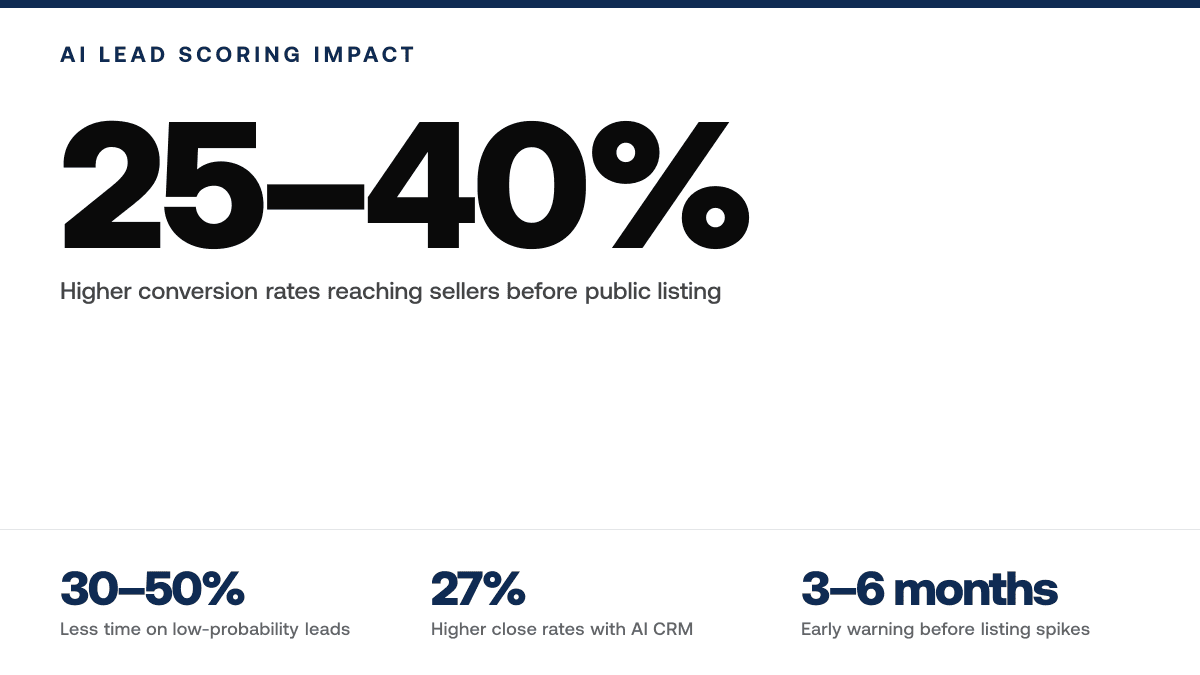
AI lead scoring cuts low-probability prospecting time by 30–50% without adding staff[2]
Reaching sellers before listing improves conversion rates by 25–40% over public MLS leads[2]
The Hidden Intent Signals That Predict a Seller's Move
Motivated sellers broadcast intent long before their property hits MLS. Tax delinquencies, code violations, probate filings, mortgage stress, and visible property neglect are early-warning indicators that a homeowner is primed to sell. Goliath Data monitors these public-record signals in real-time, but most agents only prospect from active listings, arriving 60–90 days too late when competition is fiercest.
A homeowner facing foreclosure, carrying delinquent property taxes, or inheriting through probate isn't casually browsing the market, they're under real pressure. Real estate deal close rates rise 27% with AI CRM leads[3], and that advantage compounds when you reach a seller 30–90 days before their listing posts.
Here's the thing: intent signals exist in public records today. Property appraiser databases log code violations and maintenance complaints. County recorder offices file tax delinquency notices. Probate courts publish heir claims. Mortgage servicers file forbearance records. But surfacing these signals at scale requires automation. Manual county-by-county record scraping takes weeks. By then, the seller has already called three other agents.
Goliath Data automates this detection with real-time life-event signals and ranks prospects by a Seller Intent Score. Agents access a prioritized call list of sellers most likely to move, then activate automated AI nurture sequences via call, text, and email. The workflow captures conversations while sellers are still thinking, not yet listing.
Key insight: The 30–90 day window before listing is where conversion rates peak, but only if you reach the seller before multiple competitors do. Automation is the only way to catch it at scale.
How AI Lead Scoring Separates True Motivation From Noise
Not all intent signals carry equal weight. A mortgage in forbearance signals urgent need to sell. A single code violation is noise. Goliath Data builds lead scoring around multi-signal patterns, combining financial stress, behavioral markers, and property condition data, to rank prospects by transaction likelihood and urgency, not engagement metrics alone.
Most CRMs score leads on engagement: email opens, click-throughs, form submissions. Generic scoring misses the actual drivers of seller motivation, which live in public records and financial behavior. Tax delinquency, foreclosure filings, probate status, and job changes are signals that don't appear in your email platform.
AI lead scoring delivers a 25 to 40% improvement in lead-to-close conversion rates and reduces wasted time on low-probability leads by 30 to 50%[2]. That means fewer cold calls to tire-kickers and more conversations with sellers already motivated to move.
Your scoring model must weight signals by what actually predicts a transaction. A homeowner three months behind on property taxes is more likely to list than someone with one permit violation. A property in probate is higher-intent than a property with deferred maintenance. Goliath Data's proprietary scoring prioritizes these documented patterns, automatically flagging multi-signal combinations that signal real motivation. Ranked prospects feed directly into your CRM and nurture workflows.
For real estate investors: Lead scoring cuts wasted ad spend by filtering your audience to only those with proven intent signals before you bid. For solo agents: Automated scoring means your call list is pre-sorted by likelihood to close, so you spend cold-calling hours on sellers most likely to say yes.
Frequently Asked Questions
How early can I reach a seller before they list if I'm monitoring intent signals?
The window is typically 30–90 days before an MLS listing appears. Tax delinquencies, code violations, and mortgage forbearance notices are public record events that precede seller action by weeks or months. Goliath Data flags these signals in real-time, so you can reach out while the seller is still in decision-making mode, before competing agents even know the property exists.
Why does AI lead scoring matter more than just pulling a list of distressed properties?
Not all distressed signals carry the same intent weight. A mortgage in forbearance signals urgent financial stress, while a single code violation might be routine maintenance. AI lead scoring weighs multiple signals together to rank prospects by true urgency. This delivers 25 to 40% improvement in lead-to-close conversion rates[2] and lets you focus on sellers most likely to move, not every property with a flag.
Can I legally reach out to homeowners before they list?
Yes. Reaching out based on public record signals (tax delinquencies, foreclosure filings, probate records) is legal under TCPA guidelines because you're contacting about a matter of public record related to their property. Your outreach must be permission-based and compliant: identify yourself, disclose your intent, and provide a clear opt-out path. Goliath Data's automated workflows are built with compliance in mind.
How do I know if automated outreach via AI will hurt my reputation?
Automated outreach only hurts reputation when it feels impersonal or tone-deaf. The key is timing and relevance: if you reach out within 48 hours of detecting a real intent signal and your message acknowledges the specific situation, sellers perceive it as helpful. Goliath Data's AI assistant David handles inbound calls, texts, and emails, qualifying leads and scheduling callbacks automatically, so when a seller responds, they talk to a real human with context.
What's the ROI difference between pre-list sellers versus reactive MLS leads?
Real estate deal close rates rise 27% with AI CRM leads[3], and that advantage compounds when those leads are pre-list intent signals. CRE brokers implementing end-to-end workflow automation report 30 to 50% shorter deal cycle times and 40 to 60% more transactions per year without adding staff[4]. Pre-list sellers have fewer competing agents, longer decision windows, and higher motivation, so your close rate improves and your cost per deal drops.
Does Goliath Data replace my existing CRM?
Goliath Data is a full-featured CRM with contacts, calling, texting, deal tracking, tasks, calendar, and activity logging. It can function as your entire pipeline system. If you're already embedded in another CRM, Goliath Data's integrations allow you to pull intent signals and AI-skiptraced contact info into your existing workflow. The real win is the combination: proprietary life-event signals paired with built-in CRM and AI assistant David handling inbound and outbound follow-up automatically.
