
How to Find Tax Delinquent Sellers in 48 Hours
How to Find Tax Delinquent Sellers in 48 Hours — practical guide covering setup, examples, and common mistakes. Built for practitioners working with tax delinqu

Austin Beveridge
Tennessee
, Goliath Teammate
Every year, thousands of property owners fall behind on tax payments, creating a window of opportunity that most real estate professionals never see. These tax delinquent properties sit in public records, waiting to be discovered—yet traditional methods of finding them require weeks of manual research, public record searches, and cold outreach. The sellers behind these properties are often highly motivated, facing imminent loss and willing to negotiate below market value.
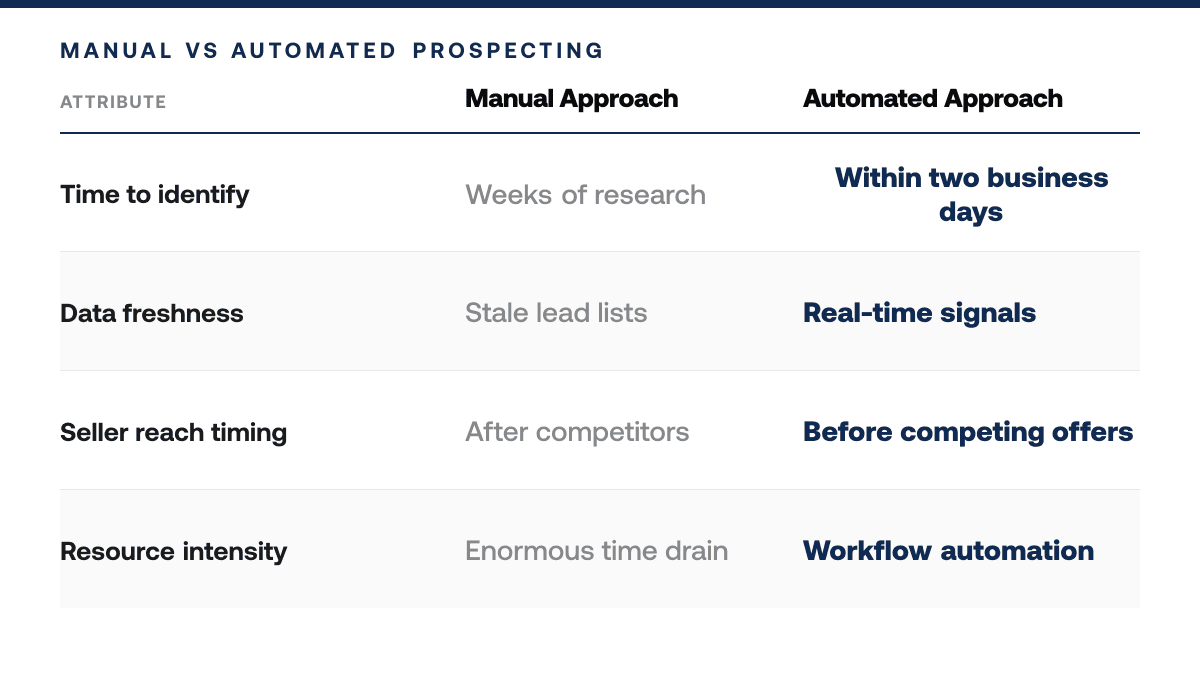
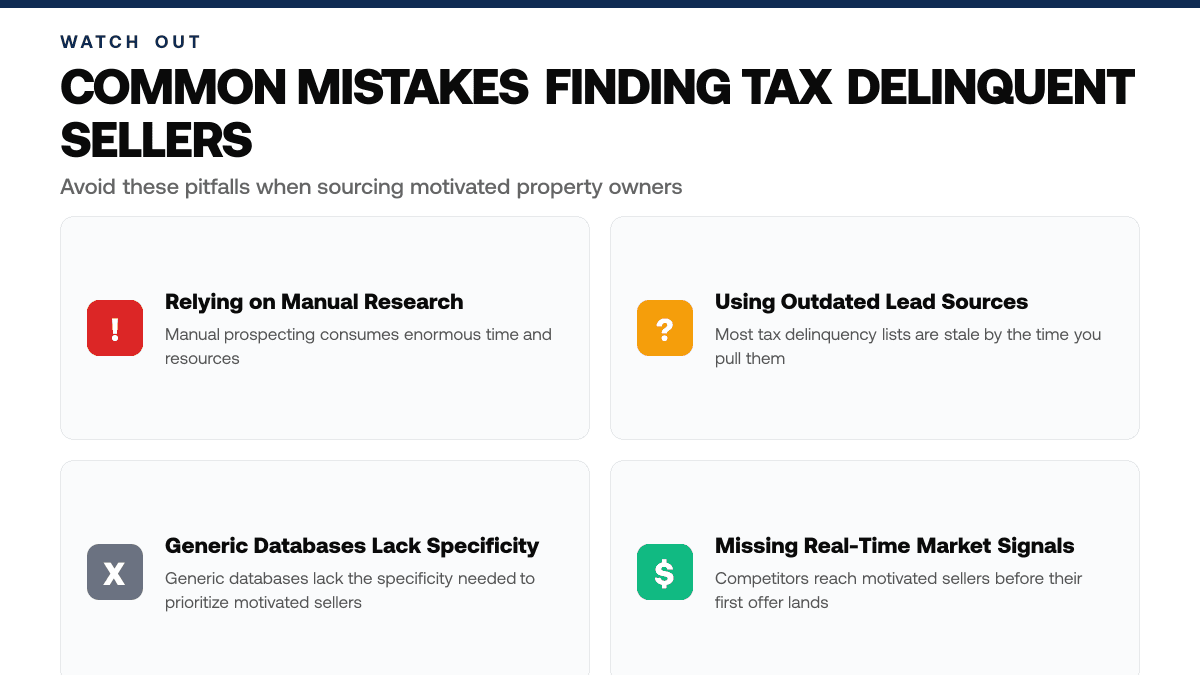
For agents and investors, the challenge isn't whether tax delinquent sellers exist—it's how to identify them efficiently before competitors do. Manual prospecting consumes enormous time and resources, and many professionals rely on outdated lead sources or generic databases that lack the specificity needed to prioritize the most motivated sellers. Data-driven approaches that automate the discovery process can compress what typically takes weeks into a matter of days, fundamentally changing how quickly you can move from prospect identification to meaningful outreach.
This guide covers the practical steps to locate tax delinquent sellers in 48 hours or less, including how to access public records efficiently, what signals indicate genuine seller motivation, and how modern prospecting tools can eliminate the friction in your seller-identification workflow. You'll learn where to find these opportunities and how to structure your outreach to convert interest into conversations. Most tax delinquency lists are stale by the time you pull them, leaving you chasing sellers who've already decided or gone dark — Goliath Data monitors real-time tax delinquency signals the moment they hit public record, so you reach motivated sellers before their first competing offer lands.
TL;DR
Tax delinquent sellers are property owners facing property tax liens who are highly motivated to sell quickly to avoid foreclosure.
Automated data tools can scan public tax records and identify these sellers, enabling targeted outreach within two business days.
Speed matters: reaching motivated sellers before competitors do increases your chances of negotiating below-market deals.[2]
Understanding Tax Delinquent Properties and Seller Motivation
What Is a Property Tax Lien?
A property tax lien arises when a property owner fails to pay annual property taxes owed to the local taxing authority. Once taxes become delinquent, the government places a legal claim against the property, creating a lien that must be resolved before the owner can sell, refinance, or transfer ownership. This process follows defined timelines and procedures established by state law, with specific redemption windows and interest accrual rates that vary by jurisdiction. Understanding these mechanics is essential for investors and agents evaluating whether a tax-delinquent property represents a viable acquisition opportunity.[2]
Why Tax Delinquency Matters to Real Estate Professionals
Tax delinquency creates measurable financial pressure on property owners. As unpaid taxes accumulate, so do penalties and interest charges, increasing the owner's total debt burden and reducing their equity position. This mounting obligation often motivates sellers to accept below-market offers simply to exit the situation and eliminate the legal liability hanging over their property. For agents and investors, identifying these motivated sellers opens a direct path to negotiating favorable purchase prices without relying on broad marketing campaigns. The financial stress of tax delinquency is a powerful indicator of seller motivation and deal potential.
Tax Delinquency in the Broader Real Estate Market
Tax-delinquent properties represent a persistent segment of the housing market, particularly in regions experiencing economic transitions or population shifts. These situations are not isolated anomalies but rather recurring opportunities that follow predictable patterns. Property owners facing delinquency often lack the resources, awareness, or ability to cure the debt themselves, making them prime candidates for direct outreach. Understanding the scope and characteristics of tax delinquency in your target market helps agents and investors prioritize prospecting efforts and allocate resources toward the highest-probability seller conversations.
Step-by-Step Process
1. Query public tax records using data automation
Access a data automation platform that aggregates public tax delinquency records across your target county or region. Use the platform to filter for properties with unpaid property taxes, focusing on those with the highest equity and shortest time since delinquency. This automated query pulls directly from public records, eliminating manual county-by-county searches and saving hours of research time.
2. Filter leads by redemption status and owner contact details
Narrow your results by redemption window status—properties still within the redemption period represent the highest-probability leads since owners retain the right to reclaim their property. Cross-reference results with verified owner contact information (phone, email, mailing address) to ensure your outreach reaches decision-makers directly. Tools like Goliath Data surface the high-leverage moves so you don't have to find them by hand. Prioritize properties where equity exceeds the tax debt, as these owners have stronger financial incentive to resolve the delinquency.
3. Execute outreach campaigns within the 48-hour window
Launch automated multi-channel outreach—email, SMS, and direct mail—immediately after identifying qualified leads. The 48-hour window is critical because other investors and wholesalers are running the same searches. Automated campaigns allow you to contact dozens of prospects simultaneously without manual dialing, maximizing your reach before competitors establish contact with the same sellers.
4. Document responses and prioritize follow-up conversations
Track all inbound responses in a centralized system to identify which sellers are most receptive. Prioritize follow-up calls with owners who reply within hours—these are typically the most motivated. Goliath Data makes this consistent across every workflow the team runs, not just the ones someone remembers to check. Use the data platform's built-in CRM features to log all interactions, ensuring no lead falls through the cracks and enabling you to refine your messaging based on early response patterns.
Watch Epic Real Estate's deeper walkthrough: 3 Ways Homeowners Are Quietly Beating Property Taxes Right Now
How This Works in Practice
Example 1: The Wholesaler's Fast-Track Identification
Picture a wholesaler who typically spends hours manually searching county records and cross-referencing tax delinquency lists to build a prospect list. Using automated data tools, she inputs her target county and filters for properties with tax delinquency status, then the system automatically pulls owner contact information and flags redemption timelines. Within hours—not days—she has a curated portfolio of single-family homes ranked by equity position and urgency. She launches a batch email and phone outreach to the most motivated sellers before competitors even know these properties exist. The speed advantage is real: her first conversations happen while owners are still processing the delinquency notice, making them more receptive to solutions like a discounted cash offer.
Traditional vs. Automated Tax Delinquent Prospecting
Approach | Time Investment | Lead Quality | Competitive Advantage |
|---|---|---|---|
Manual public record searches | Weeks of research | Stale by the time pulled | Competitors reach sellers first |
Generic databases and outdated sources | Moderate effort | Lacks specificity for motivation | Generic leads, low conversion |
Real-time automated data monitoring | Compressed to days | Fresh signals from public record | Reach motivated sellers before competing offers |
Example 2: The Agent's Targeted County Strategy
Consider a listing agent who wants to expand into a neighboring county but doesn't know where the motivated inventory is hiding. She uses a data platform to filter properties by equity threshold and redemption timeline, narrowing the county's entire inventory down to a focused list of owners facing imminent auction dates. Rather than cold-calling broadly, she reaches out to a smaller, highly-qualified group with personalized messaging about their specific situation. Simultaneously, she sets up automated follow-up sequences across multiple properties—emails triggered by redemption milestones, calls scheduled before auction dates—without manual intervention. This approach lets her nurture a handful of high-probability leads across several properties at once, converting more inquiries into listings while staying organized.
Why Speed and Automation Win
Both examples share a common thread: the agent or wholesaler who moves fastest, with the most precise targeting, captures the motivated seller before the market catches up. Automation removes the manual bottleneck—research, outreach, and follow-up happen in parallel, not in sequence. The result is more deals closed without proportionally higher marketing spend, because effort is concentrated on the sellers most likely to say yes.
Tax Delinquent Seller Outreach Checklist
Verify the property appears in county tax delinquent records and confirm current owner details before initiating contact.
Check the redemption window and accrued interest amount to calculate accurate offer pricing and deal viability.
Research the property's equity position and recent market comparables to align your offer with seller motivation.
Confirm tax sale date and any pending foreclosure actions to prioritize outreach timing within the 48-hour window.
Document ownership transfer requirements and lien payoff obligations specific to your state before presenting terms.
Common Mistakes to Avoid
Mistake: Skipping ownership and lien verification before outreach
Many agents and investors launch campaigns to tax-delinquent properties without confirming current ownership or existing liens. This wastes outreach effort on properties with clouded titles or multiple claimants, causing deals to collapse during due diligence. Before contacting any seller, pull the county assessor and recorder records to verify who holds title and what liens attach to the property. This single step eliminates dead-end prospects and focuses your effort on clean, actionable leads.[4]
Do's and Don'ts for Tax Delinquent Seller Outreach
Practice | Do This | Avoid This |
|---|---|---|
Timing of outreach | Contact sellers immediately after delinquency signals appear | Wait weeks or rely on stale lists |
Lead source selection | Use real-time data tools monitoring current public records | Chase generic databases lacking specificity |
Seller motivation assessment | Prioritize sellers with mounting penalties and reduced equity | Treat all delinquent properties as equal opportunities |
Prospecting efficiency | Automate discovery to eliminate manual research friction | Consume enormous time on outdated manual methods |
Mistake: Underestimating seller motivation and pricing offers too aggressively
Assuming all tax-delinquent sellers are desperate and offering well below market value backfires. Some owners have equity, liquidity, or emotional attachment and will reject lowball offers outright. Others may be unaware of the delinquency or have already arranged payment. Research the seller's situation—property history, prior sales, neighborhood trends—before making your offer. A realistic, respect-based proposal tailored to their actual position converts far more deals than a generic discount pitch.
Mistake: Ignoring state redemption windows and procedural deadlines
Tax-sale redemption periods and notice requirements vary significantly by state. Agents and investors who overlook these timelines miss critical windows to contact sellers, negotiate, or acquire properties before redemption rights expire. Consult your state's tax-sale statute and county procedures early in your prospecting workflow. Document key dates—sale date, redemption deadline, notice requirements—for every lead so you can prioritize outreach and avoid legal complications from missed filings or improper notice.[4]
Speed Reveals What Patience Hides
The forty-eight-hour constraint forces a different kind of thinking. Rather than waiting for perfect information, investors learn to recognize patterns in incomplete data—a skill that compounds across every deal that follows. Tax delinquency becomes less a puzzle to solve and more a signal to read.
Frequently Asked Questions
How widespread are tax delinquent properties across different regions?
Tax delinquent properties exist across all market segments and geographies, making them a reliable prospecting channel regardless of where you operate. Property tax delinquency is not confined to any single region or housing type—it occurs in urban, suburban, and rural markets alike. This geographic diversity means agents and investors can apply the same 48-hour prospecting methodology in their local market and scale it across multiple territories without needing location-specific strategies.[3]
Can automation really reduce the time I spend researching prospects?
Yes. Automation dramatically cuts manual research time by handling data aggregation, filtering, and list compilation in minutes rather than hours. This efficiency allows you to manage larger prospect volumes without expanding your team. By automating the repetitive work—pulling records, cross-referencing ownership, identifying high-probability sellers—you free up time for actual outreach and relationship-building, which are where conversions happen.
Why should I filter prospects by data rather than contact everyone on a tax delinquent list?
Data-driven filtering ensures your outreach targets high-probability sellers, which improves both conversion rates and return on investment. Contacting every name on a raw tax delinquent list wastes time on prospects unlikely to sell—absentee owners, institutional holders, or properties with title complications. By applying filters for equity position, property condition, owner contact patterns, and local market demand, you concentrate effort on motivated, reachable sellers who are more likely to respond and close.
Sources
Not legal or financial advice. This article is for general educational purposes only and should not be relied on as a substitute for professional legal, tax, or financial advice. Real estate, tax, and property laws vary by state and individual circumstances. Consult a licensed attorney or qualified professional in your jurisdiction before acting on any procedure or strategy discussed here. Reading this content does not create an attorney-client relationship.
Disclaimer: This article is provided by Goliath Data for general informational purposes only and does not constitute legal, tax, financial, or investment advice. Statutory references, redemption timelines, interest rates, and procedural requirements vary by jurisdiction and change over time. Always verify current information with the relevant county or municipal office and consult a licensed attorney, CPA, or financial advisor before making any investment, acquisition, or legal decision based on this content.
