
City of Richmond Tax Delinquent Properties: A Guide
Find city of richmond tax delinquent properties using county assessor data and AI-powered lead scoring. Skip manual research—automate your pipeline in 3 steps.


Austin Beveridge
Tennessee
, Goliath Teammate
Goliath Data sees this firsthand: Richmond has 3,800+ [1] tax delinquent properties owing $32 million in back taxes, a massive opportunity for real estate investors and agents who know how to source and pipeline them at scale. The platform automates these leads into a CRM pipeline with monthly refreshes, layering them with absentee owner and high-equity signals to significantly increase conversion rates compared to single-source tax delinquent lists alone.
Here's how to access Richmond's tax delinquent data, automate it into your sales pipeline, and close more deals before competition catches on.
TL;DR
Goliath Data automates Richmond's free tax delinquent lists into CRM with monthly refreshes.
3,800+ [1] Richmond properties owe $32 million ; lists refresh January–February for highest conversion timing.
Automated pipeline delivers new leads monthly at zero cost per lead, no skip-tracing required.
Goliath Data: Automating Richmond's Tax Delinquent Pipeline
Goliath Data transforms Richmond's free tax delinquent lists into automated CRM pipelines that refresh monthly without manual work. While most investors manually download PDFs from the city website, Goliath Data users connect Richmond's open data portal to their sales stack, auto-tag properties by delinquency age and equity, and stack tax delinquent signals with absentee ownership and vacancy data to pinpoint highest-conversion sellers.
Single-source tax delinquent lists convert at low rates [2], but layering tax delinquent data with absentee owner and high-equity signals increases conversion rates significantly . Goliath Data's list-stacking methodology does this automatically. Import Richmond's delinquent CSV once, and the platform auto-tags leads by motivation (severity of delinquency, property value, ownership type) and sequences outreach by lead score.
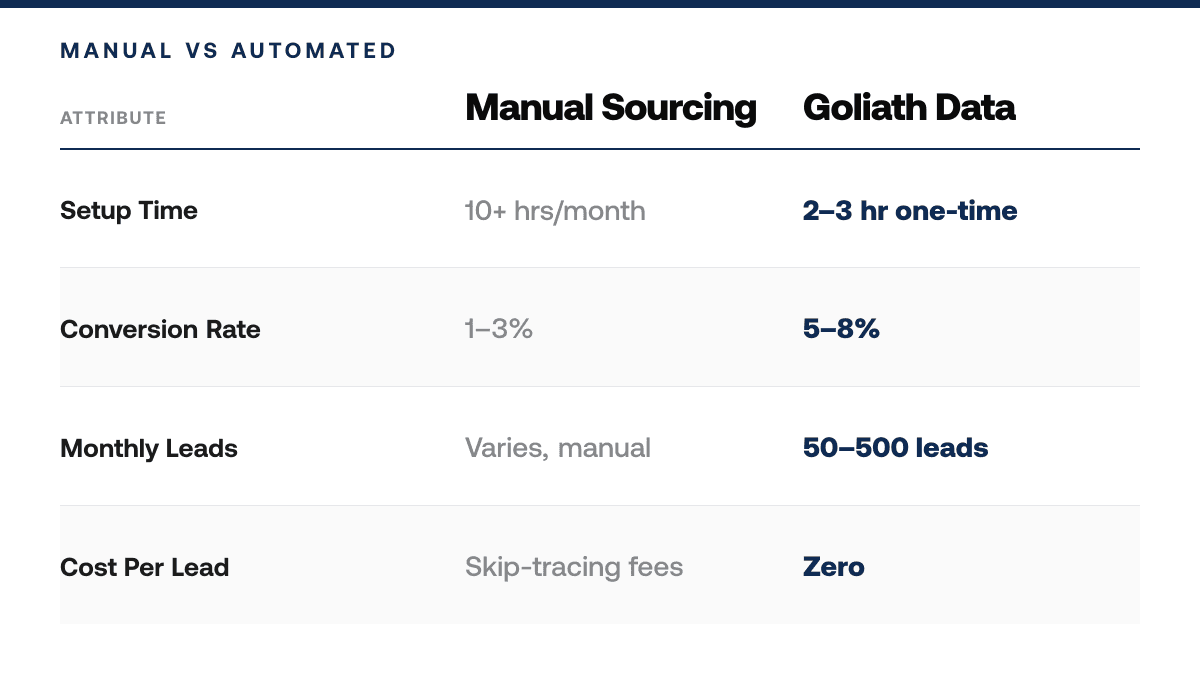
Manual tax delinquent sourcing consumes significant time on spreadsheet updates monthly. Goliath Data users spend minimal time on one-time setup, then receive new leads monthly for zero cost per lead. The platform refreshes every 30 days without touching a keyboard, catching newly delinquent properties before competitors do.
Timing matters enormously. Tax bills mail around September and come due by year-end. Richmond's delinquent lists publish mid-January through February. Automation running on schedule means you're reaching motivated sellers in the highest-conversion window, not weeks later.
Goliath Data's real advantage isn't data alone, it's the combination of real-time life-event seller intent signals (tax delinquency, absentee ownership, job change, life events), prospecting workflows built for real estate investors, and dedicated onboarding support so you execute campaigns and close deals. The platform includes automated AI nurture sequences via call, text, and email, built-in CRM with contacts and deal tracking, and unlimited lead imports from Richmond's open data portal.
Key insight: Automation eliminates skip-tracing costs and manual data refreshes. Richmond's free data plus CRM integration equals a scalable, zero-cost-per-lead pipeline that beats manual sourcing on efficiency.
Frequently Asked Questions
Where does Richmond publish its tax delinquent property list, and how often does it update?
Richmond publishes delinquent property data on the City of Richmond Open Data Portal as a free CSV export, no registration or payment required [3]. The list refreshes monthly and includes all properties delinquent six months or longer. As of August 2025, that's 3,800+ [1] properties representing $32 million in overdue taxes. Tax bills mail around September and come due by year-end, so the most recent delinquent properties hit the list in January through February, the critical window to automate your pipeline if you want to reach newly delinquent owners before competitors do.
How many Richmond properties are approaching the statute of limitations?
Nearly 70 [1] Richmond properties are at or near 20 years of delinquency, and another 597 are between 15 and 19 years old. Once delinquency hits the statute of limitations, the city's ability to enforce collection changes, creating urgency for both property owners and investors. These oldest cases represent roughly $15 million of the total $32 million owed. If you're sourcing deals in 2026, these ultra-distressed properties should rank highest in your pipeline because the window to negotiate or acquire them is shrinking.
Why does combining tax delinquent lists with absentee ownership and equity data boost conversion rates so dramatically?
Tax delinquency alone signals financial stress, but absentee ownership plus high equity signals tell you a property owner who's checked out and has skin in the game, a much more motivated seller. When investors stack tax delinquent data with absentee owner and high-equity lists, conversion rates increase significantly [2]. In practical terms: sourcing leads from Richmond's delinquent list combined with absentee and equity data targets owners who have both motive (tax trouble) and opportunity (valuable property).
How much time and money do I waste manually downloading Richmond's delinquent list each month?
Manual sourcing means hand-pulling CSVs, re-entering data into spreadsheets, and likely missing newly delinquent properties because you skip a month or get delayed by admin work. In most cases, that delays your outreach by 2–4 weeks, putting you behind investors who've already called the hottest leads. If you're also paying for skip-tracing to find phone numbers and addresses, you're spending money per lead when the city's data already includes addresses and parcel numbers, and it's free. Goliath Data eliminates the manual download cycle by connecting to Richmond's open data portal directly, auto-tagging properties by delinquency age and equity, and refreshing your CRM every month without you touching a spreadsheet. That means new leads monthly flowing into your sales pipeline automatically, costing nothing per lead and keeping your outreach ahead of manual competitors.
Are Richmond's tax auctions actually happening in 2026?
Between 2014 and 2023, Richmond conducted 981 [4] delinquent property auctions, a significant source of investor deals. Auctions stopped in 2023 and remained at zero through fiscal 2025. Current Richmond leadership has signaled intent to enforce existing tax collection laws, suggesting auctions will restart. That window before the market gets competitive again is now. If you're a wholesaler or fix-and-flip investor, 2026 is the moment to pipeline Richmond deals before every competitor realizes auctions are back on the calendar. Goliath Data's automated monthly refreshes position you to build that deal flow early.
How does Goliath Data compare to hiring a VA to manually skip-trace and cold-call Richmond delinquent properties?
A VA handling manual outreach gives you one person's effort at one point in time. Once that person calls 10–20 delinquent owners, they're done, and you're back to cold-calling strangers with low conversion rates. Goliath Data automates the entire cycle: it pulls Richmond's delinquent data monthly, stacks it with absentee and equity signals, auto-qualifies leads by motivation, and feeds them into your CRM with AI-drafted outreach sequences via call, text, and email. The AI assistant David handles inbound calls and follow-ups 24/7, so no lead goes cold. You're building a repeating pipeline, not a one-off sourcing project. For wholesalers and investors racing to find motivated sellers before competitors, that makes a significant difference in deal flow. Goliath Data's platform includes all the automation, monthly data refreshes, and AI outreach sequences you need to turn Richmond's free delinquent data into closed deals.
Sources
WRIC ABC 8News, News: Taking Action Richmond Real Estate Tax Delinquencies, 2025
City of Richmond Open Data Portal, Well Managed Government Delinquent Real
The Richmonder, How Richmonds Tax Sale Fund Swelled To 9m With No Clear Use For
Not legal or financial advice. This article is for general educational purposes only and should not be relied on as a substitute for professional legal, tax, or financial advice. Real estate, tax, and property laws vary by state and individual circumstances. Consult a licensed attorney or qualified professional in your jurisdiction before acting on any procedure or strategy discussed here. Reading this content does not create an attorney-client relationship.
