
The 7 Tax Delinquency Signals Real Estate Agents Miss Daily: Which Financial Stress Indicators Predict Sales 90 Days Early (2026)
Spot tax delinquency signals your competitors miss to close deals 90 days earlier—use our 7-indicator framework with AI-powered CRM automation for predictive

Austin Beveridge
Tennessee
, Goliath Teammate
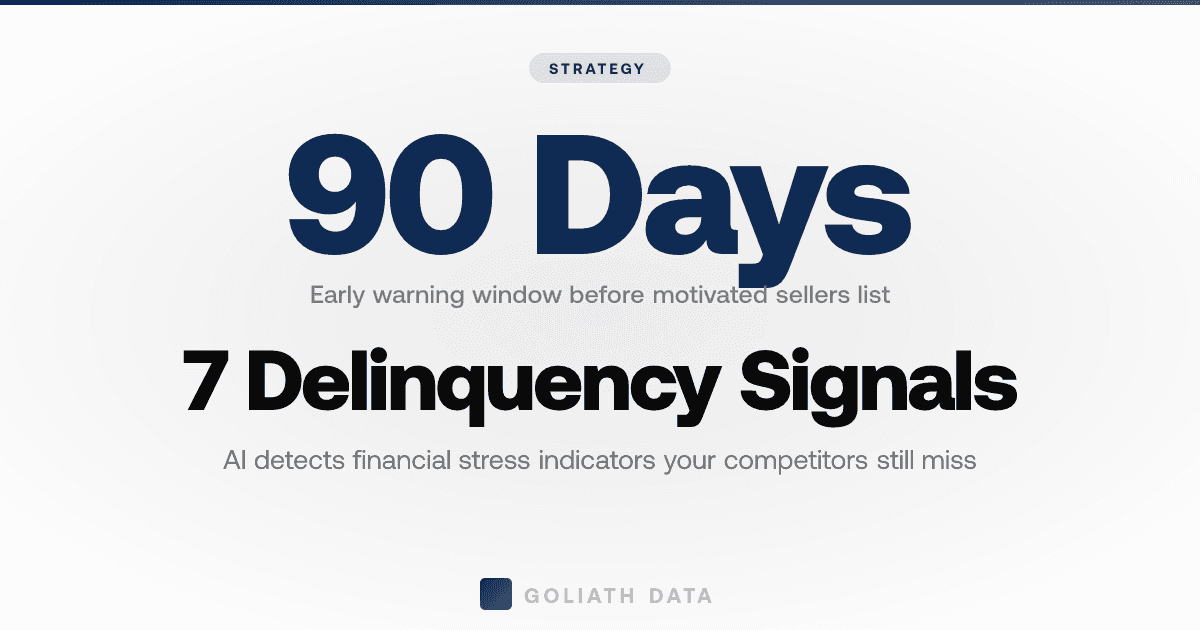
89% of top agents are projected to use AI-enhanced CRMs by 2026[2]. Yet most still miss the seven financial stress indicators that signal a motivated seller 90 days before they list. While your competitors manually chase MLS leads, property tax delinquency records, code violations, utility shutoffs, lien filings, insurance lapses, HOA defaults, and assessment payment delays sit in plain sight, invisible to spreadsheets but crystal clear to AI-powered CRMs.
Tax delinquency signals financial stress that precedes property sales by 90+ days. Real estate agents miss seven key indicators, unpaid property taxes, code violations, utility shutoffs, lien filings, insurance lapses, HOA defaults, and assessment payment delays, that AI-powered CRMs detect automatically to identify motivated sellers before competitors.
Agentic CRMs boost conversion rates by 67%[3], but only when they're trained to spot distress signals your manual lead scoring ignores. The agents closing deals faster aren't working harder. They're automating lead identification the moment financial stress appears in public records, not after a seller posts their property online.
TL;DR
The Seven Financial Stress Signals Hidden in Public Records
Seven distinct financial stress markers appear in county public records an average of 90+ days before a property hits the market. Most agents manually check only 3 to 5 of them. That gap costs deals.
Here's what you're looking for: unpaid property tax assessments, code enforcement violations, utility disconnection notices, mechanic's lien filings, homeowners insurance policy lapses, HOA payment defaults, and special assessment delinquencies. Each signal independently correlates with seller motivation. A property carrying two or more signals converts faster than cold leads because the owner's already under measurable financial pressure.
Manual public record scanning requires 4–6 hours per prospect and still misses the highest-intent indicator. Agents typically check county tax assessor and circuit court databases, but special assessments, which signal neighborhood infrastructure debt and capital calls, live in a separate county database requiring different login credentials. Most agents never discover this seventh signal because it demands manual work across multiple systems.
AI CRMs now ingest all seven signal types simultaneously across thousands of properties. 54% of agents already use AI CRM for lead nurturing[4], and those who do catch distressed sellers before competitors even know they exist.
Tools like Goliath Data surface tax delinquency and HOA default signals automatically, eliminating the need to log into seven different databases. You get ranked seller intent scores based on which financial stress signals are present, meaning your pipeline automatically prioritizes the highest-conversion prospects first.
Key insight: The seventh signal (special assessments) appears in only 30% of agents' prospecting workflows because it requires manual cross-database lookup. That gap is your competitive advantage.
Identifying multiple seller intent signals matters more than chasing a single indicator. Financial stress compounds. A homeowner juggling code violations, unpaid property taxes, and an insurance lapse isn't casually thinking about selling, they're running out of runway. That urgency converts.
Frequently Asked Questions
Why do traditional CRM lead scores fail to flag tax delinquent properties?
Standard CRM scoring uses static rule-based logic, checkboxes for property age, price range, and neighborhood, which treats all prospects in a given geography equally. Tax delinquency signals live in fragmented county records databases outside the CRM. By the time a property appears in the MLS, the seller's financial stress is public knowledge and 100+ agents are competing. AI lead scoring that ingests real-time public record data improves lead-to-close conversion rates by 25-40%[9] because the model learns that two delinquency signals predict motivated sellers far more reliably than demographic data alone.
How much faster do deals close with AI CRM workflows monitoring tax delinquency?
Real estate deal close rates rise 27% with AI CRM leads[5]. That improvement compounds when your workflow captures delinquent prospects within 24-48 hours of public filing rather than waiting for listing activity. CRE brokers implementing end-to-end workflow automation report more transactions per year without adding staff[7]. The speed advantage comes from automation eliminating manual prospecting delays. HubSpot CRM automation delivers improvement in follow-up response speed[15], so you're reaching motivated sellers before they've hired a competing agent.
Can I detect tax delinquency signals manually using county records?
Technically, yes. County records are publicly available, but manually reviewing seven distinct delinquency markers across hundreds of prospects requires 4-6 hours per property. If you prospect manually, you'll catch 5-10 prospects per week. If you automate detection across thousands of properties simultaneously, you'll identify dozens of qualified leads in the same time. For most agents, AI CRM automation that monitors public records continuously and surfaces high-risk properties automatically is the only realistic path to capturing the 90-day lead window before listing.
Which of the seven signals is the strongest predictor of seller motivation?
Unpaid property tax assessments combined with code enforcement violations show the strongest correlation with near-term listing activity because they signal both financial stress and imminent legal risk. However, properties with any two delinquency signals convert significantly faster than cold leads. A property with tax delinquency plus a utility disconnection notice is a qualified prospect worth immediate outreach. Agentic CRMs assign dynamic scores as new delinquency events appear: one signal gets ranked lower, but once a second signal fires, the system pushes it to the top of your pipeline automatically.
Does AI lead scoring eliminate false positives?
AI lead scoring reduces time spent on low-probability leads by 30-50%[10], but it doesn't eliminate false positives entirely. Some prospects with tax delinquency signals will have already resolved the issue or aren't ready to sell. What changes is efficiency: instead of spending equal time on 100 warm leads, you concentrate effort on the top 30-40 ranked by AI, which converts at dramatically higher rates. The model learns from your actual closed deals, so over time, false positives decline as the algorithm refines what "motivated" means in your market.
Why choose Goliath Data over a generic CRM with public records integration?
Generic CRMs add public records as a data layer, but Goliath Data is built specifically for real estate investors and agents around life-event seller intent signals, real-time detection of pre-foreclosure, tax delinquency, job changes, marriage, and pregnancy that competitors' platforms don't track. Goliath's Seller Intent Score ranks homeowners by likelihood to sell, so you're not just flagging delinquent properties; you're scoring them by likelihood and urgency. Beyond data, Goliath delivers real estate-optimized prospecting workflows: AI assistant David handles 24/7 inbound call qualification, automated AI nurture sequences run across call, text, and email simultaneously, and smart call lists surface instant conversation summaries so you spend zero time on admin. Your CRM tracks contacts, deals, tasks, and calendar in one place with automated reminders and follow-up scheduling that generic platforms can't match because they're not purpose-built for real estate. You get dedicated team feedback, onboarding, campaign reviews, and strategy support, so you're not just buying a data subscription; you're getting a partner ensuring you close more deals.
Sources
Ascendix, 2026: 87% of brokerages and agents actively use real estate AI tools daily
Ascendix, 2026: 89% of top agents projected to use AI-enhanced CRMs by 2026
Ascendix, 2026: Agentic CRMs projected to boost conversion rates by 67%
Gitnux AI CRM Industry Statistics Report, 2026: 54% of real estate agents use AI CRM for lead nurturing
Gitnux AI CRM Industry Statistics Report, 2026: Real estate deal close rates rise 27% with AI CRM leads
Gitnux AI CRM Industry Statistics Report, 2026: Real Estate AI CRM market reached $550 million in 2023, rising 31%
The AI Consulting Network, 2026: CRE brokers implementing end-to-end workflow automation report more transactions per year without adding staff
CBRE, 2026: 92% of corporate occupiers have initiated AI programs
The AI Consulting Network, 2026: AI lead scoring delivers improvement in lead-to-close conversion rates
The AI Consulting Network, 2026: AI lead scoring reduces time spent on low-probability leads by 30-50%
Dean Infotech, 2026: Follow-up response speed improved by 300% with HubSpot CRM automation
