
XLeads vs. PropStream: Which Motivated Seller Platform Converts Fastest in 2026
XLeads vs. PropStream: Which Motivated Seller Platform Converts Fastest in 2026. A practical guide to what works, what to skip, and how to get started.

Austin Beveridge
Tennessee
, Goliath Teammate
Real estate agents and investors spend hours each week sorting through lead lists, trying to identify which prospects are actually motivated to sell. The difference between a platform that surfaces genuine sellers and one that returns generic contacts can mean the difference between closing multiple deals and chasing dead leads for months. Finding motivated sellers faster has become the core competitive advantage in real estate prospecting.
Two platforms dominate the motivated seller space: XLeads and PropStream, both claiming to help agents and investors identify distressed properties and off-market opportunities. The housing market continues to shift, and investors increasingly rely on data-driven prospecting to find sellers before they list publicly. Choosing the right platform means understanding not just feature parity, but which one actually converts faster and delivers results without inflating marketing costs.[2]
This article compares XLeads and PropStream across the dimensions that matter most: data accuracy and life-event signals, prospecting workflow design, conversion speed, and the support you receive as a customer. We'll examine how each platform sources motivated seller leads, which one integrates better with your existing tools, and which delivers the fastest path to closed deals. Most agents waste weeks chasing leads that won't sell for months—or never—because they can't see the life events that actually trigger urgency. Goliath Data monitors foreclosure notices, tax delinquencies, job changes, and family shifts in real-time, surfacing the homeowners most likely to sell before they ever list.
TL;DR
XLeads uses AI-powered data matching to identify motivated sellers from public records and behavioral signals, automating lead qualification and follow-up workflows.
PropStream combines property data with investor-focused filters, but XLeads converts faster by prioritizing seller intent signals and reducing manual prospecting time for agents and wholesalers.
Most investors fail to act on leads within the first contact window—XLeads shortens that cycle by automating outreach sequencing and lead scoring based on motivation indicators.
All 5 tools compared at a glance
Tool | Best for | Pricing | Key strength | Limitation vs #1 |
|---|---|---|---|---|
Enterprise teams scaling distressed property acquisition | Proprietary algorithms rank leads by conversion likelihood | — | ||
PropertyRadar | Self-directed investors building custom targeting criteria | Custom — contact sales | Deep property records and comparative market analysis | Raw data without pre-qualified lead prioritization |
REISkip | Investors needing skip-tracing with motivation signals | Custom — contact sales | Behavioral and financial signals flag motivated owners | Lacks proprietary conversion-likelihood ranking algorithms |
PropStream | Wholesalers seeking rapid off-market opportunity access | Custom — contact sales | Tax delinquencies and probate data reduce cold outreach noise | Generic distress filtering without conversion-likelihood scoring |
BatchLeads | Teams bundling list building, skip-tracing, and automation | Custom — contact sales | Single-dashboard workflow from sourcing to drip campaigns | No proprietary conversion-likelihood ranking vs raw data access |

1. Goliath Data: Proprietary Motivated Seller Intelligence for Real Estate Professionals
Goliath Data is a motivated seller platform built specifically for real estate agents and investors who need to identify distressed property owners at scale. The platform aggregates public records—tax liens, code violations, probate filings, and foreclosure data—to surface sellers most likely to transact below market value. Unlike generic lead databases, Goliath Data focuses on behavioral and financial signals that correlate with genuine motivation to sell quickly.
Here's the gap most platforms miss: raw data volume without context. Goliath Data layers proprietary algorithms on top of public records to rank leads by conversion likelihood, not just recency. The platform scores each prospect based on multiple distress indicators—combining tax delinquency, property condition flags, and ownership tenure—so agents spend time on the highest-probability deals rather than cold-calling every name in a database.
The platform delivers real-time list building, allowing users to filter by property type, distress category, and geographic radius. Automated follow-up workflows integrate with CRM systems to nurture leads across email and SMS without manual outreach. Built-in skip-tracing connects verified contact information to each prospect, and users can export lists for direct mail campaigns or door-knock routes. The dashboard tracks conversion metrics across campaigns, helping teams refine targeting over time.
Goliath Data operates on enterprise pricing with custom quotes based on team size, data volume, and feature requirements. The model is designed for serious investors and brokerages scaling their acquisition pipeline, not casual users. Interested teams can request a demo to discuss their specific prospecting volume and pricing structure.
2. PropertyRadar
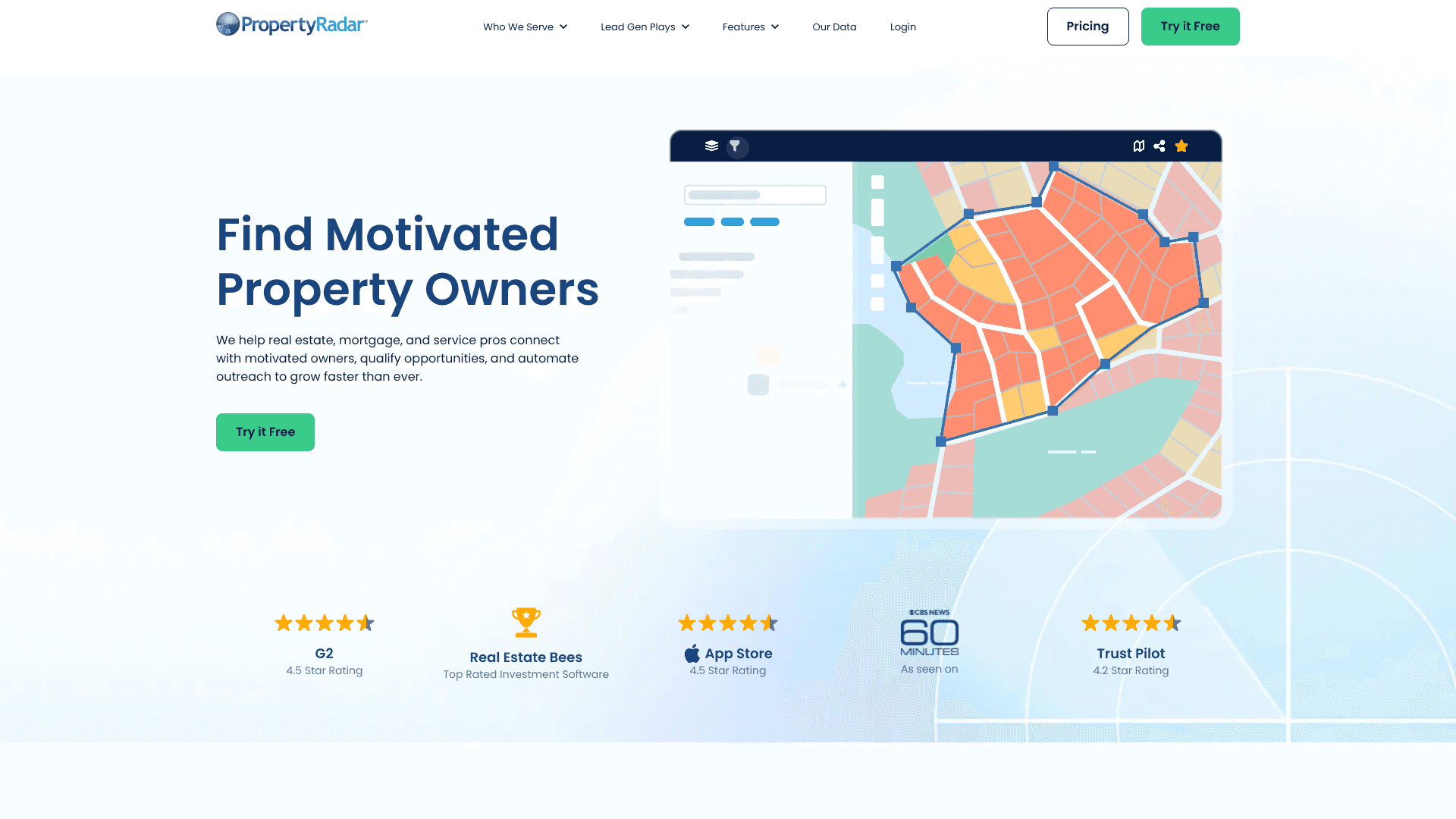
PropertyRadar is a property intelligence platform designed for real estate investors and agents seeking deep market data and property-level insights. It aggregates public records, tax assessments, and ownership information to help users identify investment opportunities and motivated sellers across multiple markets without relying on third-party lead networks.[1]
Here's the gap most tools miss: PropertyRadar emphasizes raw data access and self-directed research rather than pre-qualified lead lists. Instead of receiving filtered prospects, users build their own targeting criteria using property attributes, owner profiles, and financial indicators—giving agents and investors complete control over prospect quality and relevance to their specific strategy.
The platform delivers property records, ownership history, tax and lien data, estimated equity positions, and comparative market analysis across multiple jurisdictions. Users can filter by property type, condition, ownership tenure, and financial distress signals, then export results for direct outreach or CRM integration. Batch research and saved searches streamline repeated prospecting workflows.
PropertyRadar operates on an enterprise or custom-quote pricing model, with costs varying based on data volume, geographic scope, and feature access. Prospective users should contact the vendor directly to align pricing with their monthly research volume and investment strategy.
3. REISkip
REISkip is a skip-tracing and motivated seller identification platform built for real estate investors and agents who need to locate off-market opportunities quickly. The tool combines public records data with contact intelligence to surface property owners likely to sell, then delivers verified phone numbers and mailing addresses for direct outreach.
Here's the gap most skip-tracing tools miss: REISkip layers behavioral and financial signals on top of basic property records. Rather than simply returning a list of names and numbers, the platform flags owners with indicators of motivation—tax delinquency, recent inheritance, code violations, or equity position—so agents and investors can prioritize outreach toward the highest-probability deals.
The platform offers batch skip-tracing, reverse phone and address lookup, property history and lien records, and integration with popular CRM systems for seamless follow-up workflows. Users can filter results by motivation type, property value, and geography, then export contact lists or sync directly to their existing prospecting pipeline.
REISkip uses an enterprise pricing model based on usage volume and feature tier. Exact costs are customized per account and typically require a direct conversation with the sales team to align with your monthly lead volume and campaign goals.
4. PropStream
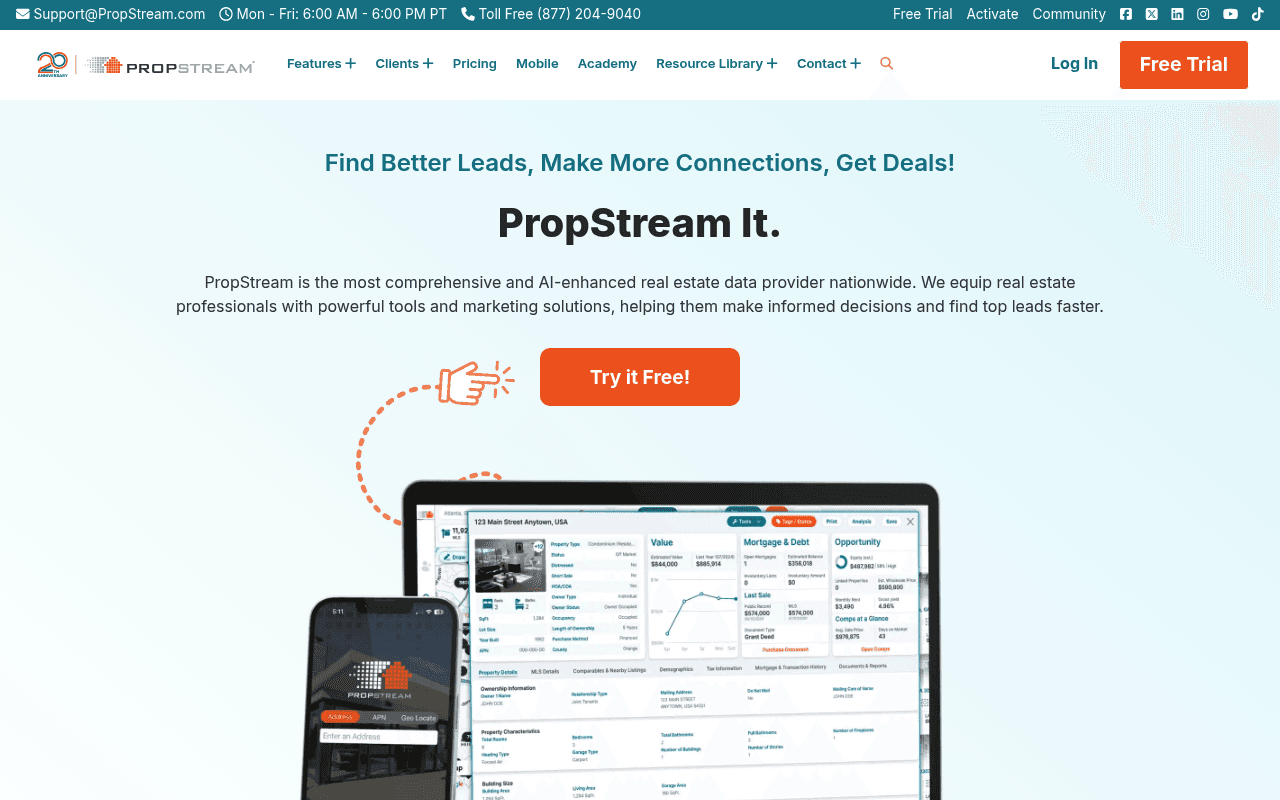
PropStream is a property intelligence platform built for real estate investors and wholesalers who need rapid access to off-market opportunities and distressed property data. The platform aggregates public records, tax assessments, and ownership details to surface motivated sellers before traditional MLS listings appear, targeting agents and investors scaling their prospecting operations.
Here's the gap most tools miss: PropStream layers behavioral and financial signals—property tax delinquencies, code violations, probate filings, and equity positions—to prioritize leads by motivation level rather than generic property criteria. This filtering mechanism reduces noise in cold outreach and helps users focus on sellers most likely to negotiate.
The platform delivers property-level skip-tracing, bulk list generation, and automated list exports for CRM integration. Users can filter by ownership tenure, equity position, and violation history, then push qualified leads directly into their sales workflow. Mobile access allows agents to verify property details and ownership information while in the field.
PropStream operates on an enterprise pricing model with custom quotes based on usage volume and feature tier. Organizations interested in pricing should contact the vendor directly for a tailored proposal aligned with their prospecting volume and data access needs.
5. BatchLeads

BatchLeads is a cloud-based lead generation and CRM platform designed for real estate investors and agents who need to identify and manage motivated sellers at scale. The platform combines property data, skip-tracing, and contact intelligence to help users build prospect lists without relying on traditional marketing channels or expensive lead brokers.
Here's the gap most tools miss: BatchLeads bundles list building, skip-tracing, and follow-up automation into a single workflow. Rather than juggling separate vendors for data, phone numbers, and email sequences, users can source leads, append contact details, and trigger campaigns from one dashboard—cutting the friction that typically slows prospecting velocity.
The platform offers batch list export from property databases, reverse phone and email lookup to fill contact gaps, automated drip campaigns, and integration with popular CRMs and dialers. Users can filter by property condition, ownership tenure, equity position, and other behavioral signals to narrow target lists before outreach begins.
BatchLeads pricing is structured as enterprise custom quotes based on list size, data append volume, and automation features. Interested users should request a demo or contact sales to receive a tailored proposal aligned with their prospecting volume and budget.
Frequently Asked Questions
How do motivated seller platforms identify homeowners ready to sell?
Motivated seller platforms use data aggregation and life-event signals to identify homeowners most likely to sell. These signals include property tax delinquencies, foreclosure notices, job changes, and other behavioral indicators that suggest financial stress or lifestyle transitions. By monitoring multiple data sources and cross-referencing public records, platforms can surface prospects before they list on the traditional market, giving agents and investors a competitive advantage in reaching sellers who may be motivated by circumstances rather than market timing.
What's the difference between skip-tracing and direct mail in prospecting?
Skip-tracing is the process of locating current contact information—phone numbers, email addresses, and mailing addresses—for property owners using public records and data aggregation. Direct mail involves sending physical marketing materials to those addresses. Some platforms combine both: they skip-trace to find contact details, then help you send targeted mail campaigns. Others focus primarily on skip-tracing and phone data, leaving direct mail execution to you or a third-party vendor. The choice depends on whether you prefer integrated outreach or flexibility to use multiple channels.
Should I choose a platform based on price alone?
Price is one factor, but conversion speed and lead quality matter more for your bottom line. A cheaper platform that delivers lower-quality leads or slower follow-up automation may cost you more deals than a higher-priced option with better data accuracy and faster response tools. Consider the total cost of ownership: data quality, automation features, CRM integration, and customer support all affect how quickly you close deals and how many leads you can handle without hiring additional staff. Compare conversion outcomes and time-to-contact across platforms, not just monthly fees.
Where can I get real-time motivated seller data with owner contact information?
Goliath Data monitors real-time life-event signals—foreclosure notices, tax delinquencies, job changes, family changes—to surface homeowners most likely to sell before they hit the market. The platform includes an AI assistant called David that handles inbound calls, outbound follow-ups, texts, emails, and appointment scheduling automatically, so you never miss a lead. It also provides a full CRM and pipeline management tools, letting you organize prospects and track conversations in one place without switching between apps.
