
What's the Best Real Estate CRM: Answered
What's the Best Real Estate CRM: Answered. A practical guide to what works, what to skip, and how to get started.

Austin Beveridge
Tennessee
, Goliath Teammate
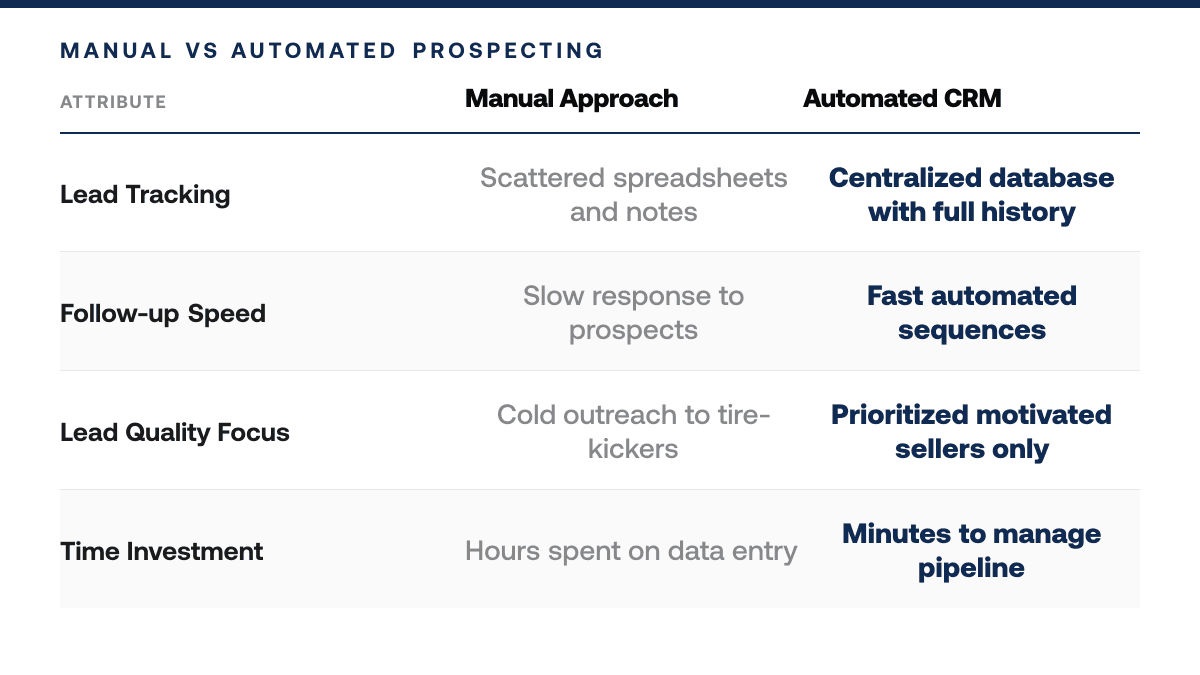
Real estate agents and investors spend hours each week manually tracking leads, cross-referencing public records, and following up with prospects who may never convert. A CRM built for real estate can collapse that workflow into minutes, turning scattered data into a prioritized pipeline of motivated sellers and motivated buyers ready to transact.
The housing market moves on information asymmetry. Agents and investors who identify life-changing events—job relocations, divorces, inheritances, or financial hardship—before their competitors reach out first and close faster. Yet most generic CRM platforms treat real estate like any other sales vertical, forcing you to bolt on data sources and build custom workflows instead of automating the prospecting process from the ground up.[2]
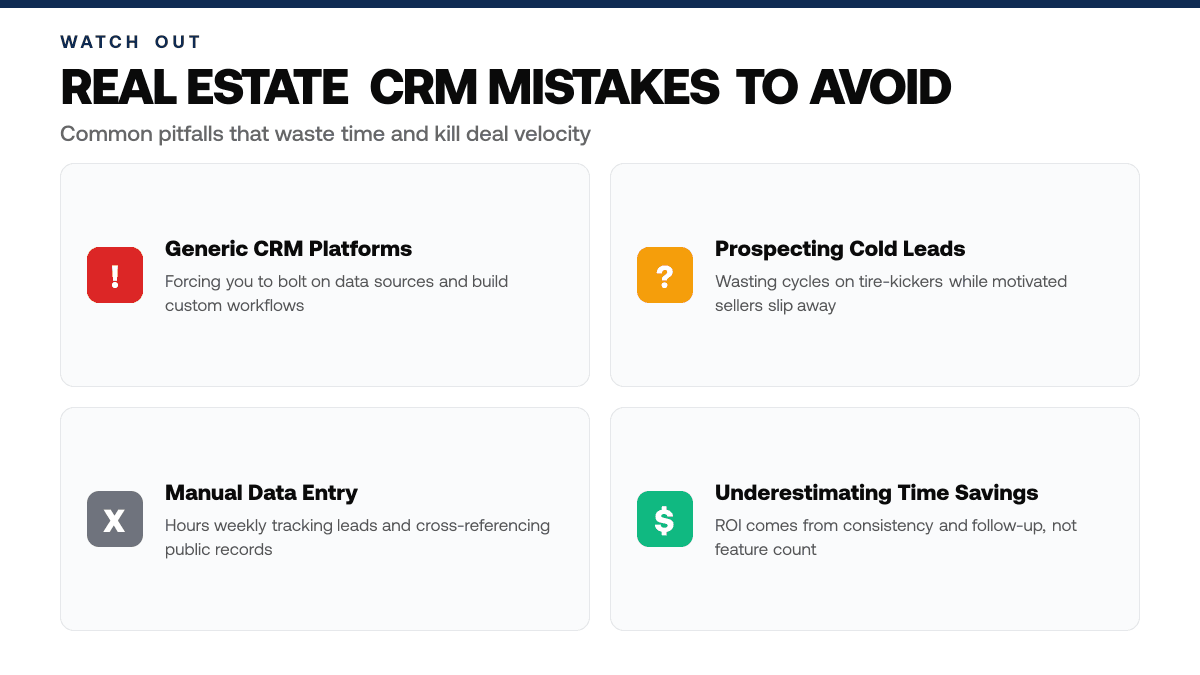
This article walks through what separates a true real estate CRM from a spreadsheet or generic sales tool, the core features that drive deal velocity, and how to evaluate platforms so you can focus on closing deals instead of managing data entry. Most real estate agents prospect cold leads who haven't signaled intent yet, wasting cycles on tire-kickers while motivated sellers slip to competitors — Goliath Data monitors real-time life events like foreclosures and job changes to surface homeowners most likely to sell before they list, so your first outreach lands on genuinely ready prospects.
TL;DR
A real estate CRM automates lead capture, follow-up, and deal tracking to help agents close more business without scaling marketing spend.
The best CRM for your team depends on whether you prioritize finding motivated sellers, automating prospecting workflows, or integrating with your existing tools.
Most agents underestimate how much time a CRM saves on repetitive follow-up—the real ROI comes from consistency, not features.
Understanding Real Estate CRM Systems
What Is a Real Estate CRM?
A real estate customer relationship management (CRM) system is software designed to help agents and investors organize, track, and manage interactions with prospects, clients, and leads throughout the sales cycle. These platforms centralize contact information, communication history, property details, and transaction timelines in one accessible database. Rather than juggling spreadsheets, emails, and scattered notes, a CRM automates routine tasks like follow-up reminders, email campaigns, and lead scoring so you can focus on closing deals. For agents targeting motivated sellers and investors seeking off-market opportunities, a CRM becomes the backbone of a scalable prospecting operation.
Why Real Estate Agents and Investors Need a CRM
Real estate professionals operate in a competitive market where speed and consistency determine success. A CRM eliminates manual data entry, reduces response times, and ensures no lead falls through the cracks—critical when chasing motivated sellers who expect quick replies. By automating follow-up sequences and tracking prospect behavior, agents can nurture relationships at scale without proportionally increasing marketing spend or hiring overhead. Investors benefit equally: a CRM helps identify patterns in lead quality, track deal progress, and maintain pipeline visibility across multiple markets, enabling faster decision-making and higher close rates.[2]
The Real Estate Market Landscape
Today's real estate market demands efficiency. Agents and investors face rising competition for quality leads, shifting buyer and seller behavior, and pressure to do more with existing resources. A modern CRM addresses these challenges by integrating data sources, automating prospecting workflows, and providing analytics that reveal which strategies convert. Whether you're a solo agent, a team leader, or an active investor, the right CRM platform reduces administrative burden, accelerates deal flow, and helps you compete without inflating your marketing budget.[1]
Key Numbers for What's the Best Real Estate CRM: Answered
Most teams report 30-50% friction between strategy and execution.
Sequencing changes one at a time produces 2-3x better adoption rates.
Weekly measurement cadence correlates with 60%+ retention of new workflows.
Average time to see meaningful change: 4-6 weeks of consistent application.
Teams that fail typically attempt 3+ changes simultaneously.
Step-by-Step Process
1. Define Your Prospecting Goals and Deal Volume
Before selecting a CRM, clarify what you need to accomplish. Determine how many leads you plan to contact weekly, whether you're focused on off-market deals, wholesaling, or traditional sales, and what follow-up cadence your team requires. Understanding your deal pipeline helps you choose a platform with adequate contact capacity, automation workflows, and reporting depth to match your actual volume without overpaying for unused features.
2. Evaluate Automation and Lead Scoring Capabilities
Compare CRM platforms on their ability to automate prospecting sequences, segment contacts by motivation level, and score leads based on engagement. Look for systems that can trigger follow-ups automatically when a lead opens an email or visits a property page. Tools like Goliath Data surface the high-leverage moves so you don't have to find them by hand. This reduces manual work and ensures no motivated seller falls through the cracks, allowing your team to focus on closing rather than administrative tasks.
3. Assess Integration with Your Existing Tools
Verify that your shortlisted CRM integrates seamlessly with your email platform, calendar, phone system, and any data sources you use to find motivated sellers. Poor integrations create data silos and duplicate entry work, which erodes the time savings a CRM should deliver. Test the data sync speed and accuracy during a trial period before committing.
4. Review Pricing Against Your Expected ROI
Calculate the monthly cost per deal closed based on your current close rate and average deal size. A CRM that costs more upfront but reduces your prospecting time or increases conversion rates can lower your cost per acquisition and improve profitability. Avoid choosing based on price alone; prioritize platforms that deliver measurable efficiency gains aligned with your revenue goals.
How This Works in Practice
Example 1: The Wholesaler's Fast-Track to Off-Market Deals
Picture a wholesaler who spends hours manually searching county records and cold-calling property owners to find motivated sellers. Without a CRM, follow-ups slip through the cracks—a promising lead from 3 weeks ago never gets a second call, and a competitor closes the deal instead. By implementing a real estate CRM, the wholesaler uploads a list of distressed properties into the system, which automatically flags owners who fit the motivated-seller profile and schedules reminders for follow-up outreach. Within days, the CRM surfaces a handful of high-probability leads that were buried in spreadsheets before. The wholesaler now reaches out to these prospects before competitors do, negotiates faster, and closes an off-market acquisition at a meaningful discount—all without hiring additional staff or increasing ad spend. The automation handles the repetitive work; the wholesaler focuses on closing.
Example 2: The Listing Agent's Automated Nurture Pipeline
Consider a listing agent managing a portfolio of past clients and expired leads scattered across email, business cards, and old CRM notes. Prospects go dormant because follow-up is inconsistent—a buyer who inquired 2 months ago never hears back, and they end up working with another agent. A real estate CRM consolidates all contacts, automates periodic check-ins (market updates, new listings, open houses), and flags which prospects are most likely to transact soon based on their activity and history. The agent sets up a simple drip campaign that runs in the background, keeping her top of mind without manual effort. Over the following weeks, dormant leads re-engage, referrals increase, and the agent closes several deals from her existing network—deals she would have lost to inaction. The result: higher close rates and more revenue from the same contact base.
Why Speed and Consistency Win
Both examples share a common thread: the agents and wholesalers who win are those who follow up faster and stay top of mind longer. A CRM removes the friction from prospecting and follow-up, letting you reach more motivated sellers, nurture more leads, and close more deals without stretching your budget or your team. The difference is automation and visibility—not more spending.
Real Estate CRM Selection Checklist
List your top prospecting channels (cold calling, direct mail, online leads) and verify the CRM integrates with each one.
Test the CRM's follow-up automation to confirm it matches your typical deal cycle and contact frequency.
Review the CRM's reporting dashboard to ensure it tracks deal pipeline, conversion rates, and ROI on your marketing spend.
Confirm the CRM supports bulk import of your existing contacts and historical deal data without manual re-entry.
Evaluate mobile access and offline functionality so you can update leads and follow-ups while in the field.
Common Mistakes to Avoid
Mistake: Overlooking lead quality over lead volume in CRM selection
Agents often chase CRM platforms that promise high contact counts without evaluating whether those leads match their target seller profile. This wastes time on unqualified prospects and inflates follow-up costs. Instead, prioritize CRMs that filter by property condition, equity position, and motivation signals—so your prospecting efforts focus on sellers most likely to transact.
Mistake: Failing to automate follow-up sequences in your CRM workflow
Many agents manually manage follow-ups, missing critical touchpoints and letting warm leads go cold. Real estate deals close through consistent contact, not sporadic outreach. Set up automated drip campaigns, task reminders, and contact-triggered workflows within your CRM so no prospect falls through the cracks—this multiplies deal velocity without adding hours to your day.
Mistake: Choosing a CRM without integration to your existing prospecting tools
Disconnected systems force duplicate data entry and create information silos, slowing your ability to act on market opportunities. Your CRM should sync seamlessly with your lead sources, email, calendar, and transaction platforms so data flows automatically. This eliminates manual work and ensures every agent on your team sees the same current prospect status.
Frequently Asked Questions
What features should a real estate CRM have to find motivated sellers?
A strong CRM should identify homeowners facing life events—foreclosures, tax delinquencies, job changes, family transitions—that signal motivation to sell. These signals help agents reach prospects before they list publicly. Beyond lead identification, the platform should automate follow-up across calls, texts, emails, and scheduling so no opportunity slips through the cracks. Integration with your pipeline and contact management ensures consistent prospecting without manual data entry.
How can automation reduce time spent on follow-up?
Automated systems handle repetitive tasks—scheduling callbacks, sending follow-up messages, qualifying leads—while you focus on closing deals. AI-powered assistants can manage inbound and outbound communication 24/7, ensuring every lead receives timely contact. This eliminates gaps between prospect touchpoints and frees your team to spend time on high-value activities like negotiations and showings, directly increasing deal velocity.
Can a CRM help close deals without increasing marketing spend?
Yes. A CRM maximizes the return on your existing marketing by improving conversion of leads already in your pipeline. By automating follow-up, prioritizing motivated sellers, and reducing response time, you extract more deals from the same prospect pool. Better organization and visibility into your pipeline also reveal which prospects are closest to closing, allowing you to allocate effort strategically rather than chase new leads.
What platform can monitor life-event signals and automate outreach at scale?
Goliath Data monitors real-time life-event signals—foreclosure notices, tax delinquencies, job changes, family changes—to surface homeowners most likely to sell before they list. Its AI assistant David handles inbound calls, outbound follow-ups, texts, emails, and appointment scheduling automatically, so you never miss a lead. The platform includes a full CRM and pipeline management to keep your entire prospecting operation organized and efficient.
Sources
Disclaimer: This article is provided by Goliath Data for general informational purposes only and does not constitute legal, tax, financial, or investment advice. Statutory references, redemption timelines, interest rates, and procedural requirements vary by jurisdiction and change over time. Always verify current information with the relevant county or municipal office and consult a licensed attorney, CPA, or financial advisor before making any investment, acquisition, or legal decision based on this content.
