
What Is Tax Delinquency in Real Estate
What Is Tax Delinquency in Real Estate — practical guide covering setup, examples, and common mistakes. Built for practitioners working with tax delinquency def

Austin Beveridge
Tennessee
, Goliath Teammate
Every year, thousands of property owners fall behind on their tax obligations, creating a distinct category of real estate that most agents and investors overlook. Tax delinquency occurs when property owners fail to pay property taxes owed on their real estate, and the consequences ripple through the market in ways that create both risk and opportunity. Understanding what triggers delinquency and how it unfolds is the first step to identifying motivated sellers before your competition does.
Delinquent properties represent a distinct market segment populated by sellers facing genuine financial pressure—whether from job loss, medical crisis, or simply poor cash flow management. These motivated sellers often accept below-market offers to resolve their tax liability quickly and avoid foreclosure. For agents and investors, this means access to acquisition opportunities that don't require the same negotiation intensity as traditional listings, paired with a clearer path to closing.[2]
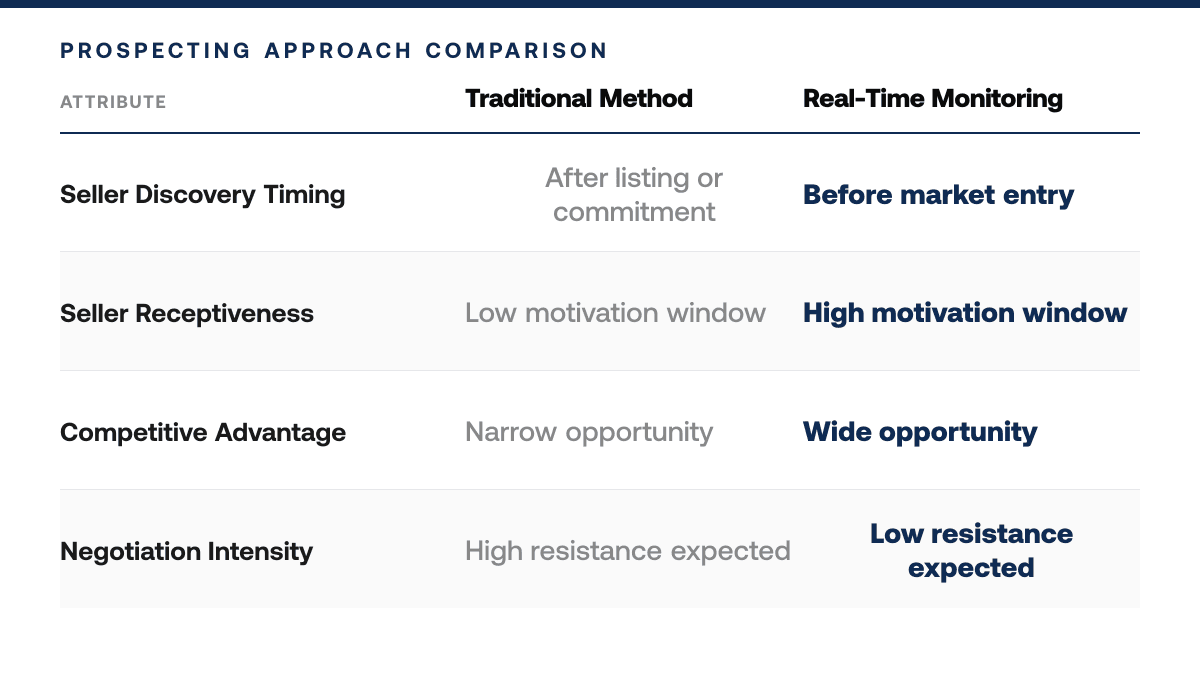
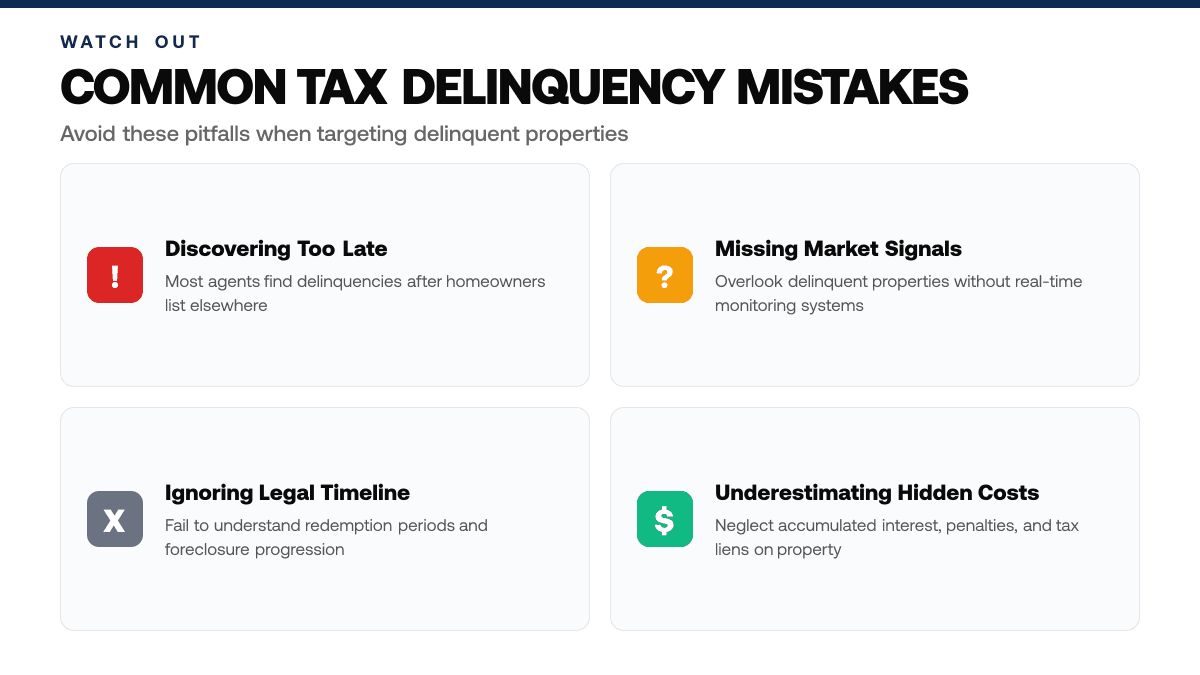
This section breaks down the mechanics of tax delinquency: how it starts, what happens when payments are missed, and why understanding the timeline and legal process matters for your prospecting strategy. You'll learn to recognize the signals that identify delinquent properties early, so you can reach motivated sellers at the moment they're most receptive to a solution. Most agents discover tax delinquencies only after the homeowner has already listed or committed elsewhere, collapsing the window to connect — Goliath Data monitors real-time tax delinquency signals to surface motivated sellers before they enter the market, so agents reach them first.
TL;DR
Tax delinquency definition: failure to pay property taxes by the due date, triggering legal and financial consequences for the property owner.
Delinquent properties enter a redemption period where owners can reclaim the property by paying back taxes plus accumulated interest and penalties.
For real estate investors and agents, tax delinquent properties represent motivated-seller opportunities available before foreclosure or tax sale occurs.[3]
Understanding Tax Delinquency in Real Estate
What Is Tax Delinquency?
Tax delinquency occurs when a property owner fails to pay property taxes owed to the county or municipality. This non-payment triggers a predictable lifecycle that moves through several distinct stages. Initially, the property owner receives notice of the unpaid taxes. If payment is not made, the county places a tax lien on the property, creating a legal claim against it. The delinquency process can eventually lead to a tax sale or foreclosure, where the property is sold to recover the unpaid tax debt. Throughout this progression, the property remains in the public record, and each stage creates opportunities for investors and agents to identify motivated sellers who may be facing financial hardship or property management challenges.[4]
Why Tax Delinquency Matters to Real Estate Professionals
For real estate agents and investors, tax-delinquent properties represent a distinct market segment of motivated sellers. Property owners facing tax delinquency often need to sell quickly to avoid foreclosure or redemption complications, making them more flexible on price and terms than typical sellers. Identifying these properties allows professionals to build targeted prospecting lists without increasing overall marketing spend. By focusing on delinquent properties, agents and investors can streamline their lead generation and prioritize outreach to sellers with genuine urgency to transact.
Finding Delinquent Properties in Your Market
County assessor and tax collector records are the primary public source for identifying tax-delinquent properties. These records detail property ownership, tax payment status, and lien placements, all accessible through county websites or records offices. Modern real estate professionals also use automated prospecting systems that aggregate county data and alert agents and investors to new delinquencies within their target areas. These tools eliminate manual record-checking and allow professionals to focus on outreach and relationship-building with motivated sellers, making the prospecting process more efficient and scalable.
Step-by-Step Process
1. Access your county tax assessor's delinquency records
Visit your county assessor's or tax collector's website and locate the published list of properties with unpaid property taxes. Many jurisdictions maintain searchable online databases organized by parcel number, owner name, or address. Download or review the most recent delinquency roll to identify properties in your target area. Note the owner's name, property address, and the amount of taxes owed. This first step establishes your prospect list and ensures you're working with current, public data.
2. Verify the property's tax sale calendar and redemption window
Confirm the jurisdiction's tax sale date and redemption period—the timeframe during which the owner can reclaim the property by paying back taxes, interest, and penalties. Understanding these deadlines is critical: an owner with only weeks until the sale date faces different urgency than one with months remaining. Tools like Goliath Data surface the high-leverage moves so you don't have to find them by hand. Cross-reference your county's published tax sale calendar and redemption statutes to establish the timeline for your outreach. This ensures your prospecting message aligns with the owner's actual window of opportunity.
3. Assess the property's condition and market value
Drive by or research the property online using public records, aerial imagery, and comparable sales data. Evaluate whether the structure is occupied, vacant, or deteriorated; note any visible liens, code violations, or structural issues. Cross-reference recent sales of similar properties in the neighborhood to estimate current market value. This assessment helps you determine whether the property is worth pursuing and informs your offer strategy when you contact the owner.
4. Locate and contact the delinquent property owner
Use the tax assessor's records, public databases, or skip-tracing services to find the owner's current mailing address and phone number. Craft a direct, non-threatening outreach message that acknowledges their tax delinquency and presents your solution—whether acquisition, payment assistance, or deed-in-lieu arrangement. Time your contact to fall within the redemption window but early enough to allow negotiation. Document all contact attempts and responses to build a systematic follow-up process.
Watch The Lecture Room of Atty. Raymond Batu's deeper walkthrough: Good News Nga Ba?
How This Works in Practice
Example 1: The Wholesaler's Fast-Track Identification
Picture a wholesaler who traditionally relied on direct mail and cold calling to find motivated sellers. She learns that delinquent property owners face mounting tax bills and imminent auction dates—a window of urgency that makes them far more receptive to a quick cash offer. By accessing delinquency data, she identifies properties in early default stages, before they hit the public auction block. She reaches out with a simple message: "I see your property is facing a tax sale. I can close fast and handle the back taxes." Within weeks, she's closing deals at meaningful discounts because the owner avoids the stress of auction, redemption complications, and legal fees. Her cost per acquisition drops because she's no longer broadcasting to cold lists—she's speaking directly to sellers already motivated by the delinquency clock.
Traditional vs. Automated Tax Delinquency Prospecting
Approach | Timeline | Competitive Advantage |
|---|---|---|
Manual county records review | Discover delinquencies after listing or commitment | Collapsed window to connect with seller |
Automated real-time monitoring | Surface motivated sellers before market entry | Reach prospects first with clear path to close |
Example 2: The Agent's Redemption-Window Leverage
Consider a listing agent who discovers a client's neighbor owns a property that entered tax default several months ago. The agent knows that in many jurisdictions, the owner has a redemption window—a period to reclaim the property after a tax sale by paying back taxes plus interest. Rather than wait for the property to languish on the market months later, the agent reaches out to the owner now, during redemption, and offers to help them sell before the window closes. The owner, facing redemption costs and uncertain about their ability to pay, accepts a listing agreement. The agent markets the property as a redemption opportunity to investors who understand the timeline and can close quickly. The result: the original owner avoids the redemption fees and legal complexity, the agent lists a property that might otherwise have disappeared into the tax system, and the investor acquires a property with clear title at a discount.
Why Speed Wins
Both examples reveal the same insight: delinquency creates a compressed timeline where motivated sellers are most receptive. Agents and wholesalers who act during this window—before auction, during redemption, or in early default—close deals faster because they're solving an immediate problem rather than competing on price alone. The data becomes a prospecting shortcut that replaces guesswork with precision.
Tax Delinquency Verification Checklist
Check the county assessor's online database to confirm the property's current tax payment status and delinquency date.
Review the county tax collector's records to identify any liens filed against the property and verify outstanding amounts owed.
Confirm the property's eligibility for tax sale by verifying it meets your state's delinquency threshold and notice requirements.
Document the redemption period and deadline applicable in the property's county to assess the timeline for investor action.
Cross-reference public records with title company data to identify any senior liens or encumbrances that affect deal viability.
Common Mistakes to Avoid
Mistake: Assuming all tax delinquency redemption windows are identical across states
Real estate agents and investors frequently treat redemption periods as uniform, but state-specific statutes set vastly different windows—some measured in months, others in years. Missing your state's exact redemption deadline means losing the property to a redeemed owner or forfeiting your investment. Always verify your state's redemption statute before making an offer; redemption rights vary dramatically by jurisdiction, and conflating one state's rules with another's can sink deals or create title disputes.[2]
Do's and Don'ts When Targeting Delinquent Properties
Do | Don't |
|---|---|
Focus on sellers facing genuine financial pressure | Assume all delinquent owners are equally motivated |
Build targeted prospecting lists from public records | Increase overall marketing spend to find motivated sellers |
Prioritize outreach at early delinquency stages | Wait until foreclosure or tax sale proceedings begin |
Expect flexibility on price and terms from sellers | Apply traditional negotiation intensity to delinquent deals |
Mistake: Skipping title and lien searches before pursuing a tax-delinquent property
Agents and investors often focus solely on back taxes without investigating prior liens, judgment liens, or title defects recorded against the property. This oversight creates unexpected liabilities—you may inherit senior liens that survive the tax sale, or discover the property has clouded title that prevents resale. Conduct a full title search and lien report before committing capital; back taxes are only one layer of a delinquent property's risk profile, and incomplete due diligence transforms a deal into a liability.[2]
Mistake: Confusing tax delinquency with actual foreclosure or default status
Many agents treat tax delinquency as synonymous with mortgage default or foreclosure, missing the critical distinction that a property can be tax-delinquent while the mortgage is current. This confusion leads to miscalculating motivated-seller urgency or misjudging the property's marketability. Verify the mortgage status separately from tax status; a tax-delinquent property with an active mortgage creates different negotiation dynamics and exit strategies than one in foreclosure, and conflating the two distorts your prospecting and deal analysis.[2]
Where Delinquency Becomes Visibility
Tax delinquency in real estate operates as a public signal—one that transforms a private financial struggle into documented evidence. Once a property enters delinquent status, the narrative shifts from hidden risk to measurable liability. Recognizing this distinction separates those who treat delinquency as a static label from those who understand it as a data point with trajectory, intervention windows, and structural consequences that ripple across portfolios and markets alike.
Frequently Asked Questions
How can I use technology to find tax delinquent properties faster?
Automated prospecting and CRM tools dramatically accelerate the identification and follow-up process for delinquent property leads. Platforms like the right tool aggregate public tax records and delinquency data, allowing agents and investors to filter properties by location, delinquency status, and other criteria in seconds rather than manually searching county records. This enables you to prioritize high-potential leads and reach out to motivated sellers before competitors do.
Can I scale my outreach without spending more on marketing?
Yes. Technology platforms enable agents and investors to scale outreach and close more deals without proportional increases in marketing spend. Once you've identified delinquent properties through automated tools, you can deploy templated follow-up sequences via email, SMS, and direct mail to hundreds of leads simultaneously. This leverages your existing marketing budget across a much larger prospect pool, improving your cost per acquisition and deal velocity.
What makes tax delinquent properties attractive to investors?
Tax delinquent properties often sell at a discount to market value because the owner faces financial pressure and time constraints. Investors can acquire these properties below-market, rehabilitate them, and resell for profit. Additionally, many delinquent properties are in neighborhoods with strong fundamentals—the owner simply fell behind on taxes due to temporary hardship, not neighborhood decline. This combination of motivated sellers and sound locations creates compelling investment opportunities.
Sources
Not legal or financial advice. This article is for general educational purposes only and should not be relied on as a substitute for professional legal, tax, or financial advice. Real estate, tax, and property laws vary by state and individual circumstances. Consult a licensed attorney or qualified professional in your jurisdiction before acting on any procedure or strategy discussed here. Reading this content does not create an attorney-client relationship.
