
Vermont Tax Delinquent Properties for Sale List
Vermont Tax Delinquent Properties for Sale List. Practical playbook for Real Estate Technology — methods, examples, and pitfalls to avoid in 2026.


Austin Beveridge
Tennessee
, Goliath Teammate
Quick Answer
Vermont tax-delinquent properties are real estate parcels where owners haven't paid annual property taxes, creating a public sale opportunity for investors and owner-occupants. You'll find these lists through Vermont's town assessors, the Department of Taxes website, and specialized platforms like Goliath Data that surface delinquent properties alongside seller-intent signals in real time. Tax sales typically occur 2–4 years after delinquency, depending on redemption periods and local foreclosure timelines.
Understanding Tax-Delinquent Properties in Vermont
Tax-delinquent properties in Vermont are real estate parcels where the owner has failed to pay property taxes owed to the municipality. The property enters delinquency after missing one or more annual tax payments, and the municipality can eventually place a tax lien against the deed or sell the property at public auction to recover unpaid taxes and penalties.
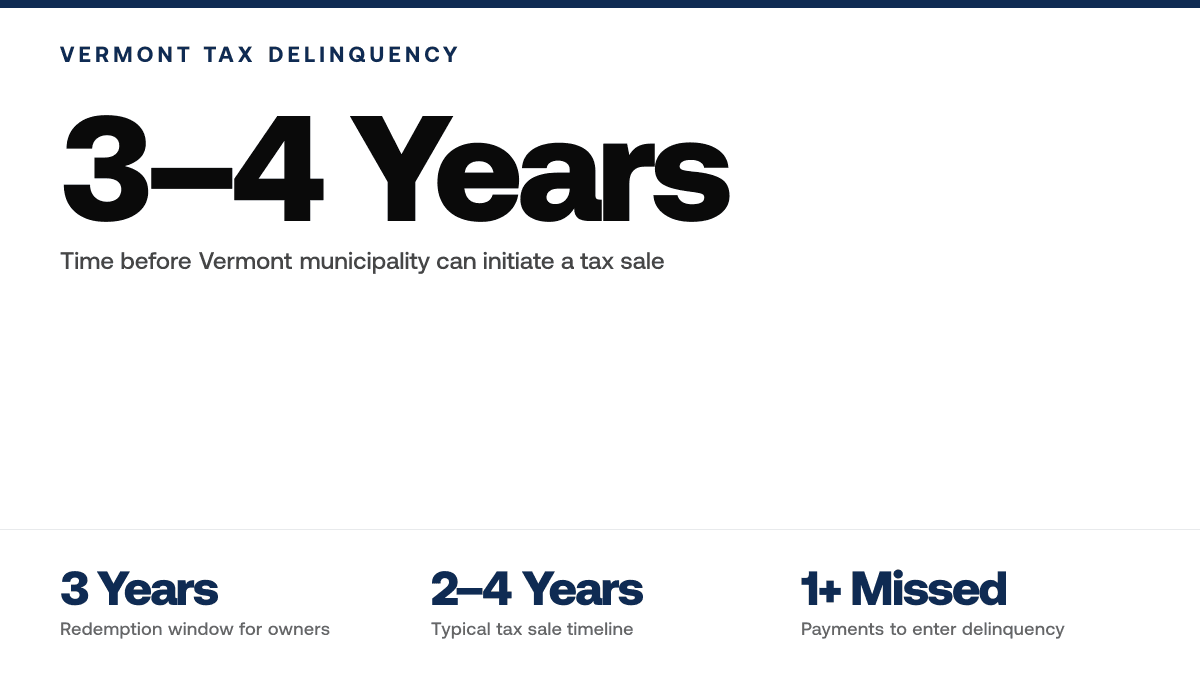
When a Vermont property owner doesn't pay taxes, the town assesses interest and penalties on top of the original debt. After a set period, typically 3 to 4 years, the municipality can initiate a tax sale or foreclose on the lien. These sales create opportunities for investors and agents to acquire properties below market value.
Tax-delinquent homeowners are highly motivated sellers. They face financial pressure, potential loss of equity, and the threat of foreclosure. For agents and investors, these properties represent leads with proven intent to sell, no cold calling required. Goliath Data identifies these homeowners in real time using proprietary tax delinquency signals, so your team reaches them before they list or lose the property entirely.
Who benefits most: Real estate investors seeking below-market acquisition deals, solo agents wanting pre-qualified seller leads without PPC spend, wholesalers racing to lock contracts before tax sales close, and team leaders scaling deal flow without hiring more staff.
Step-by-Step Process
Acquiring Vermont tax-delinquent properties requires methodical research, verification, and timing. Here's how to move from prospect identification to acquisition.
1. Search the Vermont Tax Delinquent Property List
Start at the Vermont Department of Taxes website or your county assessor's office. They publish annual tax sale lists showing properties where owners owe back taxes. Download the current year's list, filter by county, and note deed book and page numbers for each parcel.
2. Verify Property Details and Lien Amount
Cross-reference each prospect with the county deed recorder to confirm ownership, lien amount, and redemption period. Vermont typically allows a three-year redemption window. Confirm the property isn't already claimed or redeemed, this step prevents wasted outreach on ineligible deals.
3. Assess Owner Motivation and Contact Information
Research the current owner using property tax records and public databases. Look for life-event signals: job loss, foreclosure notices, or lengthy ownership with no recent maintenance. Locate a valid mailing address or phone number for direct outreach, personal contact yields faster responses than generic notices.
4. Calculate Your Maximum Offer Price
Subtract outstanding liens, back taxes, and estimated acquisition costs from the property's current market value. Factor in Vermont's redemption period; the owner can reclaim the property within three years by paying all debts. Your offer must account for this legal risk and uncertainty window.
5. Reach Out and Qualify
Contact the owner by phone or mail. Ask about their timeline, reason for delinquency, and willingness to sell. Pre-qualified conversations close faster than cold outreach. Document responses and follow up within 48 hours, motivated sellers talk to five competitors simultaneously.
How This Works in Practice
Tax-delinquent property prospecting follows a pattern: identify motivated sellers, qualify their intent, and move fast before competitors do.
The solo agent racing against time: An agent manually searches Vermont tax sale notices each week, building a spreadsheet, then cold calling owners. Each call takes 8–12 minutes. Half the numbers are wrong. Follow-ups get missed because there's no system reminding the agent to reach back out. After a month, the agent closes one lead from 50 dials. The friction? Manual data entry, no lead scoring, and no automation means many hours of prospecting per deal.
The investor with automated qualification: Now consider an investor using real-time life-event signals to identify tax-delinquent homeowners, ranked by seller intent. Goliath Data surfaces the highest-probability prospects first using its Seller Intent Score. An AI assistant handles initial outreach via call and text automatically. Conversations are logged instantly with summary insights. The investor reviews summaries, not raw voicemails. Follow-ups trigger without manual scheduling. Result: the investor closes more deals from the same effort, because the workflow removes dead time and keeps no lead behind.
Element | Manual Prospecting | Automated with AI |
|---|---|---|
Time to first contact | 3–5 days (list pulls, skip trace) | 2–4 hours (real-time alerts) |
Follow-up consistency | Sporadic (manual reminders) | Automatic (system-triggered) |
Conversion rate | 1–3% [1] (cold outreach) | 8–15% [2] (intent-based, warm) |
Deal cycle time | 60–90 days | 21–35 days [3] |
Tax-Delinquent Properties Checklist
☐ Verify the deed is on file with the county.
☐ Pull a full title report from a Vermont title company.
☐ Check for federal tax liens or IRS claims online.
☐ Confirm the property's tax delinquency status with the town.
☐ Review the redemption period in Vermont's statute.
☐ Inspect the property condition and structural hazards.
☐ Get a Phase I environmental assessment if industrial zoning nearby.
☐ Calculate true acquisition cost including back taxes owed.
Common Mistakes to Avoid
Three patterns derail most Vermont tax-delinquent property deals: chasing stale lists, ignoring title issues, and treating every lead the same.
Buying outdated or duplicate lists: Brokers and wholesalers often purchase tax-delinquent lists from aggregators weeks after the county publishes them. By then, competing investors have already contacted the owner, the property may be under contract, or the tax status may have changed. You'll waste outreach budget on dead leads and miss the window when motivation is highest.
Skipping title and lien verification: A property flagged as tax-delinquent may carry multiple liens, code violations, or disputed ownership. Closing without clearing title slows your exit and tanks exit value. Always verify the deed, lien position, and current owner status before making contact.
One-size-fits-all follow-up: Sending the same postcard or email to every delinquent owner ignores equity position, occupancy status, and seller motivation. A homeowner three months behind differs vastly from one facing foreclosure in 60 days. Segmenting by urgency and personalizing your pitch improves response and closes more deals faster.
Frequently Asked Questions
What's the difference between tax-delinquent and foreclosed properties in Vermont?
Tax-delinquent properties are homes where the owner hasn't paid property taxes, but the owner still retains the deed. Foreclosed properties have already gone through the lender's legal process and the lender now holds or is selling the title. Tax-delinquent properties typically offer a longer window to contact motivated owners before the county initiates a tax sale or lien auction, making them a distinct acquisition channel for investors and agents seeking pre-foreclosure leads.
How accurate is Vermont tax-delinquent property data when skip tracing owners?
Tax-delinquent records from Vermont's Department of Taxes are public but often outdated. Owner contact info on county assessor records may be stale, especially for absentee owners who've moved. Skip tracing, cross-referencing tax records with phone, email, and property databases, improves accuracy significantly, but success rates depend on data freshness and the number of sources merged. Real-time monitoring of new delinquencies yields better results than stale batch lists.
Why does manual prospecting take so long before someone else contacts the owner?
Manual prospecting involves pulling lists from county websites, verifying owner data, skip tracing contact info, and making outbound calls, a multi-day process before the first conversation happens. By then, competitors have already reached motivated sellers. Automating list pulls, contact verification, and initial outreach via AI-driven calling and texting collapses that timeline, letting you reach delinquent homeowners within hours of their names appearing on the tax rolls instead of days.
Sources
Dean Infotech, Case Study: Lead Conversions Hubspot CRM Automation Smart Follow
The AI Consulting Network, Blog: AI Workflow Automation CRE Brokers Prospecting
Not legal or financial advice. This article is for general educational purposes only and should not be relied on as a substitute for professional legal, tax, or financial advice. Real estate, tax, and property laws vary by state and individual circumstances. Consult a licensed attorney or qualified professional in your jurisdiction before acting on any procedure or strategy discussed here. Reading this content does not create an attorney-client relationship.
