
Probate vs. Tax Delinquent Properties: Which Motivated Seller Source Closes Faster in 2026
Probate vs. Tax Delinquent Properties: Which Motivated Seller Source Closes Faster in 2026. What actually works, and what to skip.


Austin Beveridge
Tennessee
, Goliath Teammate
Real estate investors and agents chasing motivated sellers face a critical choice: pursue probate properties or tax delinquent homes. Both represent distressed situations where owners are often willing to negotiate, but the path to closing differs significantly. Understanding which avenue delivers faster results, and fewer complications, can mean the difference between a deal that closes in weeks and one that stalls for months.
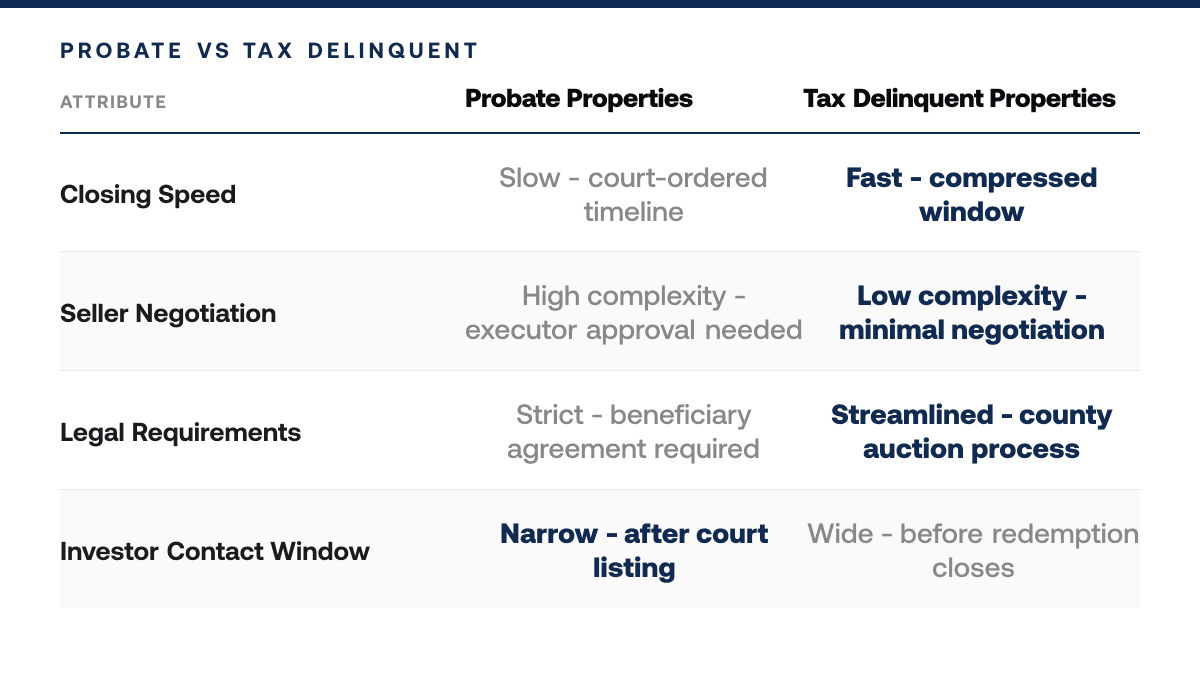
Probate properties involve estates in legal transition, where executors must follow court procedures before selling. Tax delinquent properties, by contrast, carry liens and redemption periods that vary by jurisdiction, but they can move more quickly once those windows close. The market for both has grown as housing inventory remains tight and investors seek alternative sourcing strategies beyond traditional MLS listings.[2]
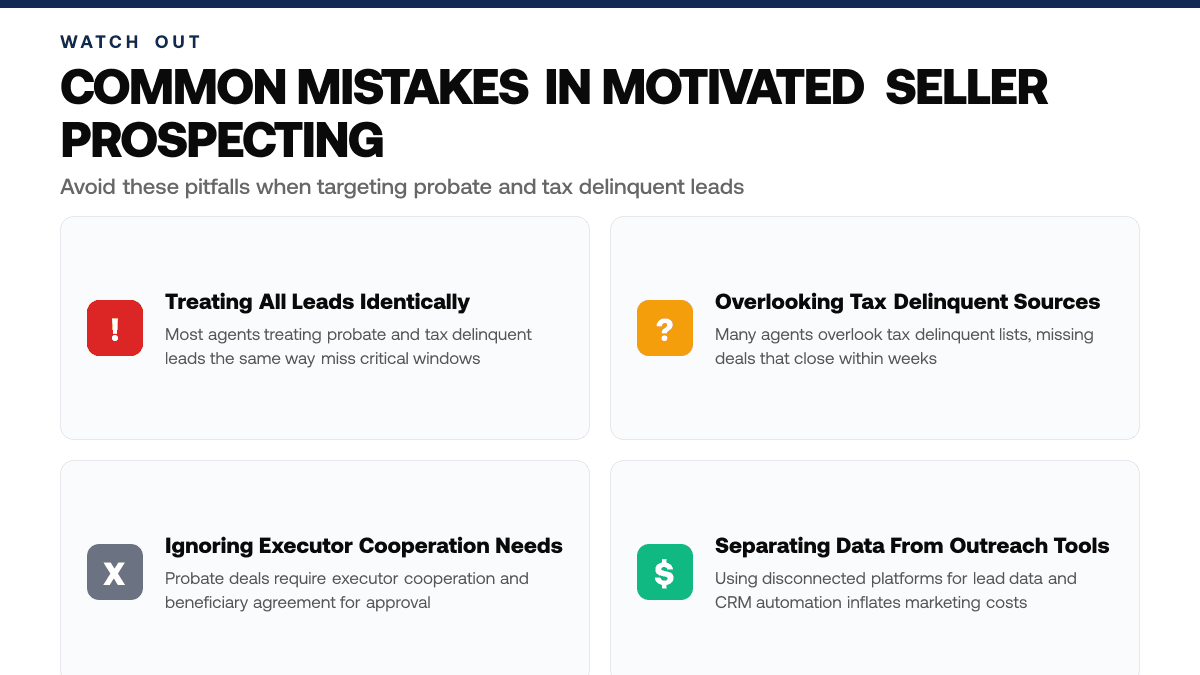
This article compares probate and tax delinquent properties across timeline, complexity, and closing probability. We'll examine the legal and financial mechanics of each, identify which motivated seller source typically closes faster in 2026, and show how targeted prospecting of the right property type can accelerate your deal flow without inflating your marketing budget. Most agents treating probate and tax delinquent leads the same way miss the critical window when each seller type actually moves, Goliath Data monitors real-time life-event signals across both categories and surfaces homeowners before they list, so agents reach motivated sellers at the exact moment they're most likely to sell.
TL;DR
Probate properties move through court-ordered sales with fixed timelines; tax delinquent properties sell via county auction with compressed closing windows.
Probate deals require executor cooperation and beneficiary agreement, while tax delinquent sales involve minimal seller negotiation, making delinquent deals close faster for motivated investors.
Many agents overlook tax delinquent lists as a motivated seller source, missing deals that close within weeks rather than months of initial contact.[1]
All 5 tools compared at a glance
Tool | Best for | Pricing | Key strength | Limitation vs #1 |
|---|---|---|---|---|
Agents and investors bundling list-building with CRM | Native CRM + AI skip-tracing + drip automation integrated | |||
PropertyRadar | Agents needing fast property records and ownership history | Public records aggregation with deed and lien history | Separates data from CRM and outreach automation | |
REI BlackBook | Wholesalers targeting probate and tax delinquent leads | Distinguishes probate vs. tax delinquent timing strategies | Separates data from CRM and outreach automation | |
PropStream | Investors filtering leads by property status and equity | Segments probate and tax delinquent by ownership context | Separates data from CRM and outreach automation | |
BatchLeads | Agents automating outreach to motivated seller lists | Connects lead ID to SMS, voice, and mail campaigns | Requires separate CRM integration for deal tracking |
Pricing as of June 2026; verify current rates on each provider's site.
1. Goliath Data: AI-Powered Motivated Seller Lists and CRM Built for Real Estate Agents and Investors

Visit goliathdata.com
Goliath Data is a CRM and list-building platform purpose-built for real estate agents and investors hunting motivated sellers in probate, tax delinquent, and preforeclosure markets. The platform combines contact management, skip-tracing, and automated outreach in one place, eliminating the need to juggle spreadsheets and separate tools. It's designed for professionals who want to close more deals without multiplying their marketing spend.
Here's the gap most tools miss: they treat data and follow-up as separate problems. Goliath Data bundles AI-powered list building with a native CRM and drip automation, so you pull a probate or tax delinquent list, skip-trace contacts in real time, and launch multi-channel campaigns, email, SMS, calling, without leaving the platform. That integration cuts friction and accelerates the path from prospect to conversation.
The platform delivers list building with AI skip-tracing (2,500 credits monthly), contact organization, calling and texting, task and deal tracking, automated drip campaigns, and an AI assistant named David. Users can also layer niche lists, probates, preforeclosures, tax delinquencies, to narrow their target and focus outreach on the most motivated sellers in their market.
The CRM + Data tier starts at $299/mo and includes all core features: list building, skip-tracing credits, calling, texting, drip automation, and deal tracking. For teams running full-service prospecting, list pulling, multi-channel outreach, lead qualification, and ongoing follow-up, the Done-For-You service is $2,999/mo. Annual billing includes two months free.
2. PropertyRadar
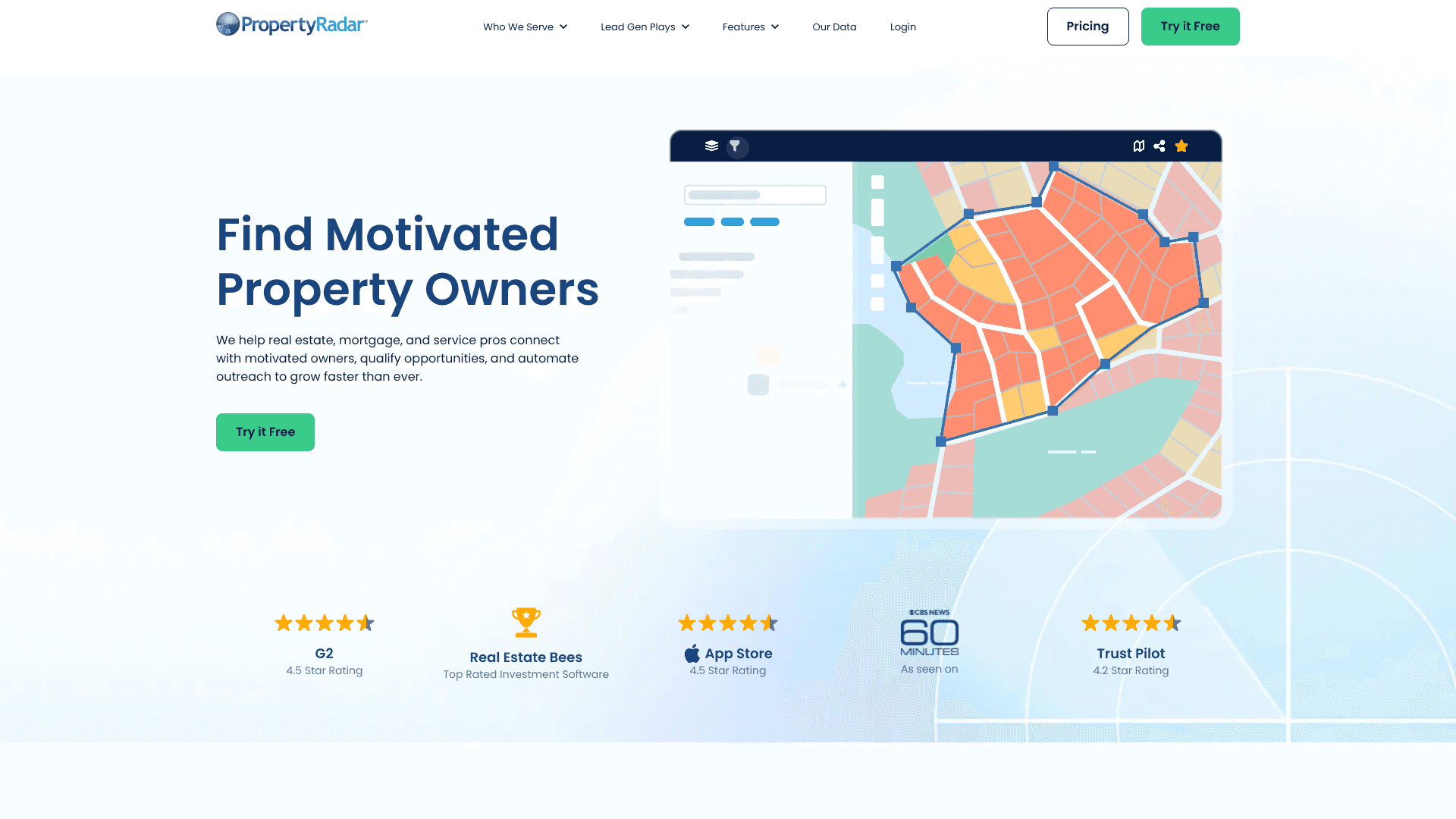
PropertyRadar is a real estate data platform built for agents and investors who need fast access to property records, ownership changes, and market signals. It aggregates public records across multiple jurisdictions to surface motivated-seller opportunities, including probate filings, tax delinquencies, and foreclosures, in a centralized dashboard, eliminating the need to manually search county records or subscribe to multiple data feeds.
Here's the gap most tools miss: PropertyRadar combines public record data with property valuation and ownership history in a single query, letting you filter for probate or tax-delinquent leads without cross-referencing separate databases. Rather than chasing courthouse records or relying on aggregators that lag weeks behind filings, you see recent changes and can prioritize outreach based on equity and timeline, cutting the prospecting friction that slows deals.
The platform offers property detail pages with deed history, lien records, and assessed values; saved searches that auto-populate new matches; bulk export for CRM integration; and mobile access for field prospecting. You can filter by property type, price range, and distress signal (probate status, tax delinquency, or foreclosure stage), then export lists or sync directly to your follow-up workflow.
PropertyRadar operates on an enterprise pricing model with custom quotes based on your team size, data volume, and feature access. Contact their sales team for a demo and pricing tailored to your prospecting volume and deal flow.
3. REI BlackBook

REI BlackBook homepage
REI BlackBook is a real estate data platform built for wholesalers, fix-and-flip investors, and agents seeking motivated sellers in probate and tax delinquent situations. The tool aggregates public records across multiple jurisdictions to surface property leads before they hit the open market, allowing investors to build pipelines of distressed and estate properties with minimal competition.
Here's the gap most tools miss: probate and tax delinquent properties require different timing and outreach strategies. Probate leads follow a predictable court calendar and executor timeline, while tax delinquent owners face imminent foreclosure and are often more receptive to quick cash offers. REI BlackBook segments these two motivated-seller sources separately, so you can prioritize which pipeline to work based on your capacity and close velocity.
The platform delivers filtered lists of probate filings and tax delinquent properties by county, with owner contact information, property details, and lien amounts. You can set automated alerts for new filings in your target markets, export leads directly into your CRM, and track outreach without toggling between multiple data sources or manual county record searches.
REI BlackBook operates on an enterprise pricing model tailored to team size and geographic coverage. Pricing is custom-quoted based on the number of counties you monitor and the frequency of data updates, making it scalable for solo investors ramping up or larger teams managing multiple markets simultaneously.
4. PropStream
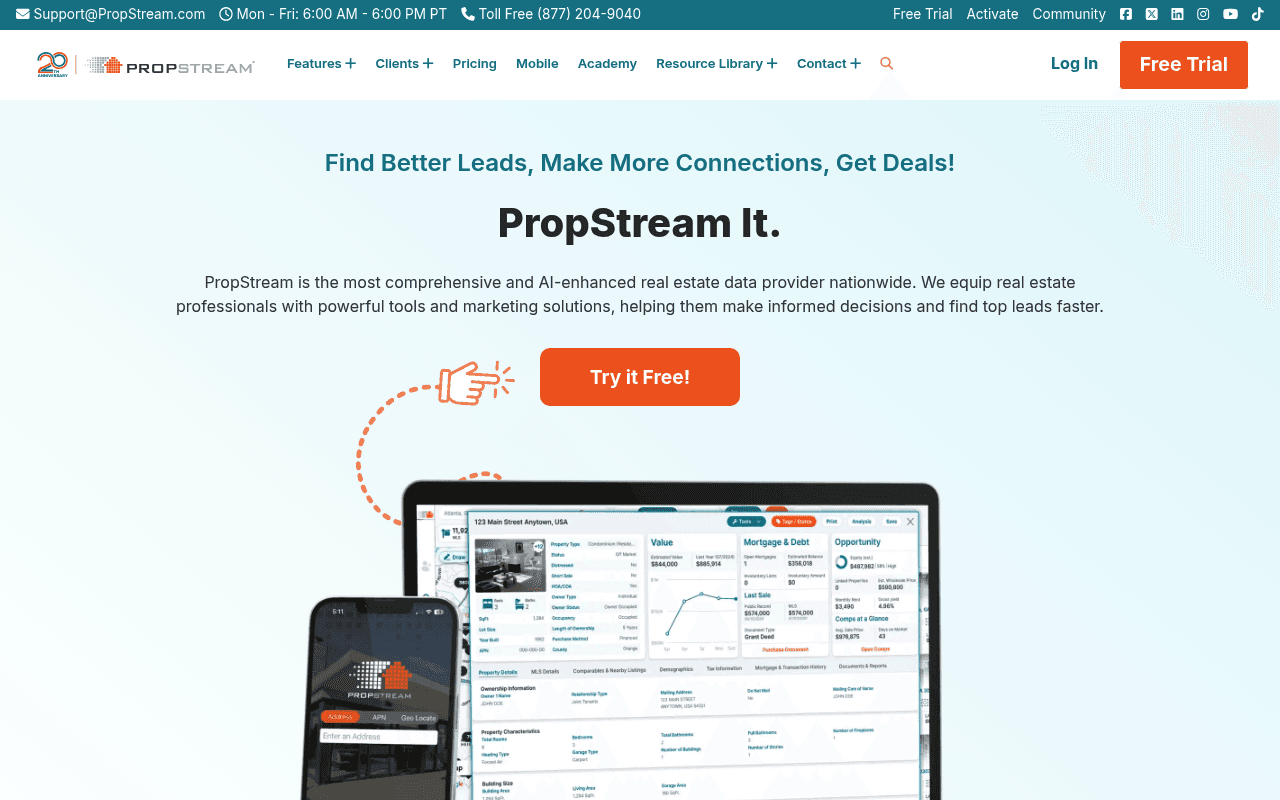
PropStream homepage
PropStream is a real estate data platform designed for agents and investors who need to identify and prioritize motivated seller opportunities, including probate and tax-delinquent properties, without manual research. The tool aggregates public records and property data to surface leads that fit specific investment criteria, helping users narrow their prospecting focus to high-probability targets.
Here's the gap most tools miss: probate and tax-delinquent properties require different timing and outreach strategies, yet most lead-gen platforms treat all motivated sellers the same. PropStream lets you filter and segment by property status and ownership context, so you can tailor your follow-up cadence and messaging to match the actual urgency and decision timeline of each lead type, not a one-size-fits-all approach.
The platform pulls public records data to identify probate estates, tax-delinquent parcels, and other distressed property signals. You can build custom lists based on equity, property type, location, and ownership status, then export leads for CRM integration or direct outreach. Batch filters and saved searches reduce manual list-building time, letting you focus on closing rather than data entry.
PropStream pricing is structured on an enterprise model; exact rates depend on your data volume, list size, and feature needs. Contact their sales team for a custom quote based on your prospecting volume and the number of properties you plan to track monthly.
5. BatchLeads

BatchLeads homepage
BatchLeads is a prospecting platform designed for real estate agents and investors who need to identify and contact motivated sellers at scale. The platform aggregates public records data, including probate, tax delinquent, and other distressed property indicators, to surface high-intent leads in your target markets. It's built for teams that want to automate lead discovery and follow-up without hiring additional staff or expanding marketing budgets.
Here's the gap most tools miss: BatchLeads connects lead identification directly to outreach automation. Rather than exporting a list and manually uploading it to a separate CRM or dialer, agents can discover motivated sellers and immediately queue them for phone, SMS, and mail campaigns within the same platform. This eliminates the data-transfer friction that slows down most prospecting workflows and lets you move from discovery to first contact in hours, not days.
The platform pulls probate and tax delinquent property records, bankruptcy filings, and other public signals to build targeted lists. BatchLeads includes built-in skip tracing to append phone numbers and email addresses, bulk SMS and voice calling tools, direct mail integration, and follow-up automation. You can also segment lists by property type, equity, timeline, and other criteria to prioritize the fastest-closing opportunities in your pipeline.
BatchLeads pricing is structured on an enterprise model with custom quotes based on data volume, outreach tools, and team size. Contact their sales team for a tailored proposal aligned to your prospecting volume and deal velocity.
Frequently Asked Questions
Which motivated seller source typically closes faster, probate or tax delinquent properties?
Tax delinquent properties often close faster because the timeline is driven by a statutory sale date set by county law, creating urgency for the owner. Probate sales involve court approval, executor decisions, and estate settlement, which typically extend the process. Both sources represent motivated sellers, but tax delinquent owners face an imminent deadline that compresses negotiation and closing windows. The specific timeline varies by state and individual circumstances, but tax delinquency's external deadline generally accelerates deal velocity compared to probate's administrative pace.[1]
What makes tax delinquent property owners motivated to sell quickly?
Tax delinquent owners face a foreclosure deadline imposed by state law, typically within a defined redemption period, after which the county can sell the property to recover unpaid taxes. This creates genuine urgency: the owner either sells to a buyer or loses the property entirely. Unlike traditional sellers, they cannot wait for market conditions to improve or hold out for top dollar. This external pressure transforms them into highly motivated sellers willing to negotiate below market value and close within weeks rather than months.[1]
How do probate sellers differ from tax delinquent sellers in terms of motivation?
Probate sellers, executors or heirs managing a deceased owner's estate, are motivated by the need to settle the estate and distribute assets, but they operate on a court-approved timeline without an external deadline threat. They may hold out for fair market value or delay sale while resolving disputes among heirs. Tax delinquent sellers, by contrast, face an imminent loss of ownership if they do not act. While both are motivated, probate sellers have flexibility; tax delinquent owners do not. This distinction directly affects negotiation leverage and closing speed.[1]
What tools help agents and investors identify and contact probate and tax delinquent sellers at scale?
Goliath Data monitors real-time life-event signals, including tax delinquencies and probate notices, to surface homeowners most likely to sell before they list on the market. The platform includes owner contact information, a full CRM, pipeline management, and an AI assistant named David that handles inbound calls, outbound follow-ups, texts, emails, and appointment scheduling automatically. This automation ensures agents never miss a lead and can focus prospecting efforts on the most motivated sources without increasing marketing spend.
Sources
Disclaimer: This article is provided by Goliath Data for general informational purposes only and does not constitute legal, tax, financial, or investment advice. Statutory references, redemption timelines, interest rates, and procedural requirements vary by jurisdiction and change over time. Always verify current information with the relevant county or municipal office and consult a licensed attorney, CPA, or financial advisor before making any investment, acquisition, or legal decision based on this content.
