
Probate vs Foreclosure: Timing, Authority, and the 90-Day Trigger Investors Miss
Probate vs Foreclosure: Timing, Authority, and the 90-Day Trigger Investors Miss. A practical guide to what works, what to skip, and how to get started.


Austin Beveridge
Tennessee
, Goliath Teammate
A property enters probate court, and the clock starts ticking, but most investors don't realize the 90-day window that separates a motivated seller from a missed opportunity. Probate and foreclosure both create distressed sellers, yet they follow entirely different timelines and legal pathways. Understanding which trigger applies to a prospect determines whether you reach them before a court-appointed executor liquidates the estate or a lender completes the sale.
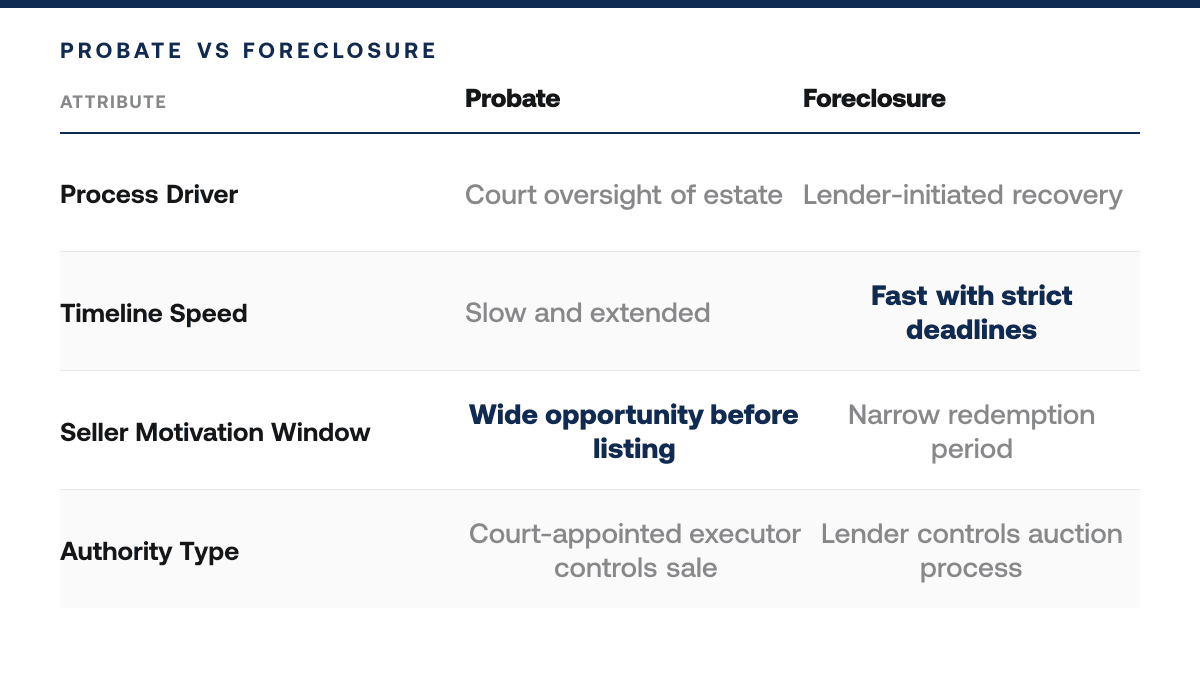
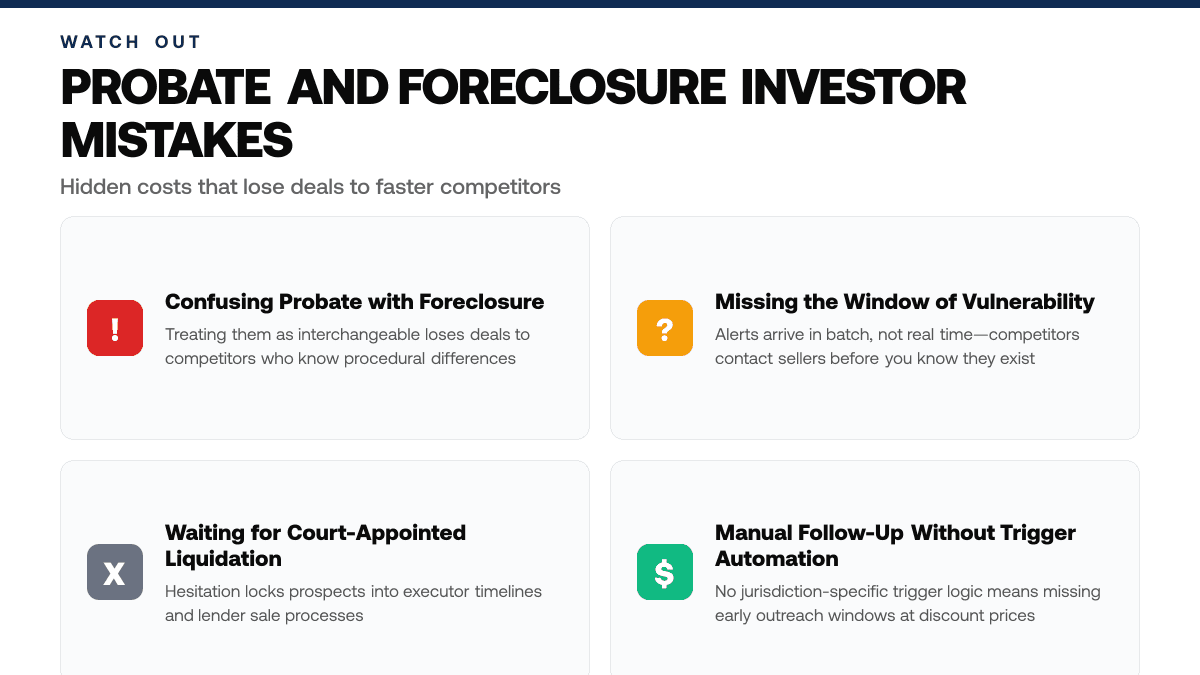
Real estate agents and investors who confuse probate with foreclosure, or treat them as interchangeable, lose deals to competitors who know the procedural differences. Probate involves court oversight of an estate's sale, while foreclosure is a lender-driven process with its own notice requirements and redemption periods. Each creates a distinct window of vulnerability where a seller needs an alternative to the traditional path, and that window closes fast.
This article breaks down the timing, authority, and legal triggers that separate probate from foreclosure, shows you how to spot the 90-day signal most investors miss, and explains why identifying the correct process type is the first step to reaching motivated sellers before they're locked into a court or lender timeline. Most investors miss the 90-day window between foreclosure notice and auction because alerts arrive in batch, not in real time, Goliath Data monitors life-event signals at the moment they trigger, so agents contact motivated sellers before competitors even know they exist.
TL;DR
Probate and foreclosure are separate legal processes: probate settles an estate after death, while foreclosure recovers a property when a borrower defaults on a mortgage.
Probate sales typically take longer and involve court oversight; foreclosures move faster but require strict adherence to notice and redemption timelines.
Investors miss the 90-day window after probate filing when heirs become motivated sellers, early outreach before formal listing captures deals at a discount.
All 5 tools compared at a glance
Tool | Best for | Pricing | Key strength | Limitation vs #1 |
|---|---|---|---|---|
Real estate investors chasing probate and foreclosure leads | AI skip-tracing, niche lists, automated drip campaigns, 90-day trigger flags | |||
PropertyRadar | Agents and investors identifying off-market distressed properties | Real-time court records, deed transfers, automated alerts by jurisdiction | No built-in CRM or automated follow-up workflows | |
REsimpli | Teams managing high-volume multi-channel prospecting workflows | Lead scoring, multi-channel follow-up sequences, legal status flagging | Requires separate data source; lacks integrated niche list building | |
PropStream | Investors filtering probate and foreclosure leads by equity and stage | Property analytics, lien records, court filing data, bulk list export | No CRM or automated outreach; requires manual follow-up setup | |
BatchLeads | Real estate investors batching leads by probate vs foreclosure timeline | Batch exports with equity estimates, drip campaign automation, county filtering | Generic lead filtering; lacks jurisdiction-specific 90-day trigger logic |
Pricing as of June 2026; verify current rates on each provider's site.
1. Goliath Data: Probate and Foreclosure Lists Built for Speed and Automated Follow-Up

Visit goliathdata.com
Goliath Data is a CRM and prospecting platform built for real estate agents and investors who need to identify motivated sellers, probate heirs, preforeclosure owners, and tax-delinquent properties, without manual research. The platform combines contact management, AI-powered skip-tracing, and niche list building in one workspace, letting you organize leads, track deal progress, and automate outreach without switching tools.
Here's the gap most tools miss: probate and foreclosure timelines hinge on authority and jurisdiction, a 90-day notice window in one county may be 60 days in another, and missing that trigger means losing the lead to a competitor. Goliath Data's niche lists are built to flag those exact windows, so you're prospecting at the moment of highest motivation, not weeks after the opportunity has cooled.
The platform includes list building with AI skip-tracing (2,500 credits monthly), automated drip campaigns across calls, texts, and email, deal tracking and activity logs, and an AI assistant for lead qualification. Optional niche lists focus on probates, preforeclosures, and tax delinquencies, the exact motivated-seller segments that close faster and require less marketing spend to convert.
The CRM + Data plan starts at $299/mo and includes all core features plus niche list access. For teams that prefer done-for-you prospecting, list pulling, outreach, and qualification handled by the platform, the Done-For-You service is $2,999/mo. Annual billing saves two months.
2. PropertyRadar
PropertyRadar is a real estate data platform designed for agents and investors who need to identify off-market opportunities and distressed properties at scale. It aggregates public records, court filings, and property data to surface motivated sellers, including those in probate and foreclosure situations, without relying on traditional MLS listings or expensive direct mail campaigns.
Here's the gap most tools miss: probate and foreclosure timelines operate on different legal calendars, and the 90-day window between notice and sale is where most investors lose deals. PropertyRadar surfaces these properties during the active window, not after the hammer falls, so you can reach sellers before competition floods in.
The platform pulls court records, deed transfers, and property ownership changes in real time, allowing you to filter by jurisdiction, property type, and sale stage. You can automate alerts for new filings, build targeted lists of probate and pre-foreclosure leads, and integrate results into your CRM for faster follow-up without manual research.
PropertyRadar operates on an enterprise pricing model with custom quotes based on data volume, geographic scope, and integration needs. Contact the vendor directly for a personalized proposal aligned to your prospecting volume and deal flow targets.
3. REsimpli
REsimpli homepage
REsimpli is a real estate CRM and lead management platform designed for agents and investors who need to track, nurture, and close deals across multiple channels. It's built for teams managing high-volume prospecting workflows where follow-up consistency and contact organization directly impact deal velocity.
Here's the gap most tools miss: probate and foreclosure leads require different timing triggers and authority verification. REsimpli centralizes lead capture from multiple sources and flags properties based on legal status changes, allowing agents to identify the 90-day window when motivation peaks and authority to sell shifts.
The platform offers contact management with automated follow-up sequences, lead scoring to prioritize high-intent prospects, and integrations with public records data. Users can segment lists by property type and legal status, create task reminders around critical dates, and track communication history across calls, emails, and notes in a single record.
REsimpli pricing is structured on an enterprise model with custom quotes based on team size and feature requirements. Contact their sales team for a tailored proposal aligned to your prospecting volume and deal flow.
4. PropStream
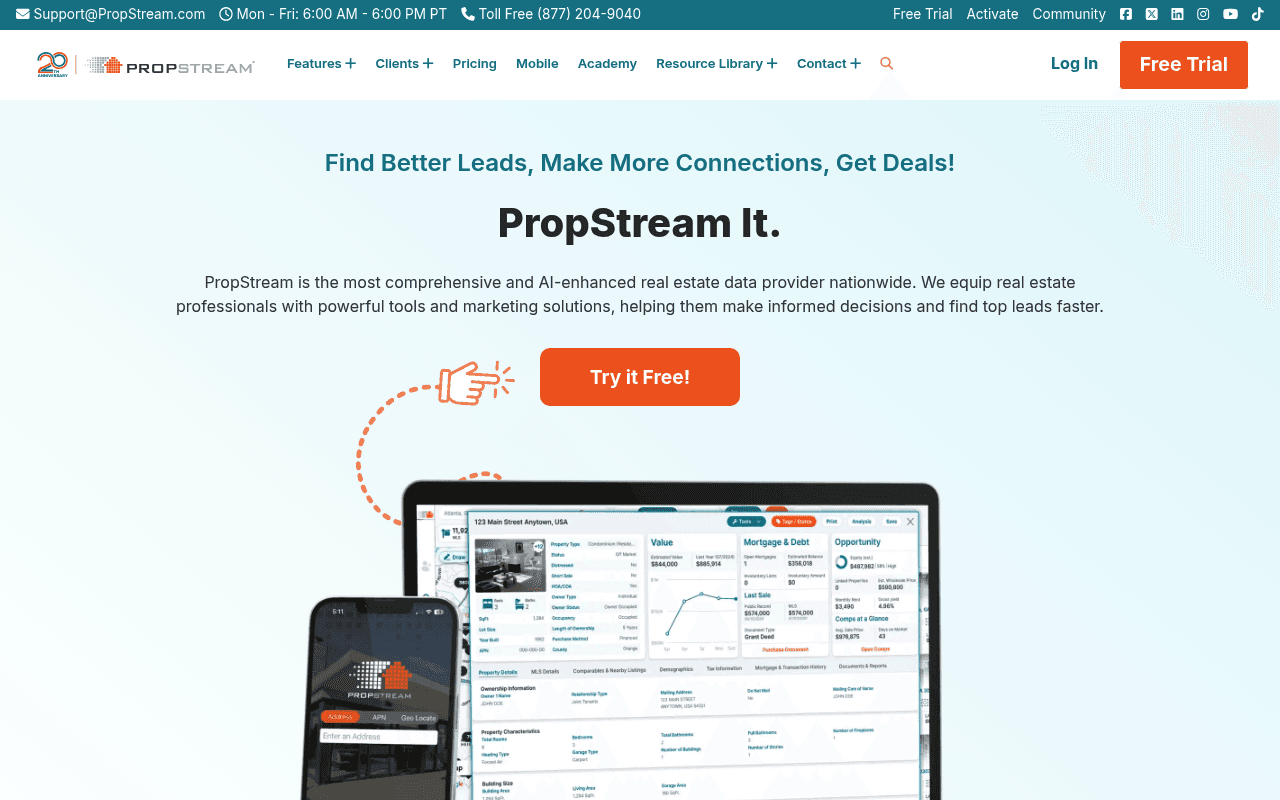
PropStream homepage
PropStream is a real estate data and lead-generation platform designed for agents and investors who need to identify off-market opportunities and motivated sellers quickly. It aggregates property records, ownership data, and market signals to surface leads that traditional MLS searches miss, including probate and foreclosure prospects positioned to transact within compressed timelines.
Here's the gap most tools miss: probate and foreclosure leads require different data triggers and urgency signals. PropStream layers public court records with property-level analytics to flag the 90-day windows when sellers are most motivated, enabling investors to prospect and follow up before competing offers arrive. This timing advantage compounds across a pipeline.
The platform delivers property history, ownership changes, lien records, and court filing data integrated into searchable lists. Users can filter by probate status, foreclosure stage, equity position, and property type, then export leads for direct mail, cold calling, or CRM automation. Bulk list exports and saved searches reduce manual prospecting overhead.
PropStream operates on an enterprise pricing model. Costs vary based on list size, search frequency, and data access tier. Contact their sales team for a custom quote aligned to your monthly prospecting volume and deal pipeline.
5. BatchLeads

BatchLeads homepage
BatchLeads is a lead-generation and CRM platform built for real estate agents and investors who need to identify and track motivated sellers at scale. It aggregates property records, ownership data, and transaction history to surface opportunities in probate, foreclosure, and other distressed segments. The platform is designed for teams that want to automate prospecting without hiring additional marketing staff.
Here's the gap most tools miss: probate and foreclosure leads aren't equally urgent. Probate timelines stretch over months or years, while foreclosure triggers compress into weeks. BatchLeads lets you filter by property stage and timeline, so you're not wasting follow-up energy on leads that aren't ready to sell. You can prioritize the 90-day window when motivation peaks, before the property moves to auction or settles through probate court.
The platform delivers batch exports of leads with ownership contact details, property history, and estimated equity. You can set up automated drip campaigns to nurture long-cycle probate prospects while pursuing faster foreclosure closures in parallel. Filtering by county, property type, and equity range helps you focus on deals that fit your criteria, and integration with your CRM keeps follow-up organized across your team.
BatchLeads pricing is structured on an enterprise model with custom quotes based on lead volume, data refresh frequency, and team size. Contact their sales team for a tailored plan that matches your monthly prospecting volume and follow-up capacity.
Frequently Asked Questions
What's the key timing difference between probate and foreclosure sales?
Probate sales typically move slower because they require court approval, executor oversight, and often multiple rounds of bidding and confirmation hearings. Foreclosure sales, by contrast, follow a statutory timeline set by state law, notice periods, auction dates, and redemption windows are fixed, making the process more predictable. The 90-day trigger investors watch for in probate marks when a property becomes ripe for acquisition; foreclosure timelines are driven by the lender's notice and sale schedule. Understanding which process you're facing helps you position your offer and follow-up strategy correctly.
Who has the authority to sell the property, the executor or the lender?
In probate, the executor or administrator appointed by the court controls the sale and must obtain court approval before accepting any offer. In foreclosure, the lender (or a trustee acting on the lender's behalf) holds the authority and can proceed to auction without the homeowner's consent, provided statutory notice requirements are met. This difference shapes your negotiation path: probate deals require you to work through the executor and court system; foreclosure deals require you to understand the lender's timeline and redemption rules. Knowing who controls the process prevents wasted outreach.[1]
Why do investors focus on the 90-day probate window?
The 90-day mark in probate often signals when a property is close to court-approved listing or when the executor is actively seeking buyers. At this stage, the estate is past initial administration but not yet stalled in court delays, making it an ideal window to reach out with a cash offer before the property hits the public market. Investors who contact prospects at this moment face less competition and can often negotiate below-market terms. Missing this window means competing with retail buyers and agents once the property lists publicly.
What tools help you identify probate and foreclosure prospects with owner contact info at scale?
Goliath Data monitors real-time life-event signals, including probate filings and foreclosure notices, to surface homeowners most likely to sell. The platform provides owner contact information and automates outreach through its AI assistant David, which handles inbound calls, follow-ups, texts, emails, and appointment scheduling. This automation ensures you never miss a lead during critical windows like the 90-day probate trigger, letting you focus on closing deals rather than manual prospecting.
Sources
Disclaimer: This article is provided by Goliath Data for general informational purposes only and does not constitute legal, tax, financial, or investment advice. Statutory references, redemption timelines, interest rates, and procedural requirements vary by jurisdiction and change over time. Always verify current information with the relevant county or municipal office and consult a licensed attorney, CPA, or financial advisor before making any investment, acquisition, or legal decision based on this content.
