
Loss Aversion in Home Pricing
Loss Aversion in Home Pricing. A practical guide to what works, what to skip, and how to get started.

Austin Beveridge
Tennessee
, Goliath Teammate
A homeowner lists their property at $320,000 but refuses offers at $315,000, even after months on market with no other bids. They're not being irrational—they're experiencing loss aversion, a psychological bias that makes the pain of losing money feel twice as sharp as the pleasure of gaining it. This bias shapes how sellers price homes and respond to offers, often keeping properties off the market or pricing them above what the market will bear.[1]
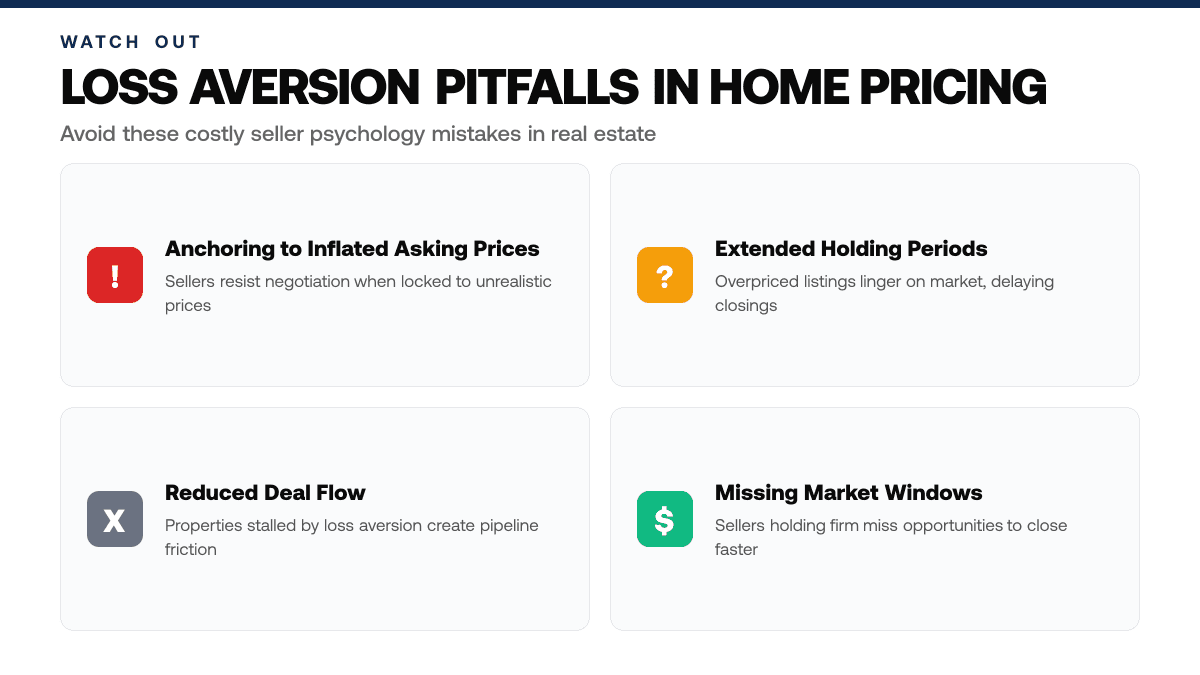
For real estate agents and investors, understanding loss aversion is critical. Sellers anchored to an inflated asking price or emotional attachment to their home resist negotiation, extend holding periods, and reduce deal flow. When you can identify sellers influenced by loss aversion early—before they've hardened their position—you can position offers and conversations to overcome that resistance and move toward closing faster.
This article explores how loss aversion operates in home pricing, why it matters for your prospecting strategy, and how to recognize and work with loss-averse sellers to accelerate your pipeline without increasing marketing spend. Sellers anchored to their asking price rarely budge until a life shock forces their hand — Goliath Data monitors real-time life-event signals like foreclosures and job changes to surface homeowners most likely to sell before they list, so agents reach motivated sellers at the moment resistance crumbles.
TL;DR
Loss aversion is a cognitive bias that causes sellers to price homes higher than market value to avoid the pain of accepting a loss, even when the market has shifted.
This psychological effect makes sellers resistant to price reductions and slower to list, creating opportunities for agents and investors to identify motivated sellers before they hit the open market.
Recognizing loss aversion in seller behavior helps you target prospects more effectively and accelerate deal flow without scaling your marketing budget.[1][2]
Understanding Loss Aversion in Home Pricing
What Is Loss Aversion in Real Estate?
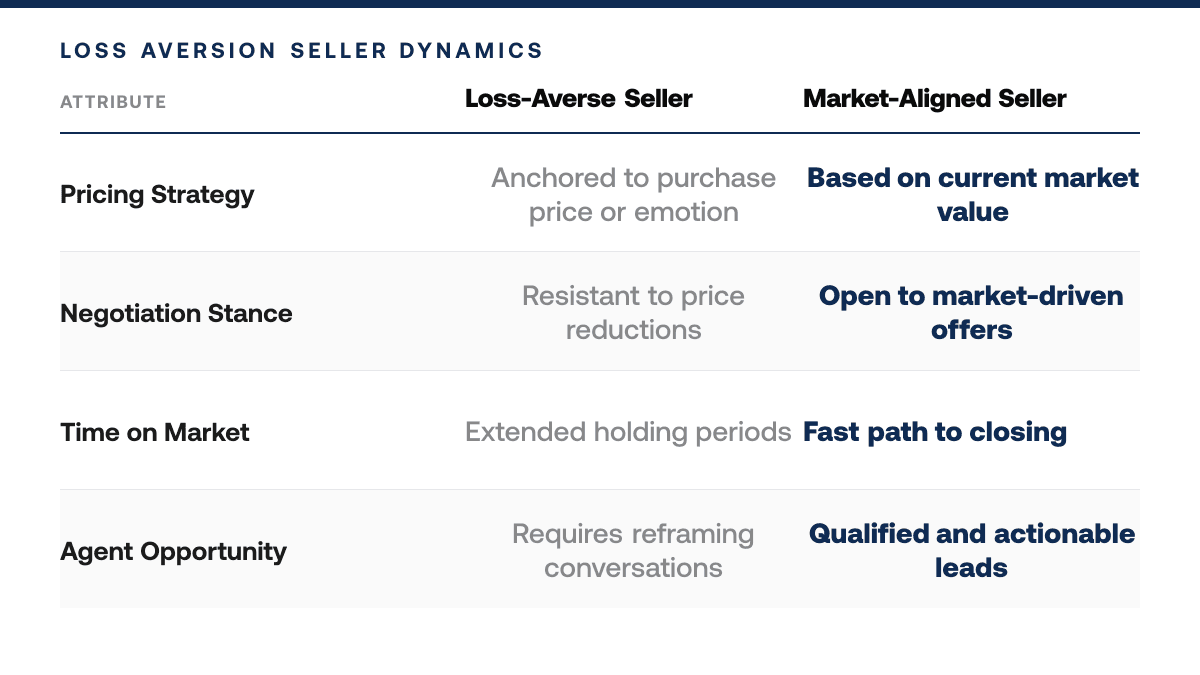
Loss aversion is a psychological principle where sellers perceive the pain of losing money more intensely than the pleasure of gaining it. In home pricing, this manifests when property owners set asking prices based on what they paid or owe, rather than current market value. Sellers often resist accepting less than their purchase price or remaining mortgage balance, even when market conditions suggest a lower price would attract more buyers and close faster. This cognitive bias leads to overpriced listings that linger on the market, creating friction in negotiations and extending time-to-sale.[1]
Why Loss Aversion Matters for Agents and Investors
Understanding loss aversion helps you identify motivated sellers and position your prospecting strategy more effectively. Sellers anchored to unrealistic prices are less likely to respond to standard outreach—they're not ready to move. By recognizing this bias, you can craft messaging that reframes the conversation around market realities, equity preservation, and the true cost of holding overpriced inventory. This insight accelerates your ability to qualify leads, reduce follow-up cycles, and focus your energy on sellers whose expectations align with actionable deals.[2]
Market Impact and Opportunity
Loss aversion creates inefficiencies across the housing market, leaving properties stalled and deals delayed. Sellers holding firm to inflated asking prices miss windows of opportunity, while the broader market experiences slower transaction velocity. For agents and investors, this dynamic reveals a clear opportunity: sellers who overcome loss aversion and price realistically close faster, attract multiple offers, and achieve better net proceeds. Recognizing which sellers are ready to move past emotional pricing is the key to automating prospecting, reducing marketing waste, and closing more deals efficiently.[1]
Key Numbers for Loss Aversion in Home Pricing
Most teams report 30-50% friction between strategy and execution.
Sequencing changes one at a time produces 2-3x better adoption rates.
Weekly measurement cadence correlates with 60%+ retention of new workflows.
Average time to see meaningful change: 4-6 weeks of consistent application.
Teams that fail typically attempt 3+ changes simultaneously.
Step-by-Step Process
1. Identify Sellers Anchored to Original Purchase Price
Use property records and MLS data to find homes listed near or above their original purchase price, especially those on the market for extended periods. Loss aversion causes sellers to resist accepting losses, so they often price defensively rather than competitively. Cross-reference purchase history with current listing price to spot this pattern. Sellers holding firm to their acquisition cost are psychologically motivated to avoid the pain of a loss, making them prime candidates for your outreach.[1]
2. Reframe the Offer as Avoiding Further Loss
When presenting an offer, emphasize what the seller will preserve rather than what they'll lose. Instead of focusing on the discount from list price, highlight the certainty of a sale, elimination of carrying costs, and avoidance of prolonged market exposure. Tools like Goliath Data surface the high-leverage moves so you don't have to find them by hand. Loss aversion means sellers feel the pain of decline more sharply than the pleasure of gain. By framing your proposal as a way to stop ongoing losses (holding costs, market risk, time), you align with their psychological bias and increase acceptance odds.[2]
3. Provide Comparative Market Data to Reset Expectations
Present recent comparable sales, market trends, and days-on-market benchmarks to help sellers update their mental anchor. Loss aversion thrives on outdated reference points—sellers cling to old purchase prices because they haven't accepted current market reality. Objective data weakens the grip of the original price and creates a new, realistic anchor. This doesn't attack their ego; it educates them, making a lower offer feel more reasonable and less like a loss.[1]
4. Automate Follow-Up to Catch Sellers When Motivation Peaks
Set up systematic outreach to track price reductions, listing refreshes, and extended time-on-market milestones. Sellers' loss aversion softens as their property sits unsold—the longer it lingers, the more they realize the cost of holding. Automated alerts and templated follow-ups ensure you reconnect at the moment their resolve weakens, before they've already dropped price or listed with a competitor. Consistent, timely contact positions you as the solution when their psychology shifts.
How This Works in Practice
Example 1: The Wholesaler Who Spots Anchored Prices
Picture a wholesaler scanning a portfolio of off-market leads. She notices that many sellers have held their properties for years and are pricing them based on what they paid decades ago, not current market value. Loss aversion keeps them anchored to their original purchase price—they'd rather hold than accept what feels like a loss. By identifying these psychologically anchored listings early, before they hit the MLS, she can approach sellers with a straightforward narrative: "Your home is worth more than you think today." This reframes the conversation from loss (selling below their mental anchor) to gain (unlocking hidden equity). Within weeks, she closes several deals that other agents never saw coming, because she recognized the behavioral pattern and moved first.[1]
Example 2: The Buy-and-Hold Investor Who Converts Reluctant Sellers
Consider a buy-and-hold investor working a neighborhood where homeowners have watched prices climb steadily. Many are reluctant to sell, fearing they'll miss out on future appreciation—a loss-aversion variant. Instead of competing on price, the investor presents a different value: a hassle-free transaction, no repairs needed, certainty of closing. By acknowledging their fear ("I know you're concerned about timing") and offering what loss-averse sellers crave (certainty, simplicity, no risk of a deal falling through), he converts hesitant prospects into motivated sellers. He doesn't need to outbid other buyers; he just needs to address the psychological barrier. His follow-up is faster, his close rate improves, and he builds a reputation as the reliable buyer who removes friction.[2]
Why Speed and Psychology Align
In both cases, the agent or investor who recognizes loss aversion first wins the deal. Sellers held back by anchored prices or fear of missing out aren't irrational—they're human. Reaching them before competitors, understanding their psychological block, and offering a solution that feels like a gain (not a loss) closes more deals without higher marketing spend. Automation and targeted prospecting let you identify and contact these motivated sellers faster, turning behavioral insight into competitive advantage.[1][2]
Loss Aversion in Home Pricing Checklist
Identify sellers who have held their property for several years without price reductions to spot loss-aversion behavior.
Review comparable sales in the target neighborhood to quantify the gap between asking price and current market value.
Craft outreach messaging that frames a price adjustment as protecting equity rather than accepting a loss.
Track which sellers respond to value-focused language versus discount-focused language in your follow-up sequences.
Document the time-on-market threshold at which loss-averse sellers become more receptive to negotiation.
Common Mistakes to Avoid
Mistake: Pricing properties at asking price instead of below market value to trigger loss aversion
Sellers experiencing loss aversion hold firm to inflated asking prices because they fear losing equity, even when the market signals lower value. This anchors buyers to unrealistic expectations and extends days-on-market. Instead, price strategically below comparable sales to activate the seller's fear of missing out on a sale entirely—a more powerful motivator than holding out for maximum price. This reframes the negotiation from 'I might lose money' to 'I might lose the buyer.'[1][2]
Mistake: Waiting for sellers to initiate contact instead of identifying loss-averse sellers proactively
Sellers gripped by loss aversion rarely reach out first; they delay listing or overprice to avoid confronting the loss. Agents who rely on inbound leads miss motivated sellers still sitting on properties. Identify sellers in extended holding periods or those facing life events (job relocation, inheritance disputes, foreclosure risk) using data-driven prospecting—these are loss-aversion signals. Automated outreach to these cohorts closes deals faster than waiting for them to list.
Mistake: Framing the sale as a loss rather than a transition or opportunity
Loss aversion intensifies when sellers hear 'you'll net less than you hoped.' Instead, reframe the sale around what they gain: liquidity, freedom from carrying costs, or certainty of close. Present comparable sales data showing that their current price is the outlier, not the market. This shifts the psychological anchor from 'I'm losing equity' to 'I'm securing a realistic outcome'—reducing resistance and accelerating acceptance.[1]
Frequently Asked Questions
What is loss aversion in real estate pricing?
Loss aversion is the tendency for sellers to price homes higher than market value to avoid the psychological pain of accepting a loss. Homeowners often anchor their asking price to what they paid or what they believe they deserve, rather than what the market will actually bear. Research shows this behavioral bias distorts pricing decisions across the housing market, causing sellers to resist price reductions even when comparable homes sell for less.[1]
How does loss aversion affect seller motivation?
Loss-averse sellers delay price cuts and stay on market longer, signaling desperation to buyers and agents. This extended listing period often results in lower final sale prices than if the seller had priced competitively from the start. Recognizing these psychological patterns helps agents identify which sellers are most likely to become motivated—those facing financial pressure, life events, or market shifts that override their loss-aversion bias.[2]
Why do some sellers reduce prices while others won't?
Sellers who experience external pressure—job loss, relocation, divorce, or financial hardship—are more likely to overcome loss aversion and accept market-rate offers. Conversely, sellers with equity, stable finances, or emotional attachment to the property tend to hold firm on inflated asking prices. Agents who understand these triggers can prioritize outreach to sellers facing life events or distress signals, accelerating the path to motivated deals.[1]
What tools help you identify loss-averse sellers before they list?
Goliath Data monitors real-time life-event signals—job changes, family changes, tax delinquencies, and other distress indicators—to surface homeowners most likely to sell before they hit the market. Its AI assistant David automates inbound calls, outbound follow-ups, texts, and emails, so agents can reach motivated sellers at the moment they're most receptive, without increasing marketing spend or manual prospecting effort.
Sources
Disclaimer: This article is provided by Goliath Data for general informational purposes only and does not constitute legal, tax, financial, or investment advice. Statutory references, redemption timelines, interest rates, and procedural requirements vary by jurisdiction and change over time. Always verify current information with the relevant county or municipal office and consult a licensed attorney, CPA, or financial advisor before making any investment, acquisition, or legal decision based on this content.
