
Hawaii Tax Delinquent Properties for Sale List
Find tax delinquent properties for sale Hawaii using AI-powered lead scoring and county recorder automation. Skip manual lists, close deals faster.


Austin Beveridge
Tennessee
, Goliath Teammate
Quick Answer
Goliath Data sees this firsthand: Tax-delinquent properties in Hawaii are residential or commercial parcels where owners haven't paid property taxes, creating a public sale list maintained by county tax assessors. Investors and agents source these lists through county websites, auction platforms, and real estate data tools, which surface tax-delinquent homeowners as pre-qualified seller leads before foreclosure auctions occur. Hawaii's redemption period gives owners time to settle arrears, making early outreach critical for deal flow.
Tools like Goliath Data surface this kind of signal in real time, which is why investors increasingly lean on data-feed providers rather than manual list-building.
Understanding Tax Delinquent Properties in Hawaii
Tax delinquent properties in Hawaii are homes where the owner has fallen behind on property tax payments to the county assessor. When property taxes go unpaid for multiple years, the county initiates a tax sale process, allowing investors and agents to acquire the property at auction or through foreclosure. These properties represent motivated sellers: homeowners facing financial hardship, divorce, job loss, or relocation who may be willing to negotiate rather than lose their home to tax sale.
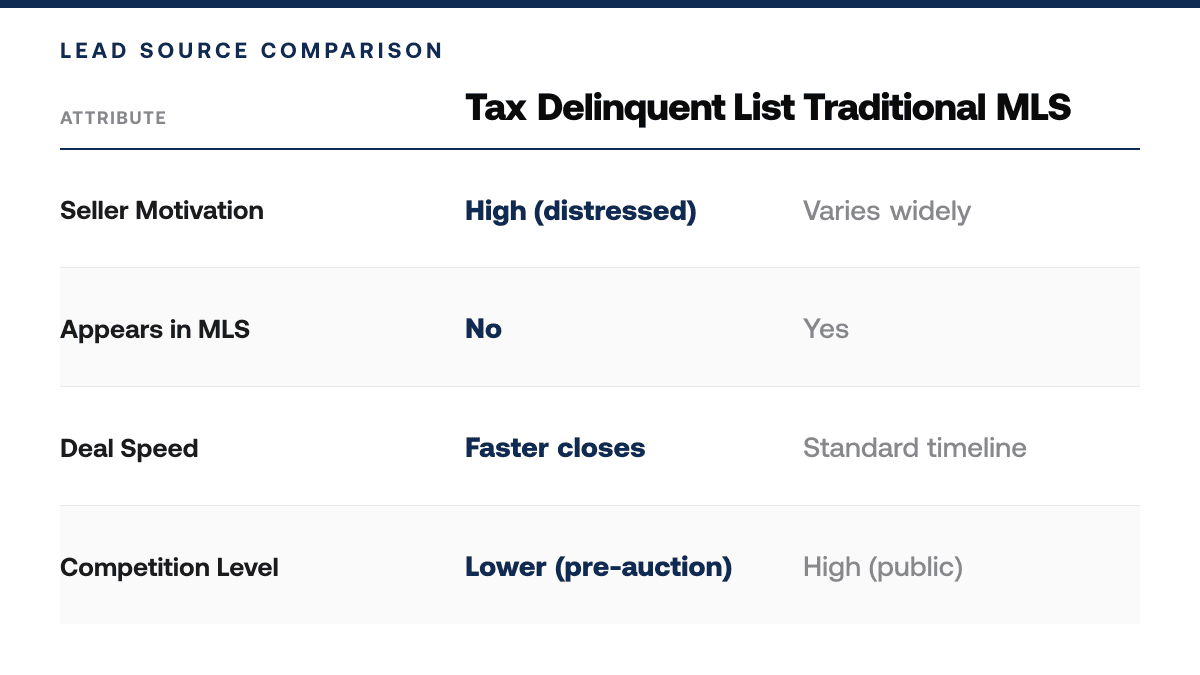
Unlike standard MLS listings, tax delinquent properties don't appear in typical real estate databases. They're identified through county tax assessor records and published on Hawaii's official tax sale notice lists. Investors must actively search these public records or use specialized data platforms to find them before competitors do.
Homeowners facing tax delinquency are highly motivated. They're confronting immediate financial pressure and often willing to sell quickly at below-market prices rather than lose equity to the government. For agents and investors, that urgency translates into faster deals, higher margins, and predictable deal flow without burning budget on PPC or cold-calling prospects who may not be ready to sell.
Real estate investors burning budget on traditional marketing, solo agents spending excessive time prospecting, wholesalers racing for pre-foreclosure deals, and fix-and-flip investors seeking pre-qualified leads all benefit from tax delinquent property lists. These properties align with motivated-seller acquisition strategies that compress deal cycles and improve conversion rates.
Step-by-Step Process
Finding and acquiring tax delinquent properties in Hawaii requires identifying prospects, verifying ownership and lien status, contacting motivated sellers, structuring offers, and closing the deal.
Step 1: Search the Hawaii Tax Delinquent Property Database. Start with Hawaii's county tax assessor websites or the state's delinquent property auction list. Filter by county, property type, and delinquency year. Note the owner's name, parcel number, and amount owed. Cross-reference MLS records to confirm the property isn't already listed for sale.
Step 2: Verify Ownership and Lien Position. Pull a title search through the county recorder's office to confirm the owner, identify senior and junior liens, and check for bankruptcy filings. Confirm the tax lien amount and redemption deadline. This step prevents competing with other creditors and ensures clear title post-acquisition.
Step 3: Locate and Contact the Property Owner. Use public records databases, skip-tracing tools, or direct mail to reach the owner. Start with a soft inquiry, letter or postcard, that conveys your solution without pressure. Emphasize stopping the foreclosure sale, eliminating liens, or recovering equity. Response rates improve when you position yourself as a problem-solver.
Step 4: Present a Concrete Offer. Based on comparable sales, repairs needed, and liens owed, make a written offer that clears the tax debt and yields the owner net proceeds. Include a timeline and clear next steps.
How This Works in Practice
Finding tax-delinquent properties in Hawaii requires speed and precision. Here's how the process unfolds when manual prospecting meets AI-assisted workflows.
An agent logging into Hawaii's county assessor website manually pulls the tax delinquency list, cross-references ownership records, and begins cold calling. The agent spends significant time identifying leads, reaches a portion of owners, and leaves voice mails. Follow-ups happen days later; by then, competing investors have already contacted the homeowner. The deal flow stalls.
Here's the thing: The difference between closing deals and losing them to competitors comes down to response time. Homeowners facing tax delinquency call the first person who answers.
Automated life-event prospecting surfaces tax-delinquent homeowners in real time using proprietary seller-intent signals. Goliath Data's AI assistant David handles inbound calls instantly, qualifies leads while the homeowner is motivated, and logs conversation summaries into the CRM automatically. The agent receives a prioritized list ranked by likelihood to sell, texts follow-ups at optimal times, and books appointments without manual dialing. Closing times compress because outreach happens before the homeowner calls a competing investor.
Tax Delinquent Properties for Sale in Hawaii Checklist
Before you pursue a tax delinquent property in Hawaii, verify each step below to protect your investment and avoid costly delays:
Verify the deed is on file with the county recorder.
Confirm all back taxes and penalties through Hawaii's tax assessor.
Check for prior liens, mortgages, and judgment claims.
Request the property's redemption timeline and deadline date.
Inspect the property condition and estimate repair costs.
Review zoning restrictions and any code violations.
Pull the title history for ownership disputes or claims.
Confirm auction date, bidding rules, and deposit requirements.
Common Mistakes to Avoid
Tax-delinquent property investing looks straightforward until you're competing against seasoned investors and missing obvious red flags. Here are three patterns that derail most newcomers.
Tax records lag behind reality. A property marked delinquent may have been redeemed, sold at auction, or transferred to a trust between the time the list was published and today. You'll waste weeks pursuing a dead lead or discover mid-closing that the title holder changed. Always pull the current deed from the county assessor's office and confirm lien status with the tax collector before making an offer.
Hawaii allows owners time to redeem after a tax sale, [1] meaning you don't own free and clear immediately. Some investors also overlook surplus funds: if the property sells for more than the tax debt, the overage goes back to the former owner, not to you. Factor redemption periods and potential claims into your timeline and ROI math.
Delinquent properties attract deferred maintenance. Electrical, plumbing, and structural problems are common. You inherit them as-is, often with no disclosure from the county. Always inspect before committing capital; termite damage or foundation rot can evaporate your margin.
Frequently Asked Questions
What's the difference between tax delinquent properties and foreclosures in Hawaii?
Tax delinquent properties are owned by individuals who've fallen behind on property tax payments, but they still hold the deed. Foreclosures occur when lenders seize the property after mortgage default. In Hawaii, tax delinquencies typically precede foreclosure by 1–3 years, making them prime targets for investors seeking motivated sellers before properties hit the auction block. The owner still has equity and negotiation power.
How accurate is public tax delinquency data for finding active seller leads in Hawaii?
Public tax records in Hawaii are accurate but often lag behind actual delinquency status. [1] A property listed as delinquent may have been paid off or entered foreclosure by the time you prospect it. The best approach combines public records with real-time intent signals, job changes, pre-foreclosure notices, or family events, to confirm current motivation and avoid wasted outreach on already-resolved cases.
Do I need skip tracing if I already have the owner's name from Hawaii tax records?
In most cases, yes, because tax records rarely include current phone numbers or email addresses. Skip tracing fills those gaps by cross-referencing public databases to surface active contact data. If you're working a small, hyper-local portfolio or have existing relationships in the neighborhood, direct mail or door-knocking may work without skip tracing. For systematic, scalable prospecting, skip tracing is essential.
Sources
Not legal or financial advice. This article is for general educational purposes only and should not be relied on as a substitute for professional legal, tax, or financial advice. Real estate, tax, and property laws vary by state and individual circumstances. Consult a licensed attorney or qualified professional in your jurisdiction before acting on any procedure or strategy discussed here. Reading this content does not create an attorney-client relationship.
