Appointment Setting for Real Estate Investor Teams
Appointment Setting for Real Estate Investor Teams. A practical guide to what works, what to skip, and how to get started.


Austin Beveridge
Tennessee, Goliath Teammate
A real estate investor's pipeline lives or dies on appointment velocity. When a lead goes silent for weeks without a callback, the deal opportunity evaporates, and so does the investor's ability to close. Yet many investor teams treat appointment setting as an afterthought, bundling it loosely with lead generation and hoping follow-up happens naturally. It doesn't.
Appointment setting is a distinct discipline that demands structured follow-up, objection handling, and persistence. The housing market's rhythm directly shapes how many leads convert to meetings and how many meetings close into deals. Market conditions, inventory levels, buyer activity, and investor volume competing for the same opportunities, determine whether your team's appointment velocity stays strong or stalls.[3]
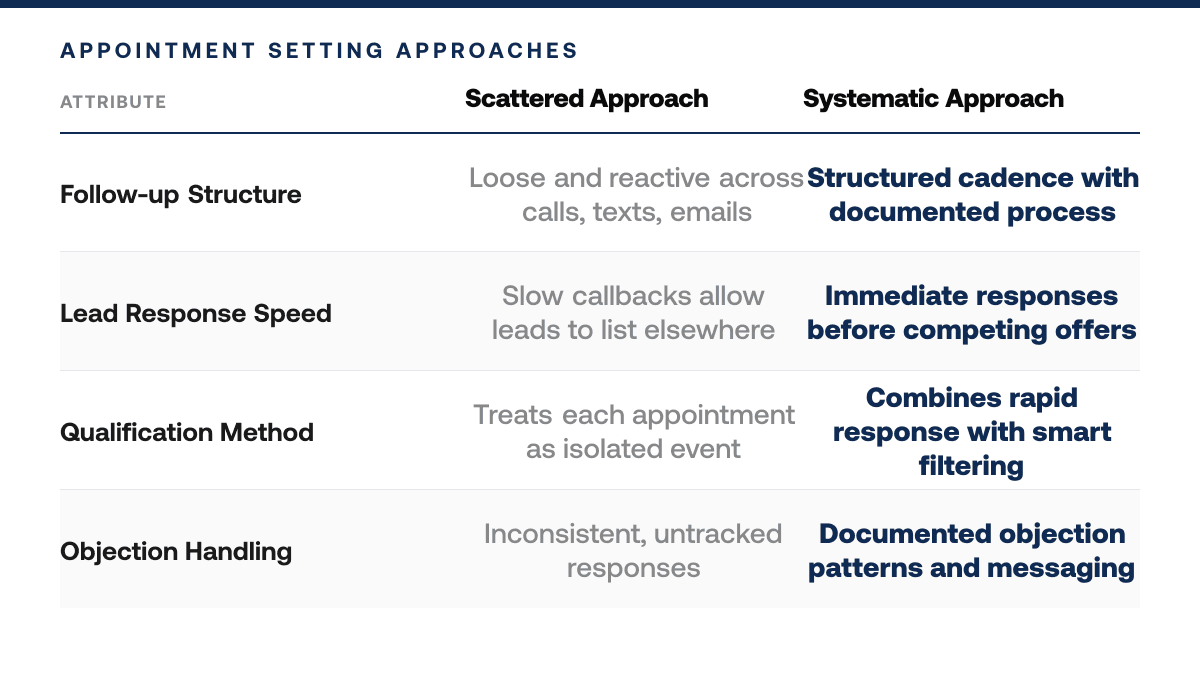
This article covers how investor teams build consistent appointment flow, the skills that separate appointment setting from lead generation, and how market dynamics influence your conversion pipeline. You'll learn the mechanics of follow-up discipline and how to adapt your appointment strategy when market conditions shift. Most investor teams lose leads to slow callbacks and scattered follow-up across calls, texts, and emails, Goliath Data's AI assistant David handles inbound and outbound contact automatically, so motivated sellers get immediate responses before they list elsewhere.
TL;DR
- Appointment setting for real estate investor teams means scheduling property viewings, consultations, and acquisition discussions with motivated sellers or acquisition partners to build a qualified pipeline.
- Success requires a repeatable scheduling process, consistent follow-up cadence, and documented responses to common objections that arise during prospect conversations.
- Most investor teams fail by treating each appointment as a one-off event rather than part of a systematic workflow that tracks outcomes and refines messaging over time.[1]
Understanding Appointment Setting for Real Estate Investor Teams
What Is Appointment Setting in Real Estate Investing?
Appointment setting in real estate investing is the process of scheduling face-to-face or virtual meetings with property sellers, motivated by specific circumstances such as financial hardship, inherited properties, or time constraints. Unlike general sales prospecting, real estate appointment setting requires understanding property-specific details, location, condition, financing constraints, and market value, alongside the emotional and financial pressures driving a seller's decision. Investor teams must gather preliminary information before scheduling to ensure the appointment targets a genuine opportunity rather than a tire-kicker or unqualified lead.[2]
Why Speed and Qualification Both Matter
Real estate deals move quickly, and investor teams face competing pressures: scheduling appointments fast enough to beat competitors while qualifying leads thoroughly enough to avoid wasting time on unqualified prospects. The balance between speed and qualification determines deal flow quality. A lead that appears promising on the surface may lack the motivation, equity, or financing flexibility needed to close. Effective appointment setting combines rapid response with smart filtering, asking qualifying questions during the initial contact to confirm the seller's situation aligns with the investor's investment criteria before committing calendar time.
Market Context and Buyer Motivations
Understanding the broader housing market and buyer motivations shapes appointment strategy. Resources from HUD and housing authorities provide insight into local market conditions, buyer demographics, and common pain points that drive sellers to consider investor offers. Sellers facing foreclosure, divorce, job relocation, or inherited properties often have different timelines and priorities than traditional home sellers. Investor teams that understand these motivations, and the economic pressures behind them, can tailor appointment conversations to address real concerns, build trust faster, and increase the likelihood of moving a qualified lead toward a deal.[2]
Key Numbers for Appointment Setting for Real Estate Investor Teams (2026)
- 65%+ of U.S. housing units are owner-occupied, the demographic baseline investor teams use to target motivated-seller neighborhoods.[2]
- ~1 in 3 U.S. households is a renter, signaling landlord-seller segments where appointment pipelines concentrate.[2]
- Median household income varies by census tract, teams that map income tiers to seller profiles report higher appointment-to-offer conversion than those that don't.[2]
- 3 core appointment metrics, show rate, no-show rate, and conversion to offer, separate high-performing investor teams from average ones.[2]
- Multiple acquisition channels (cold call, SMS, direct mail) each carry distinct show-rate profiles; teams tracking all 3 metrics per channel outperform single-channel trackers.[2]
Step-by-Step Process
1. Qualify the lead before booking
Before scheduling an appointment, confirm key details that signal genuine opportunity. Ask the seller about the property condition, current occupancy status, and reason for selling. Clarify their timeline, whether they need to close within weeks or have flexibility over several months. Verify ownership and check for liens or outstanding taxes that might complicate a transaction. This pre-qualification filters out tire-kickers and ensures your team invests time only in viable deals.
2. Offer multiple appointment slots and channels
Reduce friction by providing several scheduling options across different communication methods. Offer a range of time slots, morning, afternoon, and evening, to accommodate seller schedules. Tools like Goliath Data surface the high-leverage moves so you don't have to find them by hand. Enable booking via phone, text, email, or your CRM's scheduling link. The easier you make it to say yes, the higher your show rate. Sellers appreciate flexibility, and multiple channels capture leads who prefer one method over another.
3. Confirm appointments 24 hours in advance
Send a reminder message one day before the scheduled meeting via the seller's preferred contact method. Include the exact time, location, and your team member's name and phone number. Ask for confirmation or request rescheduling if the time no longer works. Have a backup contact method ready, if the primary number doesn't answer, use email or text. This simple step dramatically reduces no-shows and keeps your pipeline moving.
4. Document all appointment outcomes
Log every result in your CRM: attended, no-show, rescheduled, or cancelled. Note the reason if the seller cancelled or didn't attend. Track which time slots, communication channels, and lead sources produce the most confirmed appointments. Over time, this data reveals patterns, perhaps evening slots convert better, or text reminders outperform email. Use these insights to refine your scheduling strategy and allocate team resources where they yield the highest return.

How This Works in Practice
Example 1: The Wholesaler's Credibility-First Outreach
Picture a wholesaler who identifies a distressed property and calls the owner cold. Instead of a vague opener, she leads with the property address and a specific appointment time, "I'd like to walk the property with you tomorrow at 2 PM, 412 Maple Street." That precision signals she's done her homework and isn't just fishing for leads. The owner, accustomed to generic calls, feels the difference immediately. She confirms via email within the hour, then sends an SMS reminder 4 hours before, and a final check-in call 1 hour prior. By appointment time, the owner has seen the address three times across channels and trusts she's serious. When she arrives, the owner is ready to talk numbers instead of wondering if she'll show up. The follow-up sequence, spaced at 24 hours, 4 hours, and 1 hour, transforms a cold call into a warm meeting.
Example 2: The Multi-Market Team's Scaled Personalization
Suppose a small investment team manages deals across several markets simultaneously. Manually crafting appointment confirmations for each property and owner becomes a bottleneck. They build a templated confirmation system that pulls the owner's name, property address, and appointment time into a standard email and SMS flow. The template reads personal because it names the specific property and time, but the team sends it in seconds across dozens of concurrent deals. When a property owner in Market A receives her confirmation, she sees her address and time; the owner in Market B sees his. Both feel individually acknowledged, yet the team scales without hiring additional staff. The same templated sequence, email on day of booking, SMS 4 hours before, phone call 1 hour before, runs automatically across all markets, keeping show rates high and manual work low.
Why Timing and Specificity Drive Show Rates
Both examples hinge on the same principle: specificity (address, time) builds credibility, and a multi-channel sequence spaced strategically keeps the appointment top-of-mind without overwhelming the owner. Wholesalers and teams that lead with concrete details and follow up across email, SMS, and phone within the final 24 hours see owners arrive prepared and ready to negotiate. The formula works because it respects the owner's attention span and removes ambiguity, no guessing whether the appointment is real, no last-minute scramble to find the address.
Appointment Setting Checklist
- Confirm the property address and seller motivation with the lead before scheduling the appointment.
- Assign a specific team member to the appointment and send them the lead details in advance.
- Send a confirmation message to the seller the day before the scheduled appointment.
- Verify a backup contact number for the seller in case the primary contact is unavailable.
- Ensure your team member arrives at least 10 minutes early and logs the appointment outcome within 24 hours.
Common Mistakes to Avoid
Mistake: Booking appointments without qualifying leads first
Scheduling every inbound inquiry into your calendar without vetting their readiness wastes your team's time on tire-kickers and inflates no-show rates. Qualify leads on motivation, timeline, and property fit before committing them to an appointment slot. This filters out unserious prospects and ensures your team meets only investors genuinely ready to move forward.
Mistake: Skipping 24-hour appointment confirmations
Failing to send a confirmation message one day before the scheduled call or meeting leads to preventable no-shows that break your pipeline flow and waste scheduled capacity. Implement automated or manual confirmations via SMS or email to remind prospects of the time and logistics. This simple step dramatically reduces last-minute cancellations and keeps your funnel moving.
Mistake: Not documenting appointment outcomes and source attribution
Skipping notes on what was discussed, whether the lead converted, or which lead source and messaging drove the meeting prevents your team from identifying winning patterns. Log every appointment result in your CRM, which channel brought them in, what time slot they preferred, and conversion status. This data reveals which sources and messaging resonate with real estate investors, letting you double down on what works.
Frequently Asked Questions
How many appointments should an investor team schedule per week?
Appointment volume depends on your team size and local market conditions. Rather than targeting a fixed number, track your conversion rate, the percentage of scheduled appointments that close or advance, and adjust your weekly volume accordingly. A team converting at a higher rate can maintain fewer appointments; one with lower conversion needs more volume to hit pipeline goals. Monitor this metric weekly and scale up or down based on what your team can realistically handle while maintaining quality conversations.
Should appointments be phone, video, or in-person?
Match the appointment format to both the deal stage and the seller's preference. Initial qualification and lead screening often work efficiently via phone, allowing you to qualify out poor fits quickly. As deals progress and trust builds, video or in-person appointments become more valuable, especially for property walkthroughs or final negotiations. Always ask the seller how they prefer to meet; respecting that preference increases show rates and builds rapport early.
How do we reduce no-shows for scheduled appointments?
Multi-channel confirmation significantly cuts no-show rates. Send confirmations via SMS, email, and a brief phone call within 24 hours of the appointment. Include clear directions, parking information, and your contact number so the seller can reach you if plans change. This redundancy ensures the appointment stays top-of-mind and removes friction barriers, lost sellers or unclear directions are common no-show culprits. A simple reminder text the morning of the appointment also helps.
What tools help investor teams manage appointments and follow-ups at scale?
Goliath Data provides a platform that handles appointment scheduling automatically through its AI assistant David, which manages inbound calls, outbound follow-ups, texts, emails, and appointment confirmations. The platform also includes a full CRM and pipeline management system, so your team can track every appointment, follow-up, and deal stage without manual data entry. This automation ensures no lead falls through the cracks and your team stays focused on closing deals rather than administrative tasks.
Sources
Disclaimer: This article is provided by Goliath Data for general informational purposes only and does not constitute legal, tax, financial, or investment advice. Statutory references, redemption timelines, interest rates, and procedural requirements vary by jurisdiction and change over time. Always verify current information with the relevant county or municipal office and consult a licensed attorney, CPA, or financial advisor before making any investment, acquisition, or legal decision based on this content.
Read Next
Real Estate Investor CRM: A Guide — Real estate investors lose significant amounts of deal flow due to poor lead tracking. For wholesalers and fix-and-flip operators burning budget on PPC and direct mail…
Real Estate Investor Crm — A real estate investor CRM is AI-powered software that automates lead capture, scoring, and pipeline management to close deals faster. Unlike generic CRMs, investor…