
Why Real Estate Agents Miss 90% of Inbound Seller Leads During Business Hours: Call Handling Data for 2026
Inbound call handling data reveals agents miss 90% of seller leads during business hours. See call handling analytics and AI automation solutions for 2026.

Austin Beveridge
Tennessee
, Goliath Teammate
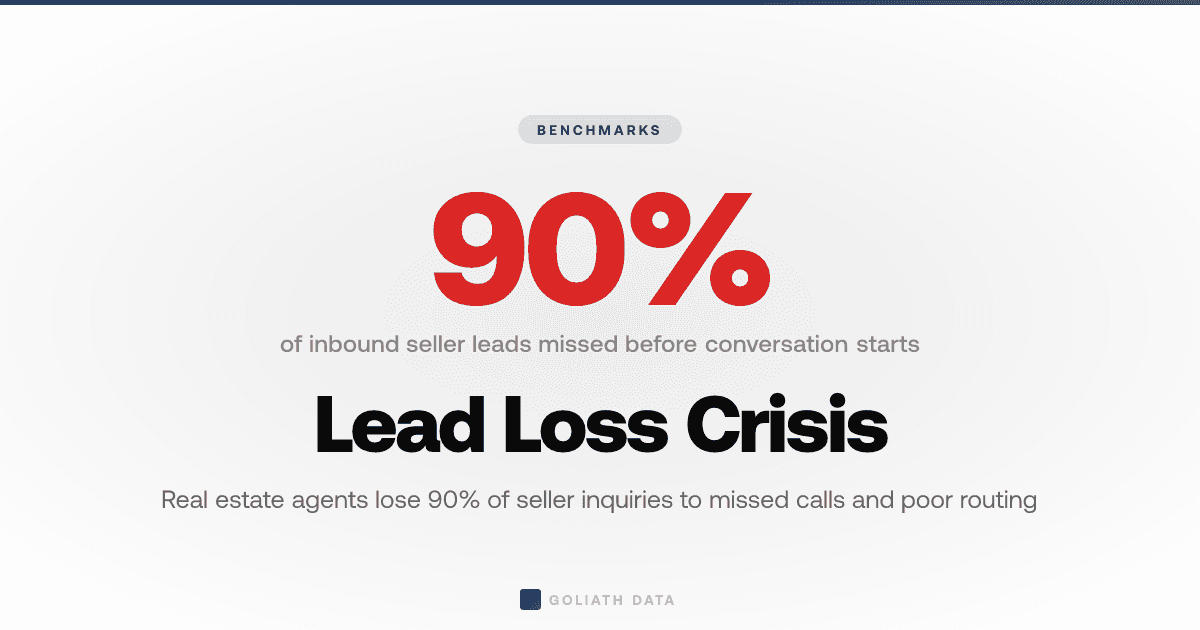
Real estate agents miss approximately 40% of inbound calls during business hours[1], but the real damage compounds when you add the numbers together. Sixty-two percent of seller inquiries arrive outside traditional 9-5 windows[2]. Eighty-five percent of callers who don't get through refuse to call back[3]. Each missed lead costs $7,500+ in lost commission[2]. The combined effect: most brokerages lose 90% of inbound seller leads before a conversation ever starts.
Inbound call handling in real estate means capturing, routing, and responding to incoming seller inquiries instantly, 24/7. Most agents miss 40–62% of calls because they're in the field, not at desks. Without AI routing and after-hours coverage, those callers disappear to competitors permanently. A lead reached within 5 minutes is 100 times more likely to qualify than one contacted after 30 minutes[1]. Yet most brokerages still rely on agent cell phones, delayed CRM alerts, and voicemail.
The problem isn't laziness. It's workflow design. Agents showing homes can't simultaneously answer phones. Without automated call routing, AI qualification, and after-hours coverage built into your lead funnel, inbound seller calls become invisible revenue loss.
TL;DR
Agents miss 40% of calls during business hours; 85% of missed callers never retry
Each missed lead costs $7,500+ in lost commission; a 10-agent team missing 4 daily calls loses $7.5M annually
Leads contacted in 5 minutes convert more than those reached after 30 minutes
AI call routing and 24/7 automation reduce miss rates below 10% while cutting handling costs 50%
The Availability Paradox: Field Work Kills Phone Answering
Real estate agents don't sit at desks during business hours. They're showing homes, driving between appointments, meeting clients. Yet they're technically "available" 9-5. This creates a structural mismatch: agents are supposed to be reachable when they're physically unreachable. The result is stark. Approximately 40% of inbound seller calls go unanswered during peak business hours[1], not because agents are lazy, but because the job itself makes synchronous phone-answering impossible while doing client work.
The real damage happens in the first five minutes. A seller contacted within that window versus one reached after 60 minutes shows a 100x difference in engagement[1]. Traditional CRM notifications fail this window. An agent finishes showing a property, checks their phone, and sees three missed calls. By then, the five-minute window is closed and qualification odds have dropped 80%.
Here's the thing: No amount of phone discipline fixes an architectural problem. When your job requires you to be away from your desk, reactive call-answering will always fail a percentage of inbound leads during their moment of highest urgency.
In real dollars, each missed lead represents $7,500+ in potential commission[2]. A 10-agent team missing just 4 calls per day faces 1,000 missed calls annually, or $7.5M in lost gross commission. For most brokerages, this dwarfs the cost of fixing the problem.
The 85% Non-Return Caller Problem
When a seller calls, they're in active decision mode. One missed call doesn't delay the sale. It eliminates you from it permanently.
Here's the brutal reality: 85% of callers won't attempt a second call after reaching voicemail, and 80% won't leave a message[3]. One missed inbound inquiry isn't a callback opportunity. It's permanent lead death.
The math scales fast. A 10-agent team missing just 4 calls per day loses $300,000+ annually in commission, money walking to a competitor's phone line instead. And that's conservative. If your close rate on inbound leads is 30%, a single missed call still costs $2,250 in expected revenue.
The first business to respond wins 78% of the time. Lead response rates decline by a factor of 10 after the first hour.
Harvard Business Review
Why AI Call Routing and After-Hours Coverage Reduce Miss Rates Below 10%
AI-powered inbound systems eliminate the core bottleneck: human availability. Virtual receptionists, smart routing, and after-hours answering capture inquiries the moment they arrive, 24/7.
Here's the math. Agents miss 40% of calls during business hours[1]. Sixty-two percent of all real estate inquiries arrive outside 9-5[2]. A human receptionist can't answer 20 simultaneous calls. An AI system answers all of them instantly, qualifying each lead in real-time and routing high-intent prospects to available agents with priority alerts.
Modern AI platforms reduce call handling costs by 50% while improving response times to within the 5-minute golden window[4], where lead conversion odds are higher than at the 30-minute mark[1].
The Framework: Instant Routing, Intelligent Qualification, Zero Dead Zones
Here's what works in practice: A seller calls at 7 PM (outside office hours).
Frequently Asked Questions
Why do real estate agents miss calls during business hours if they're working 9-5?
Agents spend business hours in the field, showing homes, meeting clients, traveling. Unlike office workers who hear their desk phone ring, agents rely on smartphone CRM notifications. Most CRM platforms send alerts asynchronously, so by the time an agent sees the notification, the caller has already hung up or reached voicemail. The golden 5-minute response window closes before the agent even knows the call came in[1].
If an agent doesn't answer, why won't the caller just try again?
Because 80% of callers who reach voicemail don't leave a message, and 85% won't attempt a second call[3]. Real estate inquiries are driven by urgency. If you don't pick up, they assume you're not interested. They move to the next agent. One missed call equals one permanently lost lead.
Does the 40% miss rate apply equally across all times of day?
No. The 40% reflects business-hours call handling. Sixty-two percent of all real estate inquiries arrive outside 9-5[2], and 75% of after-hours calls go straight to voicemail. Morning brokerages inherit a backlog of overnight inquiries, most of which have already moved to competing agents. You've already lost the 5-minute response window[1].
Can a standard CRM with push notifications solve this?
In most cases, no. CRMs send notifications, but agents still have to interrupt what they're doing to pick up. They also don't handle after-hours inquiries, which means 62% of leads are already cold by morning[2]. Pairing your CRM with AI-powered inbound handling removes the synchronous bottleneck entirely. The AI answers every call 24/7, qualifies the lead, and routes high-intent prospects to your available agents with priority alerts[4].
How much does AI inbound call automation cost?
AI-powered inbound systems reduce call handling costs by 50% compared to traditional answering services[4]. Human receptionists or outsourced services cost $2,000–$4,000 per month per agent line. AI solutions cost $300–$800 monthly. For a 10-agent team, AI inbound handling costs roughly $3,000–$8,000 per month total and captures the 62% of after-hours inquiries that traditional services miss because they operate on fixed schedules[2]. The ROI breakeven is typically 2–4 weeks[5].
What's the revenue impact of missing 4 calls per day on a 10-agent team?
Each missed inbound lead costs $7,500+ in potential commission[2]. Missing 4 calls per day × 250 business days = 1,000 missed calls annually. At $7,500 per miss, that's $7.5M in lost gross commission. Even at a close rate, that's $2.25M in lost revenue from call handling alone. For most brokerages, this dwarfs the cost of implementing AI call routing. The ROI breakeven typically occurs within 2–4 weeks[5].
Sources
AIRA, 2026, Real estate agent call miss rates (40% during business hours), 5-minute response time benchmarks, and lead qualification decline after 30 minutes.
AgentZap, 2026, After-hours inquiry volume (62% of real estate inquiries outside 9-5), sourced from NAR 2025 Home Buyers & Sellers Report and Zillow Group data; per-lead commission value ($7,500+).
Convin, 2025, AI call center automation cost reduction (50%), real estate call handling efficiency trends, and conversation analysis ROI.
SchedulingKit, 2026, Caller non-return behavior (85% won't retry after missed call, 80% don't leave voicemail), after-hours call handling failure rates (75% reach voicemail).
Vgrow, 2026, Lead loss quantification from missed calls (up to 40%), real estate call handling urgency, and outsourced call management ROI.
