
Wholesale Real Estate Contracts
Stop leaving money on wholesale contracts—use AI-powered pipeline automation to spot deals faster. See how top investors close 3x more in 30 days.


Austin Beveridge
Tennessee
, Goliath Teammate
Quick Answer
A wholesale real estate contract is a legal agreement between a property seller and a wholesaler that grants the wholesaler the right to purchase the property at a negotiated price, then assign that contract to an end buyer for a fee, typically $13,000 on average nationwide.[1] The wholesaler never takes title; instead, they profit from the assignment fee by connecting distressed sellers with qualified investors or owner-occupants.
Understanding Wholesale Contracts
A wholesale real estate contract is a legally binding agreement between a property owner and a wholesaler that grants the wholesaler the right to purchase the property at a set price, typically below market value. The wholesaler then assigns that contract to an end buyer (investor, house flipper, or owner-occupant) for a fee, pocketing the difference without ever taking title to the property.
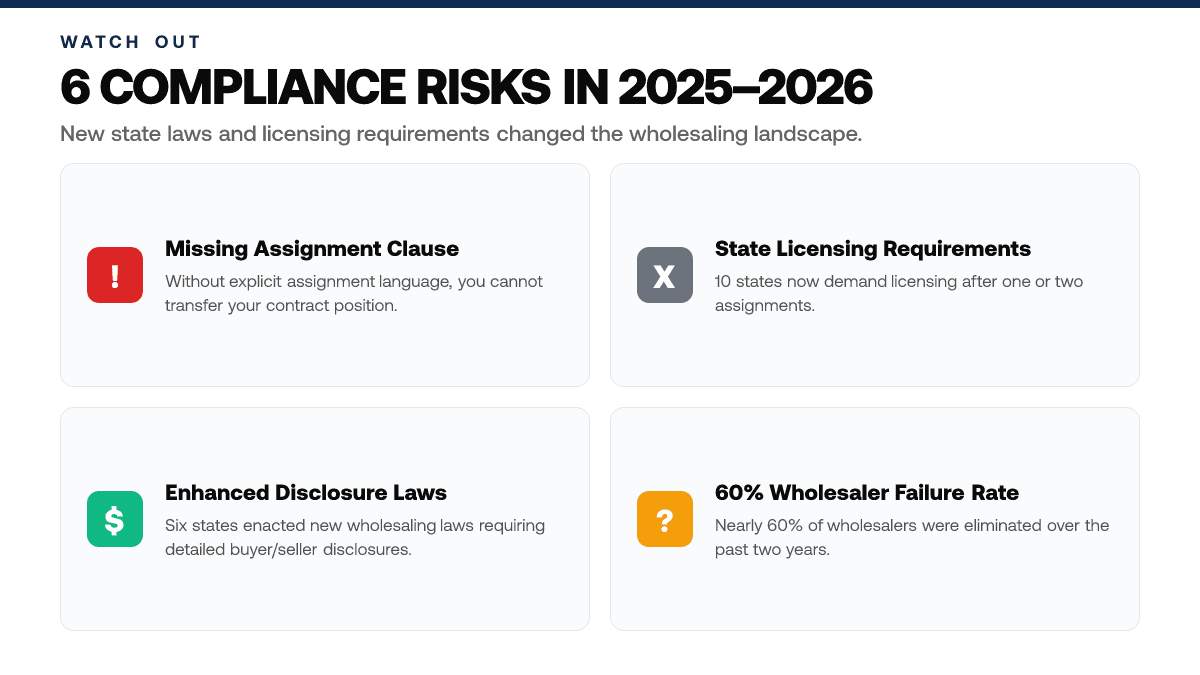
Wholesale contracts matter because they're the foundational document protecting your deal. They specify purchase price, closing timeline, contingencies (like inspection or financing), and, critically, your right to assign the contract to another buyer. Without clear assignment language, you can't legally transfer your position, and your deal collapses.
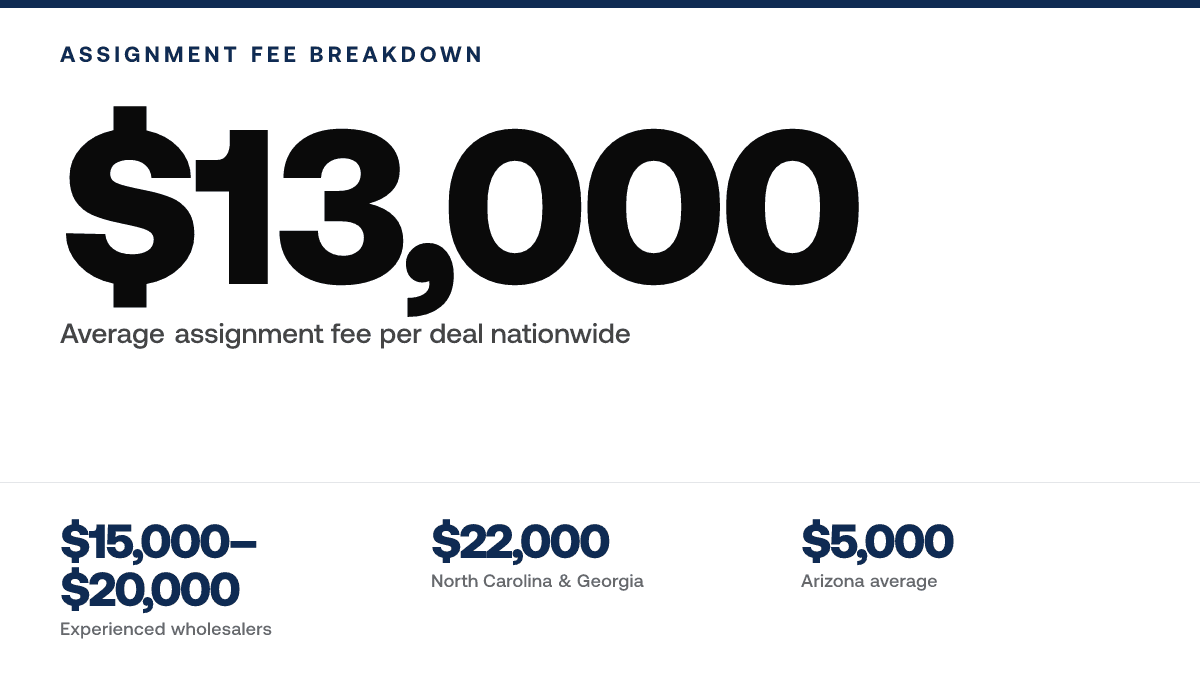
Wholesaling attracts new investors because entry barriers are low. You don't need capital to buy the property outright. The average assignment fee nationwide sits at $13,000 per deal, with experienced wholesalers earning $15,000–$20,000 depending on location.[1] North Carolina and Georgia see higher fees around $22,000, while Arizona averages closer to $5,000.[1]
But the landscape shifted in 2025–2026. Six states enacted new wholesaling laws requiring enhanced disclosure, and ten states now demand licensing after one or two assignments.[2] The era of signing any contract without legal review is over.
Here's the thing: Nearly 60% of wholesalers were wiped out over the past two years.[3] Those still standing use AI-powered tools to validate deal math, flag compliance gaps, and match buyers in hours instead of days. Speed matters more than ever.
Step-by-Step Process
Closing a wholesale deal requires five core actions: securing the contract, underwriting the property, finding your buyer, assigning the deal, and closing. Each step moves faster when you use automation, especially AI-powered CRM systems that flag compliance issues and match buyers in real time.
1. Secure the Wholesale Contract
Get a signed purchase agreement from the property owner with an assignment clause that explicitly permits you to assign your rights to a third party. Your state's laws now matter more than ever[2], verify your contract language complies before sending it.
2. Run Your ARV and Repairs Analysis
Calculate the After Repair Value (ARV) using comparable sales in the neighborhood, then estimate rehabilitation costs. This determines your assignment fee ceiling. Tools like Goliath Data automate comping workflows, saving hours of manual research per deal.
3. Identify Your End Buyer
Source cash buyers, fix-and-flip investors, or landlords likely to close on this deal type. Speed-to-lead matters in 2026, AI triage systems can rank and contact qualified buyers around the clock before your competitors do.
4. Present the Assignment Agreement
Once you've found your buyer, draft an assignment contract specifying the assignment fee and new purchase price. Both the original seller and end buyer must consent. State laws vary on disclosure requirements.[4]
5. Close and Collect Your Fee
At closing, the end buyer funds the property purchase and your assignment fee simultaneously. Wire funds to your account before signing final docs. Title company handles escrow.
Real-Life Examples
Two wholesalers using structured contract workflows and AI-enhanced buyer matching show how process discipline compounds deal velocity.
Case Study 1: Off-Market Acquisition in Texas. An investor in Texas sourced a distressed single-family property listed at $185,000. After running comps through AI valuation tools, the estimated after-repair value was $240,000. He negotiated a purchase contract at $155,000 with a 14-day assignment clause. His buyer list, managed through a CRM with automated lead scoring, identified three cash buyers within 48 hours. He assigned the contract for $18,000, an 11.6% assignment margin in under two weeks without closing costs.
Case Study 2: Multi-Unit Portfolio in North Carolina. An investor in North Carolina identified a four-unit property in pre-foreclosure, appraised at $380,000. Contract price: $295,000. Estimated ARV post-rehab: $420,000. Using AI deal analysis to validate comps and tax records, she signed an assignment contract with a 21-day close window. Her network of fix-and-flip operators generated three offers within four days. Final assignment fee: $22,000, 7.5% net profit on the original purchase price, closed in 18 days.
Wholesale Contracts Checklist
Before you sign, assign, or close, verify each element below. Missing even one clause can void the deal, expose you to liability, or trigger state licensing violations, especially critical in 2026, when six states enacted new wholesaling laws requiring enhanced disclosure and ten states now require licensing after one or two assignments.[2]
Pro tip: Load this checklist into Goliath Data or your CRM and auto-flag missing clauses before you present the contract to counsel. That saves you $200–$400 per deal in unnecessary legal review.
Common Mistakes to Avoid
Three anti-patterns plague wholesale contracts in 2026: signing without state-law verification, skipping the due diligence contingency window, and underestimating assignment fee caps.
Mistake: Ignoring State Licensing & Disclosure Laws
Six states enacted new wholesaling laws in 2025 requiring enhanced disclosure, and ten states now require licensing after one or two assignments.[2] Wholesalers who treat contracts as universal templates face contract voidance, fines, and lead loss when deals collapse mid-closing.
Mistake: Removing the Inspection Contingency to Look "Serious"
A tight contingency window (7–10 days) signals buyer credibility to sellers. Removing it entirely to appear confident actually triggers seller skepticism and kills assignment velocity. You lose optionality without gaining trust.
Mistake: Assuming the Assignment Fee Is Negotiable After Signing
Assignment clauses lock the fee upfront. Renegotiating post-signature signals weak underwriting and burns buyer relationships. Nearly 60% of wholesalers were wiped out over the past two years due to higher rates, low transaction volume, and increased competition.[3] Firms using CRM systems to validate deal math before contract execution avoid this trap entirely.
FAQs
What's the difference between a wholesale contract and a standard purchase agreement?
A wholesale contract includes an assignment clause that lets you transfer your rights to a buyer for a fee, whereas a standard purchase agreement binds the original buyer to close. Wholesalers use assignment agreements or double closings to profit without using their own capital. The assignment clause is what makes the deal assignable, without it, you're stuck closing yourself.
Why do six states now require licensing for wholesalers?
Connecticut, Maryland, North Dakota, Oklahoma, and Tennessee enacted laws in 2025 treating repeated assignments as a real estate business activity subject to disclosure and licensing requirements.[2] These laws aim to protect property owners from undisclosed middlemen and unqualified operators. If you wholesale in these states without awareness, you risk contract voidability and fines.
How accurate is AI contract analysis compared to manual legal review?
AI contract review flags non-compliant clauses in seconds and catches common pitfalls, missing contingency dates, assignment restrictions, or state-specific disclosure gaps, that human spot-checking often misses under time pressure. It's not a substitute for a lawyer, but it's a pre-flight check that catches most deal-killers before you present to counsel, saving hours and preventing costly mistakes.
When should I use an assignment agreement instead of a double closing?
Use assignment when your contract allows it and the seller doesn't object, it's faster, cheaper, and cleaner. Double closing is necessary when the original contract forbids assignment or the seller won't allow their agreement to be assigned. Double closings cost $1,000–$3,000 more but give you anonymity and flexibility in competitive markets.
Do I need a CRM if I'm wholesaling part-time with fewer than 10 deals a year?
A spreadsheet works for tiny volumes. But once you're chasing multiple leads simultaneously, a CRM prevents lead leakage and helps you track which buyers respond fastest. In 2026, AI-powered lead qualification means you'll qualify better deals faster even on low volume, and that ROI kicks in immediately.
Sources
AmeriSave, 2026, Wholesale contract fundamentals, assignment fees ($13,000–$22,000 nationally), and regional pricing variations.
Leonine Public Affairs, 2025, State licensing and disclosure requirements for real estate wholesaling in Connecticut, Maryland, North Dakota, Oklahoma, and Tennessee effective 2025.
Investor Lift Community, 2025, Market shifts, wholesaler failure rates, and AI adoption trends in wholesale real estate.
Land Buyers Alliance, 2026, State-by-state wholesaling laws, licensing thresholds, and compliance requirements by jurisdiction.
KDS Development, 2025, AI-powered deal analysis, contract automation, and buyer matching in wholesale real estate workflows.
