
Texas Tax Delinquent Properties for Sale List
Find tax delinquent properties for sale Texas using county auction records and AI lead scoring. Spot deals before they hit MLS with your automated pipeline.


Austin Beveridge
Tennessee
, Goliath Teammate
Quick Answer
Tax delinquent properties in Texas are residential and commercial real estate where owners have failed to pay property taxes for one or more years. The state publishes these lists through county tax assessor offices and auction sites; investors and agents access them to find motivated sellers before foreclosure. Goliath Data surfaces tax delinquency signals in real time, helping agents and investors identify and contact at-risk homeowners automatically, before the property hits a public tax sale list.
Understanding Tax Delinquent Properties in Texas
A tax delinquent property in Texas is a home where the owner hasn't paid property taxes for one or more years. The county initiates a formal process to recover unpaid taxes, eventually listing the property for public sale. These aren't foreclosures, they're tax-based liens that create motivated-seller scenarios before the property ever hits a traditional MLS listing.
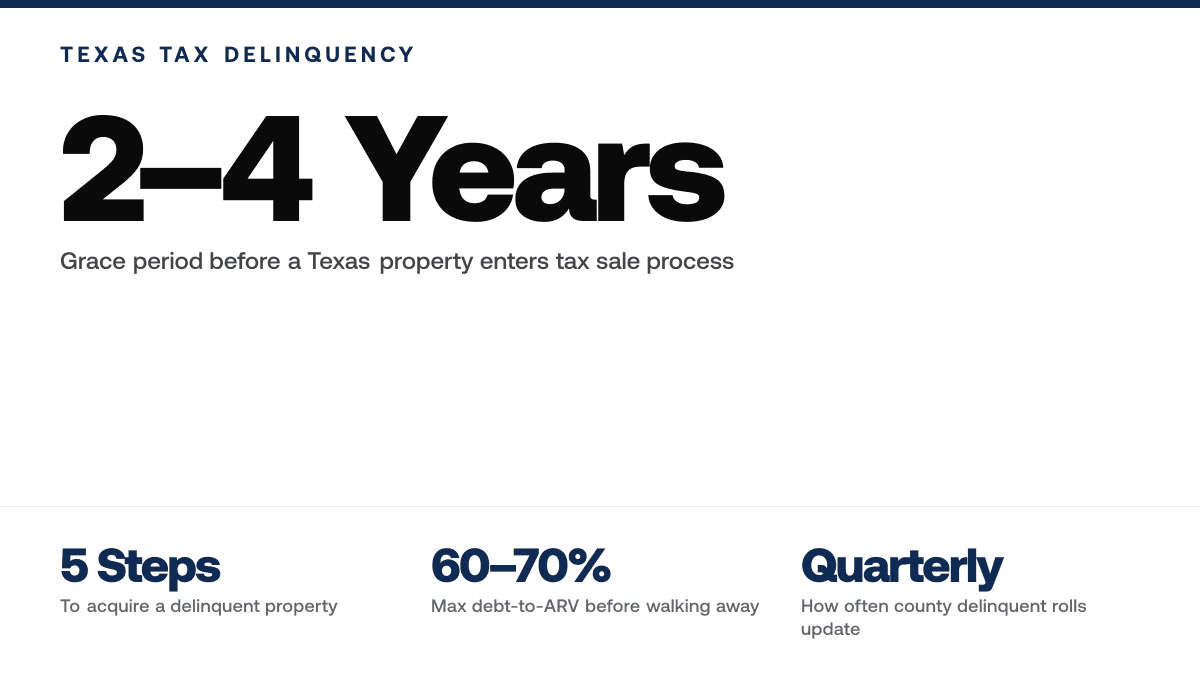
When property taxes go unpaid past their due date, counties issue notice and demand letters. If owners don't settle within a grace period (typically 2–4 years in Texas), the property enters the tax sale process. The county auctions the deed to recover owed taxes, penalties, and costs. Investors and owner-occupants both appear on these lists.
Tax delinquent properties signal financial distress. Owners facing unpaid taxes are highly motivated to sell, or negotiate quickly. You'll find these deals before they're listed publicly, giving you a competitive edge. Markets with high delinquency rates offer higher deal flow and faster transactions than cold-calling neighborhoods.
Step-by-Step Process
Finding and acquiring tax delinquent properties in Texas requires a methodical five-step approach: locate the list, verify property details, assess financial viability, contact the owner, and move toward acquisition.
1. Access the Texas Tax Delinquent Property List
Start with the Texas Comptroller of Public Accounts website or your county tax assessor's office. Most Texas counties publish delinquent rolls online, updated quarterly. You'll find property addresses, owner names, tax amounts owed, and sale dates. Some counties charge a small fee for bulk downloads; others offer free access. Don't rely on word-of-mouth leads, official records are your only reliable source.
2. Verify Ownership and Property Status
Cross-check each prospect against the county deed records and MLS. Confirm the owner's name matches, the property isn't already in foreclosure, and no recent liens have been filed. A property with multiple liens is riskier and may have title complications. Pull the legal description and survey to ensure clarity before investing time.
3. Run a Financial Feasibility Check
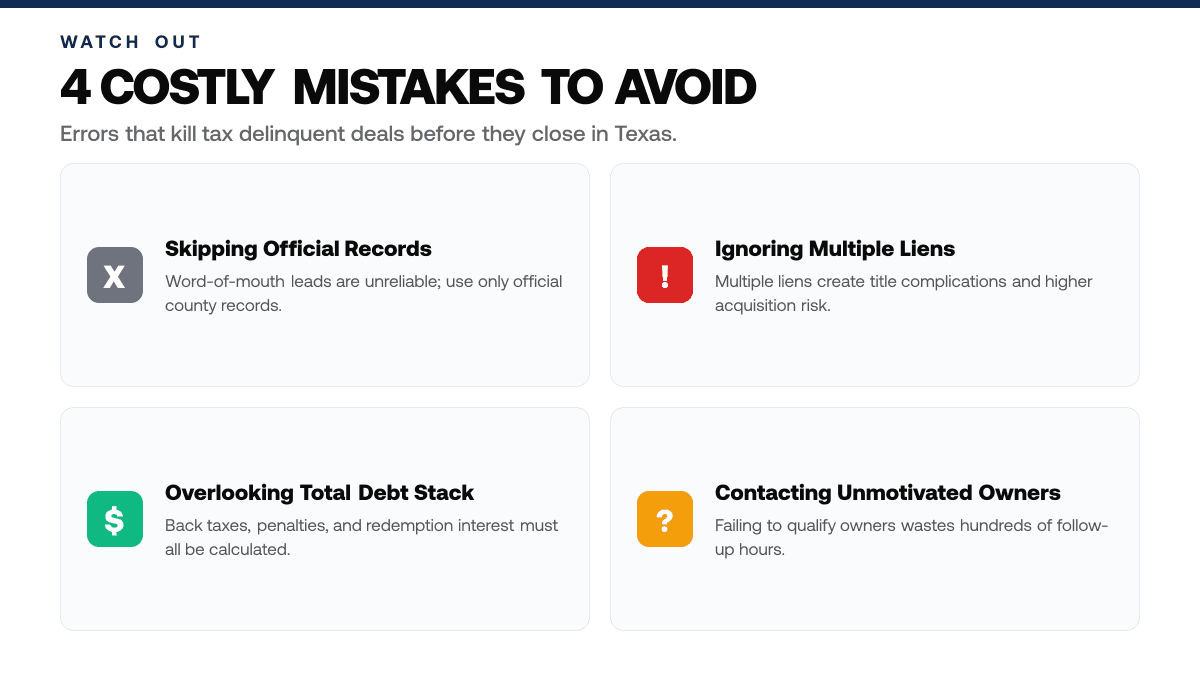
Calculate the total cost: back taxes owed, penalty fees, redemption period interest, and your acquisition expenses. Compare that against the property's current fair market value. If the total debt exceeds 60–70% of after-repair value, walk away. This screen eliminates deals that won't pencil.
4. Locate and Qualify the Owner
Use skip-tracing tools to pull phone numbers and email addresses from public records. Then qualify via phone or text: confirm they still own the property, understand their timeline, and gauge willingness to sell. Unmotivated owners waste your time. Quick qualification saves significant follow-up time.
5. Present an Offer and Move to Close
Once qualified, present a cash offer or subject-to deal structure. Tax delinquent owners typically want speed over price, they'd rather recover a portion of equity fast than wait months for auction. Close within 30–60 days and move to the next deal.
How This Works in Practice
Finding and contacting tax-delinquent homeowners requires speed and precision. Here's how the method plays out in real deal flow.
Imagine a fix-and-flip investor targeting single-family homes under $200K in the Dallas area. Instead of manually scanning county records weekly, they pull a filtered list of properties with significant unpaid taxes, equity above a sizable threshold, and no active MLS listing. They prioritize by seller intent signals, identifying which owners are most likely motivated. Within hours, Goliath's AI assistant David handles first-contact calls and texts, qualifying leads and logging responses. The investor's team follows up on the warmest prospects only, cutting outreach time significantly.
Or consider a solo agent competing in Houston's wholesale market. New pre-foreclosure notices drop daily. Rather than calling strangers cold, the agent filters for homeowners with recent job changes plus tax delinquency, a dual signal of financial stress. Automated texts go out in bulk; inbound calls route to Goliath's AI assistant, which qualifies callers and schedules appointments. The agent reviews qualified leads each morning with instant conversation summaries. By week two, three deals are under contract.
Here's the thing: Both workflows compress months of manual prospecting into weeks. Automated follow-up ensures no lead falls silent. Seller intent scoring eliminates cold calls to uninterested owners. The result is more deals per dollar spent and faster pipeline velocity.
Tax Delinquent Properties for Sale in Texas Checklist
Before you contact a tax-delinquent homeowner or bid on a property, verify the essentials. Here's your eight-point action checklist to confirm legitimacy, assess risk, and spot quick wins.
Verify the deed is on file with the county.
Confirm tax delinquency status directly via county assessor.
Check for federal or state tax liens against the owner.
Pull the full property title report for hidden encumbrances.
Review county court records for active foreclosure filings.
Inspect the property's zoning and building code compliance status.
Cross-reference owner contact information with public records.
Document the redemption period and deadline in writing now.
Common Mistakes to Avoid
Three patterns derail most investors hunting Texas tax delinquent properties: skipping due diligence on title, treating every lead the same, and missing the follow-up window entirely.
Tax delinquent properties often carry liens, easements, or prior claims you won't see in a casual online search. You'll bid confidently, win the auction, then discover you can't resell or refinance cleanly. Always pull the full chain of title from the county recorder, it costs entry-level pricing and saves substantial capital in dead deals.
Not every tax-delinquent homeowner is motivated to sell. Some have temporary cash-flow hiccups; others are absent owners or probate estates. Without ranking leads by urgency and fit, you'll waste calls on low-probability contacts. Segment by equity, property condition, and ownership type before dialing.
A homeowner might ignore your first call but answer your fourth text, or they'll list with the first agent who reaches them consistently. Sporadic follow-up kills deals. Set up automated reminders, multi-channel sequences, and a clear cadence so prospects stay engaged until they're truly uninterested or converted.
Frequently Asked Questions
What's the difference between tax delinquent properties and foreclosures in Texas?
Tax delinquent properties are homes where the owner hasn't paid property taxes; foreclosures occur when a lender repossesses due to unpaid mortgage. A property can be tax delinquent without foreclosure risk, but prolonged tax delinquency often leads to a tax sale. Texas allows homeowners a redemption period after tax sale, typically two years, to reclaim the property by paying back taxes and costs. Foreclosure, by contrast, is driven by loan default and moves faster.
How accurate is public tax delinquency data for finding motivated sellers?
Tax delinquency is a strong motivation signal: owners facing back-tax liability are typically motivated to sell or resolve the debt quickly. Public records are reliable because they're maintained by county tax assessor offices and updated regularly. However, accuracy depends on how current your data source is. Real-time data sourced directly from county records or aggregated from live filings is significantly more actionable than static lists refreshed quarterly or annually.
Do I need to hire a title company to verify tax delinquent properties, or can I search county records myself?
You can search county tax assessor websites directly and often pull delinquency rolls for free. However, DIY county searches consume time, each county has a different interface and data format. For high-volume prospecting, aggregated data sources that pull from multiple counties and surface delinquency status alongside seller contact info compress the research cycle significantly, letting you focus on outreach rather than data hygiene.
Sources
Not legal or financial advice. This article is for general educational purposes only and should not be relied on as a substitute for professional legal, tax, or financial advice. Real estate, tax, and property laws vary by state and individual circumstances. Consult a licensed attorney or qualified professional in your jurisdiction before acting on any procedure or strategy discussed here. Reading this content does not create an attorney-client relationship.
