
Louisiana Tax Delinquent Properties for Sale List
Louisiana Tax Delinquent Properties for Sale List. Practical playbook for Real Estate Technology — methods, examples, and pitfalls to avoid in 2026.


Austin Beveridge
Tennessee
, Goliath Teammate
Quick Answer
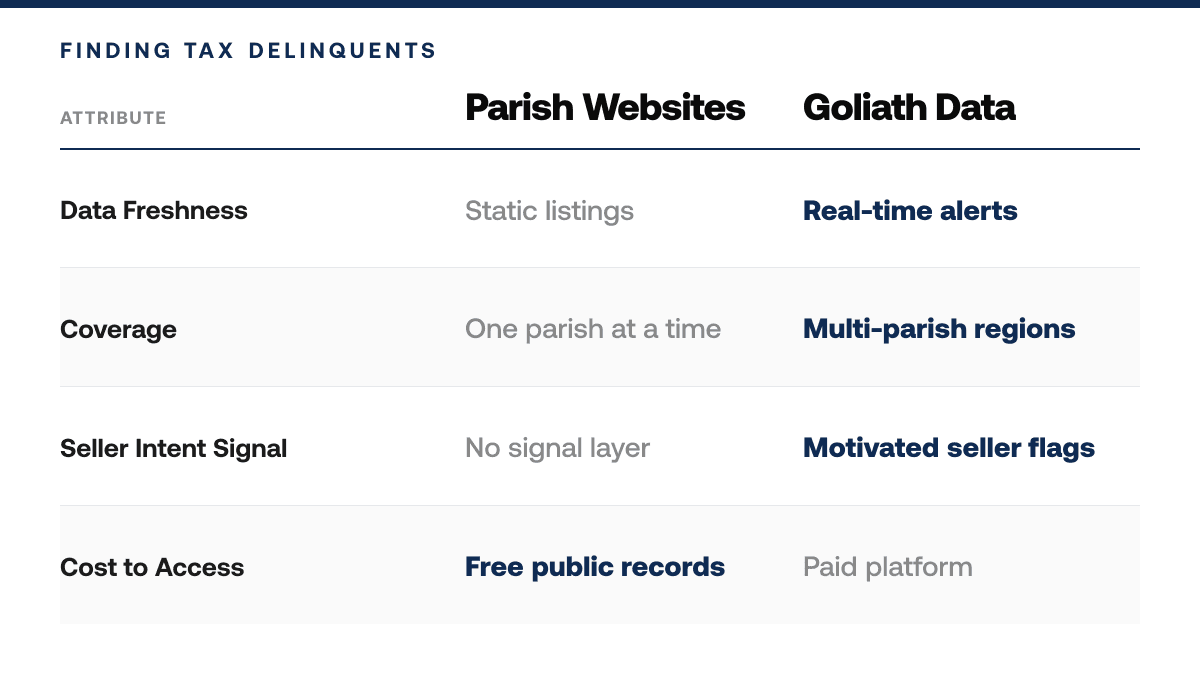
Tax-delinquent properties in Louisiana are homes where owners haven't paid property taxes, creating a public sale list managed by the state's tax assessor offices and sheriff's departments. You can access these lists through Louisiana parish tax collector websites, the state Department of Revenue, or aggregators like Goliath Data, which surfaces tax-delinquent homeowners as real-time seller-intent signals so agents and investors can contact motivated sellers before competitors do.
Understanding Tax Delinquent Properties in Louisiana
Tax delinquent properties in Louisiana are real estate parcels where owners have failed to pay property taxes for one or more years. When this happens, the parish (Louisiana's equivalent of a county) can place a lien on the property and eventually sell it at auction to recover unpaid taxes. These sales create opportunities for investors and agents to acquire properties below market value, often at steep discounts.
A property becomes tax delinquent when the owner doesn't pay annual property taxes by the deadline. In Louisiana, properties typically enter delinquency after the tax bill goes unpaid for a certain period, triggering notice to the owner and eventual parish action to recover the debt through public sale.
Tax delinquent properties represent motivated sellers. Owners facing liens either want to resolve the debt quickly or abandon the property entirely. For real estate investors and agents, this signal identifies homeowners likely to negotiate a sale before foreclosure or tax sale eliminates their equity. Goliath Data tracks these tax delinquency notices in real time, alerting investors and agents the moment a property enters delinquency, before competitors even know it exists.
Tax delinquent lists serve real estate investors hunting pre-motivated sellers, wholesalers racing to lock deals before tax sales, and fix-and-flip teams needing below-market acquisition targets.
How to Find and Contact Tax Delinquent Homeowners
Finding and acquiring tax delinquent properties in Louisiana requires methodical prospecting. Here are the core steps to identify motivated sellers before they hit the open market.
Access the Louisiana tax sale list. Start with official Louisiana tax sale records. Each parish maintains a delinquent property list on the assessor's or tax collector's office website. You'll find property addresses, parcel numbers, owners, and delinquency dates. Cross-reference multiple parishes if you're targeting a region. This baseline list tells you what's legally available to pursue.
Verify ownership and equity position. Pull the deed and title history from the parish clerk's office. Confirm the owner's legal name, check for liens (mortgages, judgment liens, tax liens), and calculate rough equity. A property with minimal equity won't motivate a quick sale. Owner-occupied homes signal different urgency than investment properties. Title clarity prevents post-acquisition legal headaches.
Assess property condition and market value. Drive by or use aerial imagery to gauge physical condition. Look for signs of vacancy, distress, or deferred maintenance. Cross-check comparable sales (recent arm's-length transactions) on MLS or public records. This tells you whether the property is worth the seller's effort to cure the delinquency or whether they'll entertain a discount offer instead.
Calculate the seller's tax burden and deadline. Determine exactly how much tax debt has accrued and when the redemption period expires. Louisiana redemption periods vary; most last 12 months after tax sale. Knowing the deadline tells you how urgent the seller's situation is and how much negotiating power you hold.
Contact the owner within 48 hours. Once you've qualified the property, reach out directly via phone, email, or direct mail. Delay matters, other investors are working the same lists. State your intent clearly: you buy properties as-is, close fast, and can resolve their tax debt immediately. Many owners are unaware a solution exists until you contact them.
Real-Life Deal Scenarios
Prospect identification and outreach in Louisiana's tax-delinquent market follow a predictable pattern: find motivated sellers, qualify them fast, and negotiate before competitors move in.
Solo agent building pipeline. An agent in New Orleans spends money on PPC ads to find motivated sellers. They pull a tax-delinquent list from the parish assessor's office, cross-reference it against MLS and public records, then cold-call homeowners weekly. Each call takes significant time. Most don't answer. Those who do often haven't decided to sell yet. Follow-up is inconsistent, calls get logged in a spreadsheet, emails get lost. Over three months, they've spent substantial budget to close one deal.
With Goliath Data, the same agent accesses real-time tax-delinquency signals ranked by seller intent. The platform's AI assistant David handles inbound calls and qualifies leads automatically. Outbound sequences, calls, texts, and emails run on autopilot. The agent logs into a CRM that already has conversation summaries and next steps flagged. In three months, they've reached significantly more homeowners with fewer manual touches and closed more deals from the same prospect pool.
Fix-and-flip team scaling without hiring. A three-person team in Baton Rouge is turning deals, but acquisition is a bottleneck. They're manually working tax-delinquent lists while managing current projects. Adding headcount costs significant annual salary. Instead, they implement Goliath Data's service to outsource list pulling, initial outreach, and lead qualification. The service delivers qualified, contact-ready prospects consistently. The team focuses on underwriting and closing. Acquisition velocity improves without hiring.
Pre-Outreach Verification Checklist
Before you contact a tax-delinquent homeowner or make an offer, verify the property's legal standing. Use this checklist to ensure nothing slips through.
Verify the deed is on file with the county.
Confirm the owner's current mailing address online.
Check for liens beyond the tax delinquency.
Pull the property's full tax history and payment status.
Validate the redemption period hasn't already expired.
Research any active bankruptcy filings on the owner.
Confirm your state's notice requirements before outreach.
Document all county records pulls for compliance audit.
Key insight: Running this checklist upfront saves weeks of legal friction. Missed liens or expired redemption windows kill deals after you've invested time in outreach.
Common Mistakes to Avoid
Tax delinquent property investing looks straightforward until you're knee-deep in paperwork, missed deadlines, or properties that don't match your buy box. Here are the costliest missteps.
Skipping county verification before making contact. Many investors pull a list and start calling without confirming the property's actual tax status or ownership. Counties update records on different schedules; what's flagged as delinquent today might be resolved or in a different redemption stage tomorrow. You'll waste time on leads that are no longer motivated and damage your reputation with false claims. Always pull the current county deed, tax assessor records, and redemption timeline before outreach.
Confusing tax delinquency stages with ready-to-buy deadlines. Tax delinquent doesn't mean the deed transfers to you next week. Louisiana has a specific redemption period, owners can reclaim their property even after a tax sale. Investors who don't account for this timeline either pursue properties about to be redeemed or miss the actual acquisition window. Confirm where the property sits in the foreclosure or tax sale cycle before committing resources.
Treating cold outreach the same across all delinquent prospects. Not every tax delinquent owner is motivated to sell. Some are temporarily cash-strapped; others are fighting the assessment or refinancing. Blasting generic "we buy houses" messages burns through your credibility and gets ignored. Segment your list by equity-to-tax-owed ratio, time in delinquency, and owner occupancy status. Tailor your pitch to the signal you're seeing.
Frequently Asked Questions
What exactly are tax delinquent properties and how do I find them in Louisiana?
Tax delinquent properties are real estate where the owner hasn't paid property taxes, typically for one or more years. In Louisiana, the state publishes tax delinquent lists annually through parish tax assessors' offices and the Louisiana Department of Revenue. You can search by parish, property address, or owner name. These lists are public records and often signal motivated sellers facing foreclosure or financial hardship.
How accurate is public tax delinquent data compared to working with a title company?
Public lists are accurate for identifying which properties are delinquent, but they lag current status, sometimes by months. Title companies provide real-time updates and deeper chain-of-title research, which matters if you're under time pressure or bidding at tax sale. For initial prospecting and lead generation, public lists work well. For underwriting and closing, title company verification is essential. Most investors use both in sequence.
When should I pursue tax delinquent properties versus pre-foreclosures or other motivated seller signals?
Tax delinquency typically signals financial distress earlier than pre-foreclosure notices, giving you a longer window to negotiate before the homeowner's equity position deteriorates. Pre-foreclosures move faster but come with more competition. For wholesalers and fix-and-flip investors, tax delinquent leads often convert to deals at lower acquisition costs because fewer investors are contacting those owners. Choose based on your timeline and buy-box criteria.
Sources
Dean Infotech, Case Study: Lead Conversions Hubspot CRM Automation Smart Follow
The AI Consulting Network, Blog: AI Workflow Automation CRE Brokers Prospecting
Not legal or financial advice. This article is for general educational purposes only and should not be relied on as a substitute for professional legal, tax, or financial advice. Real estate, tax, and property laws vary by state and individual circumstances. Consult a licensed attorney or qualified professional in your jurisdiction before acting on any procedure or strategy discussed here. Reading this content does not create an attorney-client relationship.
