
Linn County, Oregon Tax Delinquent Properties for Sale
Find tax delinquent properties using AI sales automation and CRM pipeline management to target motivated sellers in Linn County—complete county records list included.


Austin Beveridge
Tennessee
, Goliath Teammate
Quick Answer
Linn County, Oregon tax delinquent properties are parcels where owners haven't paid property taxes, creating motivated-seller opportunities for investors and agents. Find these lists through the Linn County Assessor's office, county tax foreclosure databases, or real estate data platforms that track tax delinquency signals. Goliath Data surfaces tax-delinquent homeowners in real time using life-event seller intent signals, letting you reach sellers before competitors and automate follow-up across calls, texts, and email with its AI assistant David.
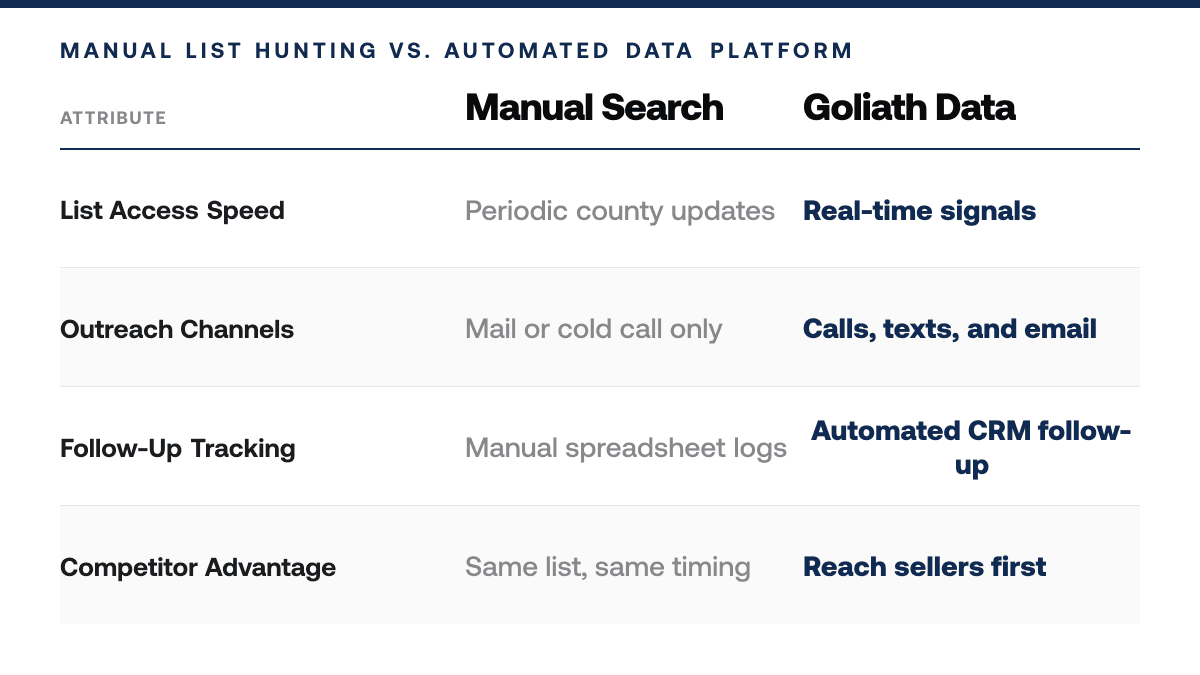
Understanding Tax Delinquent Properties in Linn County
What Are Tax Delinquent Properties?
Tax delinquent properties are real estate parcels where the owner has failed to pay property taxes owed to the county. Linn County, Oregon maintains a public list of these properties, updated regularly as tax assessments come due and payments are missed. The county uses this list to notify owners of their obligations and to help eventual tax foreclosure proceedings if debts remain unpaid.
Why This List Matters for Real Estate Investors
Tax delinquent properties represent motivated sellers. Owners facing tax liens often need to sell quickly to avoid foreclosure, making them prime acquisition targets for investors, wholesalers, and fix-and-flip operators. The Linn County list is a public resource, accessible to anyone, but most investors never systematically monitor it, leaving deals unclaimed.
Who Uses This List?
Real estate investors hunting pre-foreclosure opportunities, wholesalers racing to find motivated sellers before competitors, fix-and-flip operators needing properties matching their buy box, and solo agents building a consistent pipeline of distressed homeowners all benefit from tracking tax delinquent properties in Linn County.
Real estate investors and wholesalers
Fix-and-flip operators seeking distressed inventory
Solo agents targeting motivated sellers
Team leaders scaling acquisitions without hiring additional staff
Step-by-Step Process
1. Search the Linn County Tax Assessor Database
Visit the Linn County Assessor's website and filter for delinquent properties by unpaid tax year. Narrow results by property type, price range, and location. Export the list into a spreadsheet. This gives you the raw inventory of which homeowners owe back taxes, your starting point for outreach.
2. Verify Ownership and Equity Position
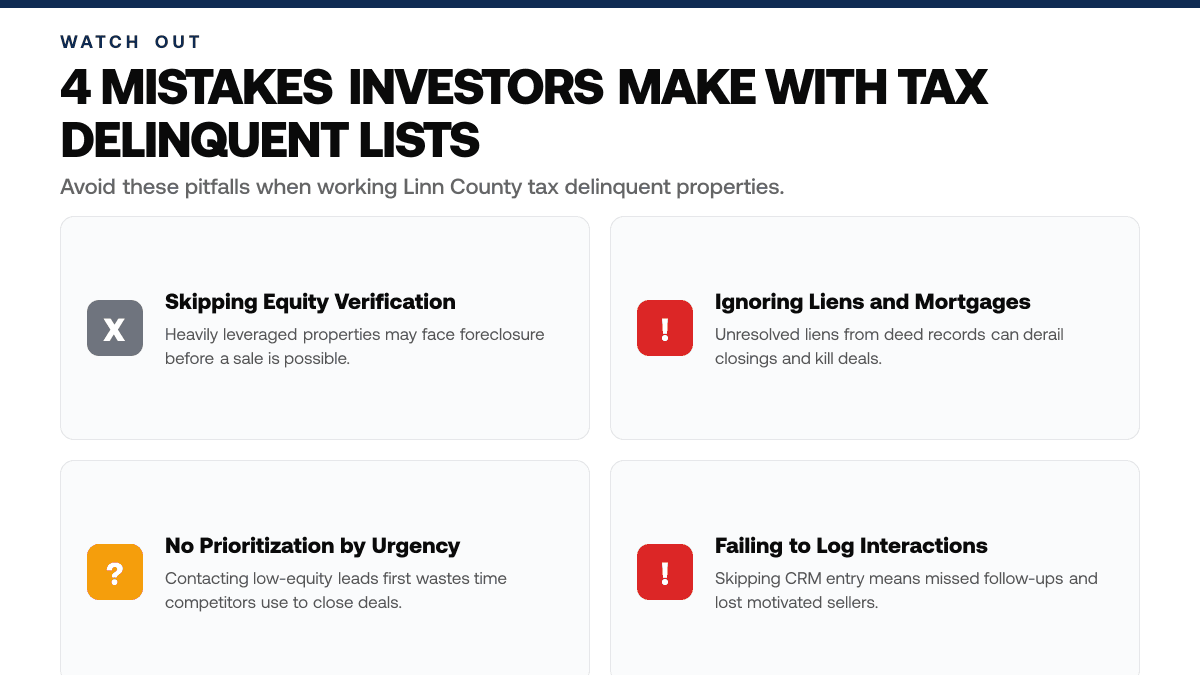
Cross-reference each property with the county deed records and title history. Check for liens, mortgages, and prior transfers. Calculate approximate equity using recent comparable sales. Properties with meaningful equity signal motivation to resolve; heavily leveraged ones may face foreclosure first.
3. Assess Property Condition and Market Value
Pull recent appraisals, inspection reports, or tax assessment values. Drive by or use aerial imagery to spot obvious defects. Estimate repair costs for fix-and-flip deals. This intel shapes your offer strategy and tells you whether the homeowner can realistically exit via sale or refinance.
4. Build a Contact List and Prioritize
Compile phone numbers, mailing addresses, and email addresses for each owner. Rank by equity, days delinquent, and property condition. Contact the highest-priority prospects first, those with the strongest motivation to sell quickly. This sequencing maximizes conversion before competitors reach the list.
5. Initiate Outreach and Document Responses
Call, text, mail, or email your ranked leads in sequence. Log every interaction in a CRM. Follow up within 24 hours on warm responses. For cold contacts, run a 30-day nurture sequence before moving to the next prospect. Automated outreach eliminates delays that competitors exploit.
How This Works in Practice
Scenario 1: The Investor Racing Against Foreclosure
Imagine a fix-and-flip investor scanning for pre-foreclosure properties in Linn County within their buy box. Manual county records searches take weeks; by then, competitors have already contacted the homeowner. With real-time alerts on tax delinquency signals, the investor surfaces notices the moment they're filed, sometimes before the homeowner fully grasps the situation. Automated outreach via call and text through Goliath's AI assistant David qualifies the lead in minutes, not days. The result: faster negotiations, better pricing, and deals that close before the property hits public auction.
Scenario 2: The Solo Agent Building Consistent Pipeline
Consider a solo agent in Linn County spending significant time weekly on cold calls with a low contact rate. Instead, they pull a targeted list of homeowners in financial distress and use Goliath's automated follow-up sequences that nurture leads 24/7 via email and text while the agent focuses on showings and closing. Within 60 days, inbound appointment requests rise, and manual prospecting hours drop noticeably.
Why Speed Matters
Tax-delinquent homeowners are under time pressure. The faster you reach them with a solution, the higher your chance of representation or acquisition. Manual workflows, checking county websites daily, hand-writing emails, leaving voicemails, introduce delays that competitors exploit. Real-time alerts and automated follow-up collapse that window, turning motivated sellers into qualified conversations before alternatives emerge.
Tax Delinquent Properties Vetting Checklist
Use this checklist to vet tax-delinquent leads before outreach. Each item ensures you're targeting motivated sellers with actual equity and clear title.
1. Verify the property's delinquency status with Linn County Assessor's office.
2. Check for liens, foreclosures, or pending legal action against the owner.
3. Confirm current market value using comparable sales in the area.
4. Calculate owner's equity after all outstanding debts.
5. Pull the owner's contact info from public records or skip-trace.
6. Review the deed to ensure title is marketable and transferable.
7. Note the redemption period deadline if foreclosure is pending.
8. Document all findings in your CRM before dialing.
Common Mistakes to Avoid
Mistake: Treating Tax Delinquency Lists as Ready-to-Call Rosters
Tax delinquency records don't guarantee seller intent or accurate contact info. Many agents skip verification and waste time calling outdated numbers or absentee owners with no equity stake. Validate ownership, cross-check with county assessor records, and confirm current phone numbers before dialing. Dead leads drain your pipeline and collapse your ROI.
Mistake: Ignoring Property Equity and Loan Status
A tax-delinquent homeowner with zero equity or an underwater mortgage won't sell, they'll file for bankruptcy or let the county foreclose. Screen for equity position and mortgage lien hierarchy first. Properties with meaningful equity and owner-occupancy signal higher conversion odds. Skipping this filter floods your CRM with untouchable deals.
Mistake: One-Touch Outreach and Radio Silence
A single call or mailer won't move a tax-delinquent owner. Effective prospecting demands multi-channel follow-up: call, text, email, and direct mail over 30–60 days. Agents relying on one-off contact abandon leads right before they warm up. Automated nurture sequences ensure no motivated seller slips away.
Frequently Asked Questions
What is a tax delinquent property and how does it differ from a foreclosure?
A tax delinquent property is one where the owner has failed to pay property taxes, triggering a tax lien. Foreclosures result from mortgage default. Tax delinquencies often precede foreclosures but move through a separate legal process with different timelines and redemption opportunities. Linn County publishes tax delinquent properties as a public sale list, making them searchable opportunities before traditional MLS listings appear.
How accurate is public tax delinquent data for finding motivated sellers?
Tax delinquency records are official county documents, so the data itself is accurate, properties listed actually owe unpaid taxes. However, not all delinquent owners are equally motivated to sell. Some resolve the debt, others dispute the amount, and still others face temporary hardship. Cross-referencing delinquent status with other signals like property condition, equity position, and owner occupancy improves your ability to identify genuinely motivated sellers.
Do I need to buy tax delinquent properties at a public auction, or can I negotiate directly with the owner?
You have two paths. Direct acquisition involves contacting the owner before or early in the tax sale process to negotiate a purchase or payment plan, often the faster route for investors. Public auction occurs on the county's scheduled sale date, where you bid competitively. In most cases, direct negotiation closes faster because you avoid auction competition, but if the owner won't engage, you can still pursue the auction if it reaches that stage. Check with Linn County's tax assessor office for specific redemption windows and sale dates in your target properties.
Sources
Not legal or financial advice. This article is for general educational purposes only and should not be relied on as a substitute for professional legal, tax, or financial advice. Real estate, tax, and property laws vary by state and individual circumstances. Consult a licensed attorney or qualified professional in your jurisdiction before acting on any procedure or strategy discussed here. Reading this content does not create an attorney-client relationship.
