
Intrafamily Property Transfer: 9 Legal Steps
Avoid costly mistakes in intrafamily property transfer using our 9-step legal checklist. See which documents you need, filing order, and tax implications


Austin Beveridge
Tennessee
, Goliath Teammate
Quick Answer
Intrafamily property transfer is the legal process of moving real estate ownership between family members, typically through gifting, inheritance, or below-market sales. The 2026 annual gift tax exclusion is $18,000 per person,[2] and transfers exceeding this amount may trigger gift tax unless structured carefully. A small paperwork mistake can lead to higher taxes, title problems, or legal disputes, making professional guidance essential.[4]
For real estate professionals and investors, these transactions represent high-intent lead opportunities. They often stem from probate filings, divorce decrees, or estate settlement timelines, signals that automated CRM tools can identify and surface within your pipeline. Monitoring family law attorneys and probate court records uncovers intrafamily transfer leads before they hit public listings.
With the estate tax exemption set to drop from $13.61 million to approximately $7 million after 2026, high-net-worth families face a closing window for tax-efficient transfers.[1] Understanding the nine legal steps, from deed selection through county recording, ensures compliance and protects family equity.

Understanding Intrafamily Property Transfer
An intrafamily property transfer is the legal process of moving real estate ownership from one family member to another, whether through gifting, inheritance, divorce settlement, or sale. It's common for estate planning, simplifying ownership after a death, or restructuring family assets, but the process involves specific legal requirements that vary by state and circumstance.
Why it matters: a single missed filing or incorrect deed can trigger unexpected gift taxes, title disputes, or capital gains complications. With the federal estate tax exemption set to drop from $13.61 million to roughly $7 million after 2026 under current sunset provisions,[1] high-net-worth families face a closing window for tax-efficient transfers.
Intrafamily transfers aren't just legal events, they're high-intent sales triggers. Divorce decrees, probate filings, and Medicaid planning deadlines create urgency and open doors for real estate professionals, attorneys, and investors. Real estate teams using CRM and lead automation tools can now surface these opportunities automatically by monitoring court records and family law activities, turning what was once manual prospecting into a predictable pipeline.[5]
Who needs this: anyone transferring property to a spouse, child, parent, or sibling. That includes estate executors, divorcing spouses, aging parents planning Medicaid eligibility, and investors acquiring family properties at below-market terms.
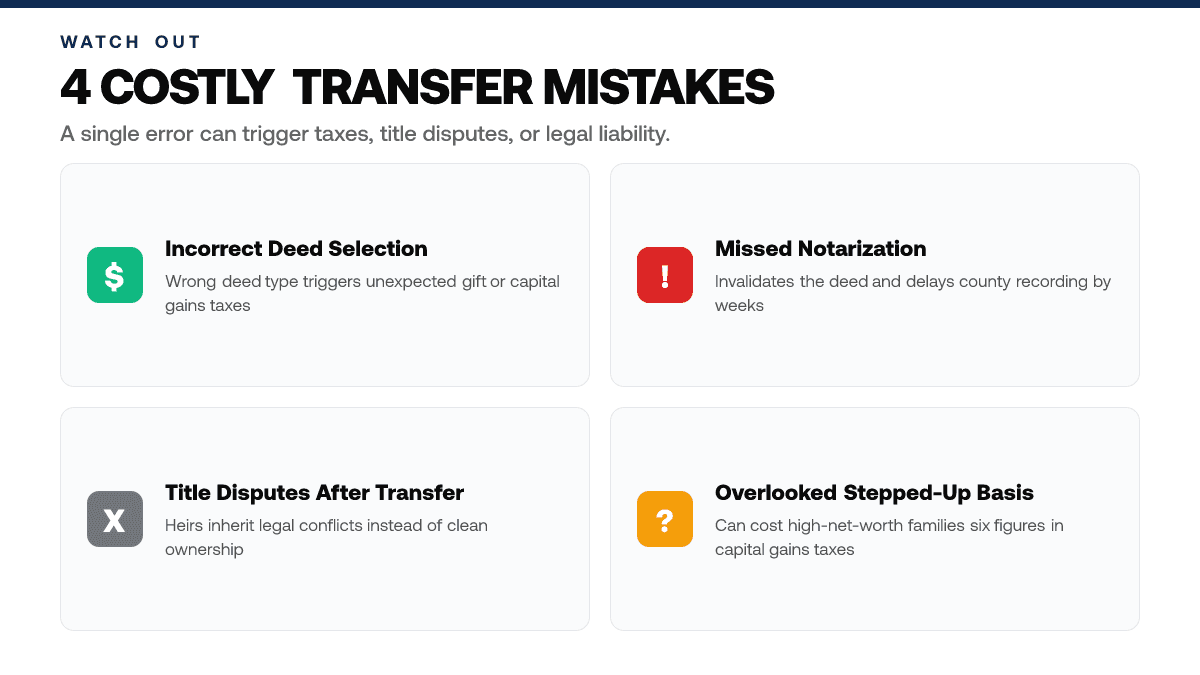
Key insight: Professional guidance isn't optional. The stepped-up basis rules alone can save high-net-worth families six figures in capital gains taxes, if you structure the transfer correctly. Get it wrong, and your heirs inherit a tax liability instead of clean title.
Step-by-Step Process
Intrafamily property transfers follow a predictable sequence: establish the transfer method (gift, sale, or trust), prepare the legal deed, execute it with notarization, record it with your county, and update ownership records. Most transfers take 4–8 weeks from start to finish, but errors during preparation can extend timelines and trigger tax consequences.
1. Determine Your Transfer Method
Decide whether you're gifting the property outright, selling it below market value, or using a family trust. Each triggers different tax outcomes. Gifting requires no payment but counts toward your $18,000 annual gift tax exclusion per recipient in 2026.[2] A below-market family loan requires a promissory note at IRS Applicable Federal Rate interest rates to avoid imputed gift tax.
2. Select the Correct Deed Type
Use a grant deed (warrants you own the property free of liens) or quitclaim deed (transfers whatever ownership stake you have, no warranties). Choose based on your state's requirements and whether you want to guarantee clear title to the recipient.
3. Prepare and Execute the Deed
Draft the deed with accurate legal property description, grantee name, and consideration (price or "love and affection"). Both parties must sign in front of a notary public. Errors in property description or grantor name are costly to fix later.
4. Record the Deed With Your County
File the notarized deed with your county recorder's office, along with a Preliminary Change of Ownership Report. Recording creates a public record and protects the recipient's title. File within 30–60 days of signing.
5. Update Insurance, Tax, and Loan Documents
Notify your mortgage lender (if applicable), homeowner's insurance company, and county tax assessor. Some lenders require the loan to be paid off before transfer closes. Update title insurance records and confirm the new owner is listed on property tax statements.
Real-Life Examples
Two case studies show how following the nine legal steps prevents costly mistakes and accelerates transfers.
Texas rental property gifting: An investor transferred a $450,000 rental property to his adult daughter via quitclaim deed without consulting a tax advisor. The daughter inherited the father's original cost basis of $180,000. When she sold three years later for $510,000, she owed capital gains tax on $330,000 in appreciation, roughly $82,500 in federal and state taxes. Had they structured it as inheritance instead, she'd have received a stepped-up basis to $510,000, eliminating the capital gains tax entirely.[3]
California commercial property transfer: A real estate investor gifted a $600,000 commercial property to three family members using a revocable living trust. She documented fair market value, filed a Preliminary Change of Ownership Report, and worked with an attorney to execute the deed correctly. Timeline: 6 weeks from planning to county recording. Outcome: property transferred cleanly with no tax reassessment, and the trust protected the property from future disputes. She avoided an estimated $120,000 in unexpected property tax liabilities.[6]
Intrafamily Property Transfer Checklist
Use this checklist to stay on track. Each item covers a critical step, skip one and you risk title issues, unexpected tax bills, or legal disputes.
Intrafamily Property Transfer Checklist
☐ Verify current deed is on file with county recorder.
☐ Obtain certified property appraisal or fair market value.
☐ Consult tax advisor on gift tax and stepped-up basis implications.
☐ Choose deed type: grant, quitclaim, or trust deed.
☐ Draft and execute deed with notary and witnesses.
☐ File Preliminary Change of Ownership Report with assessor.
☐ Record new deed with county clerk within required timeframe.
☐ Update title insurance, homeowner insurance, and tax records.
Common Mistakes to Avoid
Family property transfers look straightforward until a single filing error, missed deadline, or tax miscalculation derails the deal. Here are the anti-patterns that seem reasonable but backfire.
Skipping the deed recording step. A verbal agreement or handshake transfer isn't legally binding. Without recording the deed with the county, you don't have proof of ownership, and the property remains titled to the original owner. This creates title disputes, blocks future sales, and triggers probate complications if the donor dies before recording.[6]
Gifting without tax planning. A well-intentioned gift over the annual exclusion, $18,000 per person in 2026[2], eats into your lifetime exemption and triggers gift tax filing. Worse, inheriting triggers stepped-up basis (current market value), while gifting locks in carryover basis (donor's original cost), creating unexpected capital gains taxes for the recipient when they sell.[3]
Ignoring property tax reassessment risk. Many states reassess property value after transfer, raising annual taxes. Failing to file a Preliminary Change of Ownership Report exposes you to back taxes and penalties. This hidden cost surprises families months after closing.
Warning: In most cases, hiring an attorney ($500–$1,500) pays for itself by preventing reassessments and tax filing errors. If the property has a mortgage or complex ownership, legal help becomes essential.
About Goliath Data: Goliath Data helps families organize and verify property records during transfers by centralizing deed documentation, title histories, and ownership details in one searchable platform.
FAQs
What's the difference between gifting property versus selling it below market price?
Gifting triggers gift tax if fair market value exceeds $18,000 per person in 2026,[2] while a below-market sale is treated as a partial gift plus a loan. The difference matters for tax basis: a gift means the recipient inherits the donor's original cost basis (carryover basis), creating capital gains tax liability when they sell. A below-market loan must include IRS-required interest rates and documentation to avoid gift tax classification.[1]
Do I need a lawyer to transfer property to a family member?
You can file a deed yourself in most states, but a single paperwork mistake can lead to higher taxes, title problems, or legal disputes.[4] In most cases, hiring an attorney ($500–$1,500) is worth the cost because they verify deed language, ensure proper notarization, file the Preliminary Change of Ownership Report to avoid tax reassessment, and confirm title is clear. If the property has a mortgage or complex ownership, legal help becomes essential.
Why does a property transfer take longer when there's a mortgage involved?
Lenders must approve the transfer and may require the loan to be paid off before title changes hands, depending on the mortgage terms. The lender won't release the lien until the mortgage is satisfied or formally consented to the transfer. If you're doing a family loan instead, you'll need a promissory note with market-rate interest, a fixed repayment schedule, and proper documentation, adding 2–4 weeks to the timeline.[7]
Is it worth transferring property now instead of waiting for inheritance?
In 2026, the estate tax exemption is $13.61 million per individual,[1] but it drops to roughly $7 million after 2026 due to the sunset provision. For high-net-worth families with combined real estate over $7 million, transferring now locks in the higher exemption and avoids future estate taxes. For most families below that threshold, waiting for inheritance preserves the stepped-up basis advantage, the property's basis resets to fair market value at death, eliminating capital gains taxes.[3]
Can CRM tools help identify intrafamily transfer leads from probate or family law records?
Yes. Modern real estate CRMs with lead scoring and workflow automation can monitor probate court filings, family law attorney activities, and estate settlement records to identify high-intent transfer opportunities.[5] Teams using automated workflow tools report shorter deal cycles and faster response times through automated follow-ups and pipeline prioritization. Intrafamily transfers are goldmine leads because emotional and tax triggers create urgency.
What happens if I miss the Preliminary Change of Ownership Report deadline?
Your county assessor can reassess the property value and demand back property taxes dating to the transfer date. Penalties and interest compound over months, turning a simple $500 filing mistake into a $5,000+ liability. File within 30–60 days of recording the deed to protect yourself.
Sources
AdvisorFinder: Estate tax exemption, lifetime gift exemption, stepped-up basis strategy
Econello: 2026 annual gift tax exclusion and gifting thresholds
SmartAsset: Stepped-up basis inheritance rules and capital gains tax implications
Rentana.io: Intrafamily transfer definition, legal implications, and paperwork error consequences
The AI Consulting Network: AI-powered CRM features, lead scoring, and workflow automation for real estate
Schorr Law: Deed filing process, promissory note requirements, and timeline factors
LegalShield: Property transfer process with mortgages and loan documentation requirements
