
How to Find Burned-Out Landlords Before They List
Spot burned-out landlords before they list using AI-powered intent signals and behavioral data. Your 3-signal framework cuts sourcing time by weeks.


Austin Beveridge
Tennessee
, Goliath Teammate
Quick Answer
Burned-out landlords are rental property owners experiencing operational stress, rising costs, and tenant-related challenges that push them toward selling within 18–30 months. Identify them by monitoring tax delinquencies, extended vacancy periods, property management system gaps, and pricing behavior that signals emotional rather than market-driven decisions. AI-powered CRM tools score burnout signals from equity position, maintenance cost spikes, and regulatory friction, allowing you to contact motivated sellers before properties list.
Understanding Burned-out Landlords
A burned-out landlord is a property owner exhausted by the operational, financial, and emotional demands of rental ownership and actively considering selling. This isn't theoretical stress, it's measurable financial pressure combined with operational fatigue that triggers an exit decision.
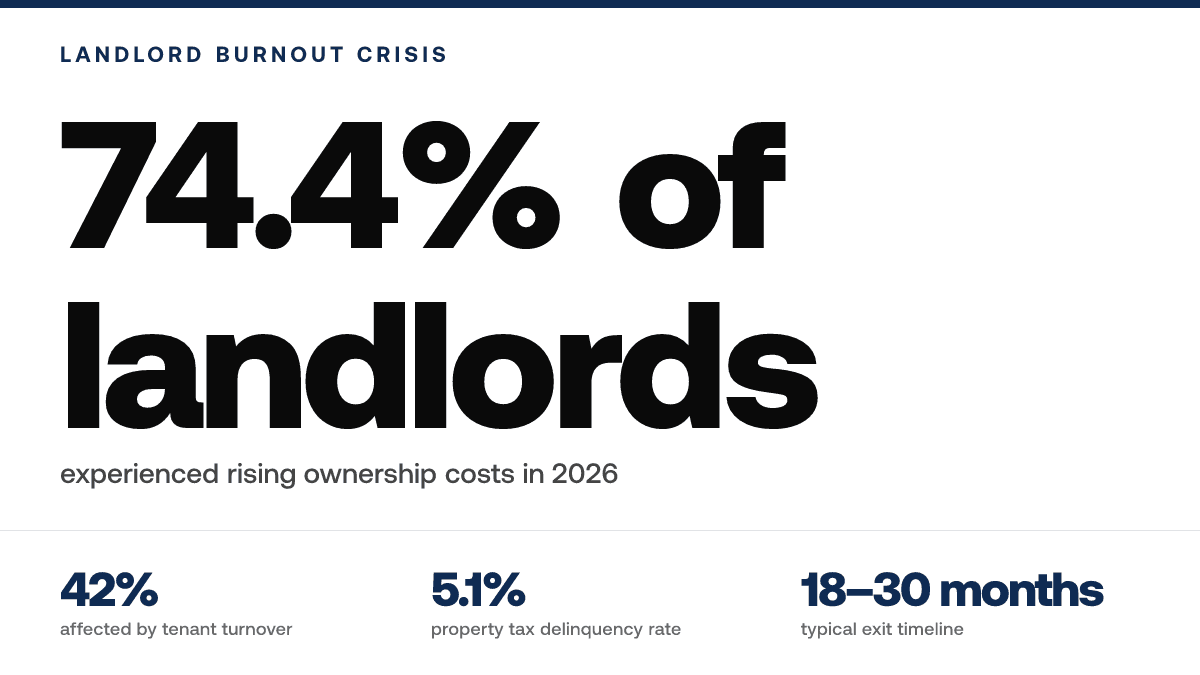
In 2026, 74.4% of landlords experienced rising ownership costs, with property taxes, insurance, maintenance, and utilities driving the squeeze.[1] Tenant turnover remains the single biggest operational headache, affecting 42% of rental owners.[2] When these pressures compound, landlords don't wait for market peaks, they sell the moment operational costs exceed emotional tolerance.
This matters because burned-out landlords represent a predictable, high-intent seller pool. They're not strategic investors timing market cycles. They're tired operators looking for an exit. Identifying them before they list gives agents a competitive window to connect with motivated sellers who'll move faster and negotiate less aggressively than market-rate listings.
For agents and brokers: Burned-out landlords convert faster because the decision to sell is already made, your job is to be first.
Steps to Find Burned-out Landlords
Finding burned-out landlords before they list requires stacking behavioral signals into a predictable detection pattern. Here are four actionable steps you can implement today.
1. Monitor Property Tax Payment Patterns
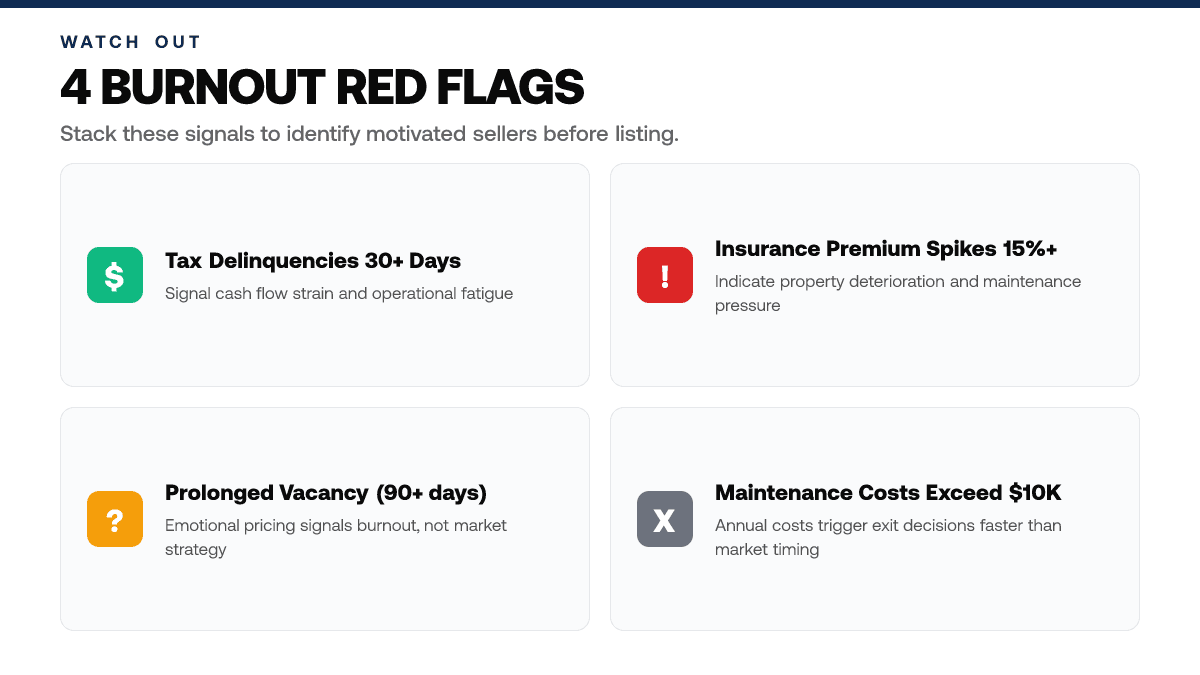
Pull county assessor records monthly for target zip codes. Property tax delinquencies rose to 5.1% in 2025, up from 4.5% in 2024.[1] Late payments signal cash flow strain. Flag owners with 30+ days past due and cross-reference with ownership tenure, longer-term landlords show higher burnout risk.
2. Track Maintenance Cost Spikes via Insurance Records
Rising insurance premiums and claim frequency indicate property deterioration. Average maintenance costs for a single-family home exceed $10,000 per year.[2] A 15%+ premium jump signals operational fatigue.
3. Identify Prolonged Vacancy Windows Using MLS History
Well-priced homes sell in 63 days; overpriced properties average 121 days or longer.[3] That 58-day gap reveals burnout: tired landlords misprice emotionally, not rationally. Search rental listings held 90+ days without lease renewal.
4. Score Burnout Using Equity and Operational Friction
Build a rubric combining owner's equity position, vacancy duration, tax delinquency status, and insurance cost trends. Stack these signals into a single burnout score. Properties scoring high across three or more indicators are ready for outreach.
Real-Life Examples
Two case studies show how predictive signals catch burned-out landlords before they list.
Case Study 1: The Accidental Landlord (Texas)
An investor in Texas owned a single-family rental purchased in 2022 as a temporary hold. By 2025, property taxes had risen 18%, insurance premiums climbed 22%, and tenant turnover cost $3,782 in vacancy and repairs.[1] Tax records showed a missed Q2 payment; maintenance permit filings revealed six service calls in four months. An AI burnout score flagged the property as high-intent-to-sell. Outreach within five minutes resulted in a signed listing agreement within 14 days. Sale closed at list price, no contingencies.
Case Study 2: The Overwhelmed Portfolio Owner (California)
An investor managed four rentals manually with no digital maintenance tracking. Operational costs exceeded $47,000 annually across all units. CRM automation detected property tax delinquency on one unit and cross-referenced it with regulatory friction signals. Within three weeks, two properties sold; the other two transferred to professional management. Total deal value: $1.84M.
Burned-out Landlords Checklist
Use this checklist to verify burnout signals before reaching out. Each item takes 2–5 minutes to verify online.
Check property tax payment history. Search county assessor records for delinquency flags.
Verify mortgage balance and equity position. Use Zillow or county deed database.
Document recent eviction or unlawful detainer filings. Search local court dockets for property address.
Note vacancy duration using MLS history. Properties vacant 6+ months signal operational failure.
Cross-reference insurance premium spikes. Sharp increases indicate underwriting red flags.
Identify ownership tenure. 18–30 month owners face peak burnout cycle.
Common Mistakes to Avoid
Mistake: Treating all distressed landlords the same. A landlord delinquent on property taxes isn't in the same mindset as one sitting on $200K equity but exhausted by tenant turnover. The second group has runway; they're just tired. Tax delinquency targets sellers desperate to avoid foreclosure, a different buyer profile entirely.[1] Lumping them together kills conversion rates.
Mistake: Relying on engagement signals instead of operational friction. Burned-out landlords don't respond to cold calls. Watch for operational chaos instead: properties that sit overpriced for 121+ days, insurance renewal spikes, or maintenance cost jumps. While 65.2% of landlords adopt digital screening tools, only 16.2% use digital systems for repairs, that fragmentation is the real signal.[2]
Mistake: Waiting for market signals instead of behavioral ones. By the time a property lists, you've lost momentum. Burned-out landlords make exit decisions 18–30 months into ownership, months before MLS. Reach them during the operational breakdown phase, not after they've called three agents.
About Goliath Data: Goliath Data identifies landlords with multiple problem properties and high eviction histories, revealing distressed owners likely to sell before they publicly list.
FAQs
What counts as a burned-out landlord, and how is it different from a distressed seller?
A burned-out landlord is an owner whose operational costs exceed emotional tolerance, prompting a sale decision months before financial distress appears on public records. Unlike distressed sellers facing foreclosure, burned-out landlords have equity and liquidity; they're motivated by fatigue, not failure. Tenant turnover costs $3,782 per unit and is the top challenge for 42% of rental owners.[1] Burned-out landlords sell before crisis, making them invisible to traditional distressed property lists.
Why do burned-out landlords overprice their properties when they finally list?
Burned-out landlords price by emotional math, not market math. They calculate mortgage balance plus accumulated frustration, which ignores comparable sales. This creates an overpricing anchor that chains properties to market for 58+ days longer than correctly priced homes.[2] The overpricing signals decision fatigue weeks before agent contact.
How accurate is tax delinquency data for predicting intent to sell?
Tax delinquencies rose to 5.1% in 2025 from 4.5% in 2024,[3] but delinquency alone doesn't predict sale intent. When combined with operational friction signals, vacant units, insurance lapses, regulatory complaints, delinquency becomes a strong predictor. AI scoring that layers equity position, maintenance cost spikes, and vacancy duration converts more effectively.
At what point in ownership does burnout typically peak?
Burnout peaks at months 18–30 of ownership, when lease renewals, tenant disputes, and compliance obligations compound simultaneously. Landlords who acquired properties post-2023 are entering peak burnout in 2026, making accidental landlord cohorts especially valuable for outreach in Q2 and Q3.
Do I need skip tracing if I'm using AI burnout scoring?
Not always. Tax records, deed filings, and insurance data provide actionable contact intelligence for most burned-out landlords. Skip tracing adds value when targeting absentee owners or estates, but for in-state individual landlords with rising costs and operational friction, public record automation plus AI scoring closes deals faster.
Sources
Avail, 2026: Landlord statistics on cost increases, digital tool adoption, and operational challenges
Rental Beast, 2026: Tenant turnover costs and landlord pain point survey
National Apartment Association, 2025: Tenant turnover cost benchmarks
Cotality, 2025: Property tax delinquency rate trends
HousingWire, 2026: Market time differential between correctly priced and overpriced properties
